The seasonally-varying influence of ENSO on rainfall and tropical cyclone activity in the Philippines (original) (raw)
Abstract
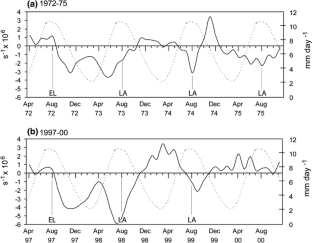
An observational study covering the period 1950–2002 examines a seasonal reversal in the ENSO rainfall signal in the north-central Philippines. In boreal Summer of El Niño (La Niña) events, above (below) average rainfall typically occurs in this area. Rainfall anomalies of opposite sign develop across the country in the subsequent fall. This study investigates the seasonal evolution of the anomalous atmospheric circulation over the western North Pacific (WNP) during both El Niño and La Niña and places these features in the context of the large-scale evolution of ENSO events, including an analysis of changes in tropical cyclone activity affecting the Philippines. The results show that during boreal summer of El Niño (La Niña) events, a relatively narrow, zonally elongated band of enhanced (reduced) low-level westerlies develops across the WNP which serves to increase (decrease) the summer monsoon flow and moisture flux over the north-central Philippines and is associated with an increase (decrease) in the strength of the WNP monsoon trough via the anomalous relative vorticity. Tropical cyclone activity is shown to be enhanced (reduced) in the study region during boreal summer of El Niño (La Niña) events, which is related to the increase (decrease) of mid-level atmospheric moisture, as diagnosed using a genesis potential index. The subsequent evolution shows development of an anomalous anticyclone (cyclone) over the WNP in El Niño (La Niña) and the well-known tendency for below (above) average rainfall in the fall. Prolonged ENSO events also exhibit seasonal rainfall sign reversals in the Philippines with a similar evolution in atmospheric circulation.
Access this article
Subscribe and save
- Starting from 10 chapters or articles per month
- Access and download chapters and articles from more than 300k books and 2,500 journals
- Cancel anytime View plans
Buy Now
Price excludes VAT (USA)
Tax calculation will be finalised during checkout.
Instant access to the full article PDF.
Fig. 1
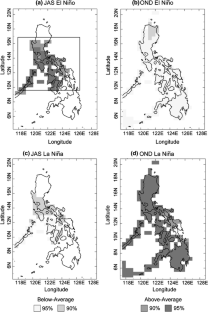
The alternative text for this image may have been generated using AI.
Fig. 2

The alternative text for this image may have been generated using AI.
Fig. 3

The alternative text for this image may have been generated using AI.
Fig. 4
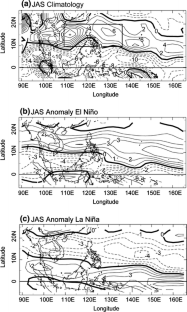
The alternative text for this image may have been generated using AI.
Fig. 5
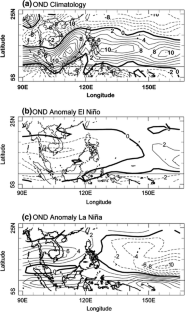
The alternative text for this image may have been generated using AI.
Fig. 6

The alternative text for this image may have been generated using AI.
Fig. 7

The alternative text for this image may have been generated using AI.
Fig. 8
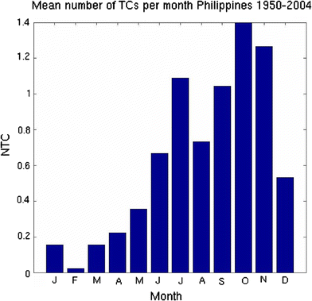
The alternative text for this image may have been generated using AI.
Fig. 9
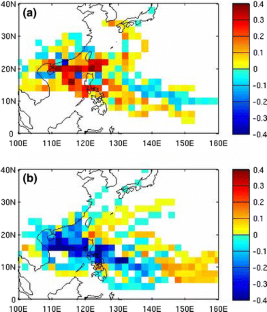
The alternative text for this image may have been generated using AI.
Fig. 10

The alternative text for this image may have been generated using AI.
Fig. 11
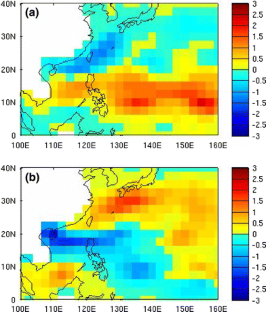
The alternative text for this image may have been generated using AI.
Fig. 12

The alternative text for this image may have been generated using AI.
Fig. 13

The alternative text for this image may have been generated using AI.
Fig. 14
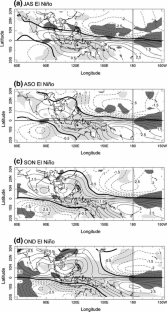
The alternative text for this image may have been generated using AI.
Fig. 15
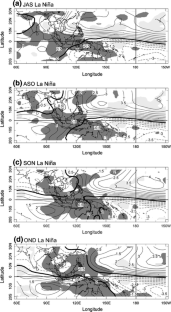
The alternative text for this image may have been generated using AI.
Fig. 16

The alternative text for this image may have been generated using AI.
Fig. 17
The alternative text for this image may have been generated using AI.
Notes
- The WNPMI is defined as the difference in the averages of the 850 hPa zonal wind, (5°N–15°N, 90°E–130°E) minus (25°N–30°N, 110°E–140°E).
- The onset date of an ENSO event is defined as the first 3 month season when the Niño3.4 SST index first exceeds the threshold of ±0.5°C.
- Probabilities are based on a Fisher Exact Test as described in Lyon et al. (2006).
- Owing to the small sample of cases, the weak La Niña of 1995–1996, not identified as an event by the general methodology of the study, was included in the CMAP composite shown in Fig. 13b.
References
- Annamalai H, Slingo JM, Sperber KR, Hodges K (1999) The mean evolution and variability of the Asian summer monsoon: comparison of ECMWF and NCEP NCAR reanalyses. Mon Weather Rev 127:1157–1186
Article Google Scholar - Barnston AG, Chelliah M, Goldenberg SB (1997) Documentation of a highly ENSO-related SST region in the equatorial Pacific. Atmos Ocean 35:367–383
Google Scholar - Bister M, Emanuel KA (1998) Dissipative heating and hurricane intensity. Meteor Atmos Phys 52:233–240
Article Google Scholar - Bister M, Emanuel KA (2002a) Low frequency variability of tropical cyclone potential intensity. 1. Interannual to interdecadal variability. J Geophys Res 107:4801, doi:10.1029/2001JD000776
Article Google Scholar - Bister M, Emanuel KA (2002b) Low frequency variability of tropical cyclone potential intensity.2. Climatology for 1982–1995. J Geophys Res 107:4621, doi:10.1029/2001JD000780
Article Google Scholar - Briegel LM, Frank WM (1997) Large-scale influences on tropical cyclogenesis in the western North Pacific. Mon Weather Rev 125:1397–1413
Article Google Scholar - Camargo SJ, Sobel AH (2005) Western North Pacific tropical cyclone intensity and ENSO. J Clim 18:2996–3006
Article Google Scholar - Camargo SJ, Emanuel KA, Sobel AH (2007a) Use of a genesis potential index to diagnose ENSO effects on tropical cyclone genesis. J Clim 20:4819–4834
Article Google Scholar - Camargo SJ, Robertson AW, Gaffney SJ, Smyth P, Ghil M (2007b) Cluster analysis of typhoon tracks. Part II: large-scale circulation and ENSO. J Clim 20:3654–3676
Article Google Scholar - Chan JCL (1985) Tropical cyclone activity in the Northwest Pacific in relation to El Niño/Southern Oscillation phenomenon. Mon Weather Rev 113:599–606
Article Google Scholar - Chan JCL (2000) Tropical cyclone activity over the western North Pacific associated with El Niño and La Niña events. J Clim 13:2960–2972
Article Google Scholar - Chang C-P (ed) (2004) East Asian Monsoon. World scientific series on meteorology of East Asia, vol 2. World Scientific, Singapore, 564 pp
- Chang C-P, Wang Z, McBride J, Liu C-H (2005) Annual cycle of Southeast Asia—maritime continent rainfall and the asymmetric monsoon transition. J Clim 18:287–301
Article Google Scholar - Chen T-C, Weng S-P, Yamazaki N, Kiehne S (1998) Interannual variation in the tropical cyclone formation over the western North Pacific. Mon Weather Rev 126:1080–1090
Article Google Scholar - Chia HH, Ropelewski CF (2002) The interannual variability in the genesis location of tropical cyclones in the northwest Pacific. J Clim 15:2934–2944
Article Google Scholar - Elsner JB, Liu K-b (2003) Examining the ENSO-typhoon hypothesis. Clim Res 25:43–54
Article Google Scholar - Emanuel KA (1995) Sensitivity of tropical cyclones to surface exchange coefficients and a revised steady-state model incorporating eye dynamics. J Atmos Sci 52:3969–3976
Article Google Scholar - Emanuel KA, Nolan DS (2004) Tropical cyclone activity and global climate. Bull Am Meteorol Soc 85:666–667
Google Scholar - Gill AE (1980) Some simple solutions for heat-induced tropical circulation. Q J R Meteorol Soc 106:447–462
Article Google Scholar - Hendon HH (2003) Indonesian rainfall variability: impacts of ENSO and local air–sea interaction. J Clim 16:1775–1790
Article Google Scholar - Hoerling MP, Kumar A, Zhong M (1997) El Niño, La Niña, and the nonlinearity of their teleconnections. J Clim 10:1769–1786
Article Google Scholar - Juneng L, Tangang FT (2005) Evolution of ENSO-related rainfall anomalies inSoutheast Asia region and its relationship with atmosphere–ocean variations in Indo-Pacific sector. Clim Dyn 25:337–350
Article Google Scholar - Kiladis GN, Diaz HF (1989) Global climatic anomalies associated with extremes in the Southern Oscillation. J Clim 2:1069–1090
Article Google Scholar - Kistler R et al (2001) The NCEP–NCAR reanalysis: monthly means CD-ROM and documentation. Bull Am Meteorol Soc 82:247–268
Article Google Scholar - Kripalani RH, Kulkarni A (1998) The relationship between some large-scale atmospheric parameters and rainfall over southeast Asia: a comparison with features over India. Theor Appl Clim 59:1–11
Article Google Scholar - Lander MA (1994) An exploratory analysis of the relationship between tropical storm formation in the western North Pacific and ENSO. Mon Weather Rev 122:636–651
Article Google Scholar - Lander MA (1996) Specific tropical cyclone tracks and unusual tropical cyclone motions associated with a reverse-oriented monsoon trough in the western North Pacific. Weather Forecast 11:170–186
Article Google Scholar - Lau N-C, Nath MJ (2000) Impact of ENSO on the variability of the Asian–Australian monsoons as simulated in GCM experiments. J Clim 13:4287–4309
Article Google Scholar - Lau N-C, Nath MJ (2003) Atmosphere–ocean variations in the Indo-Pacific sector during ENSO episodes. J Clim 16:3–20
Article Google Scholar - Lau N-C, Nath MJ (2006) ENSO modulation of the interannual and intraseasonal variability of the East Asian monsoon—a model study. J Clim 19:4508–4530
Article Google Scholar - Lau N-C, Nath MJ, Wang H (2004) Simulations by a GFDL GCM of ENSO-related variability of the coupled atmosphere–ocean system in the East Asian monsoon region. In: Chang C-P (ed) East Asian Monsoon. World scientific series on meteorology of East Asia, vol 2. World Scientific, Singapore,pp 271–300
- Lyon B, Cristi H, Verceles ER, Hilario FD, Abastillas R (2006) Seasonal reversal of the ENSO rainfall signal in the Philippines. Geophys Res Lett 33:L24710, doi:10.1029/2006GL028182
Article Google Scholar - New M, Hulme M, Jones PD (1999) Representing twentieth century space–time climate variability. Part I: development of a 1961–1990 mean monthly terrestrial climatology. J Clim 12:829–856
Article Google Scholar - New M, Hulme M, Jones PD (2000) Representing twentieth century space–time climate variability. Part II: development of 1901–96 monthly grids of terrestrial surface climate. J Clim 13:2217–2238
Article Google Scholar - Ritchie ER, Holland GJ (1999) Large-scale patterns associated with tropical cyclogenesis in the western Pacific. Mon Weather Rev 127:2027–2043
Article Google Scholar - Ropelewski CF, Halpert MS (1987) Global and regional scale precipitation patterns associated with the El Niño/Southern Oscillation. Mon Weather Rev 115:1606–1626
Article Google Scholar - Saunders MA, Chandler RE, Merchant CJ, Roberts FP (2000) Atlantic hurricanes and NW Pacific typhoons: ENSO spatial impacts on occurrence and landfall. Geophys Res Lett 27:1147–1150
Article Google Scholar - Smith TM, Reynolds RW (2003) Extended reconstruction of global sea surface temperatures based on COADS data (1854–1997). J Clim 16:1495–1510
Article Google Scholar - Trenberth KE, Guillemont CJ (1998) Evaluation of the atmospheric moisture and hydrological cycle in the NCEP NCAR reanalyses. Clim Dyn 14:213–231
Article Google Scholar - Walker GT, Bliss EW (1932) World Weather V. Mem R Meteorol Soc 4:53–84
Google Scholar - Wang B, Chan JCL (2002) How strong ENSO events affect tropical storm activity over the western North Pacific. J Clim 15:1643–1658
Article Google Scholar - Wang B, Fan Z (1999) Choice of South Asian summer monsoon indices. Bull Am Meteorol Soc 80:629–638
Article Google Scholar - Wang B, Li T (2004) East Asian Monsoon–ENSO interactions. Chap 5. In: Chang C-P (ed) East Asian Monsoon. World scientific series on meteorology of East Asia, vol 2. World Scientific, Singapore, 564 pp
- Wang B, Zhang Q (2002) Pacific-East Asian teleconnection. Part II: how the Philippines Sea anomalous anticyclone is established during El Niño development. J Clim 15:3252–3265
Article Google Scholar - Wang B, Wu R, Fu X (2000) Pacific-East Asian teleconnection: how does ENSO affect East Asian climate? J Clim 13:1517–1536
Article Google Scholar - Wang B, Wu R, Lau K-M (2001) Interannual variability of the Asian summer monsoon: contrasts between the Indian and the western North Pacific-East Asian monsoons. J Clim 14:4073–4090
Article Google Scholar - Wang B, Wu R, Li T (2003) Atmosphere–Warm Ocean interaction and its impacts on Asian–Australian Monsoon Variation. J Cim 16:1195–1211
Google Scholar - Wu R, Hu Z-Z, Kirtman BP (2003) Evolution of ENSO-related rainfall anomalies in East Asia. J Clim 16:3742–3758
Article Google Scholar - Xie P, Arkin PA (1996) Analysis of global monthly precipitation using gauge observations, satellite estimates, and numerical model predictions. J Clim 9:840–858
Article Google Scholar - Zhang R, Sumi A, Kimoto M (1996) Impact of El Nino on the East Asian monsoon: a diagnostic study of the ‘86/87’ and ‘91/92’events. J Meteor Soc Japan 74:49–62
Google Scholar
Acknowledgments
This study is an outgrowth of a collaborative research effort between the Philippine Atmospheric, Geophysical and Astronomical Services Administration (PAGASA) and the International Research Institute for Climate and Society (IRI). The authors wish to thank Dr. Flaviana Hilario, head of the Climatology and Agrometeorology Branch, Edna L. Juanillo, head of the Climate Monitoring and Prediction Center (CLIMPC), and Anthony Lucero of PAGASA for their assistance during the course of this work. This work is funded in part by a grant from the National Oceanographic and Atmospheric Administration (NOAA), NA050AR4311004, and by the US Agency for International Development’s Office of Foreign Disaster Assistance, DFD-A-00-03-00005-00. The views expressed herein are those of the authors and do not necessarily reflect those of NOAA or any of its sub-agencies.
Author information
Author notes
- Suzana J. Camargo
Present address: Lamont-Doherty Earth Observatory of Columbia University, Palisades, NY, 10964, USA
Authors and Affiliations
- International Research Institute for Climate and Society, The Earth Institute at Columbia University, Palisades, NY, 10964, USA
Bradfield Lyon & Suzana J. Camargo
Authors
- Bradfield Lyon
- Suzana J. Camargo
Corresponding author
Correspondence toBradfield Lyon.
Rights and permissions
About this article
Cite this article
Lyon, B., Camargo, S.J. The seasonally-varying influence of ENSO on rainfall and tropical cyclone activity in the Philippines.Clim Dyn 32, 125–141 (2009). https://doi.org/10.1007/s00382-008-0380-z
- Received: 23 October 2007
- Accepted: 13 February 2008
- Published: 26 February 2008
- Issue date: January 2009
- DOI: https://doi.org/10.1007/s00382-008-0380-z