Uncertainty in the ocean–atmosphere feedbacks associated with ENSO in the reanalysis products (original) (raw)
Abstract
The evolution of El Niño-Southern Oscillation (ENSO) variability can be characterized by various ocean–atmosphere feedbacks, for example, the influence of ENSO related sea surface temperature (SST) variability on the low-level wind and surface heat fluxes in the equatorial tropical Pacific, which in turn affects the evolution of the SST. An analysis of these feedbacks requires physically consistent observational data sets. Availability of various reanalysis data sets produced during the last 15 years provides such an opportunity. A consolidated estimate of ocean surface fluxes based on multiple reanalyses also helps understand biases in ENSO predictions and simulations from climate models. In this paper, the intensity and the spatial structure of ocean–atmosphere feedback terms (precipitation, surface wind stress, and ocean surface heat flux) associated with ENSO are evaluated for six different reanalysis products. The analysis provides an estimate for the feedback terms that could be used for model validation studies. The analysis includes the robustness of the estimate across different reanalyses. Results show that one of the “coupled” reanalysis among the six investigated is closer to the ensemble mean of the results, suggesting that the coupled data assimilation may have the potential to better capture the overall atmosphere–ocean feedback processes associated with ENSO than the uncoupled ones.
Access this article
Subscribe and save
- Starting from 10 chapters or articles per month
- Access and download chapters and articles from more than 300k books and 2,500 journals
- Cancel anytime View plans
Buy Now
Price excludes VAT (USA)
Tax calculation will be finalised during checkout.
Instant access to the full article PDF.
Fig. 1
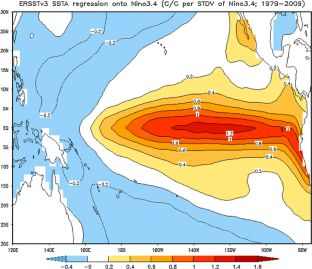
The alternative text for this image may have been generated using AI.
Fig. 2
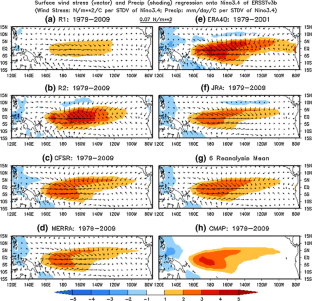
The alternative text for this image may have been generated using AI.
Fig. 3

The alternative text for this image may have been generated using AI.
Fig. 4
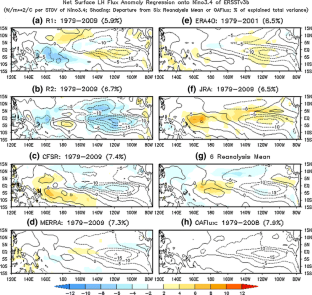
The alternative text for this image may have been generated using AI.
Fig. 5
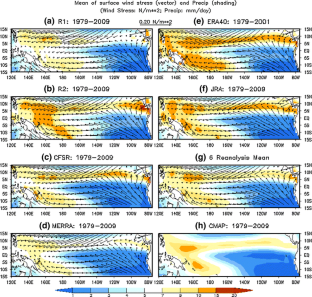
The alternative text for this image may have been generated using AI.
Fig. 6
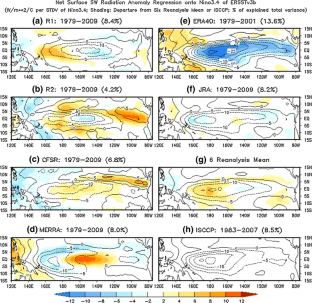
The alternative text for this image may have been generated using AI.
Fig. 7

The alternative text for this image may have been generated using AI.
Fig. 8

The alternative text for this image may have been generated using AI.
Fig. 9

The alternative text for this image may have been generated using AI.
Fig. 10

The alternative text for this image may have been generated using AI.
References
- Barnett TP, Latif M, Kirk E, Roeckner E (1991) On ENSO physics. J Clim 4(5):487–515
Article Google Scholar - Barnston AG, Chelliah M, Goldenberg SB (1997) Documentation of a highly ENSO-related SST region in the equatorial Pacific. Atmos Ocean 35:367–383
Article Google Scholar - Bjerknes J (1969) Atmospheric teleconnections from the equatorial Pacific. Mon Weather Rev 97:163–172
Article Google Scholar - Cronin MF, Bond NA, Fairall CW, Weller RA (2006) Surface cloud forcing in the east Pacific stratus deck/cold tongue/ITCZ complex. J Clim 19:392–409
Article Google Scholar - Fu C, Fan H, Diaz H (1992) Variability in latent heat flux over the tropical Pacific in association with recent two ENSO events. Adv Atmos Sci 9:351–358
Article Google Scholar - Gadgil S, Joseph PV, Joshi NV (1984) Ocean-atmosphere coupling over monsoon regions. Nature 312:141–143
Article Google Scholar - Graham NE, Barnett TP (1987) Sea surface temperature, surface wind divergence, and convection over tropical oceans. Science 238:657–659
Article Google Scholar - Guilyardi E et al (2004) Representing El Niño in coupled ocean–atmosphere GCMs: the dominant role of the atmospheric component. J Clim 17:4623–4629
Article Google Scholar - Guilyardi E et al (2009a) Understanding El Niño in ocean–atmosphere general circulation models: progress and challenges. Bull Am Meterol Soc 90:325–340
Article Google Scholar - Guilyardi E et al (2009b) Atmosphere feedbacks during ENSO in a coupled GCM with a modified atmospheric convection scheme. J Clim 22:5698–5718
Article Google Scholar - IPCC (2007) Climate change 2007: the physical science basis. In: Solomon S et al (eds) Contribution of working group I to the fourth assessment report of the intergovernmental panel on climate change. Cambridge University Press, Cambridge
- Ji M, Kumar A, Leetmaa A (1994) A multiseason climate forecast system at the National Meteorological Center. Bull Am Meterol Soc 75:569–577
Article Google Scholar - Kalnay E et al (1996) The NCEP/NCAR 40-year reanalysis project. Bull Am Meterol Soc 77:437–471
Article Google Scholar - Kanamitsu M et al (2002) NCEP-DOE AMIP-II reanalysis (R-2). Bull Am Meterol Soc 83:1631–1643
Article Google Scholar - Kim D, Kug J-S, Kang I-S, Jin F-F, Wittenberg AT (2008) Tropical Pacific impacts of convective momentum transport in the SNU coupled GCM. Clim Dyn 31:213–226
Article Google Scholar - Kumar A, Zhang Q, Peng P, Jha B (2005) SST-forced atmospheric variability in an atmospheric general circulation model. J Clim 18:3953–3967
Article Google Scholar - Lloyd J, Guilyardi E, Weller H, Slingo J (2009) The role of atmosphere feedbacks during ENSO in the CMIP3 models. Atmos Sci Lett 10:170–176
Article Google Scholar - Lloyd J, Guilyardi E, Weller H (2011) The role of atmosphere feedbacks during ENSO in the CMIP3 models. Part II: using AMIP runs to understand the heat flux feedback mechanisms. Clim Dyn. doi:10.1007/s00382-010-0895-y (published on-line)
- National Research Council (2010) Assessment of intraseasonal to interannual climate prediction and predictability. The National Academies Press, Washington, 192 pp, ISBN-10: 0-309-15183-X
- Neelin JD et al (1998) ENSO theory. J Geophys Res 103:14261–14290
Article Google Scholar - Okumura YM, Deser C (2010) Asymmetry in the duration of El Niño and La Niña. J Clim 23:5826–5843
Article Google Scholar - Onogi K et al (2007) The JRA-25 reanalysis. J Meteorol Soc Jpn 85:369–432
Article Google Scholar - Philander SGH (1990) El Niño, La Niña and the southern oscillation. Academic Press, San Diego, 293 pp, ISBN 0125532350
- Rasmusson EM, Carpenter TH (1982) Variation in tropical sea surface temperature and surface wind fields associated with Southern Oscillation/El Niño. Mon Weather Rev 110:354–384
Article Google Scholar - Rienecker MM et al (2011) MERRA—NASA’s modern-era retrospective analysis for research and applications. J Clim (submitted)
- Saha S et al (2010) The NCEP climate forecast system reanalysis. Bull Am Meterol Soc 91:1015–1057. doi:10.1175/2010BAMS3001.1
Article Google Scholar - Schneider EK (2002) Understanding differences between the equatorial Pacific as simulated by two coupled GCMs. J Clim 15:449–469
Article Google Scholar - Smith TM, Reynolds RW, Peterson TC, Lawrimore J (2008) Improvements to NOAA’s historical merged land-ocean surface temperature analysis (1880–2006). J Clim 21:2283–2296
Article Google Scholar - Sun D et al (2006) Radiative and dynamical feedbacks over the equatorial cold tongue: results from nine atmospheric GCMs. J Clim 19:4059–4074
Article Google Scholar - Sun D, Yu Y, Zhang T (2009) Tropical water vapor and cloud feedbacks in climate models: a further assessment using coupled simulations. J Clim 22:1287–1304
Article Google Scholar - Uppala SM et al (2005) The ERA-40 re-analysis. Q J R Meterol Soc 131:2961–3012. doi:10.1256/qj.04.176
Article Google Scholar - Wang C, Picaut J (2004) Understanding ENSO physics—a review. In: Wang C, Xie S-P, Carton JA (eds) Earth’s climate: the ocean–atmosphere interaction. Geophysical Monograph Series, vol 147. AGU, Washington, pp 21–48
- Xie P, Arkin PA (1997) Global precipitation: a 17-year monthly analysis based on gauge observations, satellite estimates, and numerical model outputs. Bull Am Meterol Soc 78:2539–2558
Article Google Scholar - Xue Y, Huang B, Hu Z-Z, Kumar A, Wen C, Behringer D, Nadiga S (2011) An assessment of oceanic variability in the NCEP climate forecast system reanalysis. Clim Dyn. doi:10.1007/s00382-010-0954-4 (published online)
- Yu L, Weller RA (2007) Objectively analyzed air–sea heat fluxes (OAFlux) for the global ocean. Bull Am Met Soc 88:527–539
Article Google Scholar - Zhang Y, Rossow W, Lacis A, Oinas V, Mishchenko M (2004) Calculation of radiative flux profiles from the surface to top-of atmosphere based on ISCCP and other global data sets: refinements of the radiative transfer model and input data. J Geophys Res 109:D19105. doi:10.1029/2003JD004457
Acknowledgments
We appreciate the comments of Drs. Wanqiu Wang, Yan Xue, D. G. DeWitt, and two reviewers. Thanks also go to Dr. Li Zhang for managing the reanalysis data sets at CPC.
Author information
Authors and Affiliations
- Climate Prediction Center, NCEP/NWS/NOAA, 5200 Auth Road (Suite 605), Camp Springs, MD, 20746, USA
Arun Kumar & Zeng-Zhen Hu
Authors
- Arun Kumar
- Zeng-Zhen Hu
Corresponding author
Correspondence toArun Kumar.
Rights and permissions
About this article
Cite this article
Kumar, A., Hu, ZZ. Uncertainty in the ocean–atmosphere feedbacks associated with ENSO in the reanalysis products.Clim Dyn 39, 575–588 (2012). https://doi.org/10.1007/s00382-011-1104-3
- Received: 29 March 2011
- Accepted: 18 May 2011
- Published: 04 June 2011
- Issue date: August 2012
- DOI: https://doi.org/10.1007/s00382-011-1104-3