Is a low blood level of vitamin B12 a cardiovascular and diabetes risk factor? A systematic review of cohort studies (original) (raw)
Abstract
Purpose
To assess the prior hypothesis that low blood vitamin B12, partly through hyperhomocysteinemia and partly through direct effects, increases the risk of cardiovascular diseases and diabetes. As background, we also extracted all-cause mortality from the studies that met our criteria.
Methods
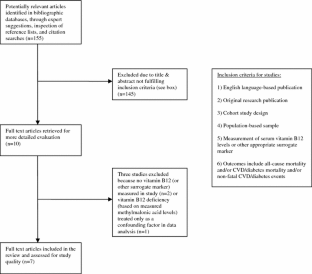
A systematic review of prospective cohort studies identified through searching six electronic databases, screening of reference lists, and citation search. Included studies reported data on the association between vitamin B12 blood levels, or other appropriate surrogate biological markers e.g. holotranscobalamin or serum/urine methylmalonic acid, and fatal or non-fatal incident diabetes and cardiovascular events.
Results
Seven studies were included. Studies differed regarding the population studied, length of follow-up, study outcomes, and data analysis—a narrative synthesis approach was performed to examine the results. Most studies met few of the quality assessment criteria which were adapted from the Scottish Intercollegiate Guidelines Network (SIGN). Only one high-quality study reported that low B12 increased the risk of incident cerebral ischaemia (RR = 1.76; 95% CI = 1.16–2.68). After controlling for homocysteine, the association persisted although weakened (RR = 1.57; 95% CI = 1.02–2.43), suggesting that the effects of low B12 were only partly mediated by homocysteine. In two studies, higher B12 levels were associated with a greater risk of total mortality (RR = 1.00; 95% CI = 1.00–1.00 and HR = 1.15; 95% CI = 1.08–1.22, respectively) and combined fatal and non-fatal coronary events (RR = 1.00; 95% CI = 1.00–1.00). No association between study outcomes and vitamin B12 levels was found in four other studies.
Conclusions
Surprisingly, there is only very limited evidence that vitamin B12 deficiency predisposes to the risk of mortality and morbidity from either cardiovascular diseases or diabetes in adults. Current data do not support vitamin B12 supplementation to reduce the risk of cardiovascular diseases or diabetes.
Access this article
Subscribe and save
- Starting from 10 chapters or articles per month
- Access and download chapters and articles from more than 300k books and 2,500 journals
- Cancel anytime View plans
Buy Now
Price excludes VAT (USA)
Tax calculation will be finalised during checkout.
Instant access to the full article PDF.
Fig. 1
References
- Wierzbicki AS (2007) Homocysteine and cardiovascular disease: a review of the evidence. Diab Vasc Dis Res 4:143–150
Article Google Scholar - Strain JJ, Dowey L, Ward M, Pentieva K, McNulty H et al (2004) B-vitamins, homocysteine metabolism and CVD. P Nutr Soc 63:597–603
Article CAS Google Scholar - Rosenberg IH (2008) Metabolic programming of offspring by vitamin B(12)/folate imbalance during pregnancy. Diabetologia 51:6–7
Article CAS Google Scholar - Green R (2009) Is it time for vitamin B-12 fortification? What are the questions? Am J Clin Nutr 89(suppl):712S–716S
Article CAS Google Scholar - Ford ES, Smith SJ, Stroup DF et al (2002) Homocyst(e)ine and cardiovascular disease: a systematic review of the evidence with special emphasis on case-control studies and nested case-control studies. Int J Epidemiol 31:59–70
Article Google Scholar - Wald DS, Law MR, Wald NJ (2005) Serum homocysteine and coronary heart disease. In: Marmot M, Elliott P et al (eds) Coronary heart disease epidemiology. From aetiology to public health, 2nd edn. Oxford University Press, Oxford, pp 239–250
Chapter Google Scholar - Virtanen JK, Voutilainen S, Happonen P et al (2005) Serum homocysteine, folate and risk of stroke: Kuopio ischaemic heart disease risk factor (KIHD) study. Eur J Cardiov Prev R 12:369–375
Article Google Scholar - Stabler SP, Allen RH (2004) Vitamin B12 deficiency as a worldwide problem. Annu Rev Nutr 24:299–326
Article CAS Google Scholar - Allen LH (2009) How common is vitamin B-12 deficiency? Am J Clin Nutr 89(suppl):693S–696S
Article CAS Google Scholar - Yajnik CS, Deshpande SS, Jackson AA et al (2008) Vitamin B12 and folate concentrations during pregnancy and insulin resistance in the offspring: the Pune Maternal Nutrition Study. Diabetologia 51:29–38
Article CAS Google Scholar - Krishnaveni GV, Hill JC, Veena SR et al (2009) Low plasma vitamin B12 in pregnancy is associated with gestational ‘diabesity’ and later diabetes. Diabetologia 52:2358–2359
Article Google Scholar - Yajnik CS, Deshmukh US (2008) Maternal nutrition, intrauterine programming and consequential risks in the offspring. Rev Endocr Metab Disord 9:203–211
Article CAS Google Scholar - Bhopal R (2009) Seven mistakes and potential solutions in epidemiology, including a call for a world council of epidemiology and causality. Emerg Themes Epidemiol 6:6
Article Google Scholar - McNulty H, Pentieva K, Hoey L et al (2008) Homocysteine, B-vitamins and CVD. Proc Nutr Soc 67:232–237
Article CAS Google Scholar - Stroup DF, Berlin JA, Morton SC et al (2000) Meta-analysis of observational studies in epidemiology: a proposal for reporting. Meta-analysis of observational studies in epidemiology (MOOSE) group. J Amer Med Assoc 283:2008–2012
Article CAS Google Scholar - Dangour AD, Breeze E, Clarke R et al (2008) Plasma homocysteine, but not folate or vitamin B12, predicts mortality in older people in the United Kingdom. J Nutr 138:1121–1128
CAS Google Scholar - Hung J, Beilby JP, Knuiman MW et al (2003) Folate and vitamin B-12 and risk of fatal cardiovascular disease: cohort study from Busselton, Western Australia. Br Med J 326:131
Article CAS Google Scholar - Looker HC, Fagot-Campagna A, Gunter EW et al (2007) Homocysteine and vitamin B(12) concentrations and mortality rates in type 2 diabetes. Diabetes Metab Rev 23:193–201
Article CAS Google Scholar - Zeitlin A, Frishman WH, Chee JC (1997) The association of vitamin B12 and folate blood levels with mortality and cardiovascular morbidity incidence in the old old: The Bronx Aging Study. Am J Ther 4:275–281
Article CAS Google Scholar - de Bree A, Verschuren WMM, Blom HJ et al (2003) Coronary heart disease mortality, plasma homocysteine, and B-vitamins: a prospective study. Atherosclerosis 166:369–377
Article Google Scholar - Folsom AR, Nieto FJ, McGovern PG et al (1998) Prospective study of coronary heart disease incidence in relation to fasting total homocysteine, related genetic polymorphisms, and B vitamins: the atherosclerosis Risk in communities (ARIC) study. Circulation 98:204–210
CAS Google Scholar - Weikert C, Dierkes J, Hoffman K et al (2007) B vitamin plasma levels and the risk of ischemic stroke and transient ischemic attack in a German cohort. Stroke 38:2908–2912
Article Google Scholar - Fibrinogen Studies Collaboration (2005) Plasma fibrinogen level and the risk of major cardiovascular diseases and nonvascular mortality. An individual participant meta-analysis. J Amer Med Assoc 294:1799–1809
Article Google Scholar - Welsh P, Lowe GDO, Chalmers J et al (2008) Associations of proinflammatory cytokines with the risk of recurrent stroke. Stroke 39:2226–2230
Article CAS Google Scholar - Smith AD, Refsum H (2009) Vitamin B12 and cognition in the elderly. Am J Clin Nutr 89(suppl):707S–711S
Article CAS Google Scholar - Salles N, Herrmann F, Sakbani K et al (2005) High vitamin B12 level: a strong predictor of mortality in elderly inpatients. J Am Geriatr Soc 53:917–918
Article Google Scholar - Hemmersbach-Miller M, Conde-Martel A, León-Betancor P (2005) Vitamin B12 as a predictor of mortality in elderly inpatients. J Am Geriatr Soc 53:2035–2036
Article Google Scholar - Sinclair KD, Allegrucci C, Singh R et al (2007) DNA methylation, insulin resistance, and blood pressure in offspring determined by maternal periconceptual B vitamin and methionine status. P Natl Acad Sci USA 104:19351–19356
Article CAS Google Scholar - Egger M, Schneider M, Smith GD (1998) Mata-analysis spurious precision? Meta-analysis of observational studies. Br Med J 316:140–144
CAS Google Scholar - Lewis SJ, Ebrahim S, Smith GD (2005) Meta-analysis of MTHFR 677C → T polymorphism and coronary heart disease: does totality of evidence support causal role for homocysteine and preventive potential of folate? Br Med J 331:1053
Article CAS Google Scholar - Namour F, Oliver JL, Abdelmouttaleb I et al (2001) Transcobalamin codon 259 polymorphism in HT-29 and Caco-2 cells and in Caucasians: relation to transcobalamin and homocysteine concentration in blood. Blood 97:1092–1098
Article CAS Google Scholar
Acknowledgments
The authors wish to thank Dr Fay Crawford, University of Edinburgh, for her generous support and advice on the study methodology, and specifically on whether a meta-analysis was warranted. We also thank Marshall Dozier, Senior Liaison Librarian for the College of Medicine and Veterinary Medicine, University of Edinburgh for helping with the literature search strategy, and Smita Kulkarni, Diabetes Unit King Edward Memorial Research Center, for her valuable contribution to the literature search. Finally, we are grateful to the referees assigned to this paper for their constructive comments and suggestions that helped improve the manuscript.
Author information
Authors and Affiliations
- Public Health Sciences Section, School of Clinical Sciences and Community Health and Centre for Population Health Sciences, University of Edinburgh, Teviot Place, Edinburgh, EH8 9AG, Scotland, UK
Snorri B. Rafnsson & Raj S. Bhopal - Clinical Sciences Research Institute, Warwick Medical School, CSB, UHCW NHS Trust, Coventry, CV2 2DX, UK
Ponnusamy Saravanan - Diabetes Unit, KEM Hospital and Research Centre, Rasta Peth, Pune, Maharashtra, 411 011, India
Chittaranjan S. Yajnik
Authors
- Snorri B. Rafnsson
- Ponnusamy Saravanan
- Raj S. Bhopal
- Chittaranjan S. Yajnik
Corresponding author
Correspondence toSnorri B. Rafnsson.
Rights and permissions
About this article
Cite this article
Rafnsson, S.B., Saravanan, P., Bhopal, R.S. et al. Is a low blood level of vitamin B12 a cardiovascular and diabetes risk factor? A systematic review of cohort studies.Eur J Nutr 50, 97–106 (2011). https://doi.org/10.1007/s00394-010-0119-6
- Received: 15 February 2010
- Accepted: 11 June 2010
- Published: 29 June 2010
- Issue date: March 2011
- DOI: https://doi.org/10.1007/s00394-010-0119-6