Distribution of Cryptosporidium subtypes in humans and domestic and wild ruminants in Portugal (original) (raw)
Abstract
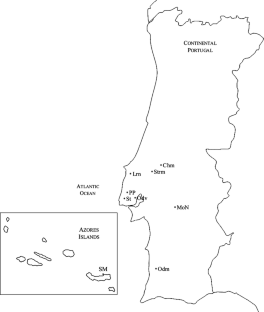
To investigate the transmission of cryptosporidiosis in Portugal, Cryptosporidium hominis and Cryptosporidium parvum from HIV-infected patients, cattle, and wild ruminants were characterized by sequence analysis of the 60-kDa glycoprotein (GP60) gene. Fourteen subtypes within nine subtype families were identified, and three of the subtype families (If, IIb, and IId) were restricted or largely limited to Portugal. Parasites from cattle from various regions in Portugal and wild ruminants in Lisbon showed limited genetic heterogeneity (only two subtype families). All wild ruminants had the same subtype, which was also the predominant subtype in cattle all over Portugal and was found in nine HIV-infected patients in Lisbon. Two other C. parvum subtypes were only restricted to limited locations. In contrast, human parasites displayed 13 subtypes in nine subtype families, with most of the infections caused by parasites in Ib, IIa, IIc, and IId families. Two of the C. parvum subtype families (IIc and IIb) had only been found in humans. The high overall parasite diversity and high percentage of C. hominis infections attributable to Ib and C. parvum infections to IId represent unique characteristics of Cryptosporidium transmission in humans in Portugal.
Access this article
Subscribe and save
- Starting from 10 chapters or articles per month
- Access and download chapters and articles from more than 300k books and 2,500 journals
- Cancel anytime View plans
Buy Now
Price excludes VAT (USA)
Tax calculation will be finalised during checkout.
Instant access to the full article PDF.
Fig. 1
References
- Alves M, Matos O, Antunes F (2001a) Multilocus PCR–RFLP analysis of Cryptosporidium isolates from HIV-infected patients from Portugal. Ann Trop Med Parasitol 95:627–632
Article PubMed CAS Google Scholar - Alves M, Matos O, Fonseca IP, Delgado E, Lourenço AM, Antunes F (2001b) Multilocus genotyping of Cryptosporidium isolates from human HIV-infected and animal hosts. J Eukaryot Microbiol Suppl:17S
Article PubMed CAS Google Scholar - Alves M, Xiao L, Sulaiman I, Lal AA, Matos O, Antunes F (2003) Subgenotype analysis of Cryptosporidium isolates from humans, cattle, and zoo ruminants in Portugal. J Clin Microbiol 41:2744–2747
Article PubMed CAS Google Scholar - Chalmers RM, Ferguson C, Cacciò S, Gasser RB, El-Osta YGA, Heijnen L, Xiao L, Elwin K, Hadfield S, Sinclair M, Stevens M (2005) Direct comparison of selected methods for genetic categorisation of Cryptosporidium parvum and Cryptosporidium hominis species. Int J Parasitol 35:397–410
Article PubMed CAS Google Scholar - Fayer R (2004) Cryptosporidium: a water-borne zoonotic parasite. Vet Parasitol 126:37–56
Article PubMed Google Scholar - Glaberman S, Moore JE, Lowery CJ, Chalmers RM, Sulaiman I, Elwin K, Rooney PJ, Millar BC, Dooley JSG, Lal AA, Xiao L (2002) Three drinking-water-associated cryptosporidiosis outbreaks, Northern Ireland. Emerg Infect Dis 8:631–633
PubMed Google Scholar - Hunter PR, Thompson RCA (2005) The zoonotic transmission of Giardia and Cryptosporidium. Int J Parasitol 35:1181–1190
Article PubMed Google Scholar - Leav BA, Mackay MR, Anyanwu A, O’Connor RM, Cevallos AM, Kindra G, Rollins NC, Bennish ML, Nelson RG, Ward HD (2002) Analysis of sequence diversity at the highly polymorphic Cpgp40/15 locus among Cryptosporidium isolates from human immunodeficiency virus-infected children in South Africa. Infect Immun 70:3881–3890
Article PubMed CAS Google Scholar - Mallon ME, MacLeod A, Wastling JM, Smith H, Tait A (2003) Multilocus genotyping of Cryptosporidium parvum type 2: population genetics and sub-structuring. Infect Genet Evol 3:207–218
Article PubMed CAS Google Scholar - Matos O, Alves M, Xiao L, Cama V, Antunes F (2004) Cryptosporidium felis and C. meleagridis in persons with HIV, Portugal. Emerg Infect Dis 10:2255–2256
Google Scholar - Peng MM, Matos O, Gatei W, Das P, Stantic-Pavlinic M, Bern C, Sulaiman IM, Glaberman S, Lal AL, Xiao L (2001) A comparison of Cryptosporidium subgenotypes from several geographic regions. J Eukaryot Microbiol Suppl:28S–31S
Article PubMed CAS Google Scholar - Peng MM, Meshnick SR, Cunliffe NA, Thindwa BDM, Hart CA, Broadhead RL, Xiao L (2003a) Molecular epidemiology of cryptosporidiosis in children in Malawi. J Eukaryot Microbiol 50:557–559
Article PubMed CAS Google Scholar - Peng MM, Wilson ML, Holland RE, Meshnick SR, Lal AA, Xiao L (2003b) Genetic diversity of Cryptosporidium spp. in cattle in Michigan: implications for understanding the transmission dynamics. Parasitol Res 90:175–180
Article PubMed Google Scholar - Stantic-Pavlinic M, Xiao L, Glaberman S, Lal AA, Oraen T, Rataj-Verglez A, Logar J, Berce I (2003) Cryptosporidiosis associated with animal contacts. Wien Klin Wochenschr 115:125–127
Article PubMed Google Scholar - Strong WB, Gut J, Nelson RG (2000) Cloning and sequence analysis of a high polymorphic Cryptosporidium parvum gene encoding a 60-kilodalton glycoprotein and characterization of its 15- and 45-kilodalton zoite surface antigen products. Infect Immun 68:4117–4134
Article PubMed CAS Google Scholar - Sulaiman IM, Lal AA, Xiao L (2001) A population genetic study of the Cryptosporidium parvum human genotype parasites. J Eukaryot Microbiol Suppl:24S–27S
Article PubMed CAS Google Scholar - Sulaiman IM, Hira PR, Zhou L, Al-Ali FM, Al-Shelahi FA, Shweiki HM, Iqbal J, Khalid N, Xiao L (2005) Unique endemicity of cryptosporidiosis in children in Kuwait. J Clin Microbiol 43:2805–2809
Article PubMed Google Scholar - Wu Z, Nagano I, Boonmars T, Nakada T, Takahashi Y (2003) Intraspecies polymorphism of Cryptosporidium parvum revealed by PCR–restriction fragment length polymorphism (RFLP) and RFLP–single strand conformational polymorphism analyses. Appl Environ Microbiol 69:4720–4726
Article PubMed CAS Google Scholar - Xiao L, Bern C, Sulaiman IM, Lal AA (2003) Molecular epidemiology of human cryptosporidiosis. In: Thompson RCA, Armson A, Ryan UM (eds) Cryptosporidium: from molecules to disease. Elsevier, Amsterdam, pp 121–146
Chapter Google Scholar - Xiao L, Ryan UM (2004) Cryptosporidiosis: an update in molecular epidemiology. Curr Opin Infect Dis 17:483–490
Article PubMed Google Scholar - Xiao L, Fayer R, Ryan U, Upton SJ (2004) Cryptosporidium taxonomy: recent advances and implications for public health. Clin Microbiol Rev 17:72–97
Article PubMed Google Scholar - Zhou L, Singh A, Jiang J, Xiao L (2003) Molecular surveillance of Cryptosporidium spp. in raw wastewater in Milwaukee: implications for understanding outbreak occurrence and transmission dynamics. J Clin Microbiol 41:5254–5257
Article PubMed CAS Google Scholar
Acknowledgements
We thank Prof. Isabel Pereira da Fonseca, Dr. Esmeralda Delgado, and Dr. Ana Mafalda Lourenço for providing bovine and wild ruminants samples. This work was supported by the Project POCTI/ESP/46369/2002 from “Fundação para a Ciência e Tecnologia”. Margarida Alves was supported by a Ph.D. grant (SFRH/BD/2898/2000) from “Fundação para a Ciência e Tecnologia”.
Author information
Authors and Affiliations
- Unidade de Protozoários Oportunistas/VIH e Outras Protozooses, Unidade de Parasitologia e Microbiologia Médicas (UPMM), Instituto de Higiene e Medicina Tropical, Universidade Nova de Lisboa, Rua da Junqueira, 96, 1349-008, Lisboa, Portugal
Margarida Alves & Olga Matos - Division of Parasitic Diseases, Centers for Disease Control and Prevention, Atlanta, GA, 30341, USA
Lihua Xiao - Clínica Universitária de Doenças Infecciosas, Faculdade de Medicina (Hospital de Santa Maria), Universidade de Lisboa, Av. Egas Moniz, 1600, Lisboa, Portugal
Francisco Antunes
Authors
- Margarida Alves
- Lihua Xiao
- Francisco Antunes
- Olga Matos
Corresponding author
Correspondence toOlga Matos.
Rights and permissions
About this article
Cite this article
Alves, M., Xiao, L., Antunes, F. et al. Distribution of Cryptosporidium subtypes in humans and domestic and wild ruminants in Portugal.Parasitol Res 99, 287–292 (2006). https://doi.org/10.1007/s00436-006-0164-5
- Received: 07 February 2006
- Accepted: 16 February 2006
- Published: 22 March 2006
- Issue date: August 2006
- DOI: https://doi.org/10.1007/s00436-006-0164-5