First report of Cryptosporidium parvum ‘ferret’ genotype in American mink (Mustela vison Shreber 1777) (original) (raw)
Abstract
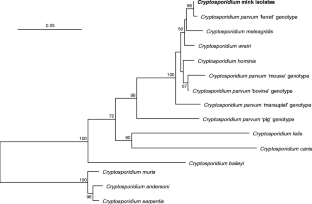
A total of 51 faecal samples from wild and farmed mink were analysed by a direct immunofluorescence antibody test. Cryptosporidium oocysts were identified in eight, apparently healthy, farmed American mink (Mustela vison). The isolates were identified as Cryptosporidium parvum ‘ferret’ genotype by PCR-RFLP and sequencing analysis of a 341-base-pair fragment of the Cryptosporidium oocyst wall protein (COWP) gene. This is the first report of Cryptosporidium in American mink.
Access this article
Subscribe and save
- Starting from 10 chapters or articles per month
- Access and download chapters and articles from more than 300k books and 2,500 journals
- Cancel anytime View plans
Buy Now
Price excludes VAT (USA)
Tax calculation will be finalised during checkout.
Instant access to the full article PDF.
Fig. 1
References
- Abe N, Iseki M (2003) Identification of genotypes of Cryptosporidium parvum isolates from ferrets in Japan. Parasitol Res 89:422–424
Article PubMed Google Scholar - Boom R, Sol CJA, Salimans MMM, Jansen CL, Wertheim-Van Dillen PME, Van Der Noordaa J (1990) Rapid and simple method for purification of nucleic acids. J Clin Microbiol 28:495–503
PubMed CAS Google Scholar - Cacciò SM, Thompson RCA, Mclauchlin J, Smith HV (2005) Unravelling Cryptosporidium and Giardia epidemiology. Trends Parasitol 21:430–437
Article PubMed Google Scholar - Fayer R (2004) Cryptosporidium: a water-borne zoonotic parasite. Vet Parasitol 126:37–56
Article PubMed Google Scholar - Gómez-Villamandos JC, Carrasco L, Mozos E, Hervás J (1995) Fatal cryptosporidiosis in ferret (Mustela putorius furo): a morphopathologic study. J Zoo Wildl Med 26:539–544
Google Scholar - Gómez-Couso H, Freire-Santos F, Amar CF, Grant KA, Williamson K, Ares-Mazás ME, Mclauchlin J (2004) Detection of Cryptosporidium and Giardia in molluscan shellfish by multiplexed nested PCR. Int J Food Microbiol 91:279–288
Article PubMed Google Scholar - Mclauchlin J, Pedraza-Díaz S, Amar-Hoetzeneder C, Nichols GL (1999) Genetic characterization of Cryptosporidium strains from 218 patients with diarrhea diagnosed as having sporadic cryptosporidiosis. J Clin Microbiol 37:3153–3158
PubMed CAS Google Scholar - Palazón S, Ceña JC, Mañas S, Ceña A, Ruiz-Olmo J (2002) Current distribution and status of the European mink (Mustela lutreola L., 1761) in Spain. Small Carniv Conserv 26:9–11
Google Scholar - Rehg JE, Gigliotti F, Stokes DC (1988) Cryptosporidiosis in ferrets. Lab Anim Sci 38:155–158
PubMed CAS Google Scholar - Sulaiman IM, Morgan UM, Thompson RCA, Lal AA, Xiao L (2000) Phylogenetic relationships of Cryptosporidium parasites based on the 70 kilodalton heat shock protein (HSP70) gene. Appl Environ Microbiol 66:2385–2391
Article PubMed CAS Google Scholar - Xiao L, Morgan UM, Limor J, Escalante A, Arrowood M, Shulaw W, Thompson RCA, Fayer R, Lal AA (1999) Genetic diversity within Cryptosporidium parvum and related Cryptosporidium species. Appl Environ Microbiol 65:3386–3391
PubMed CAS Google Scholar - Xiao L, Limor J, Morgan UM, Sulaiman IM, Thompson RCA, Lal AA (2000) Sequence differences in the diagnostic target region of the oocyst wall protein gene of Cryptosporidium parasites. Appl Environ Microbiol 66:5499–5502
Article PubMed CAS Google Scholar - Xiao L, Sulaiman IM, Ryan UM, Zhou L, Atwill ER, Tischler ML, Zhang X, Fayer R, Lal AA (2002) Host adaptation and host–parasite co-evolution in Cryptosporidium: implications for taxonomy and public health. Int J Parasitol 32:1773–1785
Article PubMed Google Scholar
Acknowledgements
The authors express their thanks to Dr. Rafael Romero Suances from the Department of Cellular Biology and Ecology, Faculty of Biology of the University of Santiago de Compostela (Spain) for providing the faecal samples from wild mink, and also to Mr. Jose Castro for allowing collection of the faecal samples from farmed mink.
Author information
Authors and Affiliations
- Laboratorio de Parasitología, Departamento de Microbiología y Parasitología, Facultad de Farmacia, Universidad de Santiago de Compostela, Avenida de Vigo s/n, 15782, Santiago de Compostela, A Coruña, Spain
H. Gómez-Couso, F. Méndez-Hermida & E. Ares-Mazás
Authors
- H. Gómez-Couso
- F. Méndez-Hermida
- E. Ares-Mazás
Corresponding author
Correspondence toE. Ares-Mazás.
Additional information
Genbank accession numbers of the sequences used in this study C. parvum, ‘bovine’ genotype AF266273; C. hominis, AF266265; C. parvum, ‘mouse’ genotype AF266268, C. wrairi, U35027; C. parvum, ‘ferret’ genotype AF266267; C. meleagridis, AF266266; C. parvum, ‘marsupial’ genotype AF266269; C. parvum, ‘pig’ genotype AF266270; C. canis, AF266274; C. felis, AF266263; C. baileyi, AF266276; C. serpentis, AF266275; C. andersoni, AF266262 and C. muris, AF161579
Rights and permissions
About this article
Cite this article
Gómez-Couso, H., Méndez-Hermida, F. & Ares-Mazás, E. First report of Cryptosporidium parvum ‘ferret’ genotype in American mink (Mustela vison Shreber 1777).Parasitol Res 100, 877–879 (2007). https://doi.org/10.1007/s00436-006-0338-1
- Received: 06 June 2006
- Accepted: 05 September 2006
- Published: 17 November 2006
- Issue date: March 2007
- DOI: https://doi.org/10.1007/s00436-006-0338-1