Re-establishment of the fish parasite fauna in the Tisa River system (Slovakia) after a catastrophic pollution event (original) (raw)
Abstract
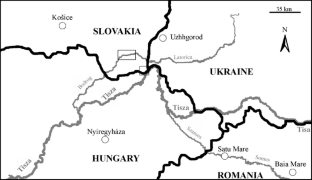
An extensive survey of helminth parasites in 1,316 freshwater fish representing 31 species from two aquatic ecosystems in southeastern Slovakia characterized by different level of environmental pollution was carried out. The helminth species diversity was compared between the Tisa River, heavily polluted with cyanides and heavy metals after a series of ecological disasters in 2000, and the less anthropogenically influenced Latorica River. A parasitological survey found 31 gastrointestinal helminths: Trematoda (11 species), Cestoda (14), Acanthocephala (3) and Nematoda (3). As many as 70 host−parasite combinations have been found. Twenty of them (28.6%) represent new host−parasite finding records for the territory of Slovakia. The component communities were species-poor in both rivers, with high dominance of one to three helminth species. Even though the fish communities were qualitatively similar (ICS = 81%) and the number of fish examined was approximately the same (676 and 640) in both localities, the helminth species richness and diversity of host−parasite combinations were two times lower in the more polluted Tisa River. The helminth communities were also much less abundant in the Tisa River. Based on the Czekanowski−Sørensen similarity index (ICS = 48.8%) and the Percentage similarity index (PI = 19.5%), the helminth communities were qualitatively and quantitatively different in the two rivers. The remarkable lack of species diversity in the Tisa River can be explained by the negative impact of residual contamination of the Tisa river bottom on certain freshwater invertebrates (bivalves and prosobranch mollusks, copepods and amphipods) which serve as obligatory intermediate hosts for the helminths. Four species, the aspidogastrean Aspidogaster limacoides Diesing, 1835, the acanthocephalan Pomphorhynchus tereticollis (Rudolphi, 1809) tapeworms Atractolytocestus huronensis Anthony, 1958 and Khawia sinensis Hsü, 1935 are recorded in Slovakia for the first time.
Access this article
Subscribe and save
- Starting from 10 chapters or articles per month
- Access and download chapters and articles from more than 300k books and 2,500 journals
- Cancel anytime View plans
Buy Now
Price excludes VAT (USA)
Tax calculation will be finalised during checkout.
Instant access to the full article PDF.
Fig. 1
References
- Amin OM, Abdullah SMA, Mhaisen FT (2003) Description of Pomphorhynchus spindletruncatus n. sp. (Acanthocephala: Pomphorhynchidae) from freshwater fishes in northern Iraq, with the erection of a new pomphorhynchid genus, Pyriproboscis n. g., and keys to genera of the Pomphorhynchidae and the species of Pomphorhynchus Monticelli, 1905. Syst Parasitol 54:229–235
Article PubMed Google Scholar - Balon K (1964) A preliminary list of the Slovakian lampreys and fishes (Petromyzones et Teleostomi). Biologia 19:343–358
Google Scholar - Brower J, Zar J, von Ende C (1990) Field and laboratory methods for general ecology. Brown, Dubuque, Iowa
Google Scholar - Bush AO, Lafferty KD, Lotz JM, Shostak AW (1997) Parasitology meets ecology on its own terms: Margolis et al. revised. J Parasitol 83:575–83
Article CAS PubMed Google Scholar - Cunningham SA (2005) Incident, accident, catastrophe: cyanide on the Danube. Disasters 29:99–128
Article PubMed Google Scholar - Dias MLGG, Eiras JC, Machado MH, Souza GTR, Pavanelli GC (2003) The life cycle of Clinostomum complanatum Rudolphi, 1814 (Digenea, Clinostomidae) on the floodplain of the high Parani river, Brazil. Parasitol Res 89:506–508
CAS PubMed Google Scholar - Diesing CM (1835) Aspidogaster limacoides, eine neue Art Binnenwurm. Medizinische Jahrbücher des k.k. österreichischen Staates 7:420–431
Google Scholar - Ergens R, Lom J (1970) Causative agents of parasitic diseases of fish. Academia, Praha (In Czech)
Google Scholar - Ergens R, Gussev VA, Izyumova NA, Molnár K (1975) Parasite fauna of fishes of the Tisa River Basin. Academia, Praha
Google Scholar - Evlanov IA (1990) Distribution of the trematode Aspidogaster limacoides in a population of roach (Rutilus rutilus) as a function of the age and sex of the host. Zool zh 69:132–134 (In Russian)
Google Scholar - Froese R, Pauly D (2008) FishBase. World Wide Web electronic publication, www.fishbase.org, version (07/2008)
- Georgiev B, Biserkov V, Genov T (1986) The staining method for cestodes with iron acetocarmine. Helminthologia 23:279–281
Google Scholar - Gibson DI, Jones A, Bray RA (2002) Keys to the Trematoda, vol. 1. CAB, Wallingford
Google Scholar - Holmes JC, Price PW (1986) Communities of parasites. In: Anderson DJ, Kikkawa J (eds) Community biology: patterns and processes. Blackwell, Oxford, pp 186–213
Google Scholar - Hoole D (1994) Tapeworm infection in fish: past and future problem. In: Pike AW, Lewis JW (eds) Parasitic diseases of fish. Samara, Tresaith, UK, pp 119–140
Google Scholar - Howmiller RP, Scott MA (1977) Environmental index based on relative abundance of oligochaete species. Journal of the Water Pollution Control Federation 49:809–815
CAS Google Scholar - Hsü HF (1935) Contribution a ľ étude des cetodes de Chine. Rev Suisse Zool 42:485–492
Google Scholar - Jones A, Bray RA, Gibson DI (2005) Keys to the Trematoda, vol. II. CAB, Wallingford
Google Scholar - Kappe A, Seifert T, El-Nobi G, Brauer G (2006) Occurrence of Atractolytocestus huronensis (Cestoda, Caryophyllaeidae) in German pond-farmed common carp Cyprinus carpio. Dis Aquat Org 70:255–259
Article CAS PubMed Google Scholar - Kennedy CR (1994) The ecology of introductions. In: Pike AW, Lewis JW (eds) Parasitic diseases of fish. Samara, Tresaith, UK, pp 189–209
Google Scholar - Khalil LF, Jones A, Bray RA (1994) Keys to the cestode parasites of vertebrates. CAB, Wallingford
Google Scholar - Long ER, Hong CB, Severn CG (2001) Relationships between acute sediment toxicity in laboratory tests and abundance and diversity of benthic fauna in marine sediments: a review. Environ Toxickol Chem 20:46–60
Article CAS Google Scholar - MacKenzie K (1999) Parasites as pollution indicators in marine ecosystems: a proposed early warning system. Mar Poll Bull 38:955–959
Article CAS Google Scholar - Mackiewicz JS (1972) Caryophyllidea (Cestoidea): a review. Exp Parasitol 34:417–512
Article Google Scholar - Magurran AE (1991) Ecological diversity and its measurement. Chapman and Hall, London
Google Scholar - Majoros G, Csaba G, Molnár K (2003) Occurrence of Atractolytocestus huronensis Anthony, 1958 (Cestoda: Caryophyllaeidae), in Hungarian pond-farmed common carp. Bull Eur Assoc Fish Pathol 23:167–175
Google Scholar - Marcogliese DJ (2005) Parasites of the superorganism: Are they indicators of ecosystem health? Int J Parasitol 35:705–716
Article PubMed Google Scholar - Marcogliese DJ, Cone DK (1997) Parasite communities as indicators of ecosystem stress. Parassitologia 39:227–232
CAS PubMed Google Scholar - Moravec F (1994) Parasitic nematodes of freshwater fishes of Europe. Academia, Praha
Google Scholar - Morley NJ (2007) Anthropogenic effects of reservoir construction on the parasite fauna of aquatic wildlife. EcoHealth 4:374–383
Article Google Scholar - Nagibina LF, Timoveeva TA (1971) True hosts of Aspidogaster limacoides Diesing, 1834 (Trematoda, Aspidogastrea). Doklady Biologicheskiy Nauk 200:677–678 (In Russian)
Google Scholar - Našincová V, Scholz T (1994) The life cycle of Asymphylodora tincae (Modeer 1790) (Trematoda: Monorchiidae): a unique development in monorchiid trematodes. Parasitol Res 80:192–197
Article PubMed Google Scholar - Ondračková M, Šimková A, Gelnar M, Jurajda P (2004) Posthodiplostomum cuticola (Digenea: Diplostomatidae) in intermediate fish host: factors contributing to the parasite infection and prey selection by the definitive bird host. Parasitology 129:761–770
Article PubMed Google Scholar - Oros M (2002) Parasite fauna of fishes in the Slovak part of the Tisa River. Parasitological Institute, SAS, Košice (MSc. Thesis)
- Oros M, Hanzelová V, Scholz T (2004) The cestode Atractolytocetus huronensis (Caryophyllidea) continues to spread in Europe: new data on the helminth parasite of common carp. Dis Aquat Org 62:115–119
Article CAS PubMed Google Scholar - Reimer LW (2002) _Aspidogaster limacoides_–ein Neozoe aus einer Plötze der mittleren Weser. Fischer and Teichwirt 1:10–11
Google Scholar - Sályi G, Csaba G, Gaálné DE, Orosz E, Láng M, Majoros G, Kunsági Z, Niklesz C (2000) Effect of the cyanide and heavy metal pollution passed in river Szamos and Tisza on the aquatic flora and fauna with special regard to the fish. Magyar Állatorvosok Lapja 122:493–500 (In Hungarian)
Google Scholar - Schmidt GD (1986) Handbook of tapeworm identification. CRC, Boca Raton, Florida
Google Scholar - Schludermann C, Laimgruber S, Konecny R, Schabuss M (2005) Aspidogaster limacoides Diesing, 1835 (Trematoda, Aspidogastridae): a new parasite of Barbus barbus (L.) (Pisces, Cyprinidae) in Austria. Annales der Naturhistorisches Museum Wien 106:141–144
Google Scholar - Scholz T, Hanzelová V (1998) Tapeworms of the genus Proteocephalus Weinland, 1858 (Cestoda: Proteocephalidae) parasites of fishes in Europe Studie AV ČR. Academia, Praha
Google Scholar - Sheehan PJ, Miller DR, Butler GC, Bordeau P (1984) Effects of pollutants at the ecosystem level. Wiley, Chichester
Google Scholar - van Damme D, Heip C, Willems KA (1984) Influence of pollution on harpacticoid copepods of two North Sea estuaries. Hydrobiologia 112:143–160
Article Google Scholar - Winner RW, Boesel MW, Farrell MP (1980) Insect community structure as an index of heavy-metal pollution in lotic ecosystems. Can Fish Aquat Sci 37:647–655
Article CAS Google Scholar - Žitňan R (1966a) Monogenoidea of fishes from the flowing waters of the Tisa River lowlands (Helminthes of fishes of the Tisa River lowlands (Czechoslovakia) I). Biologia 21:681–692
Google Scholar - Žitňan R (1966b) Cestoidea and Trematoidea of fishes from the flowing waters of the Tisa River lowlands (Helminthes of fishes of the Tisa River lowlands (Czechoslovakia) II). Biologia 21:763–770
PubMed Google Scholar - Žitňan R (1967) Nematoda, Acanthocephala and Hirudina of fishes from the flowing waters of the Tisa River lowlands (Helminthes of fishes of the Tisa River lowlands (Czechoslovakia) III). Biologia 22:381–385
Google Scholar
Acknowledgments
The authors thank Marta Špakulová, Ľudmila Turčeková, and Ľudovít Burik, and Parasitological Institute SAS, Košice for their invaluable help in field collections of fish helminths, Mrs. Natália Rozdobudková, Slovak enterprise of water management Košice, for providing data relating to the pollution of the investigated rivers and Blanka Škoríková, Institute of Parasitology, Biology Centre of the AS CR, České Budějovice, for technical assistance.
Author information
Authors and Affiliations
- Parasitological Institute, Slovak Academy of Sciences, Hlinkova 3, 04001, Košice, Slovakia
Mikuláš Oros & Vladimíra Hanzelová - Institute of Parasitology, Biology Centre of the Academy of Sciences of the Czech Republic, České Budějovice, Czech Republic
Mikuláš Oros
Authors
- Mikuláš Oros
- Vladimíra Hanzelová
Corresponding author
Correspondence toVladimíra Hanzelová.
Additional information
This study was supported by the Grant Agency VEGA (project No. 2/7192/27), Slovak Research and Development Agency (project Nos. APVV-51-062205 and LPP-0151-07), the Institute of Parasitology (project Nos. Z60220518 and LC 522) and Grant Agency of the Czech Republic (project No. 524/08/0885).
Rights and permissions
About this article
Cite this article
Oros, M., Hanzelová, V. Re-establishment of the fish parasite fauna in the Tisa River system (Slovakia) after a catastrophic pollution event.Parasitol Res 104, 1497–1506 (2009). https://doi.org/10.1007/s00436-009-1356-6
- Received: 03 September 2008
- Accepted: 21 January 2009
- Published: 13 February 2009
- Issue date: May 2009
- DOI: https://doi.org/10.1007/s00436-009-1356-6