Genetic characterization of Echinostoma revolutum and Echinoparyphium recurvatum (Trematoda: Echinostomatidae) in Thailand and phylogenetic relationships with other isolates inferred by ITS1 sequence (original) (raw)
Abstract
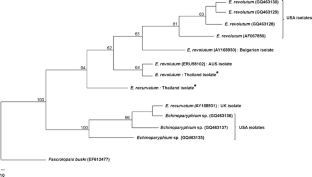
Echinostomatidae are common, widely distributed intestinal parasites causing significant disease in both animals and humans worldwide. In spite of their importance, the taxonomy of these echinostomes is still controversial. The taxonomic status of two species, Echinostoma revolutum and Echinoparyphium recurvatum, which commonly infect poultry and other birds, as well as human, is problematical. Previous phylogenetic analyses of Southeast Asian strains indicate that these species cluster as sister taxa. In the present study, the first internal transcribed spacer (ITS1) sequence was used for genetic characterization and to examine the phylogenetic relationships between an isolate from Thailand with other isolates available from GenBank database. Interspecies differences in ITS1 sequence between E. revolutum and E. recurvatum were detected at 6 (3%) of the 203 alignment positions. Of these, nucleotide deletion at positions 25, 26, and 27, pyrimidine transition at 50, 189, and pyrimidine transversion at 118 were observed. Phylogenetic analysis revealed that E. recurvatum from Thailand clustered as a sister taxa with E. revolutum and not with other members of the genus Echinoparyphium. Interestingly, this result confirms a previous report based on allozyme electrophoresis and mitochondrial DNA that E. revolutum and E. recurvatum in Southeast Asia are sister species. Hence, the taxonomic status of E. recurvatum in Thailand, as well as in Southeast Asian countries needs to be confirmed and revised using more comprehensive analyses based on morphology and other molecular techniques.
Access this article
Subscribe and save
- Starting from 10 chapters or articles per month
- Access and download chapters and articles from more than 300k books and 2,500 journals
- Cancel anytime View plans
Buy Now
Price excludes VAT (USA)
Tax calculation will be finalised during checkout.
Instant access to the full article PDF.
Fig. 1
References
- Chai JY, Murrell KD, Lymbery AJ (2005) Fish-borne parasitic zoonoses: status and issues. Int J Parasitol 35:1233–1254
Article PubMed Google Scholar - Detwiler JT, Bos DH, Minchella DJ (2010) Revealing the secret lives of cryptic species: examining the phylogenetic relationships of echinostome parasites in North America. Mol Phylogenet Evol 55:611–620
Article PubMed Google Scholar - Felsenstein J (2005) PHYLIP (Phylogeny Inference Package) version 3.6. Distributed by the author, Department of genome sciences. University of Washington, Seattle
Google Scholar - Fried B, Graczyk TK (2004) Recent advances in the biology of Echinostoma species in the “revolutum” group. Adv Parasitol 58:139–195
Article PubMed Google Scholar - Fried B, Graczyk TK, Tamang L (2004) Food-borne intestinal trematodiases in humans. Parasitol Res 93:159–170
Article PubMed Google Scholar - Fried B, Kanev I, Reddy A (2009) Studies on collar spines of echinostomatid trematodes. Parasitol Res 105:605–608
Article PubMed Google Scholar - Graczyk TK, Fried B (1998) Echinostomiasis: a common but forgotten food-borne disease. Am J Trop Med Hyg 58:501–504
CAS PubMed Google Scholar - Huffman JE, Fried B (1990) Echinostoma and echinostomiasis. Adv Parasitol 29:215–269
Article CAS PubMed Google Scholar - Ichikawa M, Itagaki T (2010) Discrimination of the ITS1 types of Fasciola spp. based on a PCR-RFLP method. Parasitol Res 106:757–761
Article PubMed Google Scholar - Kang S, Sultana T, Loktev VB, Wongratanacheewin S, Sohn WM, Eom KS, Park JK (2008) Molecular identification and phylogenetic analysis of nuclear rDNA sequences among three opisthorchid liver fluke species (Opisthorchiidae: Trematoda). Parasitol Int 57:191–197
Article CAS PubMed Google Scholar - Kostadinova A, Herniou EA, Barrett J, Littlewood DT (2003) Phylogenetic relationships of Echinostoma Rudolphi, 1809 (Digenea: Echinostomatidae) and related genera re-assessed via DNA and morphological analyses. Syst Parasitol 54:159–176
Article CAS PubMed Google Scholar - Miliotis MD, Bier JW (2003) International handbook of foodborne pathogens. CRC Press, New York
Book Google Scholar - Morgan JA, Blair D (1995) Nuclear rDNA ITS sequence variation in the trematode genus Echinostoma: an aid to establishing relationships within the 37-collar-spine group. Parasitology 111:609–615
Article CAS PubMed Google Scholar - Park GM (2007) Genetic comparison of liver flukes, Clonorchis sinensis and Opisthorchis viverrini, based on rDNA and mtDNA gene sequences. Parasitol Res 100:351–357
Article PubMed Google Scholar - Petleart A, Nateeworanart S, Kaewsook P (2005) Infection rate of the echinostome fluke in domestic ducks from Yaowarach Market, Bangkok [in Thai]. Thammasat Vejchasarn 6:22–27
Google Scholar - Saijuntha W, Sithithaworn P, Andrews RH (2010a) Genetic differentiation of Echinostoma revolutum and Hypodereaum conoideum from domestic ducks in Thailand by multilocus enzyme electrophoresis. J Helminthol 84:143–148
Article CAS PubMed Google Scholar - Saijuntha W, Tapdara S, Tantrawatpan C (2010b) Multilocus enzyme electrophoresis analysis of Echinostoma revolutum and Echinostoma malayanum (Trematoda: Echinostomatidae) isolated from Khon Kaen Province, Thailand. Asian Pacific J Trop Med 3:633–636
Article Google Scholar
Acknowledgments
This research was financially supported by Mahasarakham University and TRF-CHE (grant no. MRG5180102 to Weerachai Saijuntha). We wish to acknowledge the Faculty of Medicine, Khon Kaen University for an Overseas Visiting Professor Programme grant. Thanks to Ms. Kunyarat Duenngai, Mr. Weerasak Saijuntha, Mr. Jatupon Saijuntha for helping with sample collection, and Dr. Anchalee Techasen for the DNA extraction.
Author information
Authors and Affiliations
- Walai Rukhavej Botanical Research Institute (WRBRI), Mahasarakham University, Maha Sarakham, 44150, Thailand
Weerachai Saijuntha - Division of Cell Biology, Department of Preclinical Sciences, Faculty of Medicine, Thammasat University, Rangsit Campus, Pathumthani, 12121, Thailand
Chairat Tantrawatpan - Department of Parasitology, Liver Fluke and Cholangiocarcinoma Research Centre (LFCRC), Faculty of Medicine, Khon Kaen University, Khon Kaen, 40002, Thailand
Paiboon Sithithaworn & Ross H. Andrews - Department of Ecology and Parasitology, Karlsruhe Institute of Technology, Kornblumen Strasse 13, Karlsruhe, Germany
Trevor N. Petney
Authors
- Weerachai Saijuntha
- Chairat Tantrawatpan
- Paiboon Sithithaworn
- Ross H. Andrews
- Trevor N. Petney
Corresponding author
Correspondence toChairat Tantrawatpan.
Rights and permissions
About this article
Cite this article
Saijuntha, W., Tantrawatpan, C., Sithithaworn, P. et al. Genetic characterization of Echinostoma revolutum and Echinoparyphium recurvatum (Trematoda: Echinostomatidae) in Thailand and phylogenetic relationships with other isolates inferred by ITS1 sequence.Parasitol Res 108, 751–755 (2011). https://doi.org/10.1007/s00436-010-2180-8
- Received: 02 November 2010
- Accepted: 17 November 2010
- Published: 01 December 2010
- Issue date: March 2011
- DOI: https://doi.org/10.1007/s00436-010-2180-8