Egg viability studies on Clinostomum complanatum (Digenea: Clinostomidae) from two experimental animal model systems (original) (raw)
Abstract
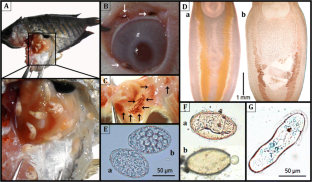
Viability of eggs is important for the successful completion of trematode life cycle, both in natural and laboratory conditions. The present study was designed to check the viability of eggs released by the digenetic trematode parasite Clinostomum complanatum transformed in experimentally infected chicken and rabbit eye. The incubation of the released eggs in distilled water at 28 ± 1 °C led to the embryonation followed by hatching on tenth day to release miracidia. These can be used to infect the snails. We propose that these two in vivo model systems can be used as a source of viable eggs for further studies on developmental biology and life cycle where in law-protected animals are not to be used. To the best of our knowledge, in contrast to the previous attempts, this is the first successful study to report any experimental model to produce ovigerous adult worms capable of releasing viable eggs.
Access this article
Subscribe and save
- Starting from 10 chapters or articles per month
- Access and download chapters and articles from more than 300k books and 2,500 journals
- Cancel anytime View plans
Buy Now
Price excludes VAT (USA)
Tax calculation will be finalised during checkout.
Instant access to the full article PDF.
Fig. 1
References
- Abidi SMA, Nizami WA (1987) Developmental changes and histopathology of Clinostomum complanatum (Trematoda) infection in an experimental host. Ind J Parasitol 11:235–238
Google Scholar - Chung D-II, Kong HH, Moon CH (1995) Demonstration of the second intermediate hosts of Clinostomum complanatum in Korea. Korean J Parasitol 33:305–312
Article PubMed CAS Google Scholar - Dias MLGG, Eiras JC, Machado MH, Souza GTR, Pavanelli GC (2003) The lifecycle of Clinostomum complanatum Rudolphi, 1814 (Digenea, Clinostomatidae) on the floodplain of the high Parana River, Brazil. Parasitol Res 89:506–508
PubMed CAS Google Scholar - Díaz MT, Hernández LE, Bashirullah AK (2002) Experimental life cycle of Philophthalmus gralli (Trematoda: Philophthalmidae) in Venezuela. Rev Biol Trop 50:629–641
PubMed Google Scholar - Fried B, Foley DA (1970) Development of Clinostomum marginatum (Trematoda) from frogs in the chick and on the chorioallantois. J Parasitol 56:332–335
Article Google Scholar - Larson OR, Uglem GL (1990) Cultivation of Clinostomum marginatum (Digenea: Clinostomatidae) metacercariae in vitro, in chick embryo and in mouse coelom. J Parasitol 76:505–508
Article PubMed CAS Google Scholar - Lo CF, Huber F, Kou GH, Lo CJ (1981) Studies of Clinostomum complanatum (Rud., 1814). Fish Pathol 15:219–227
Article Google Scholar - Rizvi A, Zaidi ZA, Alam MM, Zafar A, Shareef PAA, Saifullah MK, Saleemuddin M, Abidi SMA (2012) A rabbit eye model for in vivo transformation of progenetic metacercariae of Clinostomum complanatum into ovigerous adult worms. J Helminthol. doi:10.1017/S0022149X12000752
- Shareef PAA, Abidi SMA (2012) Incidence and histopathology of encysted progenetic metacercaria of Clinostomum complanatum (Digenea: Clinostomidae) in Channa punctatus and its development in experimental host. Asian Pac J Trop Biomed 2:421–426
Article PubMed Google Scholar - Siddiqui AA, Nizami WA (1982) Seasonal population dynamics of the metacercariae of Clinostomum complanatum (Trematoda: Digenea) in relation to sex of the host. Riv Parasitol 43:275–279
Google Scholar - Tiewchaloern S, Udomkijdecha S, Suvouttho S, Chunchamsri K, Waikagul J (1999) Clinostomum trematode from human eye. Southeast Asian J Trop Med Public Health 30:382–384
PubMed CAS Google Scholar
Acknowledgment
The authors wish to thank the Chairman, Department of Zoology, for providing necessary laboratory facilities. The fellowship provided by Aligarh Muslim University (09-PHD-L-128) and the technical assistance of Mr. Azam are also acknowledged.
Author information
Authors and Affiliations
- Section of Parasitology, Department of Zoology, Faculty of Life Sciences, Aligarh Muslim University, Aligarh, 202 002, Uttar Pradesh, India
P. A. Ahammed Shareef & S. M. A. Abidi
Authors
- P. A. Ahammed Shareef
- S. M. A. Abidi
Corresponding author
Correspondence toS. M. A. Abidi.
Rights and permissions
About this article
Cite this article
Shareef, P.A.A., Abidi, S.M.A. Egg viability studies on Clinostomum complanatum (Digenea: Clinostomidae) from two experimental animal model systems.Parasitol Res 112, 2101–2103 (2013). https://doi.org/10.1007/s00436-013-3293-7
- Received: 02 December 2012
- Accepted: 09 January 2013
- Published: 25 January 2013
- Issue date: May 2013
- DOI: https://doi.org/10.1007/s00436-013-3293-7