On the halophytic nature of mangroves (original) (raw)
Abstract
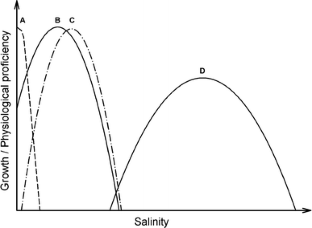
Scientists have discussed the halophytic nature of intertidal plants for decades, and have generally suggested that inherent differentiation of an obligate halophyte from a facultative halophyte relates strongly to whether the plant can survive in fresh water, and not much else. In this mini-review, we provide additional insight to support the pervasive notion that mangroves as a group are truly facultative halophytes, and thus add discourse to the alternate view that mangroves have an obligate salinity requirement. Indeed, growth and physiological optima are realized at moderate salinity concentrations in mangroves, but we maintain the notion that current evidence suggests that survival is not dependent upon a physiological requirement for salt.
Access this article
Subscribe and save
- Starting from 10 chapters or articles per month
- Access and download chapters and articles from more than 300k books and 2,500 journals
- Cancel anytime View plans
Buy Now
Price excludes VAT (USA)
Tax calculation will be finalised during checkout.
Instant access to the full article PDF.
Fig. 1
The alternative text for this image may have been generated using AI.
References
- Alongi DM (2009) The energetics of mangrove forests. Springer, New York
Google Scholar - Ball MC (1988) Ecophysiology of mangroves. Trees Struct Funct 2:129–142
Google Scholar - Ball MC (2002) Interactive effects of salinity and irradiance on growth: implications for mangrove forest structure along salinity gradients. Trees Struct Funct 16:126–139
Article Google Scholar - Ball MC, Anderson JM (1986) Sensitivity of photosystem II to NaCl in relation to salinity tolerance: comparative studies with thylakoids of the salt tolerant mangrove, Avicennia marina and the salt sensitive pea, Pisum sativum. Aust J Plant Physiol 13:689–698
Article CAS Google Scholar - Ball MC, Pidsley SM (1988) Establishment of mangrove seedlings in relation to salinity. In: Larson HK, Michie JR, Hanley JR (eds) Proceedings of a workshop on research and management held in Darwin. Australian National University Press, Canberra, pp 123–134
Google Scholar - Ball MC, Pidsley SM (1995) Growth response to salinity in relation to distribution of two mangrove species, Sonneratia alba and S. lanceolata. Funct Ecol 9:77–85
Article Google Scholar - Barbour MG (1970) Is any angiosperm an obligate halophyte? Am Nat 84:105–120
Article Google Scholar - Chapman VJ (1960) Salt marshes and deserts of the world. Interscience Publishers, New York
Google Scholar - Chapman VJ (1976) Mangrove vegetation. J. Cramer, Vaduz
Google Scholar - Clough BF (1984) Growth and salt balance of the mangroves Avicennia germinans (Forsk.) Vierh. and Rhizophora stylosa Griff. in relation to salinity. Aust J Plant Physiol 11:419–430
Article CAS Google Scholar - Cohen S, Oren A, Shilo M (1983) The divalent cation requirement of Dead Sea halobacteria. Arch Microbiol 136:184–190
Article CAS Google Scholar - Downton WJS (1982) Growth and osmotic relations of the mangrove Avicennia marina, as influenced by salinity. Aust J Plant Physiol 9:519–528
Article CAS Google Scholar - Duke NC, Ball MC, Ellison JC (1998) Factors influencing biodiversity and distributional gradients in mangroves. Glob Ecol Biogeogr Letts 7:27–47
Article Google Scholar - Elmqvist T, Cox PA (1996) The evolution of vivipary in flowering plants. Oikos 77:3–9
Article Google Scholar - Flowers TJ, Colmer TD (2008) Salinity tolerance in halophytes. New Phytol 179:945–963
Article PubMed CAS Google Scholar - Flowers TJ, Troke PF, Yeo AR (1977) The mechanism of salt tolerance in halophytes. Ann Rev Plant Physiol 28:89–121
Article CAS Google Scholar - Friess DA, Krauss KW, Horstman EM, Balke T, Bouma TJ, Galli D, Webb EL (2012) Are all intertidal wetlands naturally created equal? Bottlenecks, thresholds and knowledge gaps to mangrove and saltmarsh ecosystems. Biol Rev 87:346–366
Article PubMed Google Scholar - Gibbons NE (1974) Halobacteriaceae. In: Buchanan RE, Gibbons NE (eds) Bergey’s manual of determinative bacteriology. Williams & Wilkins, Baltimore, pp 269–273
Google Scholar - Greenway H, Munns R (1980) Mechanisms of salt tolerance in nonhalophytes. Ann Rev Plant Physiol 31:149–190
Article CAS Google Scholar - Harper JL (1977) The population biology of plants. Academic Press, London
Google Scholar - Ingram M (1957) Microorganisms resisting high concentrations of sugars and salts. In: Williams RAO, Spicer CC (eds) Seventh symposium of the Society for General Microbiology. Cambridge University Press, Cambridge, pp 90–133
Google Scholar - Joshi AC (1933) A suggested explanation of the prevalence of vivipary on the sea-shore. J Ecol 21:209–212
Article Google Scholar - Krauss KW, Lovelock CE, McKee KL, López-Hoffman L, Ewe SML, Sousa WP (2008) Environmental drivers in mangrove establishment and early development: a review. Aquat Bot 89:105–127
Article Google Scholar - Marschner H (1995) Mineral nutrition of higher plants. Academic Press, London
Google Scholar - McMillan C (1974) Salt tolerance of mangroves and submerged aquatic plants. In: Reimold RJ, Queen WH (eds) Ecology of halophytes. Academic Press, New York, pp 379–390
Google Scholar - Parida AK, Jha B (2010) Salt tolerance mechanisms in mangroves: a review. Trees Struct Funct 24:199–217
Article Google Scholar - Patel NT, Pandey AN (2009) Salinity tolerance of Aegiceras corniculatum (L.) Blanco from Gujarat coastal of India. Anales de Biología 31:93–104
Google Scholar - Poorter H, Niklas KJ, Reich PB, Oleksyn J, Poot P, Mommer L (2012) Biomass allocation to leaves, stems and roots: meta-analyses of interspecific variation and environmental control. New Phytol 193:30–50
Article PubMed CAS Google Scholar - Reef R, Feller IC, Lovelock CE (2010) Nutrition in mangroves. Tree Physiol 30:1148–1160
Article PubMed CAS Google Scholar - Saenger P (2002) Mangrove ecology, silviculture and conservation. Kluwer, Dordrecht
Google Scholar - Smith SM, Snedaker SC (1995) Salinity responses in two populations of viviparous Rhizophora mangle L. seedlings. Biotropica 27:435–440
Article Google Scholar - Taiz L, Zeiger E (2002) Plant physiology, 3rd edn. Sinauer Associates, Massachusetts
Google Scholar - Takemura T, Hanagata N, Sugihara K, Baba S, Karube I, Dubinsky Z (2000) Physiological and biochemical responses to salt stress in the mangrove, Bruguiera gymnorrhiza. Aquat Bot 68:15–28
Article CAS Google Scholar - Tindall BJ, Mills AA, Grant WD (1980) An alkalophilic red halophilic bacterium with a low magnesium requirement from a Kenyan soda lake. J Gen Microbiol 116:257–260
Google Scholar - Tomlinson PB (1986) The botany of mangroves. Cambridge University Press, Cambridge
Google Scholar - Tomlinson PB, Cox PA (2000) Systematic and functional anatomy of seedlings in mangrove Rhizophoraceae: vivipary explained? Bot J Linn Soc 134:215–231
Google Scholar - Uphof JC (1941) Halophytes. Bot Rev 7:1–58
Article CAS Google Scholar - Wang W, Yan Z, You S, Zhang Y, Chen L, Lin G (2011) Mangroves: obligate or facultative halophytes? A review. Trees Struct Funct 25:953–963
Article CAS Google Scholar - Werner A, Stelzer R (1990) Physiological responses of the mangrove Rhizophora mangle grown in the absence and presence of NaCl. Plant Cell Environ 13:243–255
Article CAS Google Scholar - White PJ, Broadley MR (2001) Chloride in soils and its uptake and movement within the plant: a review. Ann Bot 88:967–988
Article CAS Google Scholar - Yan Z, Wang W, Tang D (2007) Effect of different time of salt stress on growth and some physiological processes of Avicennia marina seedlings. Mar Biol 152:581–587
Article CAS Google Scholar
Acknowledgments
We thank the US Geological Survey Climate and Land Use Change R&D Program and the Australian Research Council (Discovery Project DP1096749) for research support. Karen L. McKee, Robert D. Guy, and Ulrich Lüttge provided reviews of previous manuscript drafts. Any use of trade, product, or firm names is for descriptive purposes only and does not imply endorsement by the US Government.
Author information
Authors and Affiliations
- US Geological Survey, National Wetlands Research Center, 700 Cajundome Blvd, Lafayette, LA, 70506, USA
Ken W. Krauss - Division of Plant Sciences, Research School of Biology, College of Medicine, Biology and Environment, Australian National University, The RN Robertson Bldg. (#46), Biology Place, Canberra, ACT, 0200, Australia
Marilyn C. Ball
Authors
- Ken W. Krauss
- Marilyn C. Ball
Corresponding author
Correspondence toKen W. Krauss.
Additional information
Communicated by R. Guy.
Rights and permissions
About this article
Cite this article
Krauss, K.W., Ball, M.C. On the halophytic nature of mangroves.Trees 27, 7–11 (2013). https://doi.org/10.1007/s00468-012-0767-7
- Received: 30 July 2012
- Accepted: 10 August 2012
- Published: 05 September 2012
- Issue date: February 2013
- DOI: https://doi.org/10.1007/s00468-012-0767-7