Decision-making models based on satisfaction degree with incomplete hesitant fuzzy preference relation (original) (raw)
Abstract
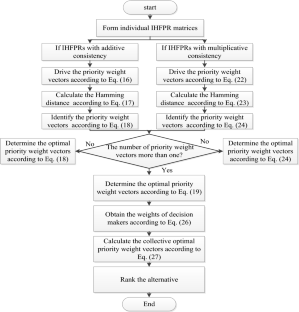
To address the situation where incomplete hesitant fuzzy preference relation (IHFPR) is necessary, this paper develops decision-making models taking into account decision makers’ satisfaction degree. First, the consistency measures, respectively, from the perspectives of additive and multiplicative consistent IHFPR are defined, which is based on the relationships of the IHPFRs and their corresponding priority weight vector. Second, two decision-making models are developed, respectively, in view of the proposed additive and multiplicative consistency measures. The main characteristic of the constructed models is they taking into account the decision makers’ satisfaction degree. The objective functions of the models are developed by maximizing the parameter of the satisfaction degree. Third, a square programming model is developed to obtain the decision makers’ weights by utilizing the optimal priority weight vectors information, the solution of the model is obtained by solving the partial derivatives of Lagrange function. Finally, a procedure for multi-criteria decision-making (MCDM) problems with IHFPRs is given, and an illustrative example in conjunction with comparative analysis is used to demonstrate the proposed models are feasible and efficiency for practical MCDM problems.
Access this article
Subscribe and save
- Starting from 10 chapters or articles per month
- Access and download chapters and articles from more than 300k books and 2,500 journals
- Cancel anytime View plans
Buy Now
Price excludes VAT (USA)
Tax calculation will be finalised during checkout.
Instant access to the full article PDF.
Fig. 1
References
- Ding RX, Palomares I, Wang X, Yang G-R, Liu B, Dong Y, Herrera-Viedma E, Herrera F (2020) Large-Scale decision-making: Characterization, taxonomy, challenges and future directions from an Artificial Intelligence and applications perspective. Inf Fusion 59:84–102
Article Google Scholar - Dong Y, Liu W, Chiclana F, Kou G, Herrera-Viedma E (2019) Are incomplete and self-confident preference relations better in multicriteria decision making? A simulation-based investigation. Inf Sci 492:40–57
Article MathSciNet MATH Google Scholar - Gong J-W, Liu H-C, You X-Y, Yin L (2021) An integrated multi-criteria decision making approach with linguistic hesitant fuzzy sets for E-learning website evaluation and selection. Appl Soft Comput 102:107118
Article Google Scholar - Khalid A, Beg I (2017) Incomplete hesitant fuzzy preference relations in group decision making. Int J Fuzzy Syst 19(3):637–645
Article MathSciNet Google Scholar - Li J, Wang JQ, Hu JH (2019) Consensus building for hesitant fuzzy preference relations with multiplicative consistency. Comput Ind Eng 128:387–400
Article Google Scholar - Liu H, Xu Z, Liao H (2016) The multiplicative consistency index of hesitant fuzzy preference relation. IEEE Trans Fuzzy Syst 24(1):82–93
Article Google Scholar - Liu J, Li H, Huang B, Liu Y, Liu D (2021a) Convex combination-based consensus analysis for intuitionistic fuzzy three-way group decision. Inf Sci 574:542–566
Article MathSciNet Google Scholar - Liu X, Wang Z, Zhang S, Garg H (2021b) Novel correlation coefficient between hesitant fuzzy sets with application to medical diagnosis. Expert Syst Appl 183:115393
Article Google Scholar - Meng F, An Q (2017) A new approach for group decision making method with hesitant fuzzy preference relations. Knowl-Based Syst 127:1–15
Article Google Scholar - Meng F, Chen S-M (2021) A framework for group decision making with multiplicative trapezoidal fuzzy preference relations. Inf Sci 577:722–747
Article MathSciNet Google Scholar - Meng F, Chen S-M, Tang J (2020a) Group decision making based on acceptable multiplicative consistency of hesitant fuzzy preference relations. Inf Sci 524:77–96
Article MathSciNet MATH Google Scholar - Meng FY, Tang J, Pedrycz W, An QX (2020b) Optimal interaction priority calculation from hesitant fuzzy preference relations based on the Monte Carlo simulation method for the acceptable consistency and consensus. IEEE Trans Cybern 99:1–12
Google Scholar - Mishra AR, Rani P, Krishankumar R, Ravichandran KS, Kar S (2021) An extended fuzzy decision-making framework using hesitant fuzzy sets for the drug selection to treat the mild symptoms of Coronavirus Disease 2019 (COVID-19). Appl Soft Comput 103:107155
Article Google Scholar - Orlovsky SA (1978) Decision-making with a fuzzy preference relation. Fuzzy Sets Syst 1(3):155–167
Article MathSciNet MATH Google Scholar - Parreiras RO, Ekel PY, Martini JSC, Palhares RM (2010) A flexible consensus scheme for multicriteria group decision making under linguistic assessments. Inf Sci 180(7):1075–1089
Article Google Scholar - Rabiee M, Aslani B, Rezaei J (2021) A decision support system for detecting and handling biased decision-makers in multi criteria group decision-making problems. Expert Syst Appl 171:114597
Article Google Scholar - Ren P, Hao Z, Wang X, Zeng X, Xu Z (2020) Decision-making models based on incomplete hesitant fuzzy linguistic preference relation with application to site selection of hydropower stations. IEEE Trans Eng Manag 1:1–12
Google Scholar - Ren P, Xu Z, Wang X, Zeng X-J (2021) Group decision making with hesitant fuzzy linguistic preference relations based on modified extent measurement. Expert Syst Appl 171:114235
Article Google Scholar - Ren P, Zhu B, Xu Z (2018) Assessment of the impact of hydropower stations on the environment with a hesitant fuzzy linguistic hyperplane-consistency programming method. IEEE Trans Fuzzy Syst 26(5):2981–2992
Article Google Scholar - Rodríguez RM, Labella Á, Dutta B, Martínez L (2021) Comprehensive minimum cost models for large scale group decision making with consistent fuzzy preference relations. Knowl-Based Syst 215:106780
Article Google Scholar - Song Y, Li G (2019) Handling group decision-making model with incomplete hesitant fuzzy preference relations and its application in medical decision. Soft Comput 23(15):6657–6666
Article MATH Google Scholar - Tang J, An Q, Meng F, Chen X (2017) A natural method for ranking objects from hesitant fuzzy preference relations. Int J Inf Technol Decis Mak 16(6):1611–1646
Article Google Scholar - Tang J, Chen S-M, Meng F (2019) Heterogeneous group decision making in the setting of incomplete preference relations. Inf Sci 483:396–418
Article MathSciNet MATH Google Scholar - Tanino T (1984) Fuzzy preference orerings in group decision-making. Fuzzy Sets Syst 12(2):117–131
Article MATH Google Scholar - Torra V, Narukawa Y (2009) On hesitant fuzzy sets and decision. In: IEEE international conference on fuzzy systems, 2009. Fuzz-Ieee
- Wan S, Yuan H, Dong J (2021) Decision making with incomplete interval multiplicative preference relations based on stochastic program and interval category. Inf Sci 570:403–427
Article MathSciNet Google Scholar - Wu P, Zhu J, Zhou L, Chen H (2019) Local feedback mechanism based on consistency-derived for consensus building in group decision making with hesitant fuzzy linguistic preference relations. Comput Ind Eng 137:106001
Article Google Scholar - Xia M, Xu Z (2013) Managing hesitant information in GDM problems under fuzzy and multiplivative referene relations. Int J Uncertain Fuzziness Knowl-Based Syst 21(6):865–897
Article MATH Google Scholar - Xia MM, Xu ZS (2011) Hesitant fuzzy information aggregation in decision making. Int J Approx Reason 52(3):395–407
Article MathSciNet MATH Google Scholar - Xie W, Xu Z, Ren Z, Herrera-Viedma E (2020) A new multi-criteria decision model based on incomplete dual probabilistic linguistic preference relations. Appl Soft Comput 91:106237
Article Google Scholar - Xu Y, Cabrerizo FJ, Herrera-Viedma E (2017) A consensus model for hesitant fuzzy preference relations and its application in water allocation management. Appl Soft Comput 58:265–284
Article Google Scholar - Xu Y, Chen L, Rodríguez RM, Herrera F, Wang H (2016) Deriving the priority weights from incomplete hesitant fuzzy preference relations in group decision making. Knowl-Based Syst 99:71–78
Article Google Scholar - Yazdani M, Mohammed A, Bai C, Labib A (2021) A novel hesitant-fuzzy-based group decision approach for outsourcing risk. Exp Syst Appl 184:115517
Article Google Scholar - Zhang H, Palomares I, Dong Y, Wang W (2018a) Managing non-cooperative behaviors in consensus-based multiple attribute group decision making: An approach based on social network analysis. Knowl-Based Syst 162:29–45
Article Google Scholar - Zhang Z (2016) Deriving the priority weights from incomplete hesitant fuzzy preference relations based on multiplicative consistency. Appl Soft Comput 46:37–59
Article Google Scholar - Zhang Z, Chen S-M (2021a) Group decision making based on multiplicative consistency-and-consensus preference analysis for incomplete q-rung orthopair fuzzy preference relations. Inf Sci 574:653–673
Article MathSciNet Google Scholar - Zhang Z, Kou X, Dong Q (2018b) Additive consistency analysis and improvement for hesitant fuzzy preference relations. Expert Syst Appl 98:118–128
Article Google Scholar - Zhang Z, Kou X, Yu W, Guo C (2018c) On priority weights and consistency for incomplete hesitant fuzzy preference relations. Knowl-Based Syst 143:115–126
Article Google Scholar - Zhang Z, Wang C, Tian X (2015a) A decision support model for group decision making with hesitant fuzzy preference relations. Knowl-Based Syst 86:77–101
Article Google Scholar - Zhang Z, Wang C, Tian X (2015b) Multi-criteria group decision making with incomplete hesitant fuzzy preference relations. Appl Soft Comput 36:1–23
Article Google Scholar - Zhu B, Xu Z (2014a) Analytic hierarchy process-hesitant group decision making. Eur J Oper Res 239(3):794–801
Article MathSciNet MATH Google Scholar - Zhu B, Xu Z (2014b) Consistency measures for hesitant fuzzy linguistic preference relations. IEEE Trans Fuzzy Syst 22(1):35–45
Article MathSciNet Google Scholar - Zhu B, Xu Z, Xu J (2014) Deriving a ranking from hesitant fuzzy preference relations under group decision making. IEEE Trans Cybern 44(8):1328–1337
Article Google Scholar
Acknowledgements
This work was supported by the National Natural Science Foundation of China (Nos.72061026), the Natural Science Foundation of Guangxi (Nos. 2020GXNSFAA297239), the Science and Technology Plan of Guangxi (gui ke AD20238006). The National Natural Science Foundation of China (Nos.61866006), the Natural Science Foundation of Guangxi (Nos. 2018JJB180015), and Young Teachers’ Basic Scientific Research Ability in Universities of Guangxi (No. 2020KY54014).
Author information
Authors and Affiliations
- School of Logistics Management and Engineering, Nanning Normal University, Nanning, 530001, People’s Republic of China
Jian Li & Qiongxia Chen - Guangxi Agricultural Vocational and Technical University, Nanning, 530007, People’s Republic of China
Jianping Ye & Li-li Niu - Guangxi Key Lab of Human-machine Interaction and Intelligent Decision, Nanning Normal University, Nanning, 530001, People’s Republic of China
Jian Li - School of Mathematics and Information Science, Guangxi University, Nanning, 530004, People’s Republic of China
Zhong-xing Wang
Authors
- Jian Li
- Jianping Ye
- Li-li Niu
- Qiongxia Chen
- Zhong-xing Wang
Corresponding authors
Correspondence toJianping Ye or Li-li Niu.
Ethics declarations
Conflict of Interest
Authors Jian Li, Jianping Ye, Li–li Niu, Qiongxia Chen and Zhong-xing Wang declare that they have no conflict of interest.
Ethical approval
This article does not contain any studies with human participants performed by any of the authors.
Additional information
Publisher's Note
Springer Nature remains neutral with regard to jurisdictional claims in published maps and institutional affiliations.
Rights and permissions
About this article
Cite this article
Li, J., Ye, J., Niu, Ll. et al. Decision-making models based on satisfaction degree with incomplete hesitant fuzzy preference relation.Soft Comput 26, 3129–3145 (2022). https://doi.org/10.1007/s00500-021-06635-y
- Accepted: 29 November 2021
- Published: 24 February 2022
- Version of record: 24 February 2022
- Issue date: April 2022
- DOI: https://doi.org/10.1007/s00500-021-06635-y