Cost optimization of mixed feeds with the particle swarm optimization method (original) (raw)
Abstract
In this study, the best mixed feed was prepared by using the algorithm of particle swarm optimization (PSO) and by taking into account the breeding type and method of the poultries and various farm animals (cattle, sheep, rabbit), their needs, ages, and feeding costs and optimizing them all. Results obtained through PSO were compared through linear programming and real-coded genetic algorithm. According to the results that were obtained, PSO produces more rapid, more stable, and optimum values.
Access this article
Subscribe and save
- Starting from 10 chapters or articles per month
- Access and download chapters and articles from more than 300k books and 2,500 journals
- Cancel anytime View plans
Buy Now
Price excludes VAT (USA)
Tax calculation will be finalised during checkout.
Instant access to the full article PDF.
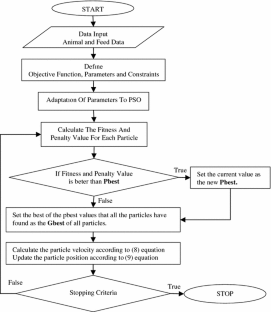
Fig. 1
References
- Baran MS, Demirel R, Demirel DŞ, Şahin T, Yeşilbağ D (2008) Determination of the feeding values of feedstuffs and mixed feeds used in the Southeastern Anatolia region of Turkey. Turk. J. Vet. Anim. Sci. 32(6):449–455
Google Scholar - Oishi K, Kumagai H, Hirooka H (2011) Application of the modified feed formulation to optimize economic and environmental criteria in beef cattle fattening systems with food by-products. Anim Feed Sci Technol 165:38–50
Article Google Scholar - Dogan I, Dogan N, Akcan A (2000) Using goal programming in rational and economical animal nutrition. Turk J Vet Anim Sci 24:233–238
Google Scholar - Kerrigan GL, Norback JP (1986) Linear programming in the allocation of milk resources for cheese making. J Dairy Sci 69(5):1432–1440. doi:10.3168/jds.S0022-0302(86)80552-5
Article Google Scholar - Munford AG (1996) The use of iterative linear programming in practical applications of animal diet formulation. Math Comput Simulat 42(2–3):255–261. doi:10.1016/0378-4754(95)00115-8
Article MATH Google Scholar - Azapagic A, Clift R (1998) Linear programming as a tool in life cycle assessment. Int J Life Cycle Assess 3(6):305–316. doi:10.1007/BF02979340
Article Google Scholar - Berntsen J, Petersen BM, Jacobsen BH, Olesen JE, Hutchings NJ (2003) Evaluating nitrogen taxation scenarios using the dynamic whole farm simulation model FASSET. Agric Syst 76:817–839. doi:10.1016/S0308-521X(02)00111-7
Article Google Scholar - Guevara VR (2004) Use of non-linear programming to optimize performance response to energy density in broiler feed formulation. Poult Sci 83:147–151
Google Scholar - Gryson N, Eeckhout M, Neijens T (2008) Cost and benefits for the segregation of GM and non-GM compound feed. 12th European association of agricultural economists congress. Ghent, Belgium
Google Scholar - Hwang SF, He RS (2006) Improving real-parameter genetic algorithm with simulated annealing for engineering problems. Adv Eng Softw 37:406–418. doi:10.1016/j.advengsoft.2005.08.002
Article Google Scholar - Cunkaş M (2010) Intelligent design of induction motors by multiobjective fuzzy genetic algorithm. J Intell Manuf 21:393–402. doi:10.1007/s10845-008-0187-0
Article Google Scholar - Şahman MA, Çunkaş M, İnal F, İnal Ş, Coşkun B, Taşkıran U (2009) Cost optimization of feed mixes by genetic algorithms. Adv Eng Softw 40:965–974
Article MATH Google Scholar - Kennedy J, Eberhart RC (1995) Particle swarm optimization. Proc IEEE Int Conf Neural Netw IV: 1942–1948
- Coşkun B, İnal F, İnal Ş (2007) Ration programs. http://veteriner.selcuk.edu.tr/bolum/hbesleme/, Accessed 14 June 2011
- Subcommittee on Poultry Nutrition (1994) NRC nutrient requirements of poultry, 9th Rev. ed edn. National Academy Press, Washington DC
Google Scholar - Şahman MA (2008) Cost optimization of feed mixes by using genetic algorithms. Dissertation, Selcuk University, Konya
- Coşkun B, Şeker E, Inal F (2000) Feeds and technology. Selcuk University, Veterinary Medicine Faculty Publication Unit, Konya
Google Scholar - Pesti GM, Miller BR (1993) Animal feed formulation: economics and computer applications. Springer, Berlin
- Eberhart R, Shi Y, Kennedy J (2001) Swarm Intelligence. Morgan Kaufmann, San Mateo, CA
Google Scholar - Chen D, Zhao C, Zhang H (2011) An improved cooperative particle swarm optimization and its application. Neural Comput Appl 20:171–182. doi:10.1007/s00521-010-0503-4
Article Google Scholar - Wang J, Yin Z (2008) A ranking selection-based particle swarm optimizer for engineering design optimization problems. Struct Multidisc Optim 37:131–147. doi:10.1007/s00158-007-0222-3
Article Google Scholar - Gao Z, Liao X (2011) Rational approximation for fractional-order system by particle swarm optimization. Nonlinear Dyn 1–9. doi: 10.1007/s11071-011-0075-6
- Chen L-F, Su C-T, Chen K-H, Wang P-C (2011) Particle swarm optimization for feature selection with application in obstructive sleep apnea diagnosis. Neural Comput Appl 1–10. doi: 10.1007/s00521-011-0632-4
- Das A, Bhattacharya M (2011) Affine-based registration of CT and MR modality images of human brain using multiresolution approaches: comparative study on genetic algorithm and particle swarm optimization. Neural Comput Appl 2:223–237. doi:10.1007/s00521-010-0374-8
Google Scholar
Author information
Authors and Affiliations
- Department of Electronic and Computer Science Education, Technical Educational Faculty, Selcuk University, Selcuklu/Konya, Turkey
Adem Alpaslan Altun - Guneysınır Vocational High School, Selcuk University, Konya, Turkey
Mehmet Akif Şahman
Authors
- Adem Alpaslan Altun
- Mehmet Akif Şahman
Corresponding author
Correspondence toAdem Alpaslan Altun.
Rights and permissions
About this article
Cite this article
Altun, A.A., Şahman, M.A. Cost optimization of mixed feeds with the particle swarm optimization method.Neural Comput & Applic 22, 383–390 (2013). https://doi.org/10.1007/s00521-011-0701-8
- Received: 04 April 2011
- Accepted: 05 July 2011
- Published: 21 July 2011
- Issue date: February 2013
- DOI: https://doi.org/10.1007/s00521-011-0701-8