Reemerging of enterovirus 71 in Taiwan: the age impact on disease severity (original) (raw)
Abstract
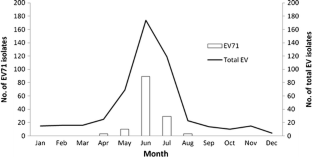
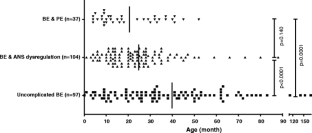
Enterovirus 71 (EV71) infection commonly strike children under the age of 3 years, with an occasionally unfavorable outcome in children. This study was designed to explore the relationship between age and the severity of complications, which may associate with antibody-dependent enhancement (ADE) in EV71. All EV71-infected patients during the outbreak of 2008 were recruited. In total, 134 patients were enrolled and categorized into two age groups, 0–12 months (n = 18) and >12 months (n = 116). Pulmonary edema/hemorrhage more commonly occur in patients younger than 12 months. No difference in the occurrence of herpangina/hand-foot-and-mouth disease (HFMD), uncomplicated brainstem encephalitis (BE), or autonomic nervous system (ANS) dysregulation was noted between the two age groups. Patients with pulmonary edema/hemorrhage (11.9 ± 14.7 months) were younger than patients with herpangina/HFMD (35.8 ± 26.4 months) or ANS dysregulation (33.9 ± 20.9 months). Our findings are in agreement with the data regarding the outbreak in Taiwan, in which a decrease in age corresponded to an increase in disease severity with regard to central nervous system complications. A reduction of maternal antibodies to the subneutralizing level within 1 year of age may be associated with the ADE of the infection. This study could provide possible clinical significance with regard to ADE phenomena in young infants infected by EV71.
Access this article
We’re sorry, something doesn't seem to be working properly.
Please try refreshing the page. If that doesn't work, please contact support so we can address the problem.
Fig. 1
The alternative text for this image may have been generated using AI.
Fig. 2

The alternative text for this image may have been generated using AI.
Fig. 3
The alternative text for this image may have been generated using AI.
References
- Wang SM, Liu CC, Tseng HW, Wang JR, Huang CC, Chen YJ et al (1999) Clinical spectrum of enterovirus 71 infection in children in southern Taiwan, with an emphasis on neurological complications. Clin Infect Dis 29:184–190
Article PubMed CAS Google Scholar - Wang SM, Liu CC, Yang YJ, Yang HB, Lin CH, Wang JR (1998) Fatal coxsackievirus B infection in early infancy characterized by fulminant hepatitis. J Infect 37:270–273
Article PubMed CAS Google Scholar - Centers for Disease Control and Prevention (CDC) (1998) Deaths among children during an outbreak of hand, foot, and mouth disease—Taiwan, Republic of China, April–July 1998. MMWR Morb Mortal Wkly Rep 47:629–632
Google Scholar - Liu CC, Tseng HW, Wang SM, Wang JR, Su IJ (2000) An outbreak of enterovirus 71 infection in Taiwan, 1998: epidemiologic and clinical manifestations. J Clin Virol 17:23–30
Article PubMed CAS Google Scholar - Ho M, Chen ER, Hsu KH, Twu SJ, Chen KT, Tsai SF et al (1999) An epidemic of enterovirus 71 infection in Taiwan. Taiwan Enterovirus Epidemic Working Group. N Engl J Med 341:929–935
Article PubMed CAS Google Scholar - Ooi MH, Wong SC, Podin Y, Akin W, del Sel S, Mohan A et al (2007) Human enterovirus 71 disease in Sarawak, Malaysia: a prospective clinical, virological, and molecular epidemiological study. Clin Infect Dis 44:646–656
Article PubMed Google Scholar - Pérez-Vélez CM, Anderson MS, Robinson CC, McFarland EJ, Nix WA, Pallansch MA et al (2007) Outbreak of neurologic enterovirus type 71 disease: a diagnostic challenge. Clin Infect Dis 45:950–957
Article PubMed Google Scholar - Lum LC, Wong KT, Lam SK, Chua KB, Goh AY, Lim WL et al (1998) Fatal enterovirus 71 encephalomyelitis. J Pediatr 133:795–798
Article PubMed CAS Google Scholar - McMinn PC, Stratov I, Nagarajan L, Davis S (2001) Neurological manifestations of enterovirus 71 infection in children during an outbreak of hand, foot, and mouth disease in Western Australia. Clin Infect Dis 32:236–242
Article PubMed CAS Google Scholar - Chan KP, Goh KT, Chong CY, Teo ES, Lau G, Ling AE (2003) Epidemic hand, foot and mouth disease caused by human enterovirus 71, Singapore. Emerg Infect Dis 9:78–85
PubMed Google Scholar - Van Tu P, Thao NTT, Perera D, Huu TK, Tien NT, Thuong TC et al (2007) Epidemiologic and virologic investigation of hand, foot, and mouth disease, southern Vietnam, 2005. Emerg Infect Dis 13:1733–1741
PubMed CAS Google Scholar - Mao LX, Wu B, Bao WX, Han FA, Xu L, Ge QJ et al (2010) Epidemiology of hand, foot, and mouth disease and genotype characterization of enterovirus 71 in Jiangsu, China. J Clin Virol 49:100–104
Article PubMed Google Scholar - Wang SM, Lei HY, Huang KJ, Wu JM, Wang JR, Yu CK et al (2003) Pathogenesis of enterovirus 71 brainstem encephalitis in pediatric patients: roles of cytokines and cellular immune activation in patients with pulmonary edema. J Infect Dis 188:564–570
Article PubMed CAS Google Scholar - Huang MC, Wang SM, Hsu YW, Lin HC, Chi CY, Liu CC (2006) Long-term cognitive and motor deficits after enterovirus 71 brainstem encephalitis in children. Pediatrics 118:e1785–e1788
Article PubMed Google Scholar - Lu CY, Lee CY, Kao CL, Shao WY, Lee PI, Twu SJ et al (2002) Incidence and case-fatality rates resulting from the 1998 enterovirus 71 outbreak in Taiwan. J Med Virol 67:217–223
Article PubMed Google Scholar - Chen KT, Chang HL, Wang ST, Cheng YT, Yang JY (2007) Epidemiologic features of hand-foot-mouth disease and herpangina caused by enterovirus 71 in Taiwan, 1998–2005. Pediatrics 120:e244–e252
Article PubMed Google Scholar - van der Sanden S, van der Avoort H, Lemey P, Uslu G, Koopmans M (2010) Evolutionary trajectory of the VP1 gene of human enterovirus 71 genogroup B and C viruses. J Gen Virol 91:1949–1958
Article PubMed Google Scholar - Shih SR, Ho MS, Lin KH, Wu SL, Chen YT, Wu CN et al (2000) Genetic analysis of enterovirus 71 isolated from fatal and non-fatal cases of hand, foot and mouth disease during an epidemic in Taiwan, 1998. Virus Res 68:127–136
Article PubMed CAS Google Scholar - Cardosa MJ, Krishnan S, Tio PH, Perera D, Wong SC (1999) Isolation of subgenus B adenovirus during a fatal outbreak of enterovirus 71-associated hand, foot, and mouth disease in Sibu, Sarawak. Lancet 354:987–991
Article PubMed CAS Google Scholar - Wang SM, Lei HY, Yu CK, Wang JR, Su IJ, Liu CC (2008) Acute chemokine response in the blood and cerebrospinal fluid of children with enterovirus 71-associated brainstem encephalitis. J Infect Dis 198:1002–1006
Article PubMed CAS Google Scholar - Luo ST, Chiang PS, Chao AS, Liou GY, Lin R, Lin TY et al (2009) Enterovirus 71 maternal antibodies in infants, Taiwan. Emerg Infect Dis 15:581–584
Article PubMed Google Scholar - Ooi EE, Phoon MC, Ishak B, Chan SH (2002) Seroepidemiology of human enterovirus 71, Singapore. Emerg Infect Dis 8:995–997
PubMed Google Scholar - Takada A, Kawaoka Y (2003) Antibody-dependent enhancement of viral infection: molecular mechanisms and in vivo implications. Rev Med Virol 13:387–398
Article PubMed CAS Google Scholar - Hawkes RA (1964) Enhancement of the infectivity of arboviruses by specific antisera produced in domestic fowls. Aust J Exp Biol Med Sci 42:465–482
Article PubMed CAS Google Scholar - Halstead SB, O’Rourke EJ (1977) Dengue viruses and mononuclear phagocytes. I. Infection enhancement by non-neutralizing antibody. J Exp Med 146:201–217
Article PubMed CAS Google Scholar - Palmer P, Charley B, Rombaut B, Daëron M, Lebon P (2000) Antibody-dependent induction of type I interferons by poliovirus in human mononuclear blood cells requires the type II Fc gamma receptor (CD32). Virology 278:86–94
Article PubMed CAS Google Scholar - Kishimoto C, Kurokawa M, Ochiai H (2002) Antibody-mediated immune enhancement in coxsackievirus B3 myocarditis. J Mol Cell Cardiol 34:1227–1238
Article PubMed CAS Google Scholar - Wang SM, Chen IC, Su LY, Huang KJ, Lei HY, Liu CC (2010) Enterovirus 71 infection of monocytes with antibody-dependent enhancement. Clin Vaccine Immunol 17:1517–1523
Article PubMed CAS Google Scholar
Acknowledgments
This study was supported by grants from the National Science Council, Taiwan (NSC-95-2314-B-006-109, NSC 96-2314-B-006-033-MY2, NSC 98-2314-B-006-002-MY3), Multidisciplinary Center of Excellence for Clinical Trial and Research, Department of Health, Executive Yuan, Taiwan (DOH100-TD-B-111-102), and the Center of Infectious Disease and Signaling Research, National Cheng Kung University, Taiwan.
Conflicts of interest
There are no conflicts of interest to declare.
Author information
Authors and Affiliations
- Department of Emergency Medicine, College of Medicine, National Cheng Kung University and Hospital, Tainan, Taiwan
S.-M. Wang & T.-S. Ho - Centers for Disease Control, 5th branch, Kaohsiung, Taiwan
H.-C. Lin - Department of Microbiology and Immunology, College of Medicine, National Cheng Kung University, Tainan, Taiwan
H.-Y. Lei - Department of Medical Laboratory Science and Biotechnology, College of Medicine, National Cheng Kung University, Tainan, Taiwan
J.-R. Wang - Department of Pediatrics, College of Medicine, National Cheng Kung University and Hospital, Tainan, Taiwan
C.-C. Liu - Center of Infectious Disease and Signaling Research, National Cheng Kung University, Tainan, Taiwan
S.-M. Wang, T.-S. Ho, H.-Y. Lei, J.-R. Wang & C.-C. Liu
Authors
- S.-M. Wang
- T.-S. Ho
- H.-C. Lin
- H.-Y. Lei
- J.-R. Wang
- C.-C. Liu
Corresponding authors
Correspondence toS.-M. Wang or C.-C. Liu.
Rights and permissions
About this article
Cite this article
Wang, SM., Ho, TS., Lin, HC. et al. Reemerging of enterovirus 71 in Taiwan: the age impact on disease severity.Eur J Clin Microbiol Infect Dis 31, 1219–1224 (2012). https://doi.org/10.1007/s10096-011-1432-6
- Received: 20 May 2011
- Accepted: 15 September 2011
- Published: 09 October 2011
- Issue date: June 2012
- DOI: https://doi.org/10.1007/s10096-011-1432-6