The role of foreign direct investment and labor productivity in explaining croatian regional export dynamics (original) (raw)
Abstract
The potential benefits of trade openness and export led growth strategy are well documented in the empirical literature. As previous researches found evidence that international trade does not support convergence in GDP per capita of Croatian regions towards average EU GDP per capita, this paper investigates the role of foreign direct investments (FDI) and labour productivity in describing Croatian regional export dynamics for the period from 2004 to 2015. The results of the estimated panel models confirm the importance of strengthening manufacturing as well as strong comovements of exports and imports as a consequence of the internalization of product chains. Furthermore, the obtained results indicate that the main obstacles towards strengthening of the Croatian regional exports are the lack of domestic demand effect and decreasing labour productivity. Moreover, as FDI inflows are mostly directed towards service sector it is not surprising that the overall impact of FDI inflows on exports is negative. Although one of the declared goals of Croatian policy makers is attracting FDI into export industries, the effects and, first of all, proper policy measures are yet to be seen.
Access this article
Subscribe and save
- Starting from 10 chapters or articles per month
- Access and download chapters and articles from more than 300k books and 2,500 journals
- Cancel anytime View plans
Buy Now
Price excludes VAT (USA)
Tax calculation will be finalised during checkout.
Instant access to the full article PDF.
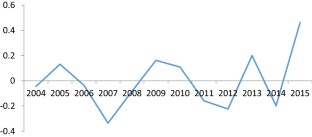
Fig. 1

Source: Author’s calculation based on Croatian Employment Service (CES) and Croatian Bureau of Statistics (CBS) data
Fig. 2
Source: Author’s calculation based on Croatian Bureau of Statistics (CBS) data
Fig. 3

Source: Author’s calculation based on CBS data
Fig. 4
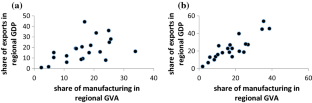
Source: Authors’ calculation based on CBS data
Fig. 5

Source: Authors’ calculation based on CBS data
FDI in Croatia
Chapter © 2021


Notes
- Regional real GDP per capita is expressed in 2015 prices.
- In balanced panel models, the test statistic is asymptotically equivalent to the Hausman fixed-versus-random effects test. However, unlike the Hausman version, test extends straightforwardly to heteroskedastic- and cluster-robust versions and is guaranteed to generate a nonnegative test statistic (Arellano 1993; Wooldridge 2002).
References
- Andreß H, Golsch K, Schmidt-Catran A (2013) Applied panel data analysis for economic and social surveys. Springer, Berlin
Book Google Scholar - Arellano M (1993) On the testing of correlated effects with panel data. J Econ 59(1–2):87–97
Article Google Scholar - Arellano M, Bond S (1991) Some tests of specification for panel data: Monte Carlo evidence and an application to employment equations. Rev Econ Stud 58:277–297
Article Google Scholar - Arellano M, Bover O (1995) Another look at the instrumental variable estimation of error-components models. J Econ 68:29–51
Article Google Scholar - Basarac M, Vučković V (2012) The analysis of export competitiveness of Croatian manufacturing industry. Ekon Pregl 62(12):729–751
Google Scholar - Belke A, Oeking A, Setzer R (2015) Domestic demand, capacity constraints and export dynamics: for vulnerable euro area countries. Econ Model 48:315–325
Article Google Scholar - Blackburne EF, Frank MW (2007) Estimation of nonstationary heterogeneous panels. Stata J 7:197–208
Article Google Scholar - Blundell R, Bond S (1998) Initial conditions and moment restrictions in dynamic panel data models. J Econ 87:115–143
Article Google Scholar - Botrić V, Broz T (2016) Competitiveness, trade with the EU and labour markets: challenges for the Western Balkans. South East Eur J Econ Bus 11(2):20–32
Article Google Scholar - Breusch TS, Pagan AR (1980) The Lagrange multiplier test and its applications to model specification in econometrics. Rev Econ Stud 47:239–253
Article Google Scholar - Bussière M, Chudik A, Sestieri G (2012) Modelling global trade flows: results from a GVAR model. Federal Reserve Bank of Dallas. Globalization and Monetary Policy Institute. Working paper 119, Dallas
- Buturac G (2008) Comparative advantages and export competitiveness of Croatian manufacturing. Ekon Istraž 21(2):47–59
Google Scholar - Buturac G (2009) Structural Characteristics of exports and imports of Croatian manufacturing. Ekon Pregl 60(9–10):432–457
Google Scholar - Buturac G, Gržinić J (2009) The competitiveness of Croatian export to EU markets. Zagreb Int Rev Econ Bus 12(1):39–51
Google Scholar - Buturac G, Lovrinčević Ž, Mikulić D (2014) Export competitiveness of Croatian textile industry—CMS analysis and importance for economy. J Text Appar 24(2):158–168
Google Scholar - Commission for Internationalisation of Croatia’s Economy (2014) Akcijski plan podrške izvozu 2014–2015. (Export Action Plan 2014–2015.) https://izvoz.gov.hr/UserDocsImages/dokumenti/Akcijski%20plan%20podrske-izvozu-2014-2015.pdf. Accessed 30 Jan 2018
- Croatian Government (2016) Program Vlade Republike Hrvatske za razdoblje 2016–2020. (The programme of the Government of the Republic of Croatia for the period 2016–2020.) https://vlada.gov.hr/UserDocsImages/ZPPI/Dokumenti%20Vlada/Program_Vlada_RH_2016_2020.pdf. Accessed 30 January 2018
- Croatian Parliament (2014) Industrijska strategija Republike Hrvatske 2014–2020. (Industrial strategy of Republic of Croatia from 2014–2020). NN 126
- Esteves S, Prades E (2016) On domestic demand and export performance in the euro area countries: does export concentration matter? Working paper series 1909, European Central Bank
- European Commission (2012) A stronger European industry for growth and economic recovery. Industrial policy communication update. SWD (2012) 297 final, Commission Staff Working Document, Brussels
- Hausman JA (1978) Specification tests in econometrics. Econometrica 46:1251–1271
Article Google Scholar - Jakšić S, Erjavec N (2017) What drives Croatian regional export? In: Proceedings of the 14th international symposium on operational research SOR’17. Slovenian Society Informatika, Section for Operational Research, Bled, pp 320–325
- Jakšić S, Žmuk B (2014) Modelling Croatian export dynamics using global macroeconometric model. In: Zagreb international review of economics and business 17, special conference Issue, pp 31–48
- Kovač I, Palić M, Mihanović D (2012) International trade of goods as a determinant of GDP growth in Croatia. Int J Bus Glob 9(2):134–156
Article Google Scholar - Lovrinčević Ž, Buturac G, Mikulić D (2015) Export performance of the Croatian wood industry and its contribution to the overall Croatian economy. For Prod J 65(3–4):159–165
Google Scholar - Marin D (1992) Is the export-led growth hypothesis valid for industrialized countries? Rev Econ Stat 74(4):678–688
Article Google Scholar - Mikulić D, Galić Nagyszombaty A (2014) Direct and indirect impacts of exports on Croatian economy. In: Global business conference 2014 proceedings: questioning the widely-held Dogmas, Innovation Institute, Dubrovnik, pp 133–148
- Mikulić D, Galić Nagyszombaty A (2015) Does international trade cause regional growth differentials in Croatia? Zb rad Ekon fak Rij 33(1):81–102
Google Scholar - Mikulić D, Kovač I (2012) The role of international trade in convergence process. Montenegrin J Econ 8(4):7–26
Google Scholar - Mikulić D, Lovrinčević Ž, Galić Nagyszombaty A (2014) Regional convergence in the European union, new member states and Croatia. South East Eur J Econ Bus 8(1):9–21
Article Google Scholar - Paas T, Schlitte P (2007) Regional income inequality and convergence processes in the EU25. HWWI_Research_Paper, pp 1–11
- Rua A, Soares Esteves P, Staehr K, Bobeica E (2015) Exports and domestic demand pressure: a dynamic panel data model for the euro area countries. European Central Bank, Working paper series 1777, Frankfurt am Main
- Sargan JD (1958) The estimation of economic relationships using instrumental variables. Econometrica 26:393–415
Article Google Scholar - Stojčić N, Benić Đ, Karanikić P (2014) Regional determinants of export competitiveness in Croatian manufacturing industry. Zb rad Ekon fak Rij 32(2):193–212
Google Scholar - UNCTAD (2002) World investment report: transnational corporations and export competitiveness. United Nations, New York
Google Scholar - Vukšić G (2005) Impact of foreign direct investment on Croatian manufacturing exports. Financ Theory Pract 29(2):131–158
Google Scholar - Vukšić G (2017) Pre-crisis wage leadership in Croatia in the context of export competitiveness: any lessons for the future? Prague economic papers, pp 1–25. https://doi.org/10.18267/j.pep.655
- Wooldridge JM (2002) Econometric analysis of cross section and panel data. MIT Press, Cambridge
Google Scholar
Acknowledgements
This work has been fully supported by Croatian Science Foundation under the project (IP-2014-09-5476).
Author information
Authors and Affiliations
- Faculty of Economics and Business, University of Zagreb, Trg J. F. Kennedyja 6, 10000, Zagreb, Croatia
Saša Jakšić, Nataša Erjavec & Boris Cota
Authors
- Saša Jakšić
- Nataša Erjavec
- Boris Cota
Corresponding author
Correspondence toSaša Jakšić.
Rights and permissions
About this article
Cite this article
Jakšić, S., Erjavec, N. & Cota, B. The role of foreign direct investment and labor productivity in explaining croatian regional export dynamics.Cent Eur J Oper Res 27, 835–849 (2019). https://doi.org/10.1007/s10100-018-0583-2
- Published: 27 October 2018
- Version of record: 27 October 2018
- Issue date: 01 September 2019
- DOI: https://doi.org/10.1007/s10100-018-0583-2