The adaptation and mitigation potential of traditional agriculture in a changing climate (original) (raw)
Abstract
The threat of global climate change has caused concern among scientists because crop production could be severely affected by changes in key climatic variables that could compromise food security both globally and locally. Although it is true that extreme climatic events can severely impact small farmers, available data is just a gross approximation at understanding the heterogeneity of small scale agriculture ignoring the myriad of strategies that thousands of traditional farmers have used and still use to deal with climatic variability. Scientists have now realized that many small farmers cope with and even prepare for climate change, minimizing crop failure through a series of agroecological practices. Observations of agricultural performance after extreme climatic events in the last two decades have revealed that resiliency to climate disasters is closely linked to the high level of on-farm biodiversity, a typical feature of traditional farming systems.
Based on this evidence, various experts have suggested that rescuing traditional management systems combined with the use of agroecologically based management strategies may represent the only viable and robust path to increase the productivity, sustainability and resilience of peasant-based agricultural production under predicted climate scenarios. In this paper we explore a number of ways in which three key traditional agroecological strategies (biodiversification, soil management and water harvesting) can be implemented in the design and management of agroecosystems allowing farmers to adopt a strategy that both increases resilience and provides economic benefits, including mitigation of global warming.
Access this article
Subscribe and save
- Starting from 10 chapters or articles per month
- Access and download chapters and articles from more than 300k books and 2,500 journals
- Cancel anytime View plans
Buy Now
Price excludes VAT (USA)
Tax calculation will be finalised during checkout.
Instant access to the full article PDF.
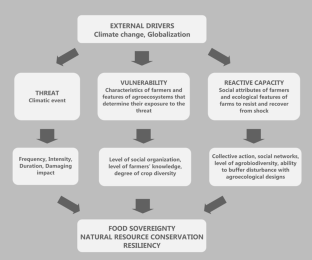
Fig. 1
The alternative text for this image may have been generated using AI.
References
- Adger WM (2000) Social and ecological resilience: are they related? Prog Hum Geogr 24:347–364
Article Google Scholar - Albrecht A, Kandji ST (2003) Carbon sequestration in tropical agroforestry systems. Agric Ecosyst Environ 99:15–27
- Altieri MA (2002) Agroecology: the science of natural resource management for poor farmers in marginal environments. Agric Ecosyst Environ 93:1–24
Article Google Scholar - Altieri MA (2004) Linking ecologists and traditional farmers in the search for sustainable agriculture. Front Ecol Environ 2:35–42
Article Google Scholar - Altieri MA, Koohafkan P (2008) Enduring farms: climate change, smallholders and traditional farming communities. Environment and Development Series 6. Malaysia: Third World Network
- Altieri MA, Toledo VM (2005) Natural resource management among small scale farmers in semi-arid lands: building on traditional knowledge and agroecology. Annals of Arid Zone 44:365–385
Google Scholar - Altieri MA, Toledo VM (2011) The agroecological revolution in Latin America: rescuing nature, ensuring food sovereignity and empowering peasants. J Peasant Stud 38:587–612
Article Google Scholar - Armillas P (1971) Gardens on swamps. Science 174:653–656
Article Google Scholar - Barrow CJ (1999) Alternative irrigation: the promise of runoff agriculture. Earthscan Publications, Ltd, London
Google Scholar - Boers TM, Ben-Asher J (1982) A review of rainwater harvesting. Agric Wafer Manag 5:145–158
Article Google Scholar - Campesina V (2010) Sustainable peasant and small family farm agriculture can feed the world. Via Campesina Views, Jakarta
Google Scholar - Critchley WRS (1989) Building on a tradition of rainwater harvesting. Appropr Technol 16(2):10–12
Google Scholar - Critchley WRS, Reij C, Willcocks TJ (2004) Indigenous soil and water conservation: a review of the state of knowledge and prospects for building on traditions. Land Degradation and Rehabilitations 5:293–314
Article Google Scholar - De Schutter O (2010) Report submitted by the Special Rapporteur on the right to food. UN General Assembly. Human Rights Council Sixteenth Session, Agenda item 3 A/HRC/16/49
- Denevan WM (1995) Prehistoric agricultural methods as models for sustainability. Adv Plant Pathol 11:21–43
Article Google Scholar - Diaz-Zorita M, Buschiazzo DE, Peineman N (1999) Soil organic matter and wheat productivity in the Semiarid Argentine Pampas. Agron J 91:276–279
Article Google Scholar - Erickson CL, Chandler KL (1989) Raised fields and sustainable agriculture in Lake Titicaca Basin of Peru. In: Browder JO (ed) Fragile lands of Latin America. Westview Press, Boulder, pp 230–243
Google Scholar - ETC Group (2009) Who will feed us? Questions for the food and climate crisis. ETC Group Comunique #102
- Gliessman SR, Garcia RE, Amador AM (1981) The ecological basis for the application of traditional agricultural technology in the management of tropical agroecosystems. Agroecosyst 7:173–185
Google Scholar - Hart TGB, Vorster HJ (2007) African Indigenous Knowledge Systems in Agricultural Production. Pretoria: Department of Science and Technology: National Indigenous Knowledge Office
- Holt-Giménez E (2002) Measuring farmers’ agroecological resistance after Hurricane Mitch in Nicaragua: a case study in participatory, sustainable land management impact monitoring. Agric Ecosyst Environ 93:87–105
Article Google Scholar - IAASTD (International Assessment of Agricultural Knowledge, Science and Technology for Development) (2009) Agriculture at a Crossroads. In: International Assessment of Agricultural Knowledge, Science and Technology for Development Global Report, Island Press, Washington, D.C.
- Jones PG, Thornton PK (2003) The potential impacts of climate change on maize production in Africa and Latin America in 2055. Glob Environ Chang 13:51–59
Article Google Scholar - Koohafkan P, Altieri MA (2010) Globally important agricultural heritage systems: a legacy for the future. UN-FAO, Rome
Google Scholar - Lin BB, Perfecto I, Vandermeer J (2008) Synergies between agricultural intensification and climate change could create surprising vulnerabilities for crops. BioScience 58:847–854
Article Google Scholar - Magdoff F, Weil R (2004) Soil organic matter management strategies. In: Magdoff F, Weil R (eds) Soil organic matter in sustainable agriculture. CRC Press, Boca Raton
Chapter Google Scholar - Montagnini F, Nair PKR (2004) Carbon sequestration: an underexploited environmental benefit of agroforestry systems. Agrofor Syst 61:281–295
Google Scholar - Mutuo PK, Cadisch G, Albrecht A, Palm CA, Verchot L (2005) Potential of agroforestry for carbon sequestration and mitigation of greenhouse gas emissions from soils in the tropics. Nutr Cycl Agroecosyst 71:43–54
Article Google Scholar - Nair PK, Kumat BM, Nair VD (2009) Agroforestry as a strategy for carbon sequestration. J Plant Nutr Soil Sci 72:10–23
Article Google Scholar - Niggli U, Fliessbach A, Hepperly P, Scialabba N (2008) Low greenhouse gas agriculture: mitigation and adaptation potential of sustainable farming systems. FAO, Rome
Google Scholar - Perfecto I, Vandermeer J, Wright A (2009) Nature’s matrix: linking agriculture, conservation and food sovereignty. Earthscan, London
Google Scholar - Philpott SM, Lin BB, Jha S, Brines SJ (2009) A multiscale assessment of hurricane impacts on agricultural landscapes based on land use and topographic features. Agric Ecosyst Environ 128:12–20
Article Google Scholar - Reij C, Scoones I, Toulmin C (1996) Sustaining the soil: indigenous soil and water conservation in Africa. Earthscan, London
Google Scholar - Rojas Rabiela T (1993) La agricultura chinampera: compilacion historica. Universidad Autonoma de Chapingo, Mexico
Google Scholar - Rosenzweig C, Hillel D (2008) Climate change and the global harvest: impacts of El Nino and other oscillations on agroecosystems. Oxford University Press, New York
Google Scholar - Rosset PM, Machín-Sosa B, Roque-Jaime AM, Avila-Lozano DR (2011) The Campesino-to-Campesino Agroecology movement of ANAP in Cuba. J Peasant Stud 38(1):161–191
Article Google Scholar - Sombroek W, Ruivo ML, Fearnside PM, Glaser B, Lehmann J (2003) Amazonian dark earths as carbon stores and sinks. In: Lehmann J, Kern D, German LA, McCann JM, Martins GC, Moreira A (eds) Amazonian dark earths: origin, properties. Management. Kluwer Academic Publishers, Netherlands, pp 125–139
Google Scholar - Stigter C, Dawei Z, Onyewotu L, Xurong M (2005) Using traditional methods and indigenous technologies for coping with climate variability. Clim Chang 70:255–271
Article Google Scholar - Tester M, Langridge P (2010) Breeding technologies to increase crop production in a changing world. Science 327:818–822
Article Google Scholar - Toledo VM, Barrera-Bassols N (2008) La Memoria Biocultural: la importancia ecologica de las sabidurıas tradicionales. ICARIA Editorial, Barcelona
Google Scholar - Tompkins EL, Adger WN (2004) Does Adaptive Management of Natural Resources Enhance Resilience to Climate Change? Ecology and Society 9(2): 10. [online] URL: http://www.ecologyandsociety.org/vol9/iss2/art10
- Tscharntke T, Klein AM, Kruess A, Steffan-Dewenter I, Thies C (2005) Landscape perspectives on agricultural intensification and biodiversity: ecosystem service management. Ecol Lett 8:857–874
Article Google Scholar - Vietmeyer N (1984) The lost crops of the Incas. Ceres 99:37–40
Google Scholar - Wilken GC (1987) Good farmers: traditional agricultural resource management in Mexico and Central America. University of California Press, Berkeley
Google Scholar
Author information
Authors and Affiliations
- Dept of Environmental Science, Policy, & Management, University of California, Berkeley, 130 Mulford Hall #3114, Berkeley, CA, 94720, USA
Miguel A. Altieri - Department of International & Area Studies, University of California, Berkeley, 217 Mulford Hall, Berkeley, CA, 94720, USA
Clara I. Nicholls
Authors
- Miguel A. Altieri
- Clara I. Nicholls
Corresponding author
Correspondence toMiguel A. Altieri.
Additional information
This article is part of a Special Issue on "Climate Change Mitigation and Adaptation with Local Communities and Indigenous Peoples" edited by Kirsty Galloway McLean, Ameyali Ramos Castillo, Edwin Castellanos, and Aqqaluk Lynge.
Electronic supplementary material
Below is the link to the electronic supplementary material.
Rights and permissions
About this article
Cite this article
Altieri, M.A., Nicholls, C.I. The adaptation and mitigation potential of traditional agriculture in a changing climate.Climatic Change 140, 33–45 (2017). https://doi.org/10.1007/s10584-013-0909-y
- Received: 25 January 2013
- Accepted: 27 August 2013
- Published: 13 September 2013
- Issue date: January 2017
- DOI: https://doi.org/10.1007/s10584-013-0909-y