North American terrestrial CO2 uptake largely offset by CH4 and N2O emissions: toward a full accounting of the greenhouse gas budget (original) (raw)
1 Introduction
Radiative forcing of climate is increasing at unprecedented rates in Earth’s atmosphere, largely due to rapid increases in the atmospheric concentrations of greenhouse gases (GHGs) such as CO2, CH4, and N2O (Forster et al. 2007). These three GHGs combined contribute to more than 90 % of anthropogenic climate warming (Hansen et al. 2000). Atmospheric CH4 and N2O are two potent greenhouse gases which in sum contribute to more than one quarter of the anthropogenic global warming (Forster et al. 2007; USGCRP 2009). Similar to atmospheric CO2, atmospheric CH4 and N2O concentrations have dramatically increased since the Industrial Revolution (Forster et al. 2007; Rigby et al. [2008](/article/10.1007/s10584-014-1072-9#ref-CR34 "Rigby M, Prinn RG, Fraser PJ et al (2008) Renewed growth of atmospheric methane. Geophys Res Lett 35, L22805. doi: 10.1029/2008GL036037
            ")). During the past decades, however, less attention has been paid to terrestrial CH4 and N2O fluxes relative to the focus on regional CO2 budget accounting. The global warming potential (GWP) of CH4 is about 25 (100-year horizon) times larger than that of CO2, while N2O is about 298 times (Forster et al. [2007](/article/10.1007/s10584-014-1072-9#ref-CR11 "Forster P, Ramaswamy V, Artaxo P et al (2007) Changes in atmospheric constituents and in radiative forcing. In: Solomon S, Qin D, Manning M, Chen Z (eds) Climate change 2007: The physical science basis. Contribution of working group I to the fourth assessment report of the intergovernmental panel on climate change. Cambridge University Press, Cambridge")). Therefore, although CH4 and N2O concentrations are relatively low in the atmosphere, they are of critical significance in contributing to climate warming. Owing to more available data from field experiments and observations and improved representations of biogeochemical processes in ecosystem models, regional CH4 and N2O fluxes have been estimated in a number of recent studies (e.g., Tian et al. [2010](/article/10.1007/s10584-014-1072-9#ref-CR40 "Tian H, Xu X, Liu M et al (2010) Spatial and temporal patterns of CH4 and N2O fluxes in terrestrial ecosystems of North America during 1979–2008: application of a global biogeochemistry model. Biogeosciences 7:2673–2694"); Xu et al. [2010](/article/10.1007/s10584-014-1072-9#ref-CR53 "Xu X, Tian H, Zhang C et al (2010) Attribution of spatial and temporal variations in terrestrial methane flux over North America. Biogeosciences 7:3637–3655"); Huang et al. [2010](/article/10.1007/s10584-014-1072-9#ref-CR15 "Huang Y, Sun W, Zhang W, Yu Y, Su Y, Song C (2010) Marshland conversion to cropland in northeast China from 1950 to 2000 reduced the greenhouse effect. Glob Chang Biol 16:680–695"); Li et al. [1996](/article/10.1007/s10584-014-1072-9#ref-CR24 "Li CS, Narayanan V, Harriss RC (1996) Model estimates of nitrous oxide emissions from agricultural lands in the United States. Glob Biogeochem Cycles 10:297–306"); Miller et al. [2012](/article/10.1007/s10584-014-1072-9#ref-CR29 "Miller SM, Kort EA, Hirsch AI et al (2012) Regional sources of nitrous oxide over the United States: seasonal variation and spatial distribution. J Geophys Res. doi:
                10.1029/2011JD016951


            ")). However, the concurrent fluxes of all these three gases have not yet been well investigated (Tian et al. [2011a](/article/10.1007/s10584-014-1072-9#ref-CR41 "Tian H, Xu X, Lu C et al. (2011a) Net exchanges of CO2, CH4, and N2O between China’s terrestrial ecosystems and the atmosphere and their contributions to global climate warming. J Geophy Res G02011, doi:
                10.1029/2010JG001393


            ")). Since close linkages exist among CO2, CH4 and N2O fluxes and one gas flux altered by environmental forces would affect the other two, a systems approach incorporating all three GHGs would be needed to provide an accurate estimate on GWP (Lu and Tian [2013](/article/10.1007/s10584-014-1072-9#ref-CR26 "Lu C, Tian H (2013) Net greenhouse gas balance in response to nitrogen enrichment: perspectives from a coupled biogeochemical model. Glob Chang Biol 19:571–588")).
The fluxes of CO2, CH4, and N2O could be greatly influenced by multiple environmental changes, such as climate, nitrogen deposition, CO2 fertilization, land use, and land management practices (e.g., nitrogen fertilizer uses and irrigation). Roles of these driving forces on North American CO2 balance are extensively studied based on the long-term experiments and observations (e.g., FLUXNET sites), remote sensing data, and modeling synthesis activities (Xiao et al. 2011; Hayes et al. 2012; Huntzinger et al. 2012), but only a few studies have investigated their roles on the fluxes of CH4 and N2O (e.g., Tian et al. 2010, 2012b; Xu et al. 2010, 2012). Many global change factors could affect the fluxes of CH4 and N2O (Huang et al. 2010; Toet et al. 2011; Banger et al. [2012](/article/10.1007/s10584-014-1072-9#ref-CR1 "Banger K, Tian H, Lu C (2012) Do nitrogen fertilizers stimulate or inhibit methane emissions from rice fields? Glob Chang Biol 18:3259–3267. doi: 10.1111/j.1365-2486.2012.02762.x
            "); Dijkstra et al. [2012](/article/10.1007/s10584-014-1072-9#ref-CR10 "Dijkstra FA, Prior SA, Runion GB et al (2012) Effects of elevated carbon dioxide and increased temperature on methane and nitrous oxide fluxes: evidence from field experiments. Front Ecol Environ 10:520–527")). For instance, elevated atmospheric CO2 might stimulate CH4 emission (Dacey et al. [1994](/article/10.1007/s10584-014-1072-9#ref-CR7 "Dacey JWH, Drake BG, Klug MJ (1994) Stimulation of methane emission by carbon dioxide enrichment of marsh vegetation. Nature 370:47–49")), while reducing or increasing N2O emission (Ineson et al. [1998](/article/10.1007/s10584-014-1072-9#ref-CR18 "Ineson P, Coward P, Hartwig U (1998) Soil gas fluxes of N2O, CH4 and CO2 beneath Lolium perenne under elevated CO2: the Swiss free air carbon dioxide enrichment experiment. Plant Soil 198:89–95"); Kettunen et al. [2005](/article/10.1007/s10584-014-1072-9#ref-CR20 "Kettunen R, Saarnio S, Martikainen PJ, Silvola J (2005) Elevated CO2 concentration and nitrogen fertilisation effects on N2O and CH4 fluxes and biomass production of Phleum pretense on farmed peat soil. Soil Biol Biochem 37:739–750")); ozone (O3) pollution might reduce CH4 emission (Toet et al. [2011](/article/10.1007/s10584-014-1072-9#ref-CR47 "Toet S, Ineson P, Peacock S, Ashmore M (2011) Elevated ozone reduces methane emissions from peatland mesocosms. Glob Chang Biol 17:288–296")), while stimulating or reducing N2O emission (Kanerva et al. [2008](/article/10.1007/s10584-014-1072-9#ref-CR19 "Kanerva T, Palojärvi A, Rämöa K, Manninen S (2008) Changes in soil microbial community structure under elevated tropospheric O3 and CO2. Soil Biol Biochem 40:2502–2510")). Meanwhile, interactions among multiple factors may also influence CH4 and N2O fluxes. For example, one recent study reported that nitrogen deposition and elevated atmospheric CO2 might interactively reduce CH4 emission from wetlands (Pancotto et al. [2010](/article/10.1007/s10584-014-1072-9#ref-CR30 "Pancotto VA, Bodegom, PM van, Hal JR van et al. (2010) N deposition and elevated CO2 on methane emissions: differential responses of indirect effects compared to direct effects through litter chemistry feedbacks. J Geophys Res 115. doi:
                10.1029/2009JG001099


            ")); another study concluded that temperature and elevated atmospheric CO2 interactively altered seasonal variation of CH4 emissions (Blankinship et al. [2010](/article/10.1007/s10584-014-1072-9#ref-CR2 "Blankinship JC, Brown JR, Dijkstra P, Hungate BA (2010) Effects of interactive global changes on methane uptake in annual grassland. J Geophys Res 115:1–9")). Therefore, it is necessary to study the concurrent fluxes of CO2, CH4 and N2O fluxes under multi-factor global changes (Tian et al. [2011a](/article/10.1007/s10584-014-1072-9#ref-CR41 "Tian H, Xu X, Lu C et al. (2011a) Net exchanges of CO2, CH4, and N2O between China’s terrestrial ecosystems and the atmosphere and their contributions to global climate warming. J Geophy Res G02011, doi:
                10.1029/2010JG001393


            ")).
Based on results and data from the North American Carbon Program (NACP) Regional Interim Synthesis (Huntzinger et al. 2012; Hayes et al. 2012), Non-CO2 GHG regional interim synthesis (Tian et al. 2012b) and model simulations with the Dynamic Land Ecosystem Model (DLEM), this study intends to: 1) estimate the overall GWP of CO2, CH4, and N2O fluxes in the terrestrial ecosystems of North America; 2) quantify the relative contributions of individual environmental factors to GWP changes during recent 32 years (1979–2010); and 3) identify gaps and uncertainties in existing estimates of the GHG balances for improving climate prediction and guiding climate change policy-making in North America.
2 Methods and data
The DLEM model (Tian et al. 2010, [2011a](/article/10.1007/s10584-014-1072-9#ref-CR41 "Tian H, Xu X, Lu C et al. (2011a) Net exchanges of CO2, CH4, and N2O between China’s terrestrial ecosystems and the atmosphere and their contributions to global climate warming. J Geophy Res G02011, doi: 10.1029/2010JG001393
            "), [b](/article/10.1007/s10584-014-1072-9#ref-CR42 "Tian H, Melillo J, Lu C et al (2011b) China’s terrestrial carbon balance: contributions from multiple global change factors. Glob Biogeochem Cycles. doi:
                10.1029/2010GB003838


            ")) was used to simultaneously quantify the magnitudes as well as spatial and temporal patterns of CO2, CH4, and N2O fluxes in the terrestrial ecosystems of North America, and attribute GWP variations to different environmental factors. Additionally previous studies were synthesized to provide an estimate of the uncertainty range of contemporary GWP from GHG fluxes. Magnitudes of CO2, CH4 and N2O sources and sinks are defined as the vertical land-atmosphere exchanges. In this study, we only estimated these fluxes from the terrestrial biosphere, while the emissions from human activities such as fossil fuel combustion, transportation, and industrial processes etc., are excluded from the estimation.
2.1 DLEM model description
The DLEM model is a highly integrated process-based ecosystem model that couples carbon, nutrients (i.e., nitrogen and phosphorus) and water cycles in terrestrial ecosystems for estimating the hydrological, biogeochemical fluxes and pool sizes at multiple scales from site to region/globe and with time steps ranging from day to year. Through the carbon-nutrient-water coupling, DLEM is capable of simultaneously depicting the biosphere-atmosphere exchange of CO2, CH4 and N2O under multiple natural and anthropogenic disturbances. DLEM has been widely applied and evaluated to estimate CO2, CH4 and N2O fluxes at multiple sites and regions including China (Ren et al. 2011, 2012; Tian et al. [2011a](/article/10.1007/s10584-014-1072-9#ref-CR41 "Tian H, Xu X, Lu C et al. (2011a) Net exchanges of CO2, CH4, and N2O between China’s terrestrial ecosystems and the atmosphere and their contributions to global climate warming. J Geophy Res G02011, doi: 10.1029/2010JG001393
            "),[b](/article/10.1007/s10584-014-1072-9#ref-CR42 "Tian H, Melillo J, Lu C et al (2011b) China’s terrestrial carbon balance: contributions from multiple global change factors. Glob Biogeochem Cycles. doi:
                10.1029/2010GB003838


            "); Lu et al. [2012](/article/10.1007/s10584-014-1072-9#ref-CR27 "Lu C, Tian H, Liu M, Ren W, Xu X, Chen G, Zhang C (2012) Effect of nitrogen deposition on China’s terrestrial carbon uptake in the context of multifactor environmental changes. Ecol Appl 22:53–75"); Xu and Tian, [2012](/article/10.1007/s10584-014-1072-9#ref-CR52 "Xu X, Tian H (2012) Methane exchange between marshland and the atmosphere over China during 1949–2008. Glob Biogeochem Cycles. doi:
                10.1029/2010GB003946


            "); Lu and Tian [2013](/article/10.1007/s10584-014-1072-9#ref-CR26 "Lu C, Tian H (2013) Net greenhouse gas balance in response to nitrogen enrichment: perspectives from a coupled biogeochemical model. Glob Chang Biol 19:571–588")), the southern US (Tian et al. [2012a](/article/10.1007/s10584-014-1072-9#ref-CR43 "Tian H, Chen G, Zhang C et al (2012a) Century-scale responses of ecosystem carbon storage and flux to multiple environmental changes in the southern United States. Ecosystems 15:674–694"); Chen et al. [2012](/article/10.1007/s10584-014-1072-9#ref-CR5 "Chen G, Tian HQ, Zhang C et al (2012) Drought in the Southern United States over the 20th century: variability and its impacts on terrestrial ecosystem productivity and carbon storage. Clim Chang 114:379–397"), [2013](/article/10.1007/s10584-014-1072-9#ref-CR6 "Chen G, Tian H, Huang C, Prior SA, Pan S (2013) Integrating a process-based ecosystem model with Landsat imagery to assess impacts of forest disturbance on terrestrial carbon dynamics: case studies in Alabama and Mississippi. J Geophys Res 118:1208–1224"); Zhang et al. [2012](/article/10.1007/s10584-014-1072-9#ref-CR56 "Zhang C, Tian H, Chen G et al (2012) Impacts of urbanization on carbon balance in terrestrial ecosystems of the Southern United States. Environ Pollut 164:89–101")), North America (Tian et al. [2010](/article/10.1007/s10584-014-1072-9#ref-CR40 "Tian H, Xu X, Liu M et al (2010) Spatial and temporal patterns of CH4 and N2O fluxes in terrestrial ecosystems of North America during 1979–2008: application of a global biogeochemistry model. Biogeosciences 7:2673–2694"), [2012b](/article/10.1007/s10584-014-1072-9#ref-CR44 "Tian H, Lu C, Chen G et al (2012b) Contemporary and projected biogenic fluxes of methane and nitrous oxide in terrestrial ecosystems of North America. Front Ecol Environ 10:528–536"); Xu et al. [2010](/article/10.1007/s10584-014-1072-9#ref-CR53 "Xu X, Tian H, Zhang C et al (2010) Attribution of spatial and temporal variations in terrestrial methane flux over North America. Biogeosciences 7:3637–3655"), [2012](/article/10.1007/s10584-014-1072-9#ref-CR54 "Xu X, Tian H, Chen G et al (2012) Multiple factor controls on terrestrial N2O flux over North America from 1979 through 2010. Biogeosciences 9:1351–1366"); Huntzinger et al. [2012](/article/10.1007/s10584-014-1072-9#ref-CR16 "Huntzinger DN, Post WM, Wei Y et al (2012) North American Carbon Program (NACP) regional interim synthesis: terrestrial biospheric model intercomparison. Ecol Model 232:144–157")), and the global land ecosystem (Melton et al. [2013](/article/10.1007/s10584-014-1072-9#ref-CR28 "Melton JR, Wania R, Hodson EL et al (2013) Present state of global wetland extent and wetland methane modelling: conclusions from a model inter-comparison project (WETCHIMP). Biogeosciences 10:753–788"); Tian et al. [2013](/article/10.1007/s10584-014-1072-9#ref-CR46 "Tian H, Chen G, Lu C et al (2013) Global land-atmosphere exchange of methane and nitrous oxide: magnitude and spatiotemporal patterns. Biogeosci Discuss 10:19811–19865")). In the Supplementary Material, we briefly present the key processes involved in simulating land-atmosphere exchanges of CO2, CH4 and N2O in DLEM. Additional details about the DLEM model can be found in our previous publications (e.g., Tian et al. [2010](/article/10.1007/s10584-014-1072-9#ref-CR40 "Tian H, Xu X, Liu M et al (2010) Spatial and temporal patterns of CH4 and N2O fluxes in terrestrial ecosystems of North America during 1979–2008: application of a global biogeochemistry model. Biogeosciences 7:2673–2694"), [2011a](/article/10.1007/s10584-014-1072-9#ref-CR41 "Tian H, Xu X, Lu C et al. (2011a) Net exchanges of CO2, CH4, and N2O between China’s terrestrial ecosystems and the atmosphere and their contributions to global climate warming. J Geophy Res G02011, doi:
                10.1029/2010JG001393


            "), [b](/article/10.1007/s10584-014-1072-9#ref-CR42 "Tian H, Melillo J, Lu C et al (2011b) China’s terrestrial carbon balance: contributions from multiple global change factors. Glob Biogeochem Cycles. doi:
                10.1029/2010GB003838


            "); Liu et al. [2013](/article/10.1007/s10584-014-1072-9#ref-CR25 "Liu M, Tian H, Yang Q, Yang J, Song X, Lohrenz SE, Cai WJ (2013) Long-term trends in evapotranspiration and runoff over the drainage basins of the Gulf of Mexico during 1901–2008. Water Resour Res 49:1988–2012")).
2.2 Model input data
The gridded input data sets at a spatial resolution of 32 km × 32 km including climate (temperature, precipitation, humidity, and solar radiation), tropospheric ozone (O3) level, atmospheric CO2 concentration and nitrogen deposition rate, land use and cropland management practices (i.e., fertilization and irrigation) were generated for driving the DLEM model simulation in North America (including the United States, Canada and Mexico) during 1979–2010 (Tian et al. 2010). Methods of these data generation is described in the Supplementary Material. Additional descriptions of changes in environmental driving factors were also presented in Tian et al. (2010) and Xu et al. (2010, 2012)
2.3 Model simulations and evaluation
For this study, several model experiments were designed to address the effects of individual and combined environmental factors on CO2, CH4, and N2O dynamics. Seven transient experiments include: 1) Combined: changes of all environmental factors are considered; 2) CLM: climate variability alone; 3) LC: land cover change alone; 4) NDEP: nitrogen deposition change alone; 5) Nfer: nitrogen fertilizer use change alone; 6) O3: tropospheric O3 change alone; 7) CO2: atmospheric CO2 concentration change alone. We aim at investigating the CO2, CH4, and N2O fluxes during 1979–2010, but we start model simulations from 1900 to consider the legacy effects before 1979. Seven additional baseline experiments were conducted to remove system errors. The baseline experiments use the transient environmental data during 1900–1978 and the input drivers remain constant after 1978. The simulated CO2, CH4 and N2O fluxes under different experiments are the differences between transient and corresponding baseline experiments. The interactive effects among multiple environmental factors were calculated as: Interaction = Combined - CLM - LC - NDEP - Nfer - O3 – CO2.
The DLEM model performance for simulating CO2, CH4 and N2O fluxes were widely evaluated against field observational/experimental data (e.g., the eddy flux towers, the Long Term Ecological Research Network, and other independent sites), other modeling results (e.g., inverse and forward modeling), and regional inventory data (e.g., Forest Inventory and Analysis). The evaluation results for CO2 fluxes were shown in Chen et al. (2012), Schwalm et al. ([2010](/article/10.1007/s10584-014-1072-9#ref-CR37 "Schwalm CR, Williams CA, Schaefer K et al (2010) A model-data intercomparison of CO2 exchange across North America: Results from the North American Carbon Program Site Synthesis. J Geophys Res. doi: 10.1029/2009JG001229
            ")), Tian et al. ([2011a](/article/10.1007/s10584-014-1072-9#ref-CR41 "Tian H, Xu X, Lu C et al. (2011a) Net exchanges of CO2, CH4, and N2O between China’s terrestrial ecosystems and the atmosphere and their contributions to global climate warming. J Geophy Res G02011, doi:
                10.1029/2010JG001393


            "), [b](/article/10.1007/s10584-014-1072-9#ref-CR42 "Tian H, Melillo J, Lu C et al (2011b) China’s terrestrial carbon balance: contributions from multiple global change factors. Glob Biogeochem Cycles. doi:
                10.1029/2010GB003838


            "), [2012a](/article/10.1007/s10584-014-1072-9#ref-CR43 "Tian H, Chen G, Zhang C et al (2012a) Century-scale responses of ecosystem carbon storage and flux to multiple environmental changes in the southern United States. Ecosystems 15:674–694"), [c](/article/10.1007/s10584-014-1072-9#ref-CR45 "Tian H, Lu C, Melillo J et al (2012c) Food benefit and climate warming potential of nitrogen fertilizer uses in China. Environ Res Lett. doi:
                10.1088/1748-9326/7/4/044020


            ")) and Lu et al. ([2012](/article/10.1007/s10584-014-1072-9#ref-CR27 "Lu C, Tian H, Liu M, Ren W, Xu X, Chen G, Zhang C (2012) Effect of nitrogen deposition on China’s terrestrial carbon uptake in the context of multifactor environmental changes. Ecol Appl 22:53–75")), while evaluations for CH4 and N2O fluxes were shown in Tian et al. ([2010](/article/10.1007/s10584-014-1072-9#ref-CR40 "Tian H, Xu X, Liu M et al (2010) Spatial and temporal patterns of CH4 and N2O fluxes in terrestrial ecosystems of North America during 1979–2008: application of a global biogeochemistry model. Biogeosciences 7:2673–2694"), [2011b](/article/10.1007/s10584-014-1072-9#ref-CR42 "Tian H, Melillo J, Lu C et al (2011b) China’s terrestrial carbon balance: contributions from multiple global change factors. Glob Biogeochem Cycles. doi:
                10.1029/2010GB003838


            "), [2012c](/article/10.1007/s10584-014-1072-9#ref-CR45 "Tian H, Lu C, Melillo J et al (2012c) Food benefit and climate warming potential of nitrogen fertilizer uses in China. Environ Res Lett. doi:
                10.1088/1748-9326/7/4/044020


            "), [2013](/article/10.1007/s10584-014-1072-9#ref-CR46 "Tian H, Chen G, Lu C et al (2013) Global land-atmosphere exchange of methane and nitrous oxide: magnitude and spatiotemporal patterns. Biogeosci Discuss 10:19811–19865")), Ren et al. ([2011](/article/10.1007/s10584-014-1072-9#ref-CR33 "Ren W, Tian H, Xu X et al (2011) Spatial and temporal patterns of CO2 and CH4 fluxes in China’s croplands in response to multifactor environmental changes. Tellus B 63:222–240")), Lu and Tian ([2013](/article/10.1007/s10584-014-1072-9#ref-CR26 "Lu C, Tian H (2013) Net greenhouse gas balance in response to nitrogen enrichment: perspectives from a coupled biogeochemical model. Glob Chang Biol 19:571–588")) and Xu et al. ([2010](/article/10.1007/s10584-014-1072-9#ref-CR53 "Xu X, Tian H, Zhang C et al (2010) Attribution of spatial and temporal variations in terrestrial methane flux over North America. Biogeosciences 7:3637–3655"), [2012](/article/10.1007/s10584-014-1072-9#ref-CR54 "Xu X, Tian H, Chen G et al (2012) Multiple factor controls on terrestrial N2O flux over North America from 1979 through 2010. Biogeosciences 9:1351–1366")). The evaluation results indicated that the DLEM model is able to capture the monthly/seasonal variations in CO2, CH4 and N2O fluxes at a relatively high confidence level. The comparisons between model-simulated and field observed factorial contributions to these GHGs were also shown in the above literature. The DLEM model parameterization and implementation are described in the Supplementary Material.
2.4 Integration of previous studies and DLEM simulation results
To estimate the uncertainty range, we synthesized many previous estimates on these three GHGs, including inventory data, as well as forward and inverse modeling results for the terrestrial ecosystems in North America. The study region covers the three countries of North America (Canada, USA, and Mexico) and the reference time period was approximately 2001–2010 for contemporary analysis and 1979–2010 for historical change analysis. The data sources mainly include: (1) the contemporary estimate of CO2 fluxes derived from the NACP- Regional and Continental Interim Synthesis studies that integrated the forward modeling results, inverse modeling results and inventory data at 97 reporting zones (Hayes et al. 2012; Huntzinger et al. 2012), which cover the majority of US states, Canadian managed ecoregions, and Mexican states for which inventory data were available; (2) the contemporary estimate of CH4 and N2O budgets in the North American terrestrial ecosystems, derived from a recent synthesis (Tian et al. 2012b); and (3) the gridded, time-series data set of DLEM-simulated CH4 and N2O fluxes, as well as the contributions of multiple environmental factors (Tian et al. 2010, 2012b; Xu et al. 2010, 2012). In this study, we combined the synthesized CO2 flux estimates and DLEM-simulated CH4 and N2O fluxes to examine net GWP for these 97 reporting zones. The multi-approach estimations during the 2000s are used to generate a “best-estimate” of the contemporary CO2, CH4 and N2O fluxes, while the DLEM simulation results are used to identify the contributions of different environmental factors on GHG fluxes for the period 1979–2010. Due to relatively slow changes in environmental factors, a long-term period is better to represent their effects on GWP.
The uncertainty ranges of the estimated CO2, CH4 and N2O fluxes, as well as the combined GWP, are expressed as the mean value ± 2 standard errors. An error propagation method is used when we combine the standard errors from multiple sources without original data (e.g., the integration of standard errors from forward and inverse modeling methods).
2.5 Calculation of GWP
The GWP of a GHG is defined as the ratio of the time-integrated radiative forcing from the instantaneous release of 1 kg of a trace substance relative to that of 1 kg of a reference gas. Negative GWP indicates GHG uptake from the atmosphere and a potential climate cooling effect while positive GWP indicates GHG release to the atmosphere and a potential climate warming effect. The equation to calculate GWP is:
GWP=FCO2−Ctimesfrac4412+FCH4−Ctimesfrac1612timesRFCH4+FN2O−Ntimesfrac4428timesRFN2OGWP={F}_{CO2-C}\times \frac{44}{12}+{F}_{CH4-C}\times \frac{16}{12}\times R{F}_{CH4}+{F}_{N2O-N}\times \frac{44}{28}\times R{F}_{N2O}GWP=FCO2−Ctimesfrac4412+FCH4−Ctimesfrac1612timesRFCH4+FN2O−Ntimesfrac4428timesRFN2O
(1)
Where F _CO_2 − C , F _CH_4 − C and F N_2_O − N are annual fluxes of CO2, CH4 and N2O between terrestrial ecosystems and the atmosphere based on mass of C and N, respectively. The fractions of 44/12, 16/12 and 44/28 convert C and N mass into mass of CO2, CH4 and N2O. RF _CH_4 and RF N_2_O are constants indicating radiative forcing of CH4 and N2O in terms of a CO2 equivalent unit, and were assigned to 25 and 298, respectively at 100 year time horizon (Forster et al. 2007).
3 Results and discussion
3.1 Contemporary GWP estimates for terrestrial North America
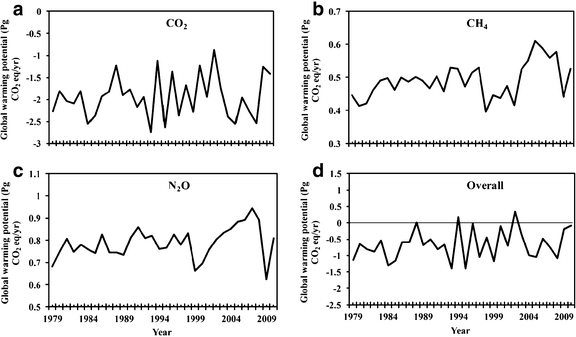
Based on DLEM simulated CO2, CH4 and N2O fluxes, our “best estimate” of the overall GWP in North American terrestrial ecosystems during 2001–2010 was −0.50 ± 0.27 (mean ± 2 SE) Pg CO2 eq/year (1 Pg = 1015 g), ranging from −1.08 Pg CO2 eq/year in 2008 to 0.34 Pg CO2 eq/year in 2002 (Table 1; Fig. 1). The overall GWP was calculated from net balance of three gases: CO2 (−1.83 ± 0.34 Pg CO2 eq/year), CH4 (0.52 ± 0.04 Pg CO2 eq/year), and N2O (0.82 ± 0.06 Pg CO2 eq/year). The terrestrial CO2 sink greatly reduced atmospheric radiative forcing; however, the emissions of CH4 and N2O could largely offset this cooling effect by a range of 58 % ~ 138 % (with a mean of 73 % ± 14 %; Table 1). The overall GWP had a wide range, yet it indicated that North American terrestrial ecosystems were generally contributing to climate cooling during the recent decade.
Table 1 CO2, CH4 and N2O fluxes and their overall global warming potential (Pg CO2 eq/year) in the 2000s as estimated by the DLEM model
Fig. 1
The alternative text for this image may have been generated using AI.
Interannual variations of global warming potential (Pg CO2 eq/year) for CO2 (a), CH4 (b), N2O (c) and their overall fluxes (c) during 1979–2010. Note Positive values indicate a potential net contribution to climate warming; the data was based on our previous publications (i.e., Tian et al. 2010; Xu et al. 2010, 2012)
3.2 Temporal patterns of GWP and contributions from multiple environmental factors
Due to the lack of other available data for simultaneously estimating CO2, CH4, and N2O fluxes over a long-term period, we used estimates from the DLEM model alone to analyze temporal patterns of GWP and contributions of multiple environmental factors during 1979–2010. Net GWP was negative during most years due to large carbon uptake in North America, with the largest negative values in 1993 (−1.39 Pg CO2 eq/year) and 1995 (−1.39 Pg CO2 eq/year); however, the positive GWP occurred in some years with extreme drought events, such as 1988 (0.02 Pg CO2 eq/year), 1994 (0.17 Pg CO2 eq/year), and 2002 (0.34 Pg CO2 eq/year) (Fig. 1). The GWP values in these three extreme dry years were significantly (P < 0.01) higher than those in normal years. It is notable that CH4 and N2O emissions offset the CO2 sink by 115 % and 138 % during 1994 and 2002, respectively, indicating that the terrestrial ecosystems in North America might act as a significant contributor to global warming due to extreme drought events.
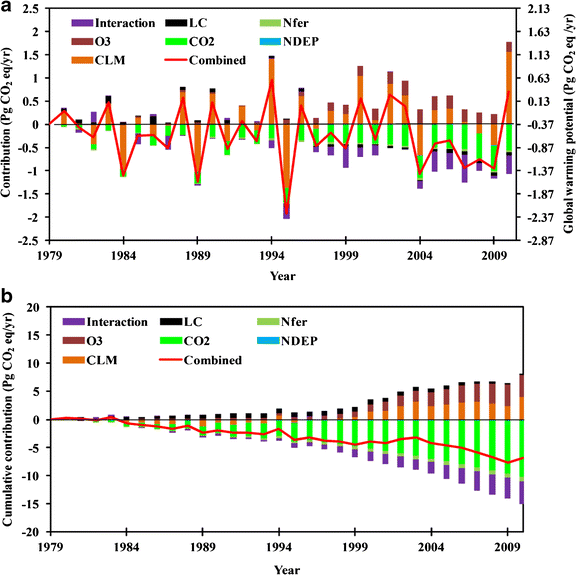
During 1979–2010, we found that interannual variation in overall GWP was largely determined by the fluxes of CO2, while CH4 and N2O emissions showed smaller variation. To identify the possible causes of GWP variation in North American terrestrial ecosystems, we conducted several factorial simulation experiments using the DLEM model. During 1979–2010, the interannual variation of the overall GWP was primarily determined by climate variability (R2 = 0.82; P < 0.05; Fig. 2a). Climate change increased GWP by 3.99 Pg CO2 eq in total during the study period, implying a positive feedback between climate change and global warming. Land use change increased GWP before 1997 and then reduced it after that, with a total increase of GWP by 0.23 Pg CO2 eq during the entire study period (Fig. 2b). Elevated atmospheric CO2 concentration was the largest contributor to the reduction of GWP (reduced GWP by 9.92 Pg CO2 eq) in North America, which resulted in a dilemma that increased atmospheric CO2 could directly lead to global warming while indirectly mitigating the warming trend through stimulating plant growth and carbon uptake. Increasing nitrogen deposition slightly reduced GWP by 0.20 Pg CO2 eq during 1979–2010. Although elevated nitrogen deposition resulted in a small CO2 sink (0.41 Pg CO2 eq), it caused an increase in N2O emission (Xu et al. 2012). Likewise, nitrogen fertilizer use in cropland resulted in a slight decrease in GWP since the nitrogen-stimulated CO2 sink was slightly larger than the increased N2O emission, which has also been previously reported (e.g., Del Grosso et al. 2006; Zaehle et al. [2011](/article/10.1007/s10584-014-1072-9#ref-CR55 "Zaehle S, Ciais P, Friend AD, Prieur V (2011) Carbon benefits of anthropogenic reactive nitrogen offset by nitrous oxide emissions. Nature Geosci 4. doi: 10.1038/NGEO1207
            "); Tian et al. [2011a](/article/10.1007/s10584-014-1072-9#ref-CR41 "Tian H, Xu X, Lu C et al. (2011a) Net exchanges of CO2, CH4, and N2O between China’s terrestrial ecosystems and the atmosphere and their contributions to global climate warming. J Geophy Res G02011, doi:
                10.1029/2010JG001393


            "), [2012c](/article/10.1007/s10584-014-1072-9#ref-CR45 "Tian H, Lu C, Melillo J et al (2012c) Food benefit and climate warming potential of nitrogen fertilizer uses in China. Environ Res Lett. doi:
                10.1088/1748-9326/7/4/044020


            ")). Our previous studies (i.e., Tian et al. [2011a](/article/10.1007/s10584-014-1072-9#ref-CR41 "Tian H, Xu X, Lu C et al. (2011a) Net exchanges of CO2, CH4, and N2O between China’s terrestrial ecosystems and the atmosphere and their contributions to global climate warming. J Geophy Res G02011, doi:
                10.1029/2010JG001393


            "), [2012b](/article/10.1007/s10584-014-1072-9#ref-CR44 "Tian H, Lu C, Chen G et al (2012b) Contemporary and projected biogenic fluxes of methane and nitrous oxide in terrestrial ecosystems of North America. Front Ecol Environ 10:528–536")) also implied that the nitrogen fertilizer-induced CO2 sink might be overturned by increasing CH4 and N2O sources if present-level or more fertilizer is applied in the near future. Through its effects on restraining plant growth, elevated tropospheric O3 concentration cumulatively increased GWP by 3.93 Pg CO2 eq (0.13 Pg CO2 eq/year) during the entire period, which is close to the contribution of climate change. Elevated O3 concentration resulted in large emissions of CO2 to the atmosphere though it slightly decreased N2O and CH4 emissions (Xu et al. [2012](/article/10.1007/s10584-014-1072-9#ref-CR54 "Xu X, Tian H, Chen G et al (2012) Multiple factor controls on terrestrial N2O flux over North America from 1979 through 2010. Biogeosciences 9:1351–1366")).
Fig. 2
The alternative text for this image may have been generated using AI.
Annual (a) and cumulative (b) contributions of different environmental factors to changes in global warming potential (Pg CO2 eq/year) in the terrestrial ecosystems of North America. The secondary Y-axis in (a) is the annual actual global warming potential under combined scenario (contribution of individual factors + baseline); Combined combined scenario (include all the environmental factors), LC land conversion, Nfer N fertilizer use, O 3 O3 pollution, CO 2 atmospheric CO2, NDEP N deposition, CLM climate variability, Interaction interaction among multiple factors calculated as: Combined – LC – Nfer – O 3 – CO 2 – NDEP – CLM
It is notable that interactive effects among multiple environmental factors resulted in a large net reduction in GWP of 4.07 Pg CO2 eq during the study period. This effect was close to that from climate change and tropospheric O3 pollution, implying that the interactive effect among multiple environmental factors is a significant effect and should not be neglected. Recently, some field experiments with a few manipulated environmental factors were conducted to examine GHG responses at several sites, such as the SPRUCE experiment site (http://mnspruce.ornl.gov/; experiment: warming + increased atmospheric CO2; target: CO2 and CH4 fluxes), the Duke Forest FACE site (Experiment: CO2 + nitrogen fertilization; target: CO2 and CH4 fluxes), and the Aspen FACE Experiment (Experiment: CO2 + ozone; target: CO2 flux). Future studies should have more field evidence to test model representation of interactive environmental effects.
Although the major sources for terrestrial CH4 (i.e., wetlands) and N2O (i.e., cropland) have been slightly shrinking in North America over the past century (Dahl 1990; CCSP 2007; EPA [2011](/article/10.1007/s10584-014-1072-9#ref-CR48 "US EPA (2011) Inventory of U.S. Greenhouse gas emissions and sinks: 1990–2009. United States Environmental Protection Agency. EPA 430-R-11-005. Available at: http://epa.gov/climatechange/emissions/usinventoryreport.html
. Accessed 09 Dec 2012")), the changes of other environmental factors such as climate, O3 pollution, and nitrogen fertilizer uses may still increase GWP. For example, large-scale drought events occurred in 2002 that have reduced the carbon sink by 20 % in the US alone (Xiao et al. [2011](/article/10.1007/s10584-014-1072-9#ref-CR51 "Xiao J, Zhuang Q, Law BE et al (2011) Assessing net ecosystem carbon exchange of U.S. Terrestrial ecosystems by integrating eddy covariance flux measurements and satellite observations. Agr For Meteorol 151:60–69")), on the other hand, CH4 and N2O emissions have not been greatly changed, resulting in a positive GWP in this year (Fig. [1](/article/10.1007/s10584-014-1072-9#Fig1)). As estimated (USGCRP [2009](/article/10.1007/s10584-014-1072-9#ref-CR50 "USGCRP (2009) Global climate change impacts in the United States. In: Karl TR, Melillo M, Peterson TC (eds) United States global change research program. Cambridge University Press, New York")), the US average temperature has increased more than 2 °F over the past 50 years and is projected to increase more in the future; the magnitude of resulting GWP change primarily depends on the amount of emitted heat-trapping gases (e.g., CH4, CO2 and N2O) and the sensitivity of climate to these emissions. Our study indicated that the decreased CO2 sink magnified the GWP increase caused by CH4 and N2O emissions under extreme climate events, suggesting GWP could be greatly increased due to more frequent climate extremes across North America in the future.3.3 Spatial characteristics of GWP in North America
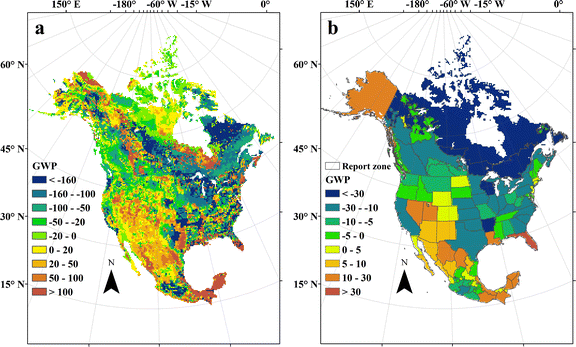
The spatial and temporal variations of environmental factors (i.e., nitrogen deposition, atmospheric CO2, land use and land cover, cropland management, and climate) led to large spatial heterogeneities of CO2, CH4, N2O fluxes and their overall GWP (Fig. 3). The overall GWP was generally negative in most areas of the eastern portion of North America, while positive values concentrated in the western and southern portions. The spatial distribution pattern of the overall GWP was more consistent with that of the CO2 fluxes than CH4 and N2O (Fig. 3a). The highest positive GWP (>100 g CO2 eq/m2/year) was generally located in wetland areas due to higher CH4 emissions and in the tropical forests of the eastern Mexico due to the higher CO2 and N2O emissions (Tian et al. 2010; Xu et al. 2012). The lowest negative GWP (<−160 g CO2 eq/m2/year) occurred in the southeastern and northeastern portions of North America. To further clarify the spatial patterns, we divided the study region as countries, reporting zones, and biome types.
Fig. 3
The alternative text for this image may have been generated using AI.
Spatial patterns of combined global warming potential for CO2, CH4 and N2O fluxes in North American terrestrial ecosystems during 2001–2010 (a: pixel level, unit: g CO2 eq/m2/year; b: reporting zones (delineated as Hayes et al. 2012, unit: Tg CO2 eq/year/zone)
There are large variations among the three countries in terms of their contributions to GWP. The US had the highest capability to reduce GWP (−0.53 ± 0.38 Pg CO2 eq/year) though a wider estimate range was obtained as compared to Canada and Mexico (Table 1). The US has acted as the highest N2O source and CO2 sink compared to the other two countries. GWP in Mexico is positive due to higher N2O emission than the terrestrial CO2 and CH4 uptake, where N2O and CH4 fluxes offset about 329 % ± 119 % of the CO2 sink. A small negative GWP (−0.09 ± 0.21 Pg CO2 eq/year) was found in Canada, due to a relatively high CO2 sink and low N2O emission, which has also been reported in previous studies, such as Chen et al. (2000), Kurz and Apps (1999), Tian et al. (2012b) and Xu et al. (2012). We further divided the three countries into 97 reporting zones based on the boundaries shown in Hayes et al. (2012). At reporting zone level, we found a positive GWP in Alaska, Nevada, Florida, Louisiana and most states in Mexico, indicating these zones were potential contributors to global warming (Fig. 3b); most zones in Canada and in the northern and central US were characterized by a negative GWP. The larger emissions of CH4 from wetlands and N2O fluxes from subtropical forests had offset the large CO2 sinks in Louisiana and Florida. The larger N2O emissions and smaller CO2 sinks in subtropical and tropical Mexico make most states in this country a positive GWP.
All biomes except wetland had negative GWP due to environmental changes, indicating a contribution to slow down global warming in these biomes (Table 2). Among them, forest (−0.48 Pg CO2 eq/year) was the largest CO2 and CH4 sink but it did not mitigate climate warming as much as we expected due to higher N2O emissions than other natural biome types. Wetland was a relatively large CO2 sink; however, CH4 emissions exceeded the CO2 sink, resulting in a positive GWP of 0.37 Pg CO2 eq/year. Due to intensive management practices such as irrigation and nitrogen fertilizer use, cropland became a very important CO2 sink over recent decades (Hayes et al. 2012), although it only covers about 11 % of the total land area of North America. Despite having the highest N2O emissions, the overall GWP of three gases in cropland was still negative and only second to forest, contributing to a reduction of climate warming under current environmental conditions. Grassland played a nearly neutral role to the overall GWP changes in North America. Other biome types (e.g., shrubland, urban lawn, and tundra) also had a negative GWP.
Table 2 CO2, CH4 and N2O fluxes and their overall global warming potential (Pg CO2 eq/year) for major biome types in North America during the recent decade
3.4 Uncertainty ranges of overall GWP
The DLEM simulation showed that 73 ± 14 % of the North American terrestrial CO2 sink was offset by CH4 and N2O emissions in the 2000s. If we include results from other continental-scale reports, the estimate spread would be wider. Given the CO2 sink estimates from forward modeling (i.e., 1.87 ± 1.51 Pg CO2 eq/year), inverse modeling (i.e., 3.41 ± 1.39 Pg CO2 eq/year), and inventory data (1.21 Pg CO2 eq/year) (Hayes et al. 2012; Huntzinger et al. 2012), the overall GWP of three GHGs was −0.53, −2.07, and 0.13 Pg CO2 eq/year, respectively. The CH4 and N2O emissions could offset 71 %, 39 %, and 111 % of the cooling effects from CO2 uptake as estimated by above approaches, respectively. It implies more research is needed to reconcile the estimated magnitude of CO2 balance in North American terrestrial ecosystems. If we consider the multi-source estimates of CO2, CH4 and N2O fluxes (Potter et al. 2006; CCSP 2007; Zhuang et al. 2007; Xiao et al. 2011; Hayes, et al. 2012; Huntzinger et al. 2012; Tian et al. 2012b), the spread of the offset ratio would be even broader (27–130 %, Supplementary Material Table S1). We found that CO2, CH4 and N2O fluxes ranged between −3.56– −1.17, 0.16–0.50, and 0.80–1.02 Pg CO2 eq/year, respectively (Fig. S3). The narrower range for N2O is due to less available data for comparisons. The DLEM-estimated terrestrial contribution to alleviate climate warming in terms of GWP (−0.50 ± 0.27 Pg CO2 eq/year) is slightly smaller than the mean value of all the existing estimates (−0.90 ± 1.33 Pg CO2 eq/year; Table S1).
By combining DLEM-estimated CH4 and N2O fluxes with CO2 flux estimates obtained from inverse modeling, forward modeling, and inventory-based estimates (Hayes et al. 2012; Huntzinger et al. 2012; King et al. 2012), we also examined the spatial variation in GWP uncertainty (Supplementary Material Fig. S3). All three methods showed a positive GWP in Alaska and some zones in the southern portion of North America, while most zones in the north-central US were characterized by negative GWP. According to the inventory-based estimate, most of the zones in Mexico, south-central US, West Pacific regions, and northern Canada had positive GWP. However, in terms of the inverse modeling results, all of the reporting zones in Canada and the US except Florida showed negative GWP. This indicated that the spatial pattern of estimated GWP still has large uncertainty. Therefore, further studies are needed to identify our knowledge gaps, diminish uncertainty ranges, and find convergence among GHG estimates from different approaches.
3.5 Implications, limitations and research needs
Both CH4 and N2O emissions were predicted to greatly increase in the near future due to environmental changes over different continents (US EPA 2012; Zaehle et al. [2011](/article/10.1007/s10584-014-1072-9#ref-CR55 "Zaehle S, Ciais P, Friend AD, Prieur V (2011) Carbon benefits of anthropogenic reactive nitrogen offset by nitrous oxide emissions. Nature Geosci 4. doi: 10.1038/NGEO1207
"); Schulze et al. [2009](/article/10.1007/s10584-014-1072-9#ref-CR36 "Schulze ED, Luyssaert S, Ciais P et al (2009) Importance of methane and nitrous oxide for Europe’s terrestrial greenhouse-gas balance. Nat Geosci 2:842–850"); Koven et al. [2011](/article/10.1007/s10584-014-1072-9#ref-CR22 "Koven CD, Ringeval B, Friedlingstein P, Ciais P, Cadule P, Khvorostyanov D, Krinner G, Tarnocai C (2011) Permafrost carbon-climate feedbacks accelerate global warming. Proc Natl Acad Sci U S A 108:14769–14774"); Tian et al. [2012b](/article/10.1007/s10584-014-1072-9#ref-CR44 "Tian H, Lu C, Chen G et al (2012b) Contemporary and projected biogenic fluxes of methane and nitrous oxide in terrestrial ecosystems of North America. Front Ecol Environ 10:528–536")). These predictions imply that climate warming may be accelerated by GHG emissions from North American terrestrial ecosystems, especially in the years with extreme climate events. Some management practices, such as nitrogen fertilizer use and manure application, have been reported to greatly increase carbon sequestration in cropland (CCSP [2007](/article/10.1007/s10584-014-1072-9#ref-CR3 "CCSP (2007) The first state of the carbon cycle report: the North American carbon budget and implications for the global carbon cycle. A report by the U.S. Climate Change Science Program and the Subcommittee on Global Change Research. In: King AW, Dilling L, Zimmerman GP et al (eds) National oceanic and atmospheric administration. National Climatic Data Center, Asheville, p 242")); however, our studies indicated these practices would also greatly increase N2O emission after a long-term application, especially when nitrogen saturation or fertilizer overuses occur (Tian et al. [2012a](/article/10.1007/s10584-014-1072-9#ref-CR43 "Tian H, Chen G, Zhang C et al (2012a) Century-scale responses of ecosystem carbon storage and flux to multiple environmental changes in the southern United States. Ecosystems 15:674–694"), [b](/article/10.1007/s10584-014-1072-9#ref-CR44 "Tian H, Lu C, Chen G et al (2012b) Contemporary and projected biogenic fluxes of methane and nitrous oxide in terrestrial ecosystems of North America. Front Ecol Environ 10:528–536"); Del Grosso et al. [2006](/article/10.1007/s10584-014-1072-9#ref-CR9 "Del Grosso SJ, Parton WJ, Mosier AR, Walsh MK, Ojima DS, Thornton PE (2006) DAYCENT national-scale simulations of nitrous oxide emissions from cropped soils in the United States. J Environ Qual 35:1451–1460")). Nitrogen fertilizer has been widely used in planted forests in the US (Fox et al. [2007](/article/10.1007/s10584-014-1072-9#ref-CR12 "Fox TR, Allen HL, Albaugh TJ, Rubilar RA, Carlson C (2007) Tree nutrition and forest fertilization of pine plantations in the southern United States. South J Appl For 31:5–11")); however, it is still uncertain how this affects N2O and CH4 fluxes though it increases carbon storage. Therefore, a comprehensive approach should be used to evaluate the consequences of these management practices on the combined GHG balance in North America in the future.As a process-based terrestrial ecosystem model, DLEM builds on the understanding of biogeochemical processes controlling C, N and water dynamics and can be used to simulate the dynamics of multiple ecosystem components (Tian et al. 2010). However, substantial uncertainties might exist in the ecosystem modeling results because some processes are still underrepresented (Hayes et al. 2012; Banger et al. [2012](/article/10.1007/s10584-014-1072-9#ref-CR1 "Banger K, Tian H, Lu C (2012) Do nitrogen fertilizers stimulate or inhibit methane emissions from rice fields? Glob Chang Biol 18:3259–3267. doi: 10.1111/j.1365-2486.2012.02762.x
            ")). For example, the hydrological processes in wetlands are not well-represented yet in most terrestrial ecosystem models, which could result in large uncertainties in simulating GHG fluxes, especially for CH4 and CO2 in wetlands (Riley et al. [2011](/article/10.1007/s10584-014-1072-9#ref-CR35 "Riley WJ, Subin ZM, Lawrence DM et al (2011) Barriers to predicting changes in global terrestrial methane fluxes: analyses using CLM4Me, a methane biogeochemistry model integrated in CESM. Biogeosciences 8:1925–1953"); Sulman et al. [2012](/article/10.1007/s10584-014-1072-9#ref-CR39 "Sulman BN, Desai AR, Schroeder NM, Ricciuto D, Barr A, Richardson AD, Flanagan LB, Lafleur PM, Tian H, Chen G, Grant RF, Poulter B, Verbeeck H, Ciais P, Ringeval B, Baker I, Schaefer K, Luo Y, Weng E (2012) Impact of hydrological variations on modeling of peatland CO2 fluxes: results from the North American Carbon Program site synthesis. J Geophys Res 117(G1):G01031. doi:
                10.1029/2011JG001862


            "); Melton et al. [2013](/article/10.1007/s10584-014-1072-9#ref-CR28 "Melton JR, Wania R, Hodson EL et al (2013) Present state of global wetland extent and wetland methane modelling: conclusions from a model inter-comparison project (WETCHIMP). Biogeosciences 10:753–788")). In addition, the model driving data also vary substantially. For example, there exist several series of climate data (e.g., CRU, NCEP1, NCEP2, CRUNCEP, etc.) and land use and land cover data (Spahni et al. [2011](/article/10.1007/s10584-014-1072-9#ref-CR38 "Spahni R, Wania R, Neef L et al (2011) Constraining global methane emissions and uptake by ecosystems. Biogeosciences 8:1643–1665"); Huntzinger et al. [2012](/article/10.1007/s10584-014-1072-9#ref-CR16 "Huntzinger DN, Post WM, Wei Y et al (2012) North American Carbon Program (NACP) regional interim synthesis: terrestrial biospheric model intercomparison. Ecol Model 232:144–157")), which may produce different modeling results. Besides, larger uncertainties also come from differences among various approaches.
To narrow down the estimate range, we need a better understanding of critical biogeochemical processes which control land–atmosphere GHG exchanges, interactions among multiple environmental factors, and classification and distribution of key vegetation cover types, such as natural wetland and inundation extent. A synthesis of the available data from multiple sources and a framework allowing full accounting of all three GHG fluxes will be applicable and urgent for global change research. Generating consistent input data, as well as conducting data-model integration and model-model intercomparison are important ways to decrease the existing uncertainties. Based on the standard model simulation procedures and consistent input data sets, the intercomparisons will identify and quantify uncertainty sources for various estimates of GHG budgets resulting from different model representations, structures and parameterizations. For land-atmosphere CO2 fluxes, several model-data integration and model-model intercomparision projects have been or are being conducted for the North America, for example, the NACP and Multi-scale Synthesis and Terrestrial Model Intercomparison Project (MsTMIP) (Huntzinger et al. [2013](/article/10.1007/s10584-014-1072-9#ref-CR17 "Huntzinger DN, Schwalm C, Michalak AM et al (2013) The North American Carbon program multi-scale synthesis and terrestrial model intercomparison project—part 1: overview and experimental design. Geosci Model Dev 6:2121–2133. doi: 10.5194/gmd-6-2121-2013
")). Unfortunately, there are no such synthesis activities for N2O and CH4 for this region. Therefore, for future research, we call for multi-constraint synthesis including inventories, field observations, inverse and forward modeling to achieve a “best estimate” of GHG balance and better understand the underlying mechanisms responsible for land-atmosphere GHG exchange in North America.References
- Banger K, Tian H, Lu C (2012) Do nitrogen fertilizers stimulate or inhibit methane emissions from rice fields? Glob Chang Biol 18:3259–3267. doi:10.1111/j.1365-2486.2012.02762.x
Article Google Scholar - Blankinship JC, Brown JR, Dijkstra P, Hungate BA (2010) Effects of interactive global changes on methane uptake in annual grassland. J Geophys Res 115:1–9
Google Scholar - CCSP (2007) The first state of the carbon cycle report: the North American carbon budget and implications for the global carbon cycle. A report by the U.S. Climate Change Science Program and the Subcommittee on Global Change Research. In: King AW, Dilling L, Zimmerman GP et al (eds) National oceanic and atmospheric administration. National Climatic Data Center, Asheville, p 242
Google Scholar - Chen J, Chen W, Liu J, Cihlar J, Gray S (2000) Annual carbon balance of Canada’s forests during 1895–1996. Glob Biogeochem Cycles 14:839–849
Article Google Scholar - Chen G, Tian HQ, Zhang C et al (2012) Drought in the Southern United States over the 20th century: variability and its impacts on terrestrial ecosystem productivity and carbon storage. Clim Chang 114:379–397
Article Google Scholar - Chen G, Tian H, Huang C, Prior SA, Pan S (2013) Integrating a process-based ecosystem model with Landsat imagery to assess impacts of forest disturbance on terrestrial carbon dynamics: case studies in Alabama and Mississippi. J Geophys Res 118:1208–1224
Google Scholar - Dacey JWH, Drake BG, Klug MJ (1994) Stimulation of methane emission by carbon dioxide enrichment of marsh vegetation. Nature 370:47–49
Article Google Scholar - Dahl TE (1990) Wetlands losses in the United States 1780s to 1980s. U.S. Department of the Interior, Fish and Wildlife Service, Washington, D.C., p 13
Google Scholar - Del Grosso SJ, Parton WJ, Mosier AR, Walsh MK, Ojima DS, Thornton PE (2006) DAYCENT national-scale simulations of nitrous oxide emissions from cropped soils in the United States. J Environ Qual 35:1451–1460
Article Google Scholar - Dijkstra FA, Prior SA, Runion GB et al (2012) Effects of elevated carbon dioxide and increased temperature on methane and nitrous oxide fluxes: evidence from field experiments. Front Ecol Environ 10:520–527
Article Google Scholar - Forster P, Ramaswamy V, Artaxo P et al (2007) Changes in atmospheric constituents and in radiative forcing. In: Solomon S, Qin D, Manning M, Chen Z (eds) Climate change 2007: The physical science basis. Contribution of working group I to the fourth assessment report of the intergovernmental panel on climate change. Cambridge University Press, Cambridge
Google Scholar - Fox TR, Allen HL, Albaugh TJ, Rubilar RA, Carlson C (2007) Tree nutrition and forest fertilization of pine plantations in the southern United States. South J Appl For 31:5–11
Google Scholar - Hansen J, Sato M, Ruedy R, Lacis A, Oinas V (2000) Global warming in the twenty-first century: an alternative scenario. Proc Natl Acad Sci U S A 97:9875–9880
Article Google Scholar - Hayes DJ, Turner DP, Stinson G et al (2012) Reconciling estimates of the contemporary North American carbon balance among terrestrial biosphere models, atmospheric inversions, and a new approach for estimating net ecosystem exchange from inventory-based data. Glob Chang Biol 18:1282–1299
Article Google Scholar - Huang Y, Sun W, Zhang W, Yu Y, Su Y, Song C (2010) Marshland conversion to cropland in northeast China from 1950 to 2000 reduced the greenhouse effect. Glob Chang Biol 16:680–695
Article Google Scholar - Huntzinger DN, Post WM, Wei Y et al (2012) North American Carbon Program (NACP) regional interim synthesis: terrestrial biospheric model intercomparison. Ecol Model 232:144–157
Article Google Scholar - Huntzinger DN, Schwalm C, Michalak AM et al (2013) The North American Carbon program multi-scale synthesis and terrestrial model intercomparison project—part 1: overview and experimental design. Geosci Model Dev 6:2121–2133. doi:10.5194/gmd-6-2121-2013
Article Google Scholar - Ineson P, Coward P, Hartwig U (1998) Soil gas fluxes of N2O, CH4 and CO2 beneath Lolium perenne under elevated CO2: the Swiss free air carbon dioxide enrichment experiment. Plant Soil 198:89–95
Article Google Scholar - Kanerva T, Palojärvi A, Rämöa K, Manninen S (2008) Changes in soil microbial community structure under elevated tropospheric O3 and CO2. Soil Biol Biochem 40:2502–2510
Article Google Scholar - Kettunen R, Saarnio S, Martikainen PJ, Silvola J (2005) Elevated CO2 concentration and nitrogen fertilisation effects on N2O and CH4 fluxes and biomass production of Phleum pretense on farmed peat soil. Soil Biol Biochem 37:739–750
Article Google Scholar - King AW, Hayes DJ, Huntzinger DN, West TO, Post WM (2012) North American carbon dioxide sources and sinks: magnitude, attribution, and uncertainty. Front Ecol Environ 10:512–519
Article Google Scholar - Koven CD, Ringeval B, Friedlingstein P, Ciais P, Cadule P, Khvorostyanov D, Krinner G, Tarnocai C (2011) Permafrost carbon-climate feedbacks accelerate global warming. Proc Natl Acad Sci U S A 108:14769–14774
Article Google Scholar - Kurz WA, Apps MJ (1999) A 70-year retrospective analysis of carbon fluxes in the Canadian forest sector. Ecol Appl 9:526–547
Article Google Scholar - Li CS, Narayanan V, Harriss RC (1996) Model estimates of nitrous oxide emissions from agricultural lands in the United States. Glob Biogeochem Cycles 10:297–306
Article Google Scholar - Liu M, Tian H, Yang Q, Yang J, Song X, Lohrenz SE, Cai WJ (2013) Long-term trends in evapotranspiration and runoff over the drainage basins of the Gulf of Mexico during 1901–2008. Water Resour Res 49:1988–2012
Article Google Scholar - Lu C, Tian H (2013) Net greenhouse gas balance in response to nitrogen enrichment: perspectives from a coupled biogeochemical model. Glob Chang Biol 19:571–588
Article Google Scholar - Lu C, Tian H, Liu M, Ren W, Xu X, Chen G, Zhang C (2012) Effect of nitrogen deposition on China’s terrestrial carbon uptake in the context of multifactor environmental changes. Ecol Appl 22:53–75
Article Google Scholar - Melton JR, Wania R, Hodson EL et al (2013) Present state of global wetland extent and wetland methane modelling: conclusions from a model inter-comparison project (WETCHIMP). Biogeosciences 10:753–788
Article Google Scholar - Miller SM, Kort EA, Hirsch AI et al (2012) Regional sources of nitrous oxide over the United States: seasonal variation and spatial distribution. J Geophys Res. doi:10.1029/2011JD016951
Google Scholar - Pancotto VA, Bodegom, PM van, Hal JR van et al. (2010) N deposition and elevated CO2 on methane emissions: differential responses of indirect effects compared to direct effects through litter chemistry feedbacks. J Geophys Res 115. doi:10.1029/2009JG001099
- Potter CS, Klooster S, Hiatt S et al (2006) Methane emissions from natural wetlands in the United States: satellite-derived estimation based on ecosystem carbon cycling. Earth Interact 10:Paper 10–Paper 022
Article Google Scholar - Ren W, Tian H, Tao B et al (2012) Impacts of ozone pollution and climate change on net primary productivity and carbon storage of China’s forest ecosystems as assessed by using a process-based ecosystem model. Global Ecol Biogeogr 20(3):391–406
Google Scholar - Ren W, Tian H, Xu X et al (2011) Spatial and temporal patterns of CO2 and CH4 fluxes in China’s croplands in response to multifactor environmental changes. Tellus B 63:222–240
Article Google Scholar - Rigby M, Prinn RG, Fraser PJ et al (2008) Renewed growth of atmospheric methane. Geophys Res Lett 35, L22805. doi:10.1029/2008GL036037
Article Google Scholar - Riley WJ, Subin ZM, Lawrence DM et al (2011) Barriers to predicting changes in global terrestrial methane fluxes: analyses using CLM4Me, a methane biogeochemistry model integrated in CESM. Biogeosciences 8:1925–1953
Article Google Scholar - Schulze ED, Luyssaert S, Ciais P et al (2009) Importance of methane and nitrous oxide for Europe’s terrestrial greenhouse-gas balance. Nat Geosci 2:842–850
Article Google Scholar - Schwalm CR, Williams CA, Schaefer K et al (2010) A model-data intercomparison of CO2 exchange across North America: Results from the North American Carbon Program Site Synthesis. J Geophys Res. doi:10.1029/2009JG001229
- Spahni R, Wania R, Neef L et al (2011) Constraining global methane emissions and uptake by ecosystems. Biogeosciences 8:1643–1665
Article Google Scholar - Sulman BN, Desai AR, Schroeder NM, Ricciuto D, Barr A, Richardson AD, Flanagan LB, Lafleur PM, Tian H, Chen G, Grant RF, Poulter B, Verbeeck H, Ciais P, Ringeval B, Baker I, Schaefer K, Luo Y, Weng E (2012) Impact of hydrological variations on modeling of peatland CO2 fluxes: results from the North American Carbon Program site synthesis. J Geophys Res 117(G1):G01031. doi:10.1029/2011JG001862
Google Scholar - Tian H, Xu X, Liu M et al (2010) Spatial and temporal patterns of CH4 and N2O fluxes in terrestrial ecosystems of North America during 1979–2008: application of a global biogeochemistry model. Biogeosciences 7:2673–2694
Article Google Scholar - Tian H, Xu X, Lu C et al. (2011a) Net exchanges of CO2, CH4, and N2O between China’s terrestrial ecosystems and the atmosphere and their contributions to global climate warming. J Geophy Res G02011, doi: 10.1029/2010JG001393
- Tian H, Melillo J, Lu C et al (2011b) China’s terrestrial carbon balance: contributions from multiple global change factors. Glob Biogeochem Cycles. doi:10.1029/2010GB003838
Google Scholar - Tian H, Chen G, Zhang C et al (2012a) Century-scale responses of ecosystem carbon storage and flux to multiple environmental changes in the southern United States. Ecosystems 15:674–694
Article Google Scholar - Tian H, Lu C, Chen G et al (2012b) Contemporary and projected biogenic fluxes of methane and nitrous oxide in terrestrial ecosystems of North America. Front Ecol Environ 10:528–536
Article Google Scholar - Tian H, Lu C, Melillo J et al (2012c) Food benefit and climate warming potential of nitrogen fertilizer uses in China. Environ Res Lett. doi:10.1088/1748-9326/7/4/044020
Google Scholar - Tian H, Chen G, Lu C et al (2013) Global land-atmosphere exchange of methane and nitrous oxide: magnitude and spatiotemporal patterns. Biogeosci Discuss 10:19811–19865
Article Google Scholar - Toet S, Ineson P, Peacock S, Ashmore M (2011) Elevated ozone reduces methane emissions from peatland mesocosms. Glob Chang Biol 17:288–296
Article Google Scholar - US EPA (2011) Inventory of U.S. Greenhouse gas emissions and sinks: 1990–2009. United States Environmental Protection Agency. EPA 430-R-11-005. Available at: http://epa.gov/climatechange/emissions/usinventoryreport.html. Accessed 09 Dec 2012
- US EPA (2012) Summary report: global anthropogenic Non-CO2 greenhouse gas emissions: 1990–2030. EPA, Office of Atmospheric Programs, Washington, DC
Google Scholar - USGCRP (2009) Global climate change impacts in the United States. In: Karl TR, Melillo M, Peterson TC (eds) United States global change research program. Cambridge University Press, New York
Google Scholar - Xiao J, Zhuang Q, Law BE et al (2011) Assessing net ecosystem carbon exchange of U.S. Terrestrial ecosystems by integrating eddy covariance flux measurements and satellite observations. Agr For Meteorol 151:60–69
Article Google Scholar - Xu X, Tian H (2012) Methane exchange between marshland and the atmosphere over China during 1949–2008. Glob Biogeochem Cycles. doi:10.1029/2010GB003946
Google Scholar - Xu X, Tian H, Zhang C et al (2010) Attribution of spatial and temporal variations in terrestrial methane flux over North America. Biogeosciences 7:3637–3655
Article Google Scholar - Xu X, Tian H, Chen G et al (2012) Multiple factor controls on terrestrial N2O flux over North America from 1979 through 2010. Biogeosciences 9:1351–1366
Article Google Scholar - Zaehle S, Ciais P, Friend AD, Prieur V (2011) Carbon benefits of anthropogenic reactive nitrogen offset by nitrous oxide emissions. Nature Geosci 4. doi:10.1038/NGEO1207
- Zhang C, Tian H, Chen G et al (2012) Impacts of urbanization on carbon balance in terrestrial ecosystems of the Southern United States. Environ Pollut 164:89–101
Article Google Scholar - Zhuang Q, Melillo JM, McGuire AD et al (2007) Net emissions of CH4 and CO2 in Alaska: implications for the region’s greenhouse gas budget. Ecol Appl 17:203–212
Article Google Scholar