Awareness of Nonalcoholic Fatty Liver Disease Is Increasing but Remains Very Low in a Representative US Cohort (original) (raw)
Abstract
Background
Nonalcoholic fatty liver disease (NAFLD) has become the most common form of chronic liver disease in the USA. Interestingly, most patients with NAFLD are unaware of having any liver disease (LD). We aimed to assess the awareness of suspected NAFLD and factors associated with being aware of LD.
Methods
Adult subjects with suspected NAFLD (BMI > 25) with elevated ALT in the absence of secondary causes of LD who participated in the continuous national health and nutrition examination survey (NHANES) during 2001–2016 were identified and analyzed. Trends of NAFLD awareness were then assessed in periods of 4 years each. Multivariable logistic regression analysis was performed to assess factors associated with LD awareness.
Results
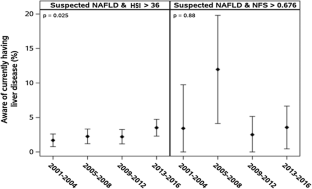
A total of 7033 subjects were included in the final analysis (1731, 1757, 1711, and 1834 subjects for the periods of 2001–2004, 2005–2008, 2009–2012, and 2013–2016, respectively). Over the study duration, an increase in BMI, waist circumference, diabetes, and HbA1c; and a decrease in the number of smokers, platelets count, bilirubin, total cholesterol, and LDL level were noticed (p < 0.001). Awareness of having LD across study periods has increased over time from 1.5% in the 2001–2004 periods to 3.1% in the 2013–2016 periods. Multivariable logistic regression analysis showed that older age, ethnicity (non-black), having fewer drinks/week, metabolic syndrome, higher ALT, ALP, and GGT were associated with being aware of having LD.
Conclusions
Awareness of having LD among subjects with suspected NAFLD has increased over the last two decades, but more than 95% of these patients are still unaware of having LD. Educational programs to increase awareness of LD and risk factors for NAFLD should be implemented on a large scale.
Clinical Trial Registration Number
Not required, as we used de-identified NHANES data.
Access this article
Subscribe and save
- Starting from 10 chapters or articles per month
- Access and download chapters and articles from more than 300k books and 2,500 journals
- Cancel anytime View plans
Buy Now
Price excludes VAT (USA)
Tax calculation will be finalised during checkout.
Instant access to the full article PDF.
Fig. 1
Abbreviations
AF:
Advanced fibrosis
AST:
Aspartate aminotransferase
ALT:
Alanine aminotransferase
APRI:
AST to platelet ration index
BMI:
Body mass index
CDC:
Centers for disease control and prevention
ESLD:
End-stage liver disease
FIB-4:
Fibrosis-4
GGT:
_γ_-Glutamyl transpeptidase
HSI:
Hepatic steatosis index
HDL:
High-density lipoprotein
HbA1c:
Hemoglobin A1c
IDF:
International diabetes federation
LDL:
Low-density lipoprotein
LD:
Liver disease
MCQ:
“Medical conditions” questionnaire
MetS:
Metabolic syndrome
NHANES:
National health and nutrition examination survey
NAFLD:
Nonalcoholic fatty liver disease
NFS:
NAFLD fibrosis score
NASH:
Nonalcoholic steatohepatitis
NCHS:
National center for health statistics
ULN:
Upper limit of normal
References
- Younossi ZM, Koenig AB, Abdelatif D, Fazel Y, Henry L, Wymer M. Global epidemiology of nonalcoholic fatty liver disease-Meta-analytic assessment of prevalence, incidence, and outcomes. Hepatology (Baltimore, Md).. 2016;64:73–84.
Article Google Scholar - Wong RJ, Liu B, Bhuket T. Significant burden of nonalcoholic fatty liver disease with advanced fibrosis in the US: a cross-sectional analysis of 2011–2014 National Health and Nutrition Examination Survey. Aliment Pharmacol Ther. 2017;46:974–980.
Article CAS Google Scholar - Kabbany MN, Conjeevaram Selvakumar PK, Watt K, et al. Prevalence of nonalcoholic steatohepatitis-associated cirrhosis in the United States: an analysis of national health and nutrition examination survey data. Am J Gastroenterol. 2017;112:581–587.
Article Google Scholar - Noureddin M, Vipani A, Bresee C, et al. NASH leading cause of liver transplant in women: updated analysis of indications for liver transplant and ethnic and gender variances. Am J Gastroenterol. 2018;113:1649–1659.
Article Google Scholar - Marchesini G, Brizi M, Bianchi G, et al. Nonalcoholic fatty liver disease: a feature of the metabolic syndrome. Diabetes. 2001;50:1844–1850.
Article CAS Google Scholar - Wieland AC, Mettler P, McDermott MT, Crane LA, Cicutto LC, Bambha KM. Low awareness of nonalcoholic fatty liver disease among patients at high metabolic risk. J Clin Gastroenterol. 2015;49:e6–e10.
Article CAS Google Scholar - Mozumdar A, Liguori G. Persistent increase of prevalence of metabolic syndrome among U.S. adults: NHANES III to NHANES 1999–2006. Diabetes Care. 2011;34:216–219.
Article Google Scholar - Adams LA, Lymp JF, St Sauver J, et al. The natural history of nonalcoholic fatty liver disease: a population-based cohort study. Gastroenterology. 2005;129:113–121.
Article Google Scholar - Sanna C, Rosso C, Marietti M, Bugianesi E. Nonalcoholic fatty liver disease and extra-hepatic cancers. Int J Mol Sci. 2016;17:717.
Article Google Scholar - Yasui K, Sumida Y, Mori Y, et al. Nonalcoholic steatohepatitis and increased risk of chronic kidney disease. Metab Clin Exp. 2011;60:735–739.
Article CAS Google Scholar - Yan LH, Mu B, Guan Y, et al. Assessment of the relationship between nonalcoholic fatty liver disease and diabetic complications. J Diabetes Investig. 2016;7:889–894.
Article CAS Google Scholar - Leung CM, Lai LS, Wong WH, et al. Nonalcoholic fatty liver disease: an expanding problem with low levels of awareness in Hong Kong. J Gastroenterol Hepatol. 2009;24:1786–1790.
Article Google Scholar - Federation ID. The IDF Consensus Worldwide Definition of the Metabolic Syndrome 2011. https://www.pitt.edu/~super1/Metabolic/IDF1.pdf. Accessed 30 Jan 2019.
- Lee JH, Kim D, Kim HJ, et al. Hepatic steatosis index: a simple screening tool reflecting nonalcoholic fatty liver disease. Dig Liver Dis: Off J Ital Soc Gastroenterol Ital Assoc Study Liver. 2010;42:503–508.
Article CAS Google Scholar - Johnson CL, Paulose-Ram R, Ogden CL, et al. National health and nutrition examination survey: analytic guidelines, 1999–2010. Vital Health Stat. 2013;2:1–24.
Google Scholar - Kim D, Kim WR. Nonobese Fatty Liver Disease. Clin Gastroenterol Hepatol: Off Clin Pract J Am Gastroenterol Assoc. 2017;15:474–485.
Article CAS Google Scholar - Yilmaz Y. Is nonalcoholic fatty liver disease the hepatic expression of the metabolic syndrome? World J Hepatol. 2012;4:332–334.
Article Google Scholar - Dyson JK, Anstee QM, McPherson S. Nonalcoholic fatty liver disease: a practical approach to diagnosis and staging. Frontline Gastroenterol. 2014;5:211–218.
Article CAS Google Scholar - Lee MJ, Kim EH, Bae SJ, et al. Age-related decrease in skeletal muscle mass is an independent risk factor for incident nonalcoholic fatty liver disease: a 10-year retrospective cohort study. Gut Liver. 2019;13:67–76.
Article Google Scholar - Lazo M, Hernaez R, Eberhardt MS, et al. Prevalence of nonalcoholic fatty liver disease in the United States: the third national health and nutrition examination survey, 1988–1994. Am J Epidemiol. 2013;178:38–45.
Article Google Scholar - Coogan PE, Wise LA, Cozier YC, Palmer JR, Rosenberg L. Lifecourse educational status in relation to weight gain in African American women. Ethn Dis. 2012;22:198–206.
PubMed PubMed Central Google Scholar - Bergqvist CJ, Skoien R, Horsfall L, Clouston AD, Jonsson JR, Powell EE. Awareness and opinions of nonalcoholic fatty liver disease by hospital specialists. Intern Med J. 2013;43:247–253.
Article Google Scholar - Grattagliano I, D’Ambrosio G, Palmieri VO, et al. Improving nonalcoholic fatty liver disease management by general practitioners: a critical evaluation and impact of an educational training program. J Gastrointestin Liver Dis. 2008;17:389–394.
PubMed Google Scholar - Polanco-Briceno S, Glass D, Stuntz M, Caze A. Awareness of nonalcoholic steatohepatitis and associated practice patterns of primary care physicians and specialists. BMC Res Notes. 2016;9:157.
Article Google Scholar - Singh Sp MB, Misra D, Pati GK, et al. Awareness and opinion of nonalcoholic fatty liver disease (NAFLD) patients about obesity and its consequences. J Hepatol. 2014;60:S352.
Google Scholar - Zelber-Sagi S, Nitzan-Kaluski D, Goldsmith R, et al. Long term nutritional intake and the risk for nonalcoholic fatty liver disease (NAFLD): a population based study. J Hepatol. 2007;47:711–717.
Article CAS Google Scholar - Singh SP, Singh A, Misra D, et al. Risk factors associated with nonalcoholic fatty liver disease in Indians: a case-control study. J Clin Exp Hepatol. 2015;5:295–302.
Article Google Scholar - Modi AA, Feld JJ, Park Y, et al. Increased caffeine consumption is associated with reduced hepatic fibrosis. Hepatology (Baltimore, Md).. 2010;51:201–209.
Article CAS Google Scholar - Kistler KD, Brunt EM, Clark JM, et al. Physical activity recommendations, exercise intensity, and histological severity of nonalcoholic fatty liver disease. Am J Gastroenterol. 2011;106:460–468. quiz 469.
Article Google Scholar - Goldberg RB, Temprosa M, Haffner S, et al. Effect of progression from impaired glucose tolerance to diabetes on cardiovascular risk factors and its amelioration by lifestyle and metformin intervention: the Diabetes Prevention Program randomized trial by the Diabetes Prevention Program Research Group. Diabetes Care. 2009;32:726–732.
Article CAS Google Scholar
Author information
Authors and Affiliations
- Department of Gastroenterology, Hepatology and Nutrition, Center for Human Nutrition, A5 Annex, Cleveland Clinic Foundation, 9500 Euclid Avenue, Cleveland, OH, 44195, USA
Amandeep Singh - Department of Gastroenterology, Hepatology and Nutrition, Digestive Diseases and Surgery Institute, Cleveland Clinic, Cleveland, OH, USA
Amandeep Singh, William Carey & Arthur McCullough - University of Nebraska Medical Center, Omaha, NE, USA
Amaninder S. Dhaliwal & Shailainder Singh - Department of Gastroenterology and Hepatology, Stony Brook University, New York, USA
Atul Kumar - Center for Populations Health Sciences and Quantitative Health Sciences, Cleveland Clinic Foundation, Cleveland, OH, USA
Rocio Lopez - Department of Hospital Medicine, Cleveland Clinic, Cleveland, OH, USA
Mohit Gupta - Cedar-Sinai Medical Center, Los Angeles, CA, USA
Mazen Noureddin - Texas Liver Institute, University of Texas (UT) Health, San Antonio, TX, USA
Naim Alkhouri
Authors
- Amandeep Singh
- Amaninder S. Dhaliwal
- Shailainder Singh
- Atul Kumar
- Rocio Lopez
- Mohit Gupta
- Mazen Noureddin
- William Carey
- Arthur McCullough
- Naim Alkhouri
Contributions
AS, ASD, MG, and NA helped in study concept and design; AS contributed to acquisition of data; all authors helped in analysis and interpretation of data, drafting of the manuscript and critical revision of the manuscript for important intellectual content, and administrative, technical, or material support; RL, AS, and NA contributed to statistical analysis; ASD, SS, AK, AK, MN, WC, AM, and NA contributed to study supervision.
Corresponding author
Correspondence toAmandeep Singh.
Ethics declarations
Conflict of interest
The authors declare that they have no conflict of interest.
Additional information
Publisher's Note
Springer Nature remains neutral with regard to jurisdictional claims in published maps and institutional affiliations.
Rights and permissions
About this article
Cite this article
Singh, A., Dhaliwal, A.S., Singh, S. et al. Awareness of Nonalcoholic Fatty Liver Disease Is Increasing but Remains Very Low in a Representative US Cohort.Dig Dis Sci 65, 978–986 (2020). https://doi.org/10.1007/s10620-019-05700-9
- Received: 04 January 2019
- Accepted: 04 June 2019
- Published: 11 June 2019
- Version of record: 11 June 2019
- Issue date: April 2020
- DOI: https://doi.org/10.1007/s10620-019-05700-9