Agricultural land use change in fertile areas (basic agriculture) in Southwestern Iran: lessons learned from a qualitative study (original) (raw)
1 Introduction
Land is a vital natural resource, and land use changes represent some of the most profound human-induced transformations of the environment. These changes can have considerable consequences for societies, affecting food accessibility and employment opportunities (Winklera et al., [2018](/article/10.1007/s10668-025-06800-5#ref-CR74 "Winklera, K. J., Scowna, M. W., & Nicholasa, K. A. (2018). A classification to align social-ecological land systems research with policy in Europe. Land Use Policy, 79, 137–145. https://doi.org/10.1016/j.landusepol.2018.06.034
          "); Savari et al., [2022](/article/10.1007/s10668-025-06800-5#ref-CR60 "Savari, M., Yazdanpanah, M., & Rouzaneh, D. (2022). Factors affecting the implementation of soil conservation practices among Iranian farmers. Scientific Reports, 12(1), 8396.")). The current global population of 7.6 billion people is projected to rise to 11.2 billion by 2100 (United Nations, [2017](/article/10.1007/s10668-025-06800-5#ref-CR70 "United Nations. (2017). World population projected to reach 9.8 billion in 2050, and 11.2 billion in 2100. Department of economic and social affairs. Retrieved from
            http://www.un.org/development/desa/en/news/population/world-population-prospects-2017.html

          ")), with an estimated increase of 83 million people added annually. As the population grows, the demand for agricultural production is expected to surge, potentially rising to 80% by 2100 (Sharma et al., [2017](/article/10.1007/s10668-025-06800-5#ref-CR64 "Sharma, S., Kooner, R., & Arora, R. (2017). Insect pests and crop losses. Breeding insect-resistant crops for sustainable agriculture (pp. 45–66). Springer.
            https://link.springer.com/chapter/


            https://doi.org/10.1007/978-981-10-6056-4_2

          "); Delfiyan et al., [2021](/article/10.1007/s10668-025-06800-5#ref-CR21 "Delfiyan, F., Yazdanpanah, M., Forouzani, M., & Yaghoubi, J. (2021). Farmers’ adaptation to drought risk through farm–level decisions: The case of farmers in Dehloran county, southwest of Iran. Climate and Development, 13(2), 152–163."); Pakmehr et al., [2021](/article/10.1007/s10668-025-06800-5#ref-CR53 "Pakmehr, S., Yazdanpanah, M., & Baradaran, M. (2021). Explaining farmers’ response to climate change-induced water stress through cognitive theory of stress: An Iranian perspective. Environment, Development and Sustainability, 23(4), 5776–5793."); Ataei et al., [2021](/article/10.1007/s10668-025-06800-5#ref-CR9 "Ataei, P., Sadighi, H., & Izadi, N. (2021). Major challenges to achieving food security in rural Iran. Rural Society, 30(1), 15–31.")).
This increasing demand for agricultural products with existing farming practices is likely to stiff competition for access to natural resources, resulting in deforestation and land degradation. Consequently, the pressure to feed a growing population will escalate resource use (Yazdanpanah et al., 2015; FAO, [2017](/article/10.1007/s10668-025-06800-5#ref-CR26 "FAO. (2017). Water for sustainable food and agriculture. A report produced for the G20 presidency of Germany, food and agriculture organization of the United Nations, Rome. https://openknowledge.fao.org/server/api/core/bitstreams/b48cb758-48bc-4dc5-a508-e5a0d61fb365/content
"); Savari et al., [2025](/article/10.1007/s10668-025-06800-5#ref-CR61 "Savari, M., Yazdanpanah, M., & Rouzaneh, D. (2025). Applying conservation agriculture practices as a strategy to control soil erosion and carbon sequestration. Results in Engineering, 26, 104854."); Ataei et al., [2022](/article/10.1007/s10668-025-06800-5#ref-CR10 "Ataei, P., Sadighi, H., Abbasi, E., & Chizari, M. (2022). Transfer of sustainability training in land and conservation agriculture project: A behavioral study in Iran. Frontiers in Sustainable Food Systems, 6, 1051930.")), particularly since most agricultural land is being diverted for non-agricultural purposes.The increase in agricultural land usage often leads to the transformation, fragmentation, and destruction of productive agricultural land (Niemand, [2011](/article/10.1007/s10668-025-06800-5#ref-CR49 "Niemand, B. (2011). Transformation of agricultural and undeveloped land in the Boland region of the western cape. Thesis presented in partial fulfilment of the requirements for the degree of Master of Arts in the Faculty of Arts and Social Sciences at Stellenbosch University. https://scholar.sun.ac.za/server/api/core/bitstreams/d82e3dd7-c4e0-4499-af64-4a3e3a84e39b/content
          ")). Furthermore, soil serves as the foundation for all agricultural activities and acts as an intermediary between agriculture and the environment. Serious soil degradation, which threatens the productivity of various soils, is currently evident worldwide (Fanelli, [2019](/article/10.1007/s10668-025-06800-5#ref-CR25 "Fanelli, R. M. (2019). The (un) sustainability of the land use practices and agricultural production in EU countries. International Journal of Environmental Studies, 76(2), 273–294.
            https://doi.org/10.1080/00207233.2018.1560761

          ")). Additionally, agricultural land is a non-renewable resource that serves as a pillar of agricultural activities. It takes many years for land to become productive under proper agricultural practices. Furthermore, clearing new land is expensive, and rehabilitating land that has been used for non-agricultural activities is both costly and time-consuming, making it challenging to return to the production cycle (Doucet, [2016](/article/10.1007/s10668-025-06800-5#ref-CR24 "Doucet, R. (2016). Agricultural land policy consultations-what was said. Available at:
            https://www2.gnb.ca/content/dam/gnb/Departments/

          ")).
As population and economy grow, productive lands in some countries are being converted into non-agricultural uses. This transformation results in extensive changes in land use and land cover, which exacerbate environmental instability, including degradation, erosion, and contamination of air, water, and soil (Valbuena et al., [2010](/article/10.1007/s10668-025-06800-5#ref-CR71 "Valbuena, D., Verburg, P. H., Bregt, A. K., & Ligtenberg, A. (2010). An agent-based approach to model land-use change at a regional scale. Landscape Ecology, 25(2), 185–199. https://doi.org/10.1007/s10980-009-9380-6
          ")). Additionally, increasing food production through intensive agricultural systems that rely on high inputs intensifies the pressure on natural resources. This shift contributes to landscape change, land-use change, deforestation, and increased greenhouse gas emissions (Lombardi et al., [2019](/article/10.1007/s10668-025-06800-5#ref-CR39 "Lombardi, G. V., Atzori, R., Acciaioli, A., Giannetti, B., Parrini, S., & Liu, G. (2019). Agricultural landscape modification and land food footprint from 1970 to 2010: A case study of Sardinia, Italy. Journal of Cleaner Production, 239, 118097.
            https://doi.org/10.1016/j.jclepro.2019.118097

          ")). Land use change is a significant issue in the field of agriculture, and in the long run, it will disrupt the process and production of agricultural products, threatening food security. Since the human demand for food is constant, the necessity of these lands to meet the growing population’s requirements has arisen (Ahmadpour & Alavi, [2014](/article/10.1007/s10668-025-06800-5#ref-CR2 "Ahmadpour, A., & Alavi, E. (2014). Identification and analysis of factors affecting agricultural land use change in rural areas (Case study: Sari County). Journal of Research and Rural Planning, 3(1), 109–120.
            https://doi.org/10.22067/jrrp.v3i5.27115

          ")). Agricultural land use change is one of the major challenges related to agricultural production and food security, resulting in soil erosion and endangering food security (Navidi et al., [2023](/article/10.1007/s10668-025-06800-5#ref-CR48 "Navidi, M., Rahmani, A., Chatrenour, H., Kharazmi, M., Jamshidi, R., Ziaee Javid, M., MohamadEsmaeil, A., Z. and, & ebrahimi meymand, F. (2023). Changes in agricultural land use as a threat to food security. Land Management Journal, 11(2), 229–248.
            https://doi.org/10.22092/lmj.2023.362757.336

          ")). In addition, changes in land use may lead to a reduction in livestock production (Mahdavian et al., [2024](/article/10.1007/s10668-025-06800-5#ref-CR41 "Mahdavian, S. M., Askari, F., Kioumarsi, H., Naseri Harsini, R., Dehghanzadeh, H., & Saboori, B. (2024). Modeling the linkage between climate change, CH4 emissions, and land use with Iran’s livestock production: A food security perspective. Natural Resources Forum, 49, 1.
            https://doi.org/10.1111/1477-8947.12532

          ")). Therefore, land preservation is a very important element in maintaining food security in society (Jalili, [2019](/article/10.1007/s10668-025-06800-5#ref-CR33 "Jalili, R. (2019). Human food security depends on cultivating and preserving agricultural lands. Available at
            https://www.shabestan.news/news/816364/

          ")). Land use is a prominent factor in global environmental change. Agricultural activities are key contributors to the management of land use changes and land cover in an area (Ahmed et al., [2016](/article/10.1007/s10668-025-06800-5#ref-CR3 "Ahmed, K. F., Wang, G., You, L., & Yu, M. (2016). Potential impact of climate and socioeconomic changes on future agricultural land use in West Africa. Earth System Dynamics, 7(1), 151–165.
            https://doi.org/10.5194/esd-7-151-2016

          ")). Furthermore, the pattern of land use reflects a country’s socio-economic conditions (Islam & Hassan, [2011](/article/10.1007/s10668-025-06800-5#ref-CR32 "Islam, M. R., & Hassan, M. Z. (2011). Land use changing pattern and challenges for agricultural land: A study on Rajshahi district. Journal of Life and Earth Science, 6, 69–74.
            https://doi.org/10.3329/jles.v6i0.9724

          ")). Economic changes are strongly reflected in land use structure, both locally and regionally (Noszczyk, [2018](/article/10.1007/s10668-025-06800-5#ref-CR50 "Noszczyk, T. (2018). Land use change monitoring as a task of local government administration in Poland. Journal of Ecological Engineering, 19(1), 170–176.
            https://doi.org/10.12911/22998993/79409

          ")). Concerns surrounding land use change in developing countries are more significant due to poor management and disruption in political and economic structures (Long et al., [2017](/article/10.1007/s10668-025-06800-5#ref-CR40 "Long, X., Ji, X., & Ulgiati, S. (2017). Is urbanization eco-friendly? An energy and land use cross-country analysis. Energy Policy, 100, 387–396.
            https://doi.org/10.1016/j.enpol.2016.06.024

          ")). Indeed, the processes of land use change are inevitable, driven by the necessary growth of urbanization, transportation, services, and various types of production, including agricultural production. Rapid changes in agricultural land use reduce land available for agricultural purposes (Noszczyk, [2018](/article/10.1007/s10668-025-06800-5#ref-CR50 "Noszczyk, T. (2018). Land use change monitoring as a task of local government administration in Poland. Journal of Ecological Engineering, 19(1), 170–176.
            https://doi.org/10.12911/22998993/79409

          ")). This reduction of agricultural land threatens livelihoods, decreases food supply, and increases poverty. As a result, there are growing concerns about the sustainability of agricultural production, with small-scale farmers bearing the brunt of the adverse effects (Saleh et al., [2014](/article/10.1007/s10668-025-06800-5#ref-CR58 "Saleh, Y., Badr, A. M., Banna, F. E., & Shahata, A. J. S. W. J. (2014). Agricultural land-use change and disappearance of farmlands in Kaduna Metropolis-Nigeria. Science World Journal, 9(1), 1–7.
            https://www.ajol.info/index.php/swj/article/view/105412

          ")). In addition, profound changes in the agricultural sector are neither simple nor specific processes, but they are often complex and reciprocal. Therefore, in general, on the one hand, the challenge of land use change is inevitable and results in food insecurity and increasing poverty, and in the Long run, will disrupt agricultural production. On the other hand, Khuzestan province, located in the southwest of Iran, ranks first in agricultural production in the country with an annual production of 17.5 million tons of agricultural and horticultural crops (Irna, [2021](/article/10.1007/s10668-025-06800-5#ref-CR31 "Irna. (2021). Khuzestan ranks first in the country with 17.5 million tons of agricultural products. Available at
            https://www.irna.ir/news/84292698/

          ")) and is recognized as an agricultural pole in Iran. Hence, it is essential to take into deep consideration changing the use of agricultural lands in this key agricultural area to achieve sustainable agricultural production. Qualitative research offers the opportunity to seek clarification and in-depth understanding of phenomena under study (Oranga & Matere, [2023](/article/10.1007/s10668-025-06800-5#ref-CR52 "Oranga, J., & Matere, A. (2023). Qualitative research: Essence, types and advantages. Open Access Library Journal, 10(12), 1–9.
            https://doi.org/10.4236/oalib.1111001

          ")). Accordingly, to gain a profound insight into the agricultural land use change, this study aimed to investigate the causes of agricultural land use change in the fertile areas of southwestern Iran using the grounded theory method. Reviewing the literature, a qualitative grounded theory approach is utilized to provide a deeper understanding of the issue. Then the findings are presented, including the participants’ characteristics and the results derived from grounded theory. Finally, the paradigm model of changing agricultural land use is illustrated, the result of which can pave the way for addressing this challenge.
2 Literature review
This section offers an overview of the impacts of agricultural land conversion, with a particular focus on the context of Iran.
2.1 Impact of land use and land cover change
Changing agricultural land use means increasing land productivity because of human activities (Dietrich et al., [2012](/article/10.1007/s10668-025-06800-5#ref-CR22 "Dietrich, J. P., Schmitz, C., Müller, C., Fader, M., Lotze-Campen, H., & Popp, A. (2012). Measuring agricultural land-use intensity–A global analysis using a model-assisted approach. Ecological Modelling, 232, 109–118. https://doi.org/10.1016/j.ecolmodel.2012.03.002
          ")). Land use change arises from the dynamic interaction between humans and their environment. Simultaneously, it impacts both human and natural systems across various time and spatial scales (Valbuena et al., [2010](/article/10.1007/s10668-025-06800-5#ref-CR71 "Valbuena, D., Verburg, P. H., Bregt, A. K., & Ligtenberg, A. (2010). An agent-based approach to model land-use change at a regional scale. Landscape Ecology, 25(2), 185–199.
            https://doi.org/10.1007/s10980-009-9380-6

          ")). Furthermore, land use change not only affects human life, but also indirectly influences the elements of the human physical and social environment, such as climate, biodiversity, and food security (Niemand, [2011](/article/10.1007/s10668-025-06800-5#ref-CR49 "Niemand, B. (2011). Transformation of agricultural and undeveloped land in the Boland region of the western cape. Thesis presented in partial fulfilment of the requirements for the degree of Master of Arts in the Faculty of Arts and Social Sciences at Stellenbosch University.
            https://scholar.sun.ac.za/server/api/core/bitstreams/d82e3dd7-c4e0-4499-af64-4a3e3a84e39b/content

          ")). The loss of agricultural land results from its conversion to non-agricultural uses (commercial, economic, residential, and industrial) and urban development, which reduces the availability of highly profitable agricultural land. These environmental changes contribute to climate change, biodiversity loss, pollution of air, water, and soil, biodiversity change, biochemistry, and hydrology (Ahmed et al., [2016](/article/10.1007/s10668-025-06800-5#ref-CR3 "Ahmed, K. F., Wang, G., You, L., & Yu, M. (2016). Potential impact of climate and socioeconomic changes on future agricultural land use in West Africa. Earth System Dynamics, 7(1), 151–165.
            https://doi.org/10.5194/esd-7-151-2016

          ")). Furthermore, the intensification of the predicted droughts, heavy rainfall, and heat waves will further destabilize food production, negatively impacting agricultural production (Sikka et al., [2018](/article/10.1007/s10668-025-06800-5#ref-CR65 "Sikka, A. K., Islam, A., & Rao, K. V. (2018). Climate-smart land and water management for sustainable agriculture. Irrigation and Drainage, 67(1), 72–81.")). In addition, analyses in various contexts indicate that climate change has significantly reduced crop yields over the long term (FAO, [2017](/article/10.1007/s10668-025-06800-5#ref-CR26 "FAO. (2017). Water for sustainable food and agriculture. A report produced for the G20 presidency of Germany, food and agriculture organization of the United Nations, Rome.
            https://openknowledge.fao.org/server/api/core/bitstreams/b48cb758-48bc-4dc5-a508-e5a0d61fb365/content

          ")).
Climate change disrupts the relationship between individuals and the biophysical environment, impacting the severity and distribution of natural hazards such as storms, floods, and droughts. The effects of some of these hazards are often created or exacerbated by inefficient land management practices. Factors contributing to accelerated land use change include rapid economic growth and, consequently, the fast expansion of urban centers, spatial imbalances, political and administrative corruption, lack of transparency, weak citizen participation in decision-making processes, ineffective government policies, and inadequate monitoring (Sayasane et al., [2016](/article/10.1007/s10668-025-06800-5#ref-CR62 "Sayasane, R., Kawasaki, A., Shrestha, S., & Takamatsu, M. (2016). Assessment of potential impacts of climate and land use changes on stream flow: A case study of the Nam Xong watershed in Lao PDR. Journal of Water and Climate Change, 7(1), 184–197. https://doi.org/10.2166/wcc.2015.050
")).Changing the use of agricultural lands can lead to several negative consequences, including the gradual decline of agriculture, reduced agricultural production, dependence on foreigners, expansion of deserts and environmental degradation, increased rural migration to cities, etc. (Jamalipour et al., [2015](/article/10.1007/s10668-025-06800-5#ref-CR34 "Jamalipour, M., Shahpouri, A. R., & Ghorbani, M. (2015). Factors affecting the formation of change in land use in the Mazandaran province: A case study of Tonekabon. Agricultural Economics & Development, 33(3), 107–115. https://doi.org/10.22067/jead2.v0i0.27902
          . (In Farsi).")). Land use change has many potential effects on water resources. In areas with limited access to water, land use change exacerbates water scarcity and consequently contributes to deteriorating living conditions (Wagner et al., [2013](/article/10.1007/s10668-025-06800-5#ref-CR72 "Wagner, P. D., Kumar, S., & Schneider, K. (2013). An assessment of land use change impacts on the water resources of the Mula and Mutha rivers catchment upstream of Pune, India. Hydrology and Earth System Sciences, 17(6), 2233–2246.
            https://doi.org/10.5194/hess-17-2233-2013

          ")). Modern society increasingly utilizes rural lands for various purposes, often resulting in the destruction of valuable land that has been productive for centuries within just a few years. In recent decades, changes in land use and management have also contributed to the destruction of many cultural landscapes in rural areas with adverse effects on local populations (Statuto et al., [2016](/article/10.1007/s10668-025-06800-5#ref-CR67 "Statuto, D., Cillis, G., & Picuno, P. (2016). Analysis of the effects of agricultural land use change on rural environment and landscape through historical cartography and GIS tools. Journal Of Agricultural Engineering, 47(1), 28–39.
            https://doi.org/10.4081/jae.2016.468

          ")).
2.2 Land use change in Iran
In Iran, approximately 51 million hectares out of Iran’s 165 million hectares of land (about 33%) are classified as arable. However, only 6.18 million hectares of this arable land are used for crop production, meaning that roughly 11% of arable land in Iran is in the production cycle. In addition, around 80% of the country’s area consists of arid and semi-arid regions. Meanwhile, the per capita agricultural land available for each Iranian is 2400 square meters, which is equivalent to a quarter of a hectare. Protecting this land and preventing it from being converted into residential areas, villas, roads, industrial facilities, etc., is becoming increasingly challenging. Furthermore, land use change, especially around metropolitan areas, is occurring continuously (Sedighi et al., [2018](/article/10.1007/s10668-025-06800-5#ref-CR63 "Sedighi, S., Darban Astane, A., & Rezvani, M. R. (2018). An investigation of the physical and political factors affecting land use change in Mahmoudabad town. Spatial Planning, 7(2), 39–58. https://doi.org/10.22108/sppl.2018.81442.0
. (In Farsi).")).An additional challenge facing Iran’s agricultural sector is the destruction of the soil base. Capital formation in the agricultural sector is low, and the labor force is generally not sufficiently knowledgeable (Allahyari et al., [2013](/article/10.1007/s10668-025-06800-5#ref-CR4 "Allahyari, M. S., Poshtiban, A., & Koundinya, V. (2013). Effective factors on agricultural land use change in Guilan Province. Iran Mediterranean Journal of Social Sciences, 4(11), 744–751. https://doi.org/10.5901/mjss.2013.v4n11p744
          ")). Furthermore, there are more than 10,000 hectares of agricultural land used annually. In addition, according to a study conducted by the Soil and Water Research Institute, approximately 200,000 hectares of land around six metropolises in the country have experienced land use change over the past 45 years (Asadi Rahmani, [2023](/article/10.1007/s10668-025-06800-5#ref-CR8 "Asadi Rahmani, H. (2023). 200,000 hectares of land use change in just 6 metropolises in the country. Available at
            https://38365004.khabarban.com/

          ")).
Unfortunately, the recent upward trend of this issue is concerning. Despite the approval of the Land Use Preservation Law in 1995, more than 140,000 hectares of land have been removed from production —averaging about 20,000 hectares per year—and have experienced shifts in land use. The continued shift in the use of agricultural land and natural resources is a source of growing concern (Molaei & Aghaei, [2018](/article/10.1007/s10668-025-06800-5#ref-CR43 "Molaei, M., & Aghaei, S. (2018). Estimating willingness to pay to avoid changes in agricultural land use: Choice experiment methods. Agricultural Economics and Development, 26(2), 51–73. https://doi.org/10.30490/AEAD.2018.73547
          . (In Farsi).")). Several factors contribute to the difficulty of protecting agricultural lands, including industrial pressures, tourism, water shortage crisis and declining fertility and productivity of the agricultural sector, changing the villagers’ lifestyle, the lack of deterrent laws, and corruption (Doroudian & Doroudian, [2018](/article/10.1007/s10668-025-06800-5#ref-CR23 "Doroudian, H. R., & Doroudian, A. (2018). Social and ecological impacts of agricultural land use change. Land Management Journal, 5(2), 81–97.
            https://doi.org/10.22092/lmj.2018.115849

          . (In Farsi).")). Additionally, increasing prices and substantial profits from land sales, combined with insufficient income in the agricultural sector, increasing the number of real estate consultants, increasing the number of land and housing brokers in villages (Amini et al., [2017](/article/10.1007/s10668-025-06800-5#ref-CR5 "Amini, S., Rahmani, B., & Majidi Khameneh, B. (2017). Economic consequences of land use change in Pira Shahri villages case: Villages of Jay district in Isfahan City. Journal of Space Economy & Rural Development, 6(2), 17–40.
            https://doi.org/10.18869/acadpub.serd.6.20.17

          . (In Farsi).")), farmers’ dissatisfaction with insurance fund programs, not receiving compensation or prolonging the time of receiving compensation causes farmers to be reluctant to engage in agricultural activities and willing to change the use (Amirnejad, [2013](/article/10.1007/s10668-025-06800-5#ref-CR6 "Amirnejad, H. (2013). Factors affecting farmers’ willingness to change land use in Mazandaran province. Journal of Agricultural Economics Research, 5(20), 87–106. (In Farsi). 20.1001.1.20086407.1392.5.20.5.6."); see also, Yazdanpanah et al., [2013a](/article/10.1007/s10668-025-06800-5#ref-CR75 "Yazdanpanah, M., Monfared, N., & Hochrainer-Stigler, S. (2013a). Interrelated effects due to droughts for rural populations: A qualitative field study for farmers in Iran. International Journal of Mass Emergencies & Disasters, 31(2), 106–129."), [b](/article/10.1007/s10668-025-06800-5#ref-CR76 "Yazdanpanah, M., Zamani, G. H., Hochrainer-Stigler, S., Monfared, N., & Yaghoubi, J. (2013b). Measuring satisfaction of crop insurance: A modified American Customer Satisfaction Model approach applied to Iranian farmers. International Journal of Disaster Risk Reduction, 5, 19–27.")).
Reviewing the literature revealed that the conversion of agricultural land use is not only a worldwide challenge, but also a critical issue in Iran, which has culminated in several complicated problems. However, to the best of the author’s knowledge, there remains a lack of in-depth qualitative research on land use change in the fertile regions of southwestern Iran. In other words, a significant knowledge gap exists in fully understanding this issue. Therefore, this study was undertaken to explore agricultural land use change more deeply and to help bridge this gap by addressing the following research question: What are the causes of changing agricultural land use in southwestern Iran? This study can make a considerable contribution to an in-depth, comprehensive understanding of the issue, which can smooth the path for overcoming it.
3 Methods
In this section, the study area is visually illustrated as well, and its features are described. In addition, the study design and data collection are explained. The method for analyzing data, as well as its trustworthiness, is also presented in the following.
3.1 Study area
Fig. 1

The alternative text for this image may have been generated using AI.
Location of Bavi County in Khuzestan Province, Iran
Bavi County is one of the counties in Khuzestan province, located in the southwest of Iran, at a latitude of 31o 35’6’’ N and a Longitude of 48o 53’6’’ E. This county is subdivided into two districts: the Central District and the Veys District. It includes four Rural Districts, including Mollasani, Anaqcheh, Veys, and Zargan (Fig. 1). According to the 2016 census, Bavi County has a population of 96,484. In terms of agriculture, various crops are cultivated in Bavi County. The area under crop cultivation is 42,835 hectares, producing 550252.9 tons of crops. Additionally, the area under horticulture is 645.08 hectares, yielding 4920.65 tons of produce (Agricultural Statistics of Khuzestan Province, [2020](/article/10.1007/s10668-025-06800-5#ref-CR1 "Agricultural Statistics of Khuzestan Province. (2020). Agricultural statistics of Khuzestan province in terms of county and year. Available at https://ajkhz.ir/main/index.php/pages/
")). In Bavi County, 45 cases of violation of unauthorized change of agricultural land use have been registered in the management of land affairs of the county, out of which 50 hectares of agricultural land of this county were changed for construction during 2016 to 2018\. Furthermore, 294 cases were registered, out of which over 300 hectares of agricultural land use in the county were legally changed in the period 2010–2018\. Due to the importance of this county’s valuable agricultural resources and their environmental, economic, and social aspects, proper protection and management are essential. The study and analysis of factors affecting land use change can additionally help policymakers to integrate these factors and thus prevent the consequences. Hence, any policymaking, planning, and initiatives related to changing the use of agricultural lands should be considered technically and in terms of economic, social, environmental, and legal studies.3.2 Study design and data collection approaches
The current study employed a qualitative approach. Qualitative method addresses socio-technical aspects with approaches associated with designing and participatory research. It also makes it possible for researchers to identify both explicit and implicit processes within their data (Charmaz & Thornberg, [2021](/article/10.1007/s10668-025-06800-5#ref-CR14 "Charmaz, K., & Thornberg, R. (2021). The pursuit of quality in grounded theory. Qualitative Research in Psychology, 18(3), 305–327. https://doi.org/10.1080/14780887.2020.1780357
          "); Chenani et al., [2021](/article/10.1007/s10668-025-06800-5#ref-CR15 "Chenani, E., Yazdanpanah, M., Baradaran, M., Azizi-Khalkheili, T., & Najafabadi, M. M. (2021). Barriers to climate change adaptation: Qualitative evidence from Southwestern Iran. Journal of Arid Environments, 189, 104487.")). One of the methods applied in these studies is grounded theory, which was developed by Glaser and Strauss ([1967](/article/10.1007/s10668-025-06800-5#ref-CR27 "Glaser, B. G., & Strauss, A. L. (1967). The discovery of grounded theory: Strategies for qualitative research. Chicago: Aldine Pub. Co.; 1967.
            http://www.sxf.uevora.pt/wp-content/uploads/2013/03/Glaser_1967.pdf

          ")). This method is centered on the development of theories related to social phenomena, making it particularly suitable when there is limited knowledge about a subject (Yazdanpanah et al., [2025](/article/10.1007/s10668-025-06800-5#ref-CR78 "Yazdanpanah, M., Romina, F. Z., Sharifi, Z., Loher, K., Bonatti, M., & Sieber, S. (2025). Digging in the shadows: A grounded theory study on the drivers of illegal well drilling in Southern Iran. Environmental Development, 57, 101338.
            https://doi.org/10.1016/j.envdev.2025.101338

          "); Zobeidi et al., [2022](/article/10.1007/s10668-025-06800-5#ref-CR79 "Zobeidi, T., Yaghoubi, J., & Yazdanpanah, M. (2022). Developing a paradigm model for the analysis of farmers’ adaptation to water scarcity. Environment, Development and Sustainability.
            https://doi.org/10.1007/s10668-021-01663-y

          ")).
The grounded theory method focuses on understanding complicated phenomena and helps researchers to synthesize data. In addition, by constructing new concepts, researchers can move beyond mere description to provide explanations of what is happening (Charmaz & Thornberg, [2021](/article/10.1007/s10668-025-06800-5#ref-CR14 "Charmaz, K., & Thornberg, R. (2021). The pursuit of quality in grounded theory. Qualitative Research in Psychology, 18(3), 305–327. https://doi.org/10.1080/14780887.2020.1780357
          ")). This method offers both systematic and flexible guidance for researchers, promoting and facilitating the development of theory. It is frequently employed in situations where a theory is not available to understand or explain the processes that unfold over time (Groen et al., [2017](/article/10.1007/s10668-025-06800-5#ref-CR28 "Groen, C., Simmons, D. R., & McNair, L. D. (2017). An introduction to grounded theory: Choosing and implementing an emergent method. In the 2017 ASEE annual conference & exposition.
            https://monolith.asee.org/public/conferences/78/papers/18881/view

          "); Rahimi-Feyzabad et al., [2021](/article/10.1007/s10668-025-06800-5#ref-CR56 "Rahimi-Feyzabad, F., Yazdanpanah, M., Gholamrezai, S., & Ahmadvand, M. (2021). Institutional constraints to groundwater resource management in arid and semi-arid regions: A straussian grounded theory study. Hydrogeology Journal, 29(3), 925–947.
            https://doi.org/10.1007/s10040-020-02283-y

          ")).
Grounded theory is an effective method, particularly when researchers aim to develop a comprehensive theory or explanation of a natural phenomenon. This approach benefits from its strong foundation in empirical evidence, as it relies on real data (Chong & Yeo, [2015](/article/10.1007/s10668-025-06800-5#ref-CR16 "Chong, C. H., & Yeo, K. J. (2015). An overview of grounded theory design in educational research. Asian Social Science, 11(12), 258–268. https://doi.org/10.5539/ass.v11n12p258
          ")). This method is employed especially for research on topics on which limited research has been carried out and to build the required theory, as well as to study technological changes and social and technical behaviors in the field of research (Wiesche et al., [2017](/article/10.1007/s10668-025-06800-5#ref-CR73 "Wiesche, M., Jurisch, M. C., Yetton, P. W., & Krcmar, H. (2017). Grounded theory methodology in information systems research. MIS Quarterly, 41(3), 685–701.
            https://doi.org/10.25300/MISQ/2017/41.3.02

          ")). Mohajan ([2018](/article/10.1007/s10668-025-06800-5#ref-CR42 "Mohajan, H. K. (2018). Qualitative research methodology in social sciences and related subjects. Journal of Economic Development, Environment and People, 7(1), 23–48.
            https://doi.org/10.26458/jedep.v7i1.571

          ")) noted that grounded theory is an appropriate method for studying human behavior on a particular issue. The main goal of the researcher is to discover the main concerns of the participants and to determine how they continually strive to address these issues (Glaser & Strauss, [1967](/article/10.1007/s10668-025-06800-5#ref-CR27 "Glaser, B. G., & Strauss, A. L. (1967). The discovery of grounded theory: Strategies for qualitative research. Chicago: Aldine Pub. Co.; 1967.
            http://www.sxf.uevora.pt/wp-content/uploads/2013/03/Glaser_1967.pdf

          ")). The grounded theory method explores and develops the theory surrounding a phenomenon through collecting and analyzing systematic data. It is mainly applied to discover logic rather than merely confirming logic (Li et al., [2017](/article/10.1007/s10668-025-06800-5#ref-CR38 "Li, J., Rodriguez, D., & Tang, X. (2017). Effects of land lease policy on changes in land use, mechanization and agricultural pollution. Land Use Policy, 64, 405–413.
            https://doi.org/10.1016/j.landusepol.2017.03.008

          ")). In this method, the researcher attempts to derive a general and abstract theory regarding a process, action, or interaction based on the participants’ perspectives. According to Creswell ([2012](/article/10.1007/s10668-025-06800-5#ref-CR18 "Creswell, J. W. (2012). Educational research: Planning, conducting, and evaluating quantitative and qualitative research (4th ed.). Pearson.")), conducting grounded theory research involves a systematic process consisting of eight essential steps. The first step requires researchers to evaluate the suitability of grounded theory for addressing the specific research problem. Following this, a practical and feasible plan for the study must be developed. Given the nature of grounded theory methodology, the third step involves establishing mechanisms to verify research activities and obtain necessary permissions from stakeholders and interview participants to ensure the validity and ethical integrity of data collection. The fourth step focuses on theoretical sampling, which guides data collection based on emerging concepts. Subsequently, data coding is conducted to organize and interpret the collected information. Selective coding then allows for the refinement and development of a coherent theory grounded in the data. The seventh step involves validating the emerging theory to confirm its credibility and relevance. Finally, the process concludes with the preparation of a comprehensive report detailing the grounded theory and the research findings. This structured approach ensures rigor and depth in grounded theory studies.
One significant advantage of grounded theory is that the analysis begins as soon as the data is collected in the first interview, provided the researcher identifies relevant concepts during the interview. The data must be analyzed systematically and accurately to uncover the concepts that lead to the formation of categories. Corbin and Strauss ([1990](/article/10.1007/s10668-025-06800-5#ref-CR17 "Corbin, J. M., & Strauss, A. (1990). Grounded theory research: Procedures, canons, and evaluative criteria. Qualitative Sociology, 13(1), 3–21. https://doi.org/10.1007/BF00988593
          ")) emphasized that data for grounded theory research can be gathered from a wide range of sources, such as interviews, observations, official documents, video recordings, newspapers, letters, and books—all of which can be analyzed using a consistent coding process. In general, grounded theory is preferred over other qualitative approaches as it serves as a prominent framework for investigating social phenomena and conducting social research. It provides a systematic method to build useful theories and helps to mitigate researcher bias (Rahimi-Feyzabad et al., [2021](/article/10.1007/s10668-025-06800-5#ref-CR56 "Rahimi-Feyzabad, F., Yazdanpanah, M., Gholamrezai, S., & Ahmadvand, M. (2021). Institutional constraints to groundwater resource management in arid and semi-arid regions: A straussian grounded theory study. Hydrogeology Journal, 29(3), 925–947.
            https://doi.org/10.1007/s10040-020-02283-y

          ")). As there is currently no complete theory explaining the causes and drivers of land use change, grounded theory is an appropriate method for studying and understanding the factors influencing changes in land use (Li et al., [2017](/article/10.1007/s10668-025-06800-5#ref-CR38 "Li, J., Rodriguez, D., & Tang, X. (2017). Effects of land lease policy on changes in land use, mechanization and agricultural pollution. Land Use Policy, 64, 405–413.
            https://doi.org/10.1016/j.landusepol.2017.03.008

          ")). In addition, this method allows for a better understanding of farmers’ perceptions regarding agricultural land issues (Rogge & Dessein, [2015](/article/10.1007/s10668-025-06800-5#ref-CR57 "Rogge, E., & Dessein, J. (2015). Perceptions of a small farming community on land use change and a changing countryside: A case-study from Flanders. European Urban and Regional Studies, 22(3), 300–315.
            https://doi.org/10.1177/0969776412474664

          ")). Hence, grounded theory is used in this study to develop a model of the causes of agricultural land use change based on the participants’ perspectives.
This study was conducted in 2020, and the statistical population of the study was the farmers in Bavi County who had legally or illegally changed their agricultural land use. The participants were selected using a chain referral method. The sampling method was snowball sampling (Hayati et al., 2010; Yazdanpanah et al., 2013a, b). Initially, a list of agricultural lands that were changed in the past decade was extracted from the land use office in the Agricultural Service Center of Bavi County. However, the list was Long, and it was not possible to have access to all. In addition, some of them had sold the land and moved to another city. Also, their registered telephone was out of order or transferred to another person. Hence, the interview started with the landowners in the List who were in access, and then they were asked to refer other owners who had also changed their land use. After conductingF 23 interviews, the data were completely repetitive, indicating that theoretical saturation, the point where the concepts were well defined and explained, had been reached. An additional 11 interviews were conducted to confirm that saturation had been reached, and a total of 34 interviews were conducted.
3.3 Data analysis
In grounded theory, data is analyzed through a systematic process that includes open, axial, and selective coding (Creswell, 2012). The process begins with open coding, where the researcher classifies the collected data into basic categories related to the information on the studied subject. To accomplish this, the researcher identifies significant words or concepts and assigns appropriate labels to them (Birks & Mills, 2011). All collected data is subsequently organized into relevant categories. The next phase, known as axial coding, involves selecting a central category from the open coding stage and systematically linking it to other categories. These connections reflect key elements such as the causal conditions underlying the phenomenon, the strategies employed to address it, contextual and intervening factors, the implementation of strategies, and the resulting outcomes. During this stage, the researcher develops hypothetical relationships between the core category and its subcategories, providing a more integrated and structured understanding of the data. The third stage is selective coding, in which the researcher develops a theory by interpreting the interrelationships established during the axial coding stage. Through this process, theory is developed by linking related categories, allowing the researcher to explore how various factors influence the phenomenon and how specific strategies contribute to particular outcomes (Creswell, 2012). In this study, the causes of agricultural land use change were identified and categorized into primary codes, secondary codes (concepts), categories, and finally, a framework of causes was obtained.
3.4 Trustworthiness
Lincoln and Guba (cited in Stahl & King, 2020) suggested that their approach to establishing trustworthiness is based on four key criteria: credibility, transferability, dependability, and confirmability. In this study, investigator triangulation—involving multiple researchers conducting comparative analyses of individual findings—was employed to enhance credibility. To ensure transferability, detailed descriptions were provided regarding the data collection methods, timelines used in the original study, and the overall duration of the fieldwork. Lastly, the use of another researcher to read and react to field notes has been applied to confirm dependability. Activities were recorded over time to be followed by other researchers to ensure confirmability.
4 Results and discussion
The results are represented in the following, including socioeconomic characteristics of the participants as well as the grounded theory results (open, axial, and selective coding).
4.1 Socioeconomic characteristics of the participants
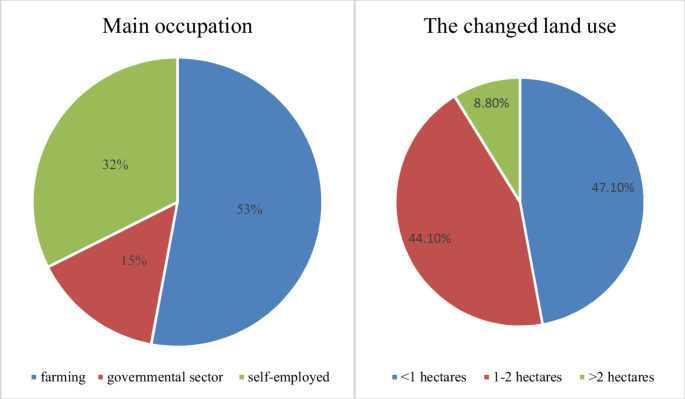
The results of descriptive statistics showed that all respondents were male. The frequency distribution of respondents by age revealed that over half of the respondents were aged 41–50 (Fig. 2). The average age of the respondents in the study sample was 49.24 years with a standard deviation of 10.12, a minimum age of 30 years, and a maximum of 73 years. The frequency distribution based on the level of education indicated that most respondents had a diploma (Fig. 2). The main occupation of most respondents was farming (Fig. 3). Regarding land use change, the results showed that approximately half of the farmers have changed the use of less than one hectare (Fig. 3). The in-depth interviews began with questions about the necessity and motivation behind changing land use, with subsequent questions tailored according to the interviewee’s responses.
Fig. 2

The alternative text for this image may have been generated using AI.
The frequency distribution of respondents by age and education
Fig. 3
The alternative text for this image may have been generated using AI.
The frequency distribution of respondents by main occupation and the changed land use
4.2 The grounded theory results
In this section, the findings of the grounded theory based on the causes of agricultural land use change in Bavi County are presented. After collecting data from the study population, interviews and manuscripts were reviewed. Analysis of the interview data was conducted using open, axial, and selective coding, each of which is explained below.
First stage: open coding
It is the first step in data analysis and encoding. In the open coding stage, the interview transcripts were regularly reviewed and carefully scrutinized, and data were broken down to the smallest un, named concepts. In other words, at this stage of the coding process, content analysis and line-by-line study of the collected information were undertaken to extract the concepts.
Representative interview quotes follow: “My agricultural land is 3 hectares, and the texture of the soil is sandy. It was a rain-fed farm, and we did not have water for irrigation. We also did not have output due to the lack of water. We had to change the use and make the farm residential”. “My children are unemployed. That’s why I decided to build a poultry farm. I fenced all around the land without a permit. But now, due to legal issues, I can neither cultivate nor complete the change of use. The ground is currently suspended. “Due to the increase in population and the inability of the villagers to live in the city, we requested the development of rural areas from the Road and Urban Development Organization, the Agricultural Jihad, and the Natural Resources and Watershed Management Organization. The main problem for the development of the village was passing two gas and oil pipelines around the village, which prevented us from increasing the area of the village on non-agricultural lands. Following up through the relevant departments, a request was made to change the agricultural land use to a residential one, which was partially agreed upon, but not finally approved. Some locals changed their use by themselves”. Reviewing the transcripts, a total of 69 key concepts were identified in the study population (Table 1).
Table 1 Conceptualization of research data (open coding)
Second stage, axial coding
In the axial coding stage, reassembling and linking the data fractured during open coding, subcategories are extracted. Accordingly, during axial coding in this study, eight subcategories were identified including the biophysical characteristics of the land (8 open codes), economic factors (16 open codes), legal factors (11 open codes), social factors (6 open codes), improvement and promotion of cultural welfare issues (10 open codes), the weakness of monitoring system (4 open codes); physical space development factor (3 open codes) and the change of weather conditions (2 open codes).
The findings indicate that biophysical land characteristics are among the key factors driving agricultural land use change in Bavi County. It includes “the small size of agricultural lands”, “sandy soil texture”, “high land unevenness and unsuitability for agricultural work”, “salinity of farm soil”, etc. (Table 2). In this regard, Amini et al. ([2017](/article/10.1007/s10668-025-06800-5#ref-CR5 "Amini, S., Rahmani, B., & Majidi Khameneh, B. (2017). Economic consequences of land use change in Pira Shahri villages case: Villages of Jay district in Isfahan City. Journal of Space Economy & Rural Development, 6(2), 17–40. https://doi.org/10.18869/acadpub.serd.6.20.17
          . (In Farsi).")) believed that the suitability of land for investment and selection of land use is defined by a wide range of different factors. Land is considered a special type of economic wealth because its supply is different in constant time and place in terms of quality, concerning the land shape, slope, soil, and its value and type of use are strongly dependent on relative geographical location and the neighborhood. Briassoulis ([2020](/article/10.1007/s10668-025-06800-5#ref-CR12 "Briassoulis, H. (2020). Analysis of land use change: Theoretical and modeling approaches. 2nd edn. Edited by Scott Loveridge and Randall Jackson. WVU research repository, 2020.
            https://researchrepository.wvu.edu/rri-web-book/3/

          ")) identified several biophysical drivers of land use change, including variations in weather and climate, landforms, topography, geomorphic processes, soil types and functions, drainage systems, and the availability of natural resources. The results of Journeaux et al. ([2017](/article/10.1007/s10668-025-06800-5#ref-CR35 "Journeaux, P., van Reenen, E., Manjala, T., Pike, S., Hanmore, I., & Millar, S. (2017). Analysis of drivers and barriers to land use change: A report prepared for the ministry for primary industries. AgFirst, Hamilton, New Zealand.
            https://www.mpi.govt.nz/dmsdocument/23056-ANALYSIS-OF-DRIVERS-AND-BARRIERS-TO-LAND-USE-CHANGE

          ")) also showed that biophysical factors such as soil type, land topography, weather, and access to water have changed land use. Also, Piquer-Rodríguez et al. ([2018](/article/10.1007/s10668-025-06800-5#ref-CR55 "Piquer-Rodríguez, M., Butsic, V., Gärtner, P., Macchi, L., Baumann, M., Pizarro, G. G., Volante, J. N., Gasparri, I. N., & Kuemmerle, T. (2018). Drivers of agricultural land-use change in the Argentine Pampas and Chaco regions. Applied Geography, 91, 111–122.
            https://doi.org/10.1016/j.apgeog.2018.01.004

          ")) found woodland conversions were chiefly determined by environmental factors, including aridity, slope, soil, and may continue in the forthcoming event due to small profitability. Msofe et al. ([2019](/article/10.1007/s10668-025-06800-5#ref-CR45 "Msofe, N. K., Sheng, L., & Lyimo, J. (2019). Land use change trends and their driving forces in the Kilombero Valley floodplain, southeastern Tanzania. Sustainability, 11(2), Article 505.
            https://doi.org/10.3390/su11020505

          ")) also identified biophysical factors as major drivers of land use changes.
Table 2 – Biophysical characteristics of the land
According to the results, the economic factor is the main reason for changing the use of agricultural lands in Bavi County that includes the items of “inefficient cultivation of rain fed agricultural land”, “conversion of agricultural land to urban land to increase the price and value of land”, “purchase of some lands by non-native people and construction of villa garden, slaughterhouse, tomato paste factory and…”, “receiving loans and facilities to create jobs”, “lack of financial ability to level the farming land”, “suffer from sanctions and increase inflation”, “low product yield per unit area and reduced profits”, “lack of financial ability of some villagers to live in the city”, “division of land between the heirs and as a result becoming small”, “lack of insurance and pensions”, “no need for agricultural income due to employment in the public sector”, “unemployment and not having jobs and enough income” (Table 3). The challenge among the low-income generation to achieve agricultural profitability cannot be denied in many cases, and this has encouraged people to work in non-agricultural areas.
Costs of farm, total income, land ownership, and labor distribution (Arunyawat & Shrestha, [2016](/article/10.1007/s10668-025-06800-5#ref-CR7 "Arunyawat, S., & Shrestha, R. P. (2016). Assessing land use change and its impact on ecosystem services in Northern Thailand. Sustainability, 8(8), Article 768. https://doi.org/10.3390/su8080768
          ")); profit, capital, infrastructure, land ownership, market, access to information, access to skilled workers (Journeaux et al., [2017](/article/10.1007/s10668-025-06800-5#ref-CR35 "Journeaux, P., van Reenen, E., Manjala, T., Pike, S., Hanmore, I., & Millar, S. (2017). Analysis of drivers and barriers to land use change: A report prepared for the ministry for primary industries. AgFirst, Hamilton, New Zealand.
            https://www.mpi.govt.nz/dmsdocument/23056-ANALYSIS-OF-DRIVERS-AND-BARRIERS-TO-LAND-USE-CHANGE

          ")), migration (Dadashpoor et al., [2019](/article/10.1007/s10668-025-06800-5#ref-CR19 "Dadashpoor, H., Azizi, P., & Moghadasi, M. (2019). Land use change, urbanization, and change in landscape pattern in a metropolitan area. Science of the Total Environment, 655, 707–719.
            https://doi.org/10.1016/j.scitotenv.2018.11.267

          ")) have been identified as the most influential economic factors driving land use change. Paudel et al. ([2019](/article/10.1007/s10668-025-06800-5#ref-CR54 "Paudel, B., Zhang, Y., Yan, J., Rai, R., & Li, L. (2019). Farmers’ perceptions of agricultural land use changes in Nepal and their major drivers. Journal of Environmental Management, 235, 432–441.
            https://doi.org/10.1016/j.jenvman.2019.01.091

          ")) determined socioeconomic factors as significant drivers of land use changes. Munthali et al. ([2019](/article/10.1007/s10668-025-06800-5#ref-CR46 "Munthali, M. G., Davis, N., Adeola, A. M., Botai, J. O., Kamwi, J. M., Chisale, H. L., & Orimoogunje, O. O. (2019). Local perception of drivers of land-use and land-cover change dynamics across Dedza district, central Malawi region. Sustainability, 11(3), Article 832.
            https://doi.org/10.3390/su11030832

          ")) identified poverty as the key driver of the observed land use and land cover changes in their study area. Stehfest et al. ([2019](/article/10.1007/s10668-025-06800-5#ref-CR68 "Stehfest, E., van Zeist, W. J., Valin, H., Havlik, P., Popp, A., Kyle, P., Tabeau, A., Mason-D’Croz, D., Hasegawa, T., Bodirsky, B. L., & Calvin, K. (2019). Key determinants of global land-use projections. Nature Communications, 10(1), 1–10.
            https://doi.org/10.1038/s41467-019-09945-w

          ")) also found that agricultural efficiency is one of the most effective determinants for future cropland and pasture extent. Msofe et al. ([2019](/article/10.1007/s10668-025-06800-5#ref-CR45 "Msofe, N. K., Sheng, L., & Lyimo, J. (2019). Land use change trends and their driving forces in the Kilombero Valley floodplain, southeastern Tanzania. Sustainability, 11(2), Article 505.
            https://doi.org/10.3390/su11020505

          ")) Market influence has been identified as one of the key drivers of land use change. As agricultural lands are converted and withdrawn from productive economic use, former landowners often shift to alternative economic sectors to sustain their livelihoods. Consequently, this transition alters the traditional functions of rural villages.
It is worth noting that biophysical characteristics of the land may interact with economic factors. For example, “high land unevenness and unsuitability for agricultural work”, “salinity of farm soil” may lead to “low product yield per unit area and reduced profits” and all of which contribute to land use change.
Table 3 Economic factors
Legal factors are also among the causes of agricultural land use change which include: “undocumented arable land and its confiscation by Natural Resources and Watershed Management Organization”, “fencing around the land without permission”, “lack of permission to develop the village space in non-agricultural lands due to passing gas and oil pipelines”, “not allowing the Water Department to build wells due to the lack of water”, “not being allowed to withdraw from the well for irrigation by the Water Department”, “inheritance and lack of documents of some agricultural lands”, “lack of legal permission for cultivation”, “prohibition of agricultural activities by the Oil Company”, “municipal compulsion to convert agricultural land to urban land”, “inclusion of land in urban development plan and lack of legal permission for agricultural activities”, “the selling of undocumented land by the Department of Natural Resources to indigenous and non-indigenous people” (Table 4). Chamling and Bera ([2020](/article/10.1007/s10668-025-06800-5#ref-CR13 "Chamling, M., & Bera, B. (2020). Spatio-temporal patterns of land use/land cover change in the Bhutan–Bengal foothill region between 1987 and 2019: Study towards geospatial applications and policy making. Earth Systems and Environment, 4(1), 117–130. https://doi.org/10.1007/s41748-020-00150-0
")) found that illegal infiltrations, along with the execution of different developmental projects, have resulted in the transformation of agricultural and forest lands into urban or built-up areas.Table 4 Legal factors
Regarding the category of social factors, it can be noted that from the respondents’ point of view, “not enough time for agricultural work due to having a self-employed job”, “not allowing of neighbors for irrigated farming due to the proximity of land to residential houses”, “lack or absence of housing and consequent renting”, “increase in population and number of households living in the village”, “trespassing farmers’ neighbor to land and abuse of the owner’s absence”, “increasing the age of the farmer and the inability and mood for farming” are causing agricultural land use change (Table 5). It appears farmers do not consider agricultural activity to be respectable in terms of social prestige and are not willing to work in agriculture, and therefore, they change their land use. It seems that social perception of farmers of their job is a societal reality, in such a way that outsiders’ attitude towards agricultural work affects farmers’ views and encourages them to change jobs. In this regard, the results of a study by Journeaux et al. ([2017](/article/10.1007/s10668-025-06800-5#ref-CR35 "Journeaux, P., van Reenen, E., Manjala, T., Pike, S., Hanmore, I., & Millar, S. (2017). Analysis of drivers and barriers to land use change: A report prepared for the ministry for primary industries. AgFirst, Hamilton, New Zealand. https://www.mpi.govt.nz/dmsdocument/23056-ANALYSIS-OF-DRIVERS-AND-BARRIERS-TO-LAND-USE-CHANGE
          ")) showed that socio-organizational factors and individual factors have changed land use. Moreover, Dadashpoor et al. ([2019](/article/10.1007/s10668-025-06800-5#ref-CR19 "Dadashpoor, H., Azizi, P., & Moghadasi, M. (2019). Land use change, urbanization, and change in landscape pattern in a metropolitan area. Science of the Total Environment, 655, 707–719.
            https://doi.org/10.1016/j.scitotenv.2018.11.267

          ")) recognized the increase in population as a major factor that resulted in land use change.
Table 5 Social factors
Improvement and promotion of cultural and welfare issues of villagers are other reasons for changing the agricultural land use in the study area which include “lack of recreational and sports space in the village”, “land donation to build a school due to the lack of school space for children to continue their education”, “land donation for the construction of a library in the village”, “land donation for the construction of a health house”, “paying attention to the welfare and tranquility of those around by constructing a garage for a heavy vehicle”, “high interest in horse breeding and construction of stables”, “voluntary construction of a football patch in the village for the leisure of the youth”, “owner’s migration and construction of a villa garden on agricultural land for weekend recreation”, “not allowing some families to continue their girls’ education outside the village”, “lack of interest in work and agricultural activities” (Table 6). Darban-e-Astaneh et al. ([2016](/article/10.1007/s10668-025-06800-5#ref-CR20 "Darban-e-Astaneh, A., Rezvani, M., & Seddiqi, S. (2016). An investigation of the factors affecting land use change (Case study: Mahmoudabad County). Journal of Research and Rural Planning, 5(3), 127–143. https://doi.org/10.22067/JRRP.V5I3.50436
. (In Farsi).")) believed that the main cause of these types of changes is the increase in literacy and the expansion of mass media, which has resulted in a different experience of socialization and has caused changes in people’s habits and practices. As a result of changing standards and, particularly, lifestyles, the willingness to engage in agricultural work has decreased, which is the first step in changing the use of agricultural land.It is noteworthy to mention that social factors and the improvement and promotion of cultural welfare issues could interact, as well. For instance, “increase in population and number of households living in the village” as a social factor on the one hand and “lack of interest in work and agricultural activities” as an improvement and promotion of cultural welfare issues factor on the other hand could culminate in land use change.
Table 6 Improvement and promotion of cultural welfare issues factors
The weakness of the monitoring system factors is another reason for the change of agricultural land use in Bavi County. The respondents noted items including “not using loans and facilities for agricultural work”, “violation and destruction of the protected area”, “abuse of personal position and land acquisition”, “the abuse of some municipal managers to change the use” (Table 7). Doroudian and Doroudian ([2018](/article/10.1007/s10668-025-06800-5#ref-CR23 "Doroudian, H. R., & Doroudian, A. (2018). Social and ecological impacts of agricultural land use change. Land Management Journal, 5(2), 81–97. https://doi.org/10.22092/lmj.2018.115849
          . (In Farsi).")) argued that the primary political and structural drivers of land use change include a lack of legal transparency, the presence of numerous ambiguous clauses and interpretations regarding land use regulations, as well as insufficient oversight and the discretionary decision-making power of local councils. Similarly, Harris ([2010](/article/10.1007/s10668-025-06800-5#ref-CR29 "Harris, R. B. (2010). Rangeland degradation on the Qinghai-Tibetan plateau: A review of the evidence of its magnitude and causes. Journal of Arid Environments, 74(1), 1–12.
            https://doi.org/10.1016/j.jaridenv.2009.06.014

          ")) conducted a study on socio-economic factors affecting the degradation of Tibetan plateau pastures in China and concluded that poor monitoring, incorrect policies, and incorrect social and environmental systems were among the causes of this type of degradation. It is worth noting that the interaction between the weakness of monitoring system factors, such as “not using loans and facilities for agricultural work,” and economic factors, such as “lack of financial ability to level the farming land,” may intensify the land use change.
Table 7 The weakness of the monitoring system factors
The need to develop the physical space of cities and villages is another reason for changing the agricultural land use in the study area. Respondents considered items such as “the need to develop urban and rural areas”, as well as “the proximity of land to residential houses and infrastructure” (Table 8). Khorasanian and Nazarian (2016) investigated the changes in Tehran city and its impacts on land use change in suburbs and found that the pattern of physical development of Tehran, especially during the last thirty years, has had a great impact on land use change in Islamshahr. In addition, changes to land use in the last decade have not had a positive effect on residents’ satisfaction with their quality of life. Amini et al. ([2017](/article/10.1007/s10668-025-06800-5#ref-CR5 "Amini, S., Rahmani, B., & Majidi Khameneh, B. (2017). Economic consequences of land use change in Pira Shahri villages case: Villages of Jay district in Isfahan City. Journal of Space Economy & Rural Development, 6(2), 17–40. https://doi.org/10.18869/acadpub.serd.6.20.17
          . (In Farsi).")) stated that Iran has witnessed a change of rural agricultural land use to residential, commercial-service, and industrial use over the past few decades, which has been affected by a combination of various factors, including rural population migration to cities and the need to expand and develop cities. Sedighi et al. ([2018](/article/10.1007/s10668-025-06800-5#ref-CR63 "Sedighi, S., Darban Astane, A., & Rezvani, M. R. (2018). An investigation of the physical and political factors affecting land use change in Mahmoudabad town. Spatial Planning, 7(2), 39–58.
            https://doi.org/10.22108/sppl.2018.81442.0

          . (In Farsi).")) offered that the most important physical factors are changing the tourist use of the region, the pressure of city development, the increasing construction of rental villas, and the expansion of transportation and communications. The results of the Islam & Hassn ([2011](/article/10.1007/s10668-025-06800-5#ref-CR32 "Islam, M. R., & Hassan, M. Z. (2011). Land use changing pattern and challenges for agricultural land: A study on Rajshahi district. Journal of Life and Earth Science, 6, 69–74.
            https://doi.org/10.3329/jles.v6i0.9724

          ")) in Bangladesh revealed that every year the country loses 1% of arable land due to population growth and infrastructure development. Furthermore, the pattern of land use in the Rajshahi region is changing, particularly as agricultural land is significantly reduced and is now more vulnerable. The agricultural land of the study area is decreasing by 0.46% per year, and the area of infrastructure is increasing by 5.86% per year. If this rate continues, Rajshahi agricultural lands will be eliminated in the next 217 years. Sali ([2012](/article/10.1007/s10668-025-06800-5#ref-CR59 "Sali, G. (2012). Agricultural land consumption in developed countries. In 2012 conference, August 18–24, 2012, Foz do Iguacu, Brazil, no. 126431. International Association of Agricultural Economists.
            https://doi.org/10.22004/ag.econ.126431

          ")) believed that influences such as high levels of gross domestic product (GDP) (and increasing urban size and transportation networks can be considered factors in reducing agricultural land and turning it into forest sites in developed countries.
It is noteworthy to mention that “proximity of land to residential houses and infrastructure” as a physical space development factor could interact with “lack or absence of housing and consequent renting” as a social factor, and “municipal compulsion to convert agricultural land to urban land” as a legal factor. As a result, land use change would occur.
Table 8 Physical space development factors
In the subcategory of the change of weather conditions, respondents noted that “the lack of water for irrigation (drought)” and “fallow land for several consecutive years due to the lack of water” are among the reasons that cause agricultural land use change (Table 9). Kalali Moghaddam ([2015](/article/10.1007/s10668-025-06800-5#ref-CR36 "Kalali Moghaddam, Z. (2015). An investigation of the factors affecting land use changing of agricultural lands (Case study: Rural areas of Rasht Town-Iran). Journal of Research and Rural Planning, 4(1), 113–132. https://doi.org/10.22067/JRRP.V4I9.33738
          ")) found that climatic conditions and excessive 24-hour rainfall, steep terrain, as well as devastating floods, not only cause human and financial losses, but also soil erosion and reduced agricultural soil fertility, and consequently lead to land use change. Motavaselie et al. ([2016](/article/10.1007/s10668-025-06800-5#ref-CR44 "Motavaselie, B., Ghorbaniyan, A. R., Naderian Zadeh, A. R., & Zaresahhie, H. (2016). The alteration in land allocation against rural guide plans in Taft County (2010–2013). Journal of Housing and the Built Environment, 35(155), 77–92.")) stated that the land use in rural areas, two basic factors, including natural factors (agricultural land capability) and human factors (population) have a significant role in the different uses. The results of Amini et al. ([2017](/article/10.1007/s10668-025-06800-5#ref-CR5 "Amini, S., Rahmani, B., & Majidi Khameneh, B. (2017). Economic consequences of land use change in Pira Shahri villages case: Villages of Jay district in Isfahan City. Journal of Space Economy & Rural Development, 6(2), 17–40.
            https://doi.org/10.18869/acadpub.serd.6.20.17

          . (In Farsi).")) showed that the proximity of villages to the city, climatic and natural conditions of the region, drought and depletion of the Zayandeh Rood River, and migration from village to city were effective in changing the land use of villages. Sylvester et al. ([2013](/article/10.1007/s10668-025-06800-5#ref-CR69 "Sylvester, K. M., Brown, D. G., Deane, G. D., & Kornak, R. N. (2013). Land transitions in the American plains: Multilevel modeling of drivers of grassland conversion (1956–2006). Agriculture Ecosystems & Environment, 168, 7–15.
            https://doi.org/10.1016/j.agee.2013.01.014

          ")) also pointed out that follow landslides have influenced the coverage of the Great Plains of the United States in the second half of the twentieth century. The interaction between “inefficient cultivation of rainfed agricultural land” as an economic factor and “the lack of water for irrigation (drought)” as a change of weather conditions factor could make a contribution to land use change.
Table 9 The change of weather conditions
From the respondents’ point of view, several factors play an important role in preventing this phenomenon. These include the “implementation of land consolidation projects to improve facilitation of agricultural production”, “the extension of agricultural operations and teaching methods for the protection of water and soil resources”, “adoption and amendment of new laws for the protection of agricultural lands”, “rehabilitation of rain fed agricultural lands”, “construction of irrigation canals in rain fed lands”, “managing and monitoring of the city land affairs organization on construction in agricultural lands”, “coordination of organizations and institutions in charge of planning and civil affairs, such as municipalities and the environmental protection organization, etc.“, “establishing deterrent laws and amending existing laws and dealing severely with unauthorized land use changes”. (Table 10).
Table 10 Strategies to prevent land use change
One of the key legal frameworks for preventing the conversion of agricultural land and regulating construction activities in the country is the Law on the Preservation of Agricultural Land Use, which the Cabinet approved in its meeting dated 5/23/2007 as an amendment to the Preservation Law of Agricultural and Horticultural Land Use. According to the Amended Land Use Preservation Law of 2006, collecting tolls from applicants for “agricultural exploiters’ licenses”, the necessity for service organizations to obtain Licenses from the Note 1 Article 1 Commission and natural and legal persons, and impose fines, demolition of the construction, imprisonment for one to six months in case of recurrence of the crime, permanent dismissal from government services, revocation of the issued license, seizure of operations by Agriculture Jihad officers and law enforcement are among the executive guarantees of this law (Oni & Sharifi, 2018, Namjouian et al., 2018). Therefore, in recent years, a large amount of agricultural land in the country has been subjected to destruction and change of authorized and unauthorized uses, and this issue seriously threatens food security, community health, and basic resources of the country. Thus, preserving agricultural lands as the national capital of the country is vital and is considered one of the important priorities for independence, self-sufficiency, and food production. Table 11 presents the consequences of employing the mentioned strategies.
Table 11 Consequences
Third stage: selective coding
Selective coding aims to establish connections among the identified subcategories by developing a coherent storyline that explains and supports these relationships, ultimately producing a visual paradigm model of the central research theme. During the selective coding phase of this study, the identified subcategories were systematically organized into broader categories such as contextual conditions, causal conditions, intervening conditions, strategies, and outcomes. Accordingly, a paradigm model of the causes of changing agricultural land use was presented in Fig. 4 based on the paradigm model of Corbin and Strauss ([1990](/article/10.1007/s10668-025-06800-5#ref-CR17 "Corbin, J. M., & Strauss, A. (1990). Grounded theory research: Procedures, canons, and evaluative criteria. Qualitative Sociology, 13(1), 3–21. https://doi.org/10.1007/BF00988593
")). In this presented paradigm model, the research phenomenon is changing agricultural land use that some context has led to the occurrence of the phenomenon and some conditions have affected the occurrence of this phenomenon. Based on selective coding, it can be pointed out that the occurrence of this phenomenon was due to causal conditions such as biophysical characteristics of the land (including “the small size of agricultural lands”, “sandy soil texture”, “high land unevenness and unsuitability for agricultural work”, “salinity of farm soil”, etc.), the change of weather conditions (such as “the lack of water for irrigation (drought)” and “fallow land for several consecutive years due to the lack of water”) along with spatial physical development (including “the need to develop urban and rural areas”, as well as “the proximity of land to residential houses and infrastructure”). In addition, economic factors (such as “low product yield per unit area and reduced profits”, “lack of financial ability of some villagers to live in the city”, “lack of insurance and pensions”, “unemployment and not having jobs and enough income”, “lack of financial ability to level the farming land”, “suffer from sanctions and increase inflation”, etc. provide the appropriate context for the occurrence of the phenomenon of changing land use in agriculture. Moreover, social factors (including “not allowing of neighbors for irrigated farming due to the proximity of land to residential houses”, “lack or absence of housing and consequent renting”, “increase in population and number of households living in the village”, “trespassing farmers’ neighbor to land and abuse of the owner’s absence”, “increasing the age of the farmer and the inability and mood for farming”, etc.) as well as the weakness of the regulatory system (such as “not using loans and facilities for agricultural work”, “violation and destruction of the protected area”, “abuse of personal position and land acquisition”, “the abuse of some municipal managers to change the use”) provide the context for the phenomenon of land use change in agriculture. Furthermore, legal factors (including “lack of permission to develop the village space in non-agricultural lands due to passing gas and oil pipelines”, “not being allowed to withdraw from the well for irrigation by the Water Department”, “lack of legal permission for cultivation”, etc.) and improvement and promotion of cultural and welfare issues (such as “lack of recreational and sports space in the village”, “land donation to build a school due to the lack of school space for children to continue their education”, “land donation for the construction of a library in the village”, “owner’s migration and construction of a villa garden on agricultural land for weekend recreation”, etc.) have played an intervening role in exacerbating land use changes.Furthermore, as noted previously, the derived factors could interact with one another, which is demonstrated with a double-headed dotted arrow in Fig. 4.
The phenomenon prompted stakeholders to use targeted strategies to adapt. In this regard, activities such as the “implementation of land consolidation projects to improve facilitation of agricultural production”, “the extension of agricultural operations and teaching methods for the protection of water and soil resources”, “adoption and amendment of new laws for the protection of agricultural lands”, “rehabilitation of rainfed agricultural lands”, “construction of irrigation canals in rainfed lands”, “managing and monitoring of the city land affairs organization on construction in agricultural lands”, “establishing deterrent laws and amending existing laws and dealing severely with unauthorized land use changes”, “coordination of organizations and institutions in charge of planning and civil affairs, such as municipalities and the Environmental Protection Organization, etc.” have been developed. The implementation of strategies has had consequences such as “reducing the tendency to change the agricultural land use” and “the tendency to preserve agricultural land use”.
Fig. 4

The alternative text for this image may have been generated using AI.
Paradigm model of changing agricultural land use
5 Policy implications
The results of the research imply several policy suggestions presented in the following:
- The findings revealed economic factors with the largest number of extracted codes. Some economic factors, such as “low product yield per unit area and reduced profits,” were cited as the farmers’ reasons to change the use of agricultural land. Therefore, it is suggested that the government provide farmers with low-interest financial support and Long-term return periods to reduce production costs. Furthermore, providing low-cost or subsided inputs and services such as fertilizers, seeds, etc. can support farmers financially to prevent the conversion and destruction of such lands. In addition, recruiting agricultural experts to provide free consultation to farmers during 3 stages, including cultivation, protection, and harvest for their crops, could lead to enhancing crop productivity.
- Legal factors were also with a considerable number of extracted codes. Some items, such as “not allowing the Water Department to build wells due to the lack of water, lack of legal permission for cultivation, prohibition of agricultural activities by the Oil Company, etc.) were legal factors. Hence, planning, supporting, and cooperating with responsible and involved institutions such as Agriculture Jihad, Water Department, etc. is suggested to implement projects that not only solve existing problems (such as lack of access to water resources, etc.), but also provide the necessary conditions for agricultural activities. Furthermore, based on the findings, in some villages, farmers’ agricultural land had been inherited and was undocumented. Therefore, documenting such arable lands can be a very effective action in preventing their destruction and fragmentation as well as maintaining the existing condition of the lands.
- Population growth and housing needs were acquired social factors in land use change that led to problematic conversion of a large part of the land to residential use, especially around the villages. Therefore, proper and principled management of rural space is essential to effectively prevent land use change in this area.
- Improvement and promotion of cultural welfare issues factors were recognized as reasons for the conversion of agricultural land use. Therefore, in order not to change land use due to cultural welfare issues, these issues in rural areas should be given specific attention by the Culture and Guidance Department.
- The change of weather conditions, such as “the lack of water for irrigation (drought)”, was another reason for changing land use. Thus, water management through providing modern irrigation methods, such as drip irrigation, for farmers is highly suggested.
- The weakness of the monitoring system factors and physical space development factors were acquired as other reasons of converting agricultural land use. Strengthening the monitoring system as well as following a specific plan in terms of rural development should be taken into consideration by authorities, including the Agriculture Jihad, Housing Foundation, etc.
6 Conclusion
Currently, the change of agricultural land use after water shortages is the second major problem of agriculture in Iran and exemplifies a significant human influence on the environment. Risk-taking in agricultural work, potential risks, and unforeseen events that actually hinder agricultural activity on the land lead people to activities that have relatively fewer risks. Research results indicate that land use change is not only an important issue, but also has become a big challenge. On the one hand, this phenomenon causes the destruction of a large share of agricultural land, which has very important consequences in terms of food security, self-sufficiency, and sustainable employment in rural communities. On the other hand, the pressure of industry, tourism, water shortage crisis, reduced fertility of the agricultural sector, changing the villagers’ lifestyle, etc., make the protection of agricultural lands more challenging. Accordingly, due to the great significance of preserving agricultural lands and preventing their destruction and use change, identifying the factors that accelerate land use change is crucial. Accordingly, this study employs a qualitative grounded theory approach to explore the causes of agricultural land use change in Bavi County, Khuzestan Province. The results of this study showed that subcategories, including biophysical characteristics of the land, economic factors, legal factors, social factors, improvement and promotion of cultural and welfare issues, the weakness of the monitoring system, physical space development factor, and the change of weather conditions, are the causes of changing agricultural land use in Bavi County. Because these findings align with previous studies, they can be used nationally and internationally; to prevent the change of agricultural land use, all the mentioned factors should be taken into consideration by authorities, including legislators, Agriculture Jihad experts, the Land Affairs Organization, and other entities. It should be noted that most of the extracted codes were related to economic and legal factors, which indicates these were the most significant causes of changing agricultural land use in the study area. For instance, high effort and low profitability in the agricultural sector and profits make farmers willing to work in other sectors. In addition, organizations, and institutions in charge of planning and development affairs, such as municipalities and the Environmental Protection organization, do not act in a coordinated manner, and each makes decisions based on its interests. Also, in this study, a paradigm model of changing agricultural land use was presented, which included the main phenomenon, contextual conditions, causal conditions, intervening conditions, strategies, and consequences. Accordingly, effective strategies to prevent changing agricultural land use should include implementation of land consolidation projects, the extension of agricultural operations and teaching methods for the protection of water and soil resources, rehabilitation of rain fed agricultural lands, construction of irrigation canals in rainfed lands, establishing deterrent laws and amending existing laws and dealing severely with unauthorized land use changes, etc.
Although the results of this study could make a contribution to a comprehensive perception of the causes of land use change in southwestern Iran, it has some limitations that could be taken into consideration in future research. First, since the data collection method in this study was interviews, the data collection process was time-consuming as well as costly. Second, conducting the interview required the consent and willingness of the respondents, and the patience and perseverance of the interviewer. Finally, due to the limited number of interviews with farmers in Bavi County who have changed their agricultural land use, there was no generalization of results to other regions or larger groups. Therefore, as a future research direction, it is suggested that studies with mixed-method approaches (integrating both qualitative and quantitative methods) be conducted on a large scale with more samples to be generalizable to the country. In addition, investigating the causes of land use change not only from the farmers’ perspective, but also from the authorities’ and Agriculture Jihad staff’s viewpoint, could shed more light on this issue.
References
- Agricultural Statistics of Khuzestan Province. (2020). Agricultural statistics of Khuzestan province in terms of county and year. Available at https://ajkhz.ir/main/index.php/pages/
- Ahmadpour, A., & Alavi, E. (2014). Identification and analysis of factors affecting agricultural land use change in rural areas (Case study: Sari County). Journal of Research and Rural Planning, 3(1), 109–120. https://doi.org/10.22067/jrrp.v3i5.27115
Article Google Scholar - Ahmed, K. F., Wang, G., You, L., & Yu, M. (2016). Potential impact of climate and socioeconomic changes on future agricultural land use in West Africa. Earth System Dynamics, 7(1), 151–165. https://doi.org/10.5194/esd-7-151-2016
Article Google Scholar - Allahyari, M. S., Poshtiban, A., & Koundinya, V. (2013). Effective factors on agricultural land use change in Guilan Province. Iran Mediterranean Journal of Social Sciences, 4(11), 744–751. https://doi.org/10.5901/mjss.2013.v4n11p744
Article Google Scholar - Amini, S., Rahmani, B., & Majidi Khameneh, B. (2017). Economic consequences of land use change in Pira Shahri villages case: Villages of Jay district in Isfahan City. Journal of Space Economy & Rural Development, 6(2), 17–40. https://doi.org/10.18869/acadpub.serd.6.20.17. (In Farsi).
Article Google Scholar - Amirnejad, H. (2013). Factors affecting farmers’ willingness to change land use in Mazandaran province. Journal of Agricultural Economics Research, 5(20), 87–106. (In Farsi). 20.1001.1.20086407.1392.5.20.5.6.
Google Scholar - Arunyawat, S., & Shrestha, R. P. (2016). Assessing land use change and its impact on ecosystem services in Northern Thailand. Sustainability, 8(8), Article 768. https://doi.org/10.3390/su8080768
Article Google Scholar - Asadi Rahmani, H. (2023). 200,000 hectares of land use change in just 6 metropolises in the country. Available at https://38365004.khabarban.com/
- Ataei, P., Sadighi, H., & Izadi, N. (2021). Major challenges to achieving food security in rural Iran. Rural Society, 30(1), 15–31.
Article Google Scholar - Ataei, P., Sadighi, H., Abbasi, E., & Chizari, M. (2022). Transfer of sustainability training in land and conservation agriculture project: A behavioral study in Iran. Frontiers in Sustainable Food Systems, 6, 1051930.
Article Google Scholar - Birks, M., & Mills, J. (2011). Grounded theory: A practical guide. Sage.
- Briassoulis, H. (2020). Analysis of land use change: Theoretical and modeling approaches. 2nd edn. Edited by Scott Loveridge and Randall Jackson. WVU research repository, 2020. https://researchrepository.wvu.edu/rri-web-book/3/
- Chamling, M., & Bera, B. (2020). Spatio-temporal patterns of land use/land cover change in the Bhutan–Bengal foothill region between 1987 and 2019: Study towards geospatial applications and policy making. Earth Systems and Environment, 4(1), 117–130. https://doi.org/10.1007/s41748-020-00150-0
Article Google Scholar - Charmaz, K., & Thornberg, R. (2021). The pursuit of quality in grounded theory. Qualitative Research in Psychology, 18(3), 305–327. https://doi.org/10.1080/14780887.2020.1780357
Article Google Scholar - Chenani, E., Yazdanpanah, M., Baradaran, M., Azizi-Khalkheili, T., & Najafabadi, M. M. (2021). Barriers to climate change adaptation: Qualitative evidence from Southwestern Iran. Journal of Arid Environments, 189, 104487.
Article Google Scholar - Chong, C. H., & Yeo, K. J. (2015). An overview of grounded theory design in educational research. Asian Social Science, 11(12), 258–268. https://doi.org/10.5539/ass.v11n12p258
Article Google Scholar - Corbin, J. M., & Strauss, A. (1990). Grounded theory research: Procedures, canons, and evaluative criteria. Qualitative Sociology, 13(1), 3–21. https://doi.org/10.1007/BF00988593
Article Google Scholar - Creswell, J. W. (2012). Educational research: Planning, conducting, and evaluating quantitative and qualitative research (4th ed.). Pearson.
- Dadashpoor, H., Azizi, P., & Moghadasi, M. (2019). Land use change, urbanization, and change in landscape pattern in a metropolitan area. Science of the Total Environment, 655, 707–719. https://doi.org/10.1016/j.scitotenv.2018.11.267
Article CAS Google Scholar - Darban-e-Astaneh, A., Rezvani, M., & Seddiqi, S. (2016). An investigation of the factors affecting land use change (Case study: Mahmoudabad County). Journal of Research and Rural Planning, 5(3), 127–143. https://doi.org/10.22067/JRRP.V5I3.50436. (In Farsi).
Article Google Scholar - Delfiyan, F., Yazdanpanah, M., Forouzani, M., & Yaghoubi, J. (2021). Farmers’ adaptation to drought risk through farm–level decisions: The case of farmers in Dehloran county, southwest of Iran. Climate and Development, 13(2), 152–163.
Article Google Scholar - Dietrich, J. P., Schmitz, C., Müller, C., Fader, M., Lotze-Campen, H., & Popp, A. (2012). Measuring agricultural land-use intensity–A global analysis using a model-assisted approach. Ecological Modelling, 232, 109–118. https://doi.org/10.1016/j.ecolmodel.2012.03.002
Article Google Scholar - Doroudian, H. R., & Doroudian, A. (2018). Social and ecological impacts of agricultural land use change. Land Management Journal, 5(2), 81–97. https://doi.org/10.22092/lmj.2018.115849. (In Farsi).
Article Google Scholar - Doucet, R. (2016). Agricultural land policy consultations-what was said. Available at: https://www2.gnb.ca/content/dam/gnb/Departments/
- Fanelli, R. M. (2019). The (un) sustainability of the land use practices and agricultural production in EU countries. International Journal of Environmental Studies, 76(2), 273–294. https://doi.org/10.1080/00207233.2018.1560761
Article Google Scholar - FAO. (2017). Water for sustainable food and agriculture. A report produced for the G20 presidency of Germany, food and agriculture organization of the United Nations, Rome. https://openknowledge.fao.org/server/api/core/bitstreams/b48cb758-48bc-4dc5-a508-e5a0d61fb365/content
- Glaser, B. G., & Strauss, A. L. (1967). The discovery of grounded theory: Strategies for qualitative research. Chicago: Aldine Pub. Co.; 1967. http://www.sxf.uevora.pt/wp-content/uploads/2013/03/Glaser_1967.pdf
- Groen, C., Simmons, D. R., & McNair, L. D. (2017). An introduction to grounded theory: Choosing and implementing an emergent method. In the 2017 ASEE annual conference & exposition. https://monolith.asee.org/public/conferences/78/papers/18881/view
- Harris, R. B. (2010). Rangeland degradation on the Qinghai-Tibetan plateau: A review of the evidence of its magnitude and causes. Journal of Arid Environments, 74(1), 1–12. https://doi.org/10.1016/j.jaridenv.2009.06.014
Article CAS Google Scholar - Hayati, D., Yazdanpanah, M., & Karbalaee, F. (2010). Coping with drought: The case of poor farmers of South Iran. Psychology and Developing Societies, 22(2), 361–383.
Article Google Scholar - Irna. (2021). Khuzestan ranks first in the country with 17.5 million tons of agricultural products. Available at https://www.irna.ir/news/84292698/
- Islam, M. R., & Hassan, M. Z. (2011). Land use changing pattern and challenges for agricultural land: A study on Rajshahi district. Journal of Life and Earth Science, 6, 69–74. https://doi.org/10.3329/jles.v6i0.9724
Article Google Scholar - Jalili, R. (2019). Human food security depends on cultivating and preserving agricultural lands. Available at https://www.shabestan.news/news/816364/
- Jamalipour, M., Shahpouri, A. R., & Ghorbani, M. (2015). Factors affecting the formation of change in land use in the Mazandaran province: A case study of Tonekabon. Agricultural Economics & Development, 33(3), 107–115. https://doi.org/10.22067/jead2.v0i0.27902. (In Farsi).
Article Google Scholar - Journeaux, P., van Reenen, E., Manjala, T., Pike, S., Hanmore, I., & Millar, S. (2017). Analysis of drivers and barriers to land use change: A report prepared for the ministry for primary industries. AgFirst, Hamilton, New Zealand. https://www.mpi.govt.nz/dmsdocument/23056-ANALYSIS-OF-DRIVERS-AND-BARRIERS-TO-LAND-USE-CHANGE
- Kalali Moghaddam, Z. (2015). An investigation of the factors affecting land use changing of agricultural lands (Case study: Rural areas of Rasht Town-Iran). Journal of Research and Rural Planning, 4(1), 113–132. https://doi.org/10.22067/JRRP.V4I9.33738
Article Google Scholar - Khorasanian, M., & Nazarian, A. A. (2016). Investigating the changes in Tehran city and its impacts on land use change in suburbs) case study: Agricultural land use change and gardens in Islamshahr City). New Attitudes in Human Geography, 9(1), 153–168. (In Farsi). 20.1001.1.66972251.1395.9.1.9.6.
- Li, J., Rodriguez, D., & Tang, X. (2017). Effects of land lease policy on changes in land use, mechanization and agricultural pollution. Land Use Policy, 64, 405–413. https://doi.org/10.1016/j.landusepol.2017.03.008
Article Google Scholar - Lombardi, G. V., Atzori, R., Acciaioli, A., Giannetti, B., Parrini, S., & Liu, G. (2019). Agricultural landscape modification and land food footprint from 1970 to 2010: A case study of Sardinia, Italy. Journal of Cleaner Production, 239, 118097. https://doi.org/10.1016/j.jclepro.2019.118097
Article Google Scholar - Long, X., Ji, X., & Ulgiati, S. (2017). Is urbanization eco-friendly? An energy and land use cross-country analysis. Energy Policy, 100, 387–396. https://doi.org/10.1016/j.enpol.2016.06.024
Article Google Scholar - Mahdavian, S. M., Askari, F., Kioumarsi, H., Naseri Harsini, R., Dehghanzadeh, H., & Saboori, B. (2024). Modeling the linkage between climate change, CH4 emissions, and land use with Iran’s livestock production: A food security perspective. Natural Resources Forum, 49, 1. https://doi.org/10.1111/1477-8947.12532
Article Google Scholar - Mohajan, H. K. (2018). Qualitative research methodology in social sciences and related subjects. Journal of Economic Development, Environment and People, 7(1), 23–48. https://doi.org/10.26458/jedep.v7i1.571
Article Google Scholar - Molaei, M., & Aghaei, S. (2018). Estimating willingness to pay to avoid changes in agricultural land use: Choice experiment methods. Agricultural Economics and Development, 26(2), 51–73. https://doi.org/10.30490/AEAD.2018.73547. (In Farsi).
Article Google Scholar - Motavaselie, B., Ghorbaniyan, A. R., Naderian Zadeh, A. R., & Zaresahhie, H. (2016). The alteration in land allocation against rural guide plans in Taft County (2010–2013). Journal of Housing and the Built Environment, 35(155), 77–92.
Google Scholar - Msofe, N. K., Sheng, L., & Lyimo, J. (2019). Land use change trends and their driving forces in the Kilombero Valley floodplain, southeastern Tanzania. Sustainability, 11(2), Article 505. https://doi.org/10.3390/su11020505
Article Google Scholar - Munthali, M. G., Davis, N., Adeola, A. M., Botai, J. O., Kamwi, J. M., Chisale, H. L., & Orimoogunje, O. O. (2019). Local perception of drivers of land-use and land-cover change dynamics across Dedza district, central Malawi region. Sustainability, 11(3), Article 832. https://doi.org/10.3390/su11030832
Article Google Scholar - Namjouian, S., & Varmazyar, M. J. (2018). Laws and regulations related to breaking agricultural lands. Nevisandeh publications (by order of the land management organization). (In Farsi)& Molla Ahmad Najm Abadi.
- Navidi, M., Rahmani, A., Chatrenour, H., Kharazmi, M., Jamshidi, R., Ziaee Javid, M., MohamadEsmaeil, A., Z. and, & ebrahimi meymand, F. (2023). Changes in agricultural land use as a threat to food security. Land Management Journal, 11(2), 229–248. https://doi.org/10.22092/lmj.2023.362757.336
Article Google Scholar - Niemand, B. (2011). Transformation of agricultural and undeveloped land in the Boland region of the western cape. Thesis presented in partial fulfilment of the requirements for the degree of Master of Arts in the Faculty of Arts and Social Sciences at Stellenbosch University. https://scholar.sun.ac.za/server/api/core/bitstreams/d82e3dd7-c4e0-4499-af64-4a3e3a84e39b/content
- Noszczyk, T. (2018). Land use change monitoring as a task of local government administration in Poland. Journal of Ecological Engineering, 19(1), 170–176. https://doi.org/10.12911/22998993/79409
Article Google Scholar - Oni, A., & Sharifi, J. (2018). Laws and Regulations for the Conservation of Agricultural Lands and Gardens. Nevisandeh. (By order of the Land Management Organization). (In Farsi).
Google Scholar - Oranga, J., & Matere, A. (2023). Qualitative research: Essence, types and advantages. Open Access Library Journal, 10(12), 1–9. https://doi.org/10.4236/oalib.1111001
Article Google Scholar - Pakmehr, S., Yazdanpanah, M., & Baradaran, M. (2021). Explaining farmers’ response to climate change-induced water stress through cognitive theory of stress: An Iranian perspective. Environment, Development and Sustainability, 23(4), 5776–5793.
Article Google Scholar - Paudel, B., Zhang, Y., Yan, J., Rai, R., & Li, L. (2019). Farmers’ perceptions of agricultural land use changes in Nepal and their major drivers. Journal of Environmental Management, 235, 432–441. https://doi.org/10.1016/j.jenvman.2019.01.091
Article Google Scholar - Piquer-Rodríguez, M., Butsic, V., Gärtner, P., Macchi, L., Baumann, M., Pizarro, G. G., Volante, J. N., Gasparri, I. N., & Kuemmerle, T. (2018). Drivers of agricultural land-use change in the Argentine Pampas and Chaco regions. Applied Geography, 91, 111–122. https://doi.org/10.1016/j.apgeog.2018.01.004
Article Google Scholar - Rahimi-Feyzabad, F., Yazdanpanah, M., Gholamrezai, S., & Ahmadvand, M. (2021). Institutional constraints to groundwater resource management in arid and semi-arid regions: A straussian grounded theory study. Hydrogeology Journal, 29(3), 925–947. https://doi.org/10.1007/s10040-020-02283-y
Article Google Scholar - Rogge, E., & Dessein, J. (2015). Perceptions of a small farming community on land use change and a changing countryside: A case-study from Flanders. European Urban and Regional Studies, 22(3), 300–315. https://doi.org/10.1177/0969776412474664
Article Google Scholar - Saleh, Y., Badr, A. M., Banna, F. E., & Shahata, A. J. S. W. J. (2014). Agricultural land-use change and disappearance of farmlands in Kaduna Metropolis-Nigeria. Science World Journal, 9(1), 1–7. https://www.ajol.info/index.php/swj/article/view/105412
Google Scholar - Sali, G. (2012). Agricultural land consumption in developed countries. In 2012 conference, August 18–24, 2012, Foz do Iguacu, Brazil, no. 126431. International Association of Agricultural Economists. https://doi.org/10.22004/ag.econ.126431
- Savari, M., Yazdanpanah, M., & Rouzaneh, D. (2022). Factors affecting the implementation of soil conservation practices among Iranian farmers. Scientific Reports, 12(1), 8396.
Article CAS Google Scholar - Savari, M., Yazdanpanah, M., & Rouzaneh, D. (2025). Applying conservation agriculture practices as a strategy to control soil erosion and carbon sequestration. Results in Engineering, 26, 104854.
Article CAS Google Scholar - Sayasane, R., Kawasaki, A., Shrestha, S., & Takamatsu, M. (2016). Assessment of potential impacts of climate and land use changes on stream flow: A case study of the Nam Xong watershed in Lao PDR. Journal of Water and Climate Change, 7(1), 184–197. https://doi.org/10.2166/wcc.2015.050
Article Google Scholar - Sedighi, S., Darban Astane, A., & Rezvani, M. R. (2018). An investigation of the physical and political factors affecting land use change in Mahmoudabad town. Spatial Planning, 7(2), 39–58. https://doi.org/10.22108/sppl.2018.81442.0. (In Farsi).
Article Google Scholar - Sharma, S., Kooner, R., & Arora, R. (2017). Insect pests and crop losses. Breeding insect-resistant crops for sustainable agriculture (pp. 45–66). Springer. https://link.springer.com/chapter/https://doi.org/10.1007/978-981-10-6056-4_2
- Sikka, A. K., Islam, A., & Rao, K. V. (2018). Climate-smart land and water management for sustainable agriculture. Irrigation and Drainage, 67(1), 72–81.
Article Google Scholar - Stahl, N. A., & King, J. R. (2020). Expanding approaches for research: Understanding and using trustworthiness in qualitative research. Journal of Developmental Education, 44(1), 26–29.
Google Scholar - Statuto, D., Cillis, G., & Picuno, P. (2016). Analysis of the effects of agricultural land use change on rural environment and landscape through historical cartography and GIS tools. Journal Of Agricultural Engineering, 47(1), 28–39. https://doi.org/10.4081/jae.2016.468
Article Google Scholar - Stehfest, E., van Zeist, W. J., Valin, H., Havlik, P., Popp, A., Kyle, P., Tabeau, A., Mason-D’Croz, D., Hasegawa, T., Bodirsky, B. L., & Calvin, K. (2019). Key determinants of global land-use projections. Nature Communications, 10(1), 1–10. https://doi.org/10.1038/s41467-019-09945-w
Article CAS Google Scholar - Sylvester, K. M., Brown, D. G., Deane, G. D., & Kornak, R. N. (2013). Land transitions in the American plains: Multilevel modeling of drivers of grassland conversion (1956–2006). Agriculture Ecosystems & Environment, 168, 7–15. https://doi.org/10.1016/j.agee.2013.01.014
Article Google Scholar - United Nations. (2017). World population projected to reach 9.8 billion in 2050, and 11.2 billion in 2100. Department of economic and social affairs. Retrieved from http://www.un.org/development/desa/en/news/population/world-population-prospects-2017.html
- Valbuena, D., Verburg, P. H., Bregt, A. K., & Ligtenberg, A. (2010). An agent-based approach to model land-use change at a regional scale. Landscape Ecology, 25(2), 185–199. https://doi.org/10.1007/s10980-009-9380-6
Article Google Scholar - Wagner, P. D., Kumar, S., & Schneider, K. (2013). An assessment of land use change impacts on the water resources of the Mula and Mutha rivers catchment upstream of Pune, India. Hydrology and Earth System Sciences, 17(6), 2233–2246. https://doi.org/10.5194/hess-17-2233-2013
Article Google Scholar - Wiesche, M., Jurisch, M. C., Yetton, P. W., & Krcmar, H. (2017). Grounded theory methodology in information systems research. MIS Quarterly, 41(3), 685–701. https://doi.org/10.25300/MISQ/2017/41.3.02
Article Google Scholar - Winklera, K. J., Scowna, M. W., & Nicholasa, K. A. (2018). A classification to align social-ecological land systems research with policy in Europe. Land Use Policy, 79, 137–145. https://doi.org/10.1016/j.landusepol.2018.06.034
Article Google Scholar - Yazdanpanah, M., Monfared, N., & Hochrainer-Stigler, S. (2013a). Interrelated effects due to droughts for rural populations: A qualitative field study for farmers in Iran. International Journal of Mass Emergencies & Disasters, 31(2), 106–129.
Article Google Scholar - Yazdanpanah, M., Zamani, G. H., Hochrainer-Stigler, S., Monfared, N., & Yaghoubi, J. (2013b). Measuring satisfaction of crop insurance: A modified American Customer Satisfaction Model approach applied to Iranian farmers. International Journal of Disaster Risk Reduction, 5, 19–27.
Article Google Scholar - Yazdanpanah, M., Feyzabad, F. R., Forouzani, M., Mohammadzadeh, S., & Burton, R. J. (2015). Predicting farmers’ water conservation goals and behavior in Iran: A test of social cognitive theory. Land Use Policy, 47, 401–407.
Article Google Scholar - Yazdanpanah, M., Romina, F. Z., Sharifi, Z., Loher, K., Bonatti, M., & Sieber, S. (2025). Digging in the shadows: A grounded theory study on the drivers of illegal well drilling in Southern Iran. Environmental Development, 57, 101338. https://doi.org/10.1016/j.envdev.2025.101338
- Zobeidi, T., Yaghoubi, J., & Yazdanpanah, M. (2022). Developing a paradigm model for the analysis of farmers’ adaptation to water scarcity. Environment, Development and Sustainability. https://doi.org/10.1007/s10668-021-01663-y
Article Google Scholar