Seasonal Water Storage Variations as Impacted by Water Abstractions: Comparing the Output of a Global Hydrological Model with GRACE and GPS Observations (original) (raw)
Abstract
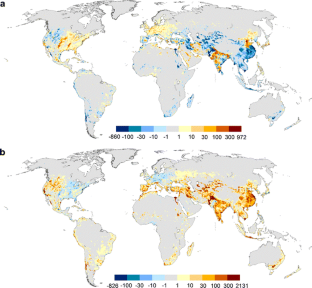
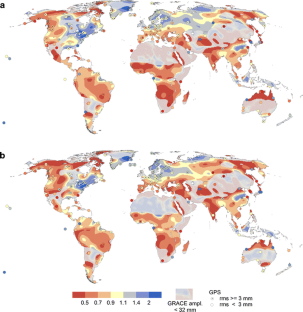
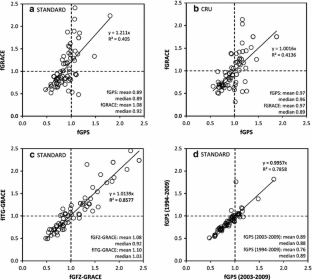
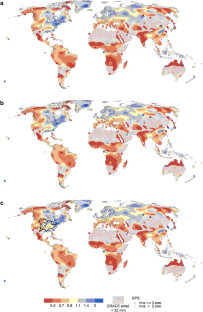
Better quantification of continental water storage variations is expected to improve our understanding of water flows, including evapotranspiration, runoff and river discharge as well as human water abstractions. For the first time, total water storage (TWS) on the land area of the globe as computed by the global water model WaterGAP (Water Global Assessment and Prognosis) was compared to both gravity recovery and climate experiment (GRACE) and global positioning system (GPS) observations. The GRACE satellites sense the effect of TWS on the dynamic gravity field of the Earth. GPS reference points are displaced due to crustal deformation caused by time-varying TWS. Unfortunately, the worldwide coverage of the GPS tracking network is irregular, while GRACE provides global coverage albeit with low spatial resolution. Detrended TWS time series were analyzed by determining scaling factors for mean annual amplitude (f GRACE) and time series of monthly TWS (f GPS). Both GRACE and GPS indicate that WaterGAP underestimates seasonal variations of TWS on most of the land area of the globe. In addition, seasonal maximum TWS occurs 1 month earlier according to WaterGAP than according to GRACE on most land areas. While WaterGAP TWS is sensitive to the applied climate input data, none of the two data sets result in a clearly better fit to the observations. Due to the low number of GPS sites, GPS observations are less useful for validating global hydrological models than GRACE observations, but they serve to support the validity of GRACE TWS as observational target for hydrological modeling. For unknown reasons, WaterGAP appears to fit better to GPS than to GRACE. Both GPS and GRACE data, however, are rather uncertain due to a number of reasons, in particular in dry regions. It is not possible to benefit from either GPS or GRACE observations to monitor and quantify human water abstractions if only detrended (seasonal) TWS variations are considered. Regarding GRACE, this is mainly caused by the attenuation of the TWS differences between water abstraction variants due to the filtering required for GRACE TWS. Regarding GPS, station density is too low. Only if water abstractions lead to long-term changes in TWS by depletion or restoration of water storage in groundwater or large surface water bodies, GRACE may be used to support the quantification of human water abstractions.
Access this article
Subscribe and save
- Starting from 10 chapters or articles per month
- Access and download chapters and articles from more than 300k books and 2,500 journals
- Cancel anytime View plans
Buy Now
Price excludes VAT (USA)
Tax calculation will be finalised during checkout.
Instant access to the full article PDF.
Fig. 1
The alternative text for this image may have been generated using AI.
Fig. 2
The alternative text for this image may have been generated using AI.
Fig. 3
The alternative text for this image may have been generated using AI.
Fig. 4
The alternative text for this image may have been generated using AI.
Fig. 5
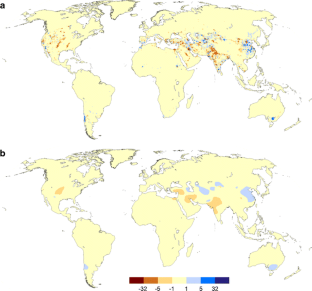
The alternative text for this image may have been generated using AI.
Fig. 6
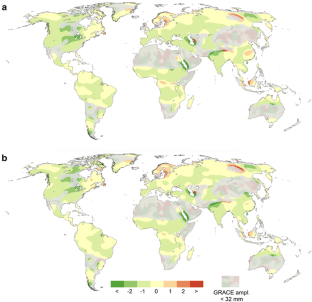
The alternative text for this image may have been generated using AI.
Fig. 7
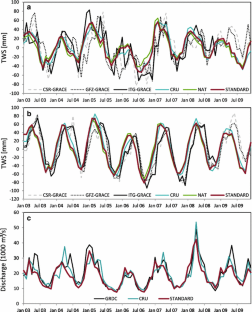
The alternative text for this image may have been generated using AI.
References
- Alkama R, Decharme B, Douville H, Becker M, Cazenave A, Sheffield J, Voldoire A, Tyteca S, Le Moigne P (2010) Global evaluation of the ISBA–TRIP continental hydrological system. Part I: comparison to GRACE terrestrial water storage estimates and in situ river discharges. J Hydrom 11(3):583–600. doi:10.1175/2010JHM1211.1
Article Google Scholar - Bettadpur SV (2012) Insights into the Earth system mass variability from CSR-RL05 GRACE gravity fields. EGU General Assembly Conference Abstracts. http://meetingorganizer.copernicus.org/EGU2012/EGU2012-6409.pdf
- Cheng M (2004) Variations in the Earth's oblateness during the past 28 years. J Geophys Res 109(B9):B09402. doi:10.1029/2004JB003028
Google Scholar - Clarke PJ, Lavallée DA, Blewitt G, van Dam TM, Wahr JM (2005) Effect of gravitational consistency and mass conservation on seasonal surface mass loading models. Geophys Res Lett 32(8):L08306. doi:10.1029/2005GL022441
Google Scholar - Crétaux J, Jelinski W, Calmant S, Kouraev A, Vuglinski V, Bergé-Nguyen M et al (2011) SOLS: a lake database to monitor in the near real time water level and storage variations from remote sensing data. Adv Space Res 47(9):1497–1507. doi:10.1016/j.asr.2011.01.004
Article Google Scholar - Dahle C, Flechtner F, Gruber C, König D, König R, Michalak G, Neumayer K (2012) GFZ GRACE level-2 processing standards document for level-2 product release 0005. Geoforschungszentrum (GFZ) Potsdam
- Döll P, Fiedler K (2008) Global-scale modeling of groundwater recharge. Hydrol Earth Syst Sci 12(3):863–885. doi:10.5194/hess-12-863-2008
Article Google Scholar - Döll P, Siebert S (2002) Global modeling of irrigation water requirements. Water Resour Res 38 (4):8-1– 8-10. doi:10.1029/2001WR000355
Google Scholar - Döll P, Kaspar F, Lehner B (2003) A global hydrological model for deriving water availability indicators: model tuning and validation. J Hydrol 270(1–2):105–134. doi:10.1016/S0022-1694(02)00283-4
Article Google Scholar - Döll P, Fiedler K, Zhang J (2009) Global-scale analysis of river flow alterations due to water withdrawals and reservoirs. Hydrol Earth Syst Sci 6:2413–2432. doi:10.5194/hess-13-2413-2009
Article Google Scholar - Döll P, Hoffmann-Dobrev H, Portmann FT, Siebert S, Eicker A, Rodell M et al (2012) Impact of water withdrawals from groundwater and surface water on continental water storage variations. J Geodyn 59–60:143–156. doi:10.1016/j.jog.2011.05.001
Article Google Scholar - Famiglietti JS, Lo M, Ho SL, Bethune J, Anderson KJ, Syed TH et al (2011) Satellites measure recent rates of groundwater depletion in California's Central Valley. Geophys Res Lett 38(3):L03403. doi:10.1029/2010GL046442
Google Scholar - Fersch B, Kunstmann H, Bárdossy A, Devaraju B, Sneeuw N (2012) Continental-scale basin water storage variation from global and dynamically downscaled atmospheric water budgets in comparison with GRACE-derived observations. J Hydrom 13(5):1589–1603. doi:10.1175/JHM-D-11-0143.1
Article Google Scholar - Flechtner F (2007) AOD1B product description document for product releases 01–04. Technical Report, Geoforschungszentrum (GFZ) Potsdam
Google Scholar - Friedl MA, Sulla-Menashe D, Tan B, Schneider A, Ramankutty N, Sibley A, Huang X (2010) MODIS Collection 5 global land cover: algorithm refinements and characterization of new datasets. Remote Sens Env 114(1):168–182. doi:10.1016/j.rse.2009.08.016
Article Google Scholar - Fritsche M, Döll P, Dietrich R (2012) Global-scale validation of model-based load deformation of the Earth's crust from continental watermass and atmospheric pressure variations using GPS. J Geodyn 59–60:133–142. doi:10.1016/j.jog.2011.04.001
Article Google Scholar - Grippa M, Kergoat L, Frappart F, Araud Q, Boone A, de Rosnay P et al (2011) Land water storage variability over West Africa estimated by gravity recovery and climate experiment (GRACE) and land surface models. Water Resour Res 47(5):W05549. doi:10.1029/2009WR008856
Article Google Scholar - Harris I, Jones P, Osborn T, Lister D (2013) Updated high-resolution grids of monthly climatic observations—the CRU TS3.10 dataset. Int J Climatol 34:623–642. doi:10.1002/joc.3711
Google Scholar - Hunger M, Döll P (2008) Value of river discharge data for global-scale hydrological modeling. Hydrol Earth Syst Sci 12(3):841–861. doi:10.5194/hess-12-841-2008
Article Google Scholar - Kusche J (2007) Approximate decorrelation and non-isotropic smoothing of time-variable GRACE-type gravity field models. J Geod 81(11):733–749. doi:10.1007/s00190-007-0143-3
Article Google Scholar - Kusche J, Schmidt R, Petrovic S, Rietbroek R (2009) Decorrelated GRACE time-variable gravity solutions by GFZ, and their validation using a hydrological model. J Geod 83(10):903–913. doi:10.1007/s00190-009-0308-3
Article Google Scholar - Landerer FW, Dickey JO, Güntner A (2010) Terrestrial water budget of the Eurasian pan-Arctic from GRACE satellite measurements during 2003-2009. J Geophys Res 115:D23115. doi:10.1029/2010JD014584
Article Google Scholar - Mayer-Gürr T, Kurtenbach E, Eicker A (2010) ITG-Grace2010 gravity field model. Institut für Geodäsie und Geoinformation Universität Bonn. http://www.igg.uni-bonn.de/apmg/index.php?id=itg-grace2010
- McGuire V (2011) Water-level changes in the High Plains Aquifer, predevelopment to 2007, 2007–08, and 2008–09, and change in water storage, predevelopment to 2009. U.S. Geological Survey Scientific Investigations Report:2011-5089
- Müller Schmied H, Eisner S, Franz D, Wattenbach M, Portmann FT, Flörke M, Döll P (2014) Sensitivity of simulated global-scale freshwater fluxes and storages to input data, hydrological model structure, human water use and calibration. Hydrol Earth Syst Sci Discuss 11:1583–1649. doi:10.5194/hessd-11-1583-2014
- Pedinotti V, Boone A, Decharme B, Crétaux JF, Mognard N, Panthou G et al (2012) Evaluation of the ISBA-TRIP continental hydrologic system over the Niger basin using in situ and satellite derived datasets. Hydrol Earth Syst Sci 16(6):1745–1773. doi:10.5194/hess-16-1745-2012
Article Google Scholar - Riegger J, Tourian M, Devaraju B, Sneeuw N (2012) Analysis of grace uncertainties by hydrological and hydro-meteorological observations. J Geodyn 59–60:16–27. doi:10.1016/j.jog.2012.02.001
Article Google Scholar - Rietbroek R, Brunnabend S, Kusche J, Schröter J (2012a) Resolving sea level contributions by identifying fingerprints in time-variable gravity and altimetry. J Geodyn 59–60:72–81. doi:10.1016/j.jog.2011.06.007
Article Google Scholar - Rietbroek R, Fritsche M, Brunnabend S, Daras I, Kusche J, Schröter J et al (2012b) Global surface mass from a new combination of GRACE, modelled OBP and reprocessed GPS data. J Geodyn 59–60:64–71. doi:10.1016/j.jog.2011.02.003
Article Google Scholar - Rost S, Gerten D, Bondeau A, Lucht W, Rohwer J, Schaphoff S (2008) Agricultural green and blue water consumption and its influence on the global water system. Water Resour Res 44(9):W09405. doi:10.1029/2007WR006331
Article Google Scholar - Schmidt R, Schwintzer P, Flechtner F, Reigber C, Güntner A, Döll P et al (2006) GRACE observations of changes in continental water storage. Glob Plan Change 50(1–2):112–126. doi:10.1016/j.gloplacha.2004.11.018
Article Google Scholar - Schneider U, Becker A, Finger P, Meyer-Christoffer A, Ziese M, Rudolf B (2013) GPCC's new land surface precipitation climatology based on quality-controlled in situ data and its role in quantifying the global water cycle. Theor Appl Climatol. doi:10.1007/s00704-013-0860-x
Google Scholar - Strassberg G, Scanlon BR, Chambers D (2009) Evaluation of groundwater storage monitoring with the GRACE satellite: case study of the high plains aquifer, central United States. Water Resour Res 45(5):W05410. doi:10.1029/2008WR006892
Article Google Scholar - Tiwari VM, Wahr J, Swenson S (2009) Dwindling groundwater resources in northern India, from satellite gravity observations. Geophys Res Lett 36(18):L18401. doi:10.1029/2009GL039401
Article Google Scholar - Vergnes J-P, Decharme B (2012) A simple groundwater scheme in the TRIP river routing model: global off-line evaluation against GRACE terrestrial water storage estimates and observed river discharges. Hydrol Earth Syst Sci 16:3889–3908. doi:10.5194/hess-16-3889-2012
Article Google Scholar - Wada Y, van Beek LPH, Bierkens MFP (2012) Nonsustainable groundwater sustaining irrigation: a global assessment. Water Resour Res 48:W00L06. doi:10.1029/2011WR010562
- Wahr J, Molenaar M, Bryan F (1998) Time variability of the Earth's gravity field: hydrological and oceanic effects and their possible detection using GRACE. J Geophys Res 103(B12):30205–30229. doi:10.1029/98JB02844
Article Google Scholar - Wang D (2012) Evaluating interannual water storage changes at watersheds in Illinois based on long-term soil moisture and groundwater level data. Water Resour Res 48(3):W03502. doi:10.1029/2011WR010759
Article Google Scholar - Weedon GP, Gomes S, Viterbo P, Shuttleworth WJ, Blyth E, Österle H et al (2011) Creation of the WATCH Forcing Data and its use to assess global and regional reference crop evaporation over land during the twentieth century. J Hydrom 12(5):823–848. doi:10.1175/2011JHM1369.1
Article Google Scholar - Werth S, Güntner A (2010) Calibration analysis for water storage variability of the global hydrological model WGHM. Hydrol Earth Syst Sci 14(1):59–78
Article Google Scholar - Xie H, Longuevergne L, Ringler C, Scanlon BR (2012) Calibration and evaluation of a semi-distributed watershed model of Sub-Saharan Africa using GRACE data. Hydrol Earth Syst Sci 16(9):3083–3099. doi:10.5194/hess-16-3083-2012
Article Google Scholar
Acknowledgments
Part of this study was funded by the German Research Foundation (DFG Priority Program SPP 1257 Mass Transport and Mass Distribution in the System Earth). We are grateful to the two reviewers and to the editor who helped us to improve the manuscript. We thank Carina Schuh for data processing and figure preparation.
Author information
Authors and Affiliations
- Institute of Physical Geography, University of Frankfurt, 60054, Frankfurt, Germany
Petra Döll & Hannes Müller Schmied - Institute of Planetary Geodesy, Technical University Dresden, 01069, Dresden, Germany
Mathias Fritsche - Institute of Geodesy and Geoinformation, University of Bonn, 53115, Bonn, Germany
Annette Eicker
Authors
- Petra Döll
- Mathias Fritsche
- Annette Eicker
- Hannes Müller Schmied
Corresponding author
Correspondence toPetra Döll.
Rights and permissions
About this article
Cite this article
Döll, P., Fritsche, M., Eicker, A. et al. Seasonal Water Storage Variations as Impacted by Water Abstractions: Comparing the Output of a Global Hydrological Model with GRACE and GPS Observations.Surv Geophys 35, 1311–1331 (2014). https://doi.org/10.1007/s10712-014-9282-2
- Received: 28 June 2013
- Accepted: 12 November 2013
- Published: 13 March 2014
- Issue date: November 2014
- DOI: https://doi.org/10.1007/s10712-014-9282-2