Developing an Integrated Electronic Medication Reconciliation Platform and Evaluating its Effects on Preventing Potential Duplicated Medications and Reducing 30-Day Medication-Related Hospital Revisits for Inpatients (original) (raw)
Abstract
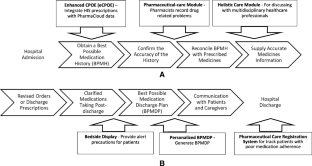
The aims were to develop an integrated electronic medication reconciliation (ieMR) platform, evaluate its effects on preventing potential duplicated medications, analyze the distribution of the potential duplicated medications by the Anatomical Therapeutic and Chemical (ATC) code for all inpatients, and determine the rate of 30-day medication-related hospital revisits for a geriatric unit. The study was conducted in a tertiary medical center in Taiwan and involved a retrospective quasi pre-intervention (July 1–November 30, 2015) and post-intervention (October 1–December 31, 2016) study design. A multidisciplinary team developed the ieMR platform covering the process from admission to discharge. The ieMR platform included six modules of an enhanced computer physician order entry system (eCPOE), Pharmaceutical-care, Holistic Care, Bedside Display, Personalized Best Possible Medication Discharge Plan, and Pharmaceutical Care Registration System. The ieMR platform prevented the number of potential duplicated medications from pre (25,196 medications, 2.3%) to post (23,413 medications, 3.8%) phases (OR 1.71, 95% CI, 1.68–1.74; p < .001). The most common potential duplicated medications classified by the ATC codes were cardiovascular system (28.4%), alimentary tract and metabolism (26.4%), and nervous system (14.9%), and by chemical substances were sennoside (12.5%), amlodipine (7.5%), and alprazolam (7.4%). The rate of medication-related 30-day hospital revisits for the geriatric unit was significantly decreased in post-intervention compared with that in pre-intervention (OR = 0.12; 95% CI, 0.03–0.53; p < .01). This study indicated that the ieMR platform significantly prevented the number of potential duplicated medications for inpatients and reduced the rate of 30-day medication-related hospital revisits for the patients on the geriatric unit.
Access this article
Subscribe and save
- Starting from 10 chapters or articles per month
- Access and download chapters and articles from more than 300k books and 2,500 journals
- Cancel anytime View plans
Buy Now
Price excludes VAT (USA)
Tax calculation will be finalised during checkout.
Instant access to the full article PDF.
Fig. 1
References
- Cornish PL, Knowles SR, Marchesano R, Tam V, Shadowitz S, Juurlink DN, Etchells EE (2005) Unintended medication discrepancies at the time of hospital admission. Arch Intern Med 165:424-429. https://doi.org/10.1001/archinte.165.4.424
Article PubMed Google Scholar - Cheng SH, Chen CC (2014) Effects of continuity of care on medication duplication among the elderly. Med Care 52:149-156. https://doi.org/10.1097/MLR.0000000000000042
Article PubMed Google Scholar - Gleason KM, Groszek JM, Sullivan C, Rooney D, Barnard C, Noskin GA (2004) Reconciliation of discrepancies in medication histories and admission orders of newly hospitalized patients. Am J Health Syst Pharm 61:1689-1695. https://doi.org/10.1093/ajhp/61.16.1689
Article PubMed Google Scholar - Lee JY, Leblanc K, Fernandes OA, Huh JH, Wong GG, Hamandi B, Lazar NM, Morra D, Bajcar JM, Harrison J (2010) Medication reconciliation during internal hospital transfer and impact of computerized prescriber order entry. Ann Pharmacother 44:1887-1895. https://doi.org/10.1345/aph.1P314
Article PubMed Google Scholar - Schnipper JL, Liang CL, Hamann C, Karson AS, Palchuk MB, McCarthy PC, Sherlock M, Turchin A, Bates DW (2011) Development of a tool within the electronic medical record to facilitate medication reconciliation after hospital discharge. J Am Med Inform Assoc 18:309-313. https://doi.org/10.1136/amiajnl-2010-000040
Article PubMed PubMed Central Google Scholar - Moore P, Armitage G, Wright J, Dobrzanski S, Ansari N, Hammond I, Scally A (2011) Medicines reconciliation using a shared electronic health care record. J Patient Saf 7:148-154. https://doi.org/10.1097/PTS.0b013e31822c5bf9
Article PubMed Google Scholar - Bédard P, Tardif L, Ferland A, Bussières JF, Lebel D, Bailey B, Girard M, Lachaîne J (2011) A medication reconciliation form and its impact on the medical record in a paediatric hospital. J Eval Clin Pract 17:222-227. https://doi.org/10.1111/j.1365-2753.2010.01424.x
Article PubMed Google Scholar - De Winter S, Vanbrabant P, Spriet I, Desruelles D, Indevuyst C, Knockaert D, Gillet JB, Willems L (2011) A simple tool to improve medication reconciliation at the emergency department. Eur J Intern Med 22:382-385. https://doi.org/10.1016/j.ejim.2011.03.010
Article PubMed Google Scholar - Feldman LS, Costa LL, Feroli ER, Jr., Nelson T, Poe SS, Frick KD, Efird LE, Miller RG (2012) Nurse-pharmacist collaboration on medication reconciliation prevents potential harm. J Hosp Med 7:396-401. https://doi.org/10.1002/jhm.1921
Article PubMed Google Scholar - Henneman EA, Tessier EG, Nathanson BH, Plotkin K (2014) An evaluation of a collaborative, safety focused, nurse-pharmacist intervention for improving the accuracy of the medication history. J Patient Saf 10:88-94. https://doi.org/10.1097/PTS.0b013e318294890c
Article PubMed Google Scholar - National Health Insurance Administration(NHIA) (2016) NHI PharmaCloud system. https://www.nhi.gov.tw/English/Content_List.aspx?n=02BA04454AED80E0&topn=BCB2B0D2433F6491. Accessed 15 September 2018
- Liao CY, Wu MF, Poon SK, Liu YM, Chen HC, Wu CL, Sheu WH, Liou WS (2019) Improving medication safety by cloud technology: Progression and value-added applications in Taiwan. Int J Med Inform 126:65-71. https://doi.org/10.1016/j.ijmedinf.2019.03.012
Article PubMed Google Scholar - Hung PL, Chen JY, Chen MT, Li PL, Li WC, Wang ZC, Huang TT, Liang YT, Lin PC (2019) The impact of a medication reconciliation programme at geriatric hospital admission: A pre-/postintervention study. Br J Clin Pharmacol 85:2614-2622. https://doi.org/10.1111/bcp.14095
Article PubMed PubMed Central Google Scholar - Talebi MM, Sefidani Forough A, Riazi Esfahani P, Eskandari R, Haghgoo R, Fahimi F (2018) Medication interaction and physicians' compliance assessment through medication reconciliation forms in a university affiliated hospital. Iran J Pharm Res 17:159-167
PubMed PubMed Central Google Scholar - Developed through the ASHP Council on Pharmacy Practice, approved by the ASHP Board of Directors on April, by the ASHP House of Delegates on June (2013) ASHP statement on the pharmacist's role in medication reconciliation. Am J Health Syst Pharm 70:453-456. https://doi.org/10.2146/sp120009
- Gillespie U, Alassaad A, Henrohn D, Garmo H, Hammarlund-Udenaes M, Toss H, Kettis-Lindblad A, Melhus H, Mörlin C (2009) A comprehensive pharmacist intervention to reduce morbidity in patients 80 years or older: a randomized controlled trial. Arch Intern Med 169:894-900. https://doi.org/10.1001/archinternmed.2009.71
Article PubMed Google Scholar - Christensen M, Lundh A (2016) Medication review in hospitalised patients to reduce morbidity and mortality. Cochrane Database Syst Rev 2:CD008986. https://doi.org/10.1002/14651858.CD008986.pub3
Article PubMed Google Scholar - Bosma LBE, Hunfeld NGM, Quax RAM, Meuwese E, Melief P, van Bommel J, Tan S, van Kranenburg MJ, van den Bemt P (2018) The effect of a medication reconciliation program in two intensive care units in the Netherlands: a prospective intervention study with a before and after design. Ann Intensive Care 8:19. https://doi.org/10.1186/s13613-018-0361-2
Article PubMed PubMed Central Google Scholar - Lisby M, Thomsen A, Nielsen LP, Lyhne NM, Breum-Leer C, Fredberg U, Jorgensen H, Brock B (2010) The effect of systematic medication review in elderly patients admitted to an acute ward of internal medicine. Basic Clin Pharmacol Toxicol 106:422-427. https://doi.org/10.1111/j.1742-7843.2009.00511.x
Article CAS PubMed Google Scholar - Liu YL, Chu LL, Su HC, Tsai KT, Kao PH, Chen JF, Hsieh HC, Lin HJ, Hsu CC, Huang CC (2019) Impact of computer-based and pharmacist-assisted medication review initiated in the Emergency Department. J Am Geriatr Soc 67:2298-2304. DOI:https://doi.org/10.1111/jgs.16078
Article PubMed Google Scholar - World Health Organization High 5s: Standard operating procedures. https://www.who.int/patientsafety/topics/high-5s/en/. Accessed 05 May 2019
- Moore C, Wisnivesky J, Williams S, McGinn T (2003) Medical errors related to discontinuity of care from an inpatient to an outpatient setting. J Gen Intern Med 18:646-651. https://doi.org/10.1046/j.1525-1497.2003.20722.x
Article PubMed PubMed Central Google Scholar - Sullivan C, Gleason KM, Rooney D, Groszek JM, Barnard C (2005) Medication reconciliation in the acute care setting: opportunity and challenge for nursing. J Nurs Care Qual 20:95-98. https://doi.org/10.1097/00001786-200504000-00001
Article PubMed Google Scholar - WHO Collaborating Centre for Drug Statistics Methodology, Norwegian Institute of Public Health (2018) Updates included in the ATC/DDD Index. https://www.whocc.no/atc_ddd_index/updates_included_in_the_atc_ddd_index/. Accessed 10 July 2019
- Tamblyn R, Winslade N, Lee TC, Motulsky A, Meguerditchian A, Bustillo M, Elsayed S, Buckeridge DL, Couture I, Qian CJ, Moraga T, Huang A (2018) Improving patient safety and efficiency of medication reconciliation through the development and adoption of a computer-assisted tool with automated electronic integration of population-based community drug data: the RightRx project. J Am Med Inform Assoc 25:482-495. https://doi.org/10.1093/jamia/ocx107
Article PubMed Google Scholar - Mekonnen AB, Abebe TB, McLachlan AJ, Brien JA (2016) Impact of electronic medication reconciliation interventions on medication discrepancies at hospital transitions: a systematic review and meta-analysis. BMC Med Inform Decis Mak 16:112. https://doi.org/10.1186/s12911-016-0353-9
Article PubMed PubMed Central Google Scholar - Yang CY, Lo YS, Chen RJ, Liu CT (2018) A Clinical Decision Support Engine Based on a National Medication Repository for the Detection of Potential Duplicate Medications: Design and Evaluation. JMIR Med Inform 6:e6. https://doi.org/10.2196/medinform.9064
Article PubMed PubMed Central Google Scholar - Nebeker JR, Barach P, Samore MH (2004) Clarifying adverse drug events: a clinician's guide to terminology, documentation, and reporting. Ann Intern Med 140:795-801. https://doi.org/10.7326/0003-4819-140-10-200405180-00009
Article PubMed Google Scholar - Klarin I, Wimo A, Fastbom J (2005) The association of inappropriate drug use with hospitalisation and mortality: a population-based study of the very old. Drugs Aging 22:69-82. https://doi.org/10.2165/00002512-200522010-00005
Article PubMed Google Scholar - Ziaeian B, Araujo KL, Van Ness PH, Horwitz LI (2012) Medication reconciliation accuracy and patient understanding of intended medication changes on hospital discharge. J Gen Intern Med 27:1513-1520. https://doi.org/10.1007/s11606-012-2168-4
Article PubMed PubMed Central Google Scholar - Brown LM (2013) Emerging opportunities for pharmacists to improve health care for the poor and underserved. J Health Care Poor Underserved 24:6-14. https://doi.org/10.1353/hpu.2013.0042
Article PubMed Google Scholar - Poole DL, Chainakul JN, Pearson M, Graham L (2006) Medication reconciliation: a necessity in promoting a safe hospital discharge. J Healthc Qual 28:12-19. https://doi.org/10.1111/j.1945-1474.2006.tb00607.x
Article PubMed Google Scholar - De Winter S, Spriet I, Indevuyst C, Vanbrabant P, Desruelles D, Sabbe M, Gillet JB, Wilmer A, Willems L (2010) Pharmacist- versus physician-acquired medication history: a prospective study at the emergency department. Qual Saf Health Care 19:371-375. https://doi.org/10.1136/qshc.2009.035014
Article PubMed Google Scholar - Mekonnen AB, McLachlan AJ, Brien JA (2016) Effectiveness of pharmacist-led medication reconciliation programmes on clinical outcomes at hospital transitions: a systematic review and meta-analysis. BMJ Open 6:e010003. https://doi.org/10.1136/bmjopen-2015-010003
Article PubMed PubMed Central Google Scholar
Acknowledgments
We acknowledge Mr. Che-Fu Tsai for his comments regarding this project implementation. In addition, we thank Pao-Lin Li, Tzu-Ting Huang, Wei-Chi Li, Zi-Cheng Wang, Yen-Tzu Liang, the Quality Control Center, all members of the Center for Geriatrics and Gerontology, Nursing Department, Emergency Department, and Information Technology Department at Kaohsiung Veterans General Hospital for their support in the implementation of this project.
Funding
This research did not receive any specific grant from funding agencies in the public, commercial, or not-for-profit sectors.
Author information
Authors and Affiliations
- Department of Pharmacy, Kaohsiung Veterans General Hospital, No. 386, Dazhong 1st Road, Zuoying District, Kaohsiung City, 81362, Taiwan
Pi-Lien Hung & Miao-Ting Chen - Department of Pharmacy, School of Pharmacy, Kaohsiung Medical University, No.100, Shih-Chuan 1st Road, Sanmin Dist, Kaohsiung City, 80708, Taiwan
Pi-Lien Hung & Pei-Chin Lin - Department of Medical Education and Research, Kaohsiung Veterans General Hospital, No. 386, Dazhong 1st Road, Zuoying District, Kaohsiung City, 81362, Taiwan
Pei-Chin Lin - Department of Pharmacy, National Cheng Kung University Hospital, No.138, Sheng Li Road, Tainan, Taiwan
Jung-Yi Chen - Center for Geriatrics and Gerontology, Kaohsiung Veterans General Hospital, No. 386, Dazhong 1st Road, Zuoying District, Kaohsiung City, 81362, Taiwan
Ming-Yueh Chou & Yu-Te Lin - Aging and Health Research Center, National Yang-Ming University, No.155, Sec.2, Linong Street, Beitou District, Taipei City, 11221, Taiwan
Ming-Yueh Chou - Department of Critical Care Medicine, Kaohsiung Veterans General Hospital, No. 386, Dazhong 1st Road, Zuoying District, Kaohsiung City, 81362, Taiwan
Wei-Chun Huang - School of Medicine, National Yang-Ming University, No.155, Sec.2, Linong Street, Beitou District, Taipei City, 11221, Taiwan
Wei-Chun Huang - Department of Physical Therapy, Fooyin University, No. 151, Jinxue Road Daliao District, Kaohsiung City, 83102, Taiwan
Wei-Chun Huang - Quality Management Center, Kaohsiung Veterans General Hospital, No. 386, Dazhong 1st Road, Zuoying District, Kaohsiung City, 81362, Taiwan
Wang-Chuan Juang - Department of Business Management, National Sun Yat-sen University, 70 Lienhai Rd, Kaohsiung, 80424, Taiwan
Wang-Chuan Juang - Division of Pharmacy Practice and Administrative Sciences, The James L. Winkle College of Pharmacy, University of Cincinnati, 3225 Eden Avenue, Cincinnati, OH, 45267-0004, USA
Alex C. Lin
Authors
- Pi-Lien Hung
- Pei-Chin Lin
- Jung-Yi Chen
- Miao-Ting Chen
- Ming-Yueh Chou
- Wei-Chun Huang
- Wang-Chuan Juang
- Yu-Te Lin
- Alex C. Lin
Contributions
Pi-Lien Hung: Conceptualization, Methodology, Writing - Original Draft. Jung-Yi Chen: Formal analysis, Investigation. Miao-Ting Chen: Methodology, Data Curation. Ming-Yueh Chou: Conceptualization, Data Curation. Wei-Chun Huang: Validation, Project administration. Wang-Chuan Juang: Validation. Yu-Te Lin: Resources, Supervision. Pei-Chin Lin, Alex C. Lin: Methodology, Writing - Review & Editing, Visualization.
Corresponding authors
Correspondence toPei-Chin Lin or Alex C. Lin.
Ethics declarations
Statement on conflicts of interest
The authors declare that they have no known competing financial interests or personal relationships that could have appeared to influence the work reported in this paper.
Additional information
Publisher’s Note
Springer Nature remains neutral with regard to jurisdictional claims in published maps and institutional affiliations.
Appendices
Appendix 1-A
Fig. 2
Personalized medication information integrated from PharmaCloud System
Appendix 1-B
Fig. 3
Pharmacists record drug related problems on a pharmaceutical-care platform
Appendix 1-C
Fig. 4
Holistic care platform provided for discussing with multidisciplinary healthcare professionals
Appendix 1-D
Fig. 5
Bedside electronic display providing alert precautions for patients
Appendix 1-E
Fig. 6
Personalized BPMDP informed patients and caregivers Pharmacists
Appendix 1-F
Fig. 7
Pharmaceutical Care Registration System for track patients with poor medication adherence
Rights and permissions
About this article
Cite this article
Hung, PL., Lin, PC., Chen, JY. et al. Developing an Integrated Electronic Medication Reconciliation Platform and Evaluating its Effects on Preventing Potential Duplicated Medications and Reducing 30-Day Medication-Related Hospital Revisits for Inpatients.J Med Syst 45, 47 (2021). https://doi.org/10.1007/s10916-021-01717-8
- Received: 06 December 2020
- Accepted: 25 January 2021
- Published: 01 March 2021
- Version of record: 01 March 2021
- DOI: https://doi.org/10.1007/s10916-021-01717-8