Megacities – megarisks (original) (raw)
Abstract
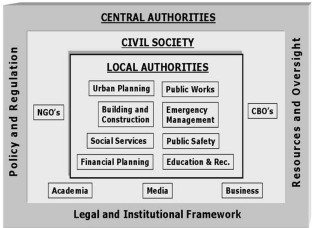
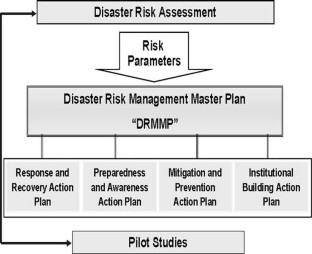
We review the definitions, population trends, and characteristics of megacities. Characteristics of megacities are, apart from their size, their complexity in terms of administration, infrastructure, traffic, etc., and at the same time the speed of change. Vulnerabilities and risk potential are discussed using the examples of Mexico City and Mumbai. We present the experience accumulated in the 6 years work of the Earthquakes and Megacities Initiative (EMI, http://www-megacities.physik.uni-karlsruhe.de/) with more than 20 large cities around the world, mostly located in the developing world. On this background we analyze obstacles that keep megacities from developing an efficient approach towards disaster mitigation and define a strategy that might overcome these problems. The key element of this strategy is the development of a Disaster Risk Management Master Plan (DRMMP) for cities. Currently the Istanbul Earthquake Master Plan (IEMP) serves as best example for an appropriate strategy for disaster reduction in megacities.
Access this article
Subscribe and save
- Starting from 10 chapters or articles per month
- Access and download chapters and articles from more than 300k books and 2,500 journals
- Cancel anytime View plans
Buy Now
Price excludes VAT (USA)
Tax calculation will be finalised during checkout.
Instant access to the full article PDF.
Fig. 1
The alternative text for this image may have been generated using AI.
Fig. 2
The alternative text for this image may have been generated using AI.
References
- Bilham R (1988) Earthquakes and urban growth. Nature 336:625–626
Article Google Scholar - Bilham R (1995) Global fatalities in the past 2000 years: prognosis for the next 30. In: Rundle J, Klein F, Turcotte D (eds) Reduction and predictability of natural disasters, Santa Fe Institute Studies in the Sciences of Complexity, vol XXV. Addison Wesley
- Bilham R (2004) Urban earthquake fatalities: a safer world, or worse to come? Seismol Res Lett 75(6):706–712
Article Google Scholar - Chernov Yu K, Sokolov V Yu (1999) Correlation of seismic intensity with Fourier acceleration spectra. Phys Chem Earth 24(6):523–528
Article Google Scholar - Gelbard A, Haub C, Kent M (1999) World population beyond six billion. Popul Bull 54(1):3–40
Google Scholar - Hough SE, Martin S, Bilham R, Atkinson GM (2002) The 26 January 2001 M 7.6 Bhuj, India. Earthquake: observed and predicted ground motion. Bull Seism Soc Am 92:2061–2079
Article Google Scholar - Husa K, Wohlschlägl H (1999) Megastädte der Dritten Welt im Globalisierungsprozess. Mexico City, Jakarta, Bombay – Vergleichende Fallstudien in ausgewählten Kulturkreisen, Abhandlungen zur Geographie und Regionalforschung, Band 6, Institut für Geographie der Universität Wien, ISBN 3-900830-40-1
- Jaiswal K, Sokolov V, Sinha R, Wenzel F, Chernov Y (2004) Probabilistic seismic hazard assessment for Mumbai (western India) area. In: Chen YT, Panza GF, Wu ZL (eds) IUGG special volume: earthquake hazard, risk, and strong ground motion. Seismological Press, Beijing, pp 7–30
- Panza GF, Paskaleva I, Nunziata C (2004) Seismic ground motion in large urban areas. Pageoph Topical Volumes, Birkhäuser Verlag, Basel-Boston-Berlin, ISBN: 3-7643-7042-4, vol 161, No. 5/6, pp 943–1300
- Puente S (1999) Social vulnerability to disasters in Mexico city: an assessment method. In: Mitchell JK (ed) Crucibles of hazard: mega-cities and disasters in transition. United Nations University Press, Tokyo, New York, Paris, ISBN 92-808-0987-3, pp 295–334
- Sinha R, Adrash N (1999) A postulated earthquake damage scenario for Mumbai. Indian Soc Earthquake Technol 36(3):1
Google Scholar - Sokolov VYu (2002) Seismic intensity and Fourier acceleration spectra: revised relationship. Earthquake Spectra 18(1):161–187
Article Google Scholar - Telford Th (1995) Megacities: reducing vulnerability to natural disasters. Institution of Civil Engineers, Thomas Telford Publications, London, ISBN 0-7277-2068-6
- UN [United Nations Population Division] (2000) World urbanization prospects: the 1999 revision. United Nations Population Division, New York, 128 pp
- Yong C, Tsoi KL, Fehbi C, Zhenhuan G, Oija Z, Zhangli C (1988) The Great Tangshan earthquake of 1976: an anatomy of disaster. Pergamon Press, ISBN 0-080-344875-0, 162 pp
Author information
Authors and Affiliations
- Geophysical Institute, Karlsruhe University, Hertzstr. 16, 76187, Karlsruhe, Germany
Friedemann Wenzel - Risk Management Solutions, Inc., 7015 Gateway Blvd., Newark, CA, 94560-1011, USA
Fouad Bendimerad - Department of Civil Engineering, IIT, Powai, Mumbai, 400 076, India
Ravi Sinha
Authors
- Friedemann Wenzel
- Fouad Bendimerad
- Ravi Sinha
Corresponding author
Correspondence toFriedemann Wenzel.
Rights and permissions
About this article
Cite this article
Wenzel, F., Bendimerad, F. & Sinha, R. Megacities – megarisks.Nat Hazards 42, 481–491 (2007). https://doi.org/10.1007/s11069-006-9073-2
- Received: 04 April 2005
- Accepted: 01 July 2006
- Published: 24 February 2007
- Issue date: September 2007
- DOI: https://doi.org/10.1007/s11069-006-9073-2