Use of satellite remote sensing data in the mapping of global landslide susceptibility (original) (raw)
Abstract
Satellite remote sensing data has significant potential use in analysis of natural hazards such as landslides. Relying on the recent advances in satellite remote sensing and geographic information system (GIS) techniques, this paper aims to map landslide susceptibility over most of the globe using a GIS-based weighted linear combination method. First, six relevant landslide-controlling factors are derived from geospatial remote sensing data and coded into a GIS system. Next, continuous susceptibility values from low to high are assigned to each of the six factors. Second, a continuous scale of a global landslide susceptibility index is derived using GIS weighted linear combination based on each factor’s relative significance to the process of landslide occurrence (e.g., slope is the most important factor, soil types and soil texture are also primary-level parameters, while elevation, land cover types, and drainage density are secondary in importance). Finally, the continuous index map is further classified into six susceptibility categories. Results show the hot spots of landslide-prone regions include the Pacific Rim, the Himalayas and South Asia, Rocky Mountains, Appalachian Mountains, Alps, and parts of the Middle East and Africa. India, China, Nepal, Japan, the USA, and Peru are shown to have landslide-prone areas. This first-cut global landslide susceptibility map forms a starting point to provide a global view of landslide risks and may be used in conjunction with satellite-based precipitation information to potentially detect areas with significant landslide potential due to heavy rainfall.
Access this article
Subscribe and save
- Starting from 10 chapters or articles per month
- Access and download chapters and articles from more than 300k books and 2,500 journals
- Cancel anytime View plans
Buy Now
Price excludes VAT (USA)
Tax calculation will be finalised during checkout.
Instant access to the full article PDF.
Fig. 1
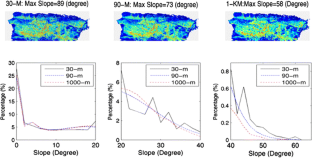
The alternative text for this image may have been generated using AI.
Fig. 2

The alternative text for this image may have been generated using AI.
Fig. 3

The alternative text for this image may have been generated using AI.
Fig. 4
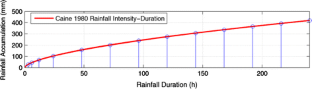
The alternative text for this image may have been generated using AI.
References
- Anbalagan R (1992) Landslide hazard evaluation and zonation mapping in mountainous terrain. Eng Geol 32:269–277
Article Google Scholar - Ayalew L, Yamagishi H, Ugawa N (2004) Landslide susceptibility mapping using GIS-based weighted linear combination, the case in Tsugawa area of Agano River, Niigata Prefecure, Japan. Landslide 1:73–81
Article Google Scholar - Baum RL, Savage WZ, Godt JW (2002) TRIGRS – A Fortran program for transient rainfall infiltration and grid-based regional slope-stability analysis: U.S. Geological Survey Open-File Report 02-0424, 64 pp. http://pubs.usgs.gov/of/2002/ofr-02-424/
- Caine N (1980) The rainfall intensity-duration control of shallow landslides and debris flows. Geografiska Annaler 62A:23–27
Article Google Scholar - Carrara A, Cardinali M, Detti R, Guzzetti F, Pasqui V, Reichenbach P (1991) GIS techniques and statistical models in evaluating landslide hazard. Earth Surf Proc Land 16:427– 445
Article Google Scholar - Coe JA, Godt JW, Baum RL, Bucknam RC, Michael JA (2004) Landslide susceptibility from topography in Guatemala. In: Lacerda et al. (eds) Landslides evaluation and stabilization. Taylor and Francis Group, London, pp 69–78
- Dai FC, Lee CF (2002) Landslide characteristics and slope instability modeling using GIS, Lantau Island, Hong Kong. Geomorphology 42:213–238
Article Google Scholar - Davis JC (1986) Statistics and data analysis in geology. John Wiley & Sons, New York
Google Scholar - Fabbri AG, Chung CF, Cendrero A, Remondo J (2003) Is prediction of future landslides possible with GIS? Nat Hazards 30:487–499
Article Google Scholar - Farr T, Kobrick M (2000) Shuttle Radar Topography Mission produces a wealth of data, Eos Trans. AGU 81:583–585
Google Scholar - Fernandez T, Irigaray C, El Hamdouni R, Chacon J (2003) Methodology for landslide susceptibility mapping by means of a GIS, application to the contraviesa area (Granada, Spain). Nat Hazards 30:297–308
Article Google Scholar - Friedl MA, McIver DK, Hodges JCF, Zhang XY, Muchoney D, Strahler AH, Woodcock CE, Gopal S, Schneider A, Cooper A, Baccini A, Gao F, Schaaf C (2002) Global land cover mapping from MODIS: algorithms and early results. Remote Sens Environ 83(1–2):287–302
Google Scholar - Godt J (2004) Observed and Modeled conditions for shallow landslide in the Seattle, Washington area. PhD dissertation University of Colorado, Boulder, CO
- Guzzetti F, Carrara A, Cardinali M, Reichenbach P (1999) Landslide hazard evaluation: a review of current techniques and their application in a multi-scale study, Central Italy. Geomorphology 31:181–216
Article Google Scholar - Huffman GJ, Adler RF, Bolvin DT, Gu G, Nelkin EJ, Bowman KP, Hong Y, Stocker EF, Wolff DB (2006) The TRMM Multi-satellite Precipitation Analysis: Quasi-Global, Multi-Year, Combined-Sensor Precipitation Estimates at Fine Scale. J. Hydrometeor., accepted
- Larsen MC, Simon A (1993) A rainfall intensity-duration threshold for landslides in a humid-tropical environment, Puerto Rico. Geografiska Annaler 75A:13–23
Article Google Scholar - Larsen MC, Torres Sanchez AJ (1998) The frequency and distribution of recent landslides in three montane tropical regions of Puerto Rico. Geomorphology 24:309–331
Article Google Scholar - Lee S, Min K (2001) Statistical analysis of landslide susceptibility at Yongin, Korea. Environ Geol 40:1095–1113
Article Google Scholar - Sarkar S, Kanungo DP (2004) An integrated approach for landslide susceptibility mapping using remote sensing and GIS. Photo Eng Remote Sens 70:617–625
Google Scholar - Saha AK, Gupta RP, Arora MK (2002) GIS-based landslide hazard zonation in the Bagirathi (Ganga) Valley, Himalayas. Int J Remote Sens 23(2):357–369
Article Google Scholar - Saha AK, Gupta RP, Sarkar I, Arora MK, Csaplovics E (2005) An approach for GIS-based statistical landslide susceptibility zonation—with a case study in the Himalayas. Landslides 2:61–69
Article Google Scholar - Sidle RC, Ochiai H (2006) Landslide processes, prediction, land use. American Geophysical Union, Washington, DC, pp 1–312
Acknowledgements
This research is supported by NASA’s Applied Sciences program under Steven Ambrose of NASA Headquarters.
Author information
Authors and Affiliations
- Goddard Earth and Science Technology Center, University of Maryland Baltimore County, Baltimore, MD, USA
Yang Hong - NASA Goddard Space Flight Center, Laboratory for Atmospheres, Mail code 613.1, Greenbelt, MD, 20771, USA
Yang Hong, Robert Adler & George Huffman - Science System Application Inc., Greenbelt, MD, 20771, USA
George Huffman
Authors
- Yang Hong
- Robert Adler
- George Huffman
Corresponding author
Correspondence toYang Hong.
Rights and permissions
About this article
Cite this article
Hong, Y., Adler, R. & Huffman, G. Use of satellite remote sensing data in the mapping of global landslide susceptibility.Nat Hazards 43, 245–256 (2007). https://doi.org/10.1007/s11069-006-9104-z
- Received: 28 August 2006
- Accepted: 07 December 2006
- Published: 13 March 2007
- Issue date: November 2007
- DOI: https://doi.org/10.1007/s11069-006-9104-z