Fiscal resilience over time and its management in the context of multi-risks: an application to the Danube Region (original) (raw)
1 Introduction
Governments play a crucial role in addressing present and future emerging challenges, such as fulfilling the Sustainable Development Goals (European Union [2015](/article/10.1007/s11069-024-06678-y#ref-CR8 "European Union (2015) Transforming our world: the 2030 Agenda for Sustainable Development. Resolution adopted by the General Assembly on 25 September 2015. Available online at https://documents-dds-ny.un.org/doc/UNDOC/GEN/N15/291/89/PDF/N1529189.pdf?OpenElement
            . Accessed 01 April 2024")), the Paris Agreement (United Nations Framework Convention on Climate Change [2016](/article/10.1007/s11069-024-06678-y#ref-CR40 "United Nations Framework Convention on Climate Change (2016) The Paris Agreement. United Nations Framework Convention on Climate Change. Denmark. Available online at
              https://unfccc.int/sites/default/files/resource/parisagreement_publication.pdf

            . Accessed 01 April 2024")), and the Sendai Framework for Disaster Risk Reduction 2015–2030 (United Nations Office for Disaster Risk Reduction [2015](/article/10.1007/s11069-024-06678-y#ref-CR41 "United Nations Office for Disaster Risk Reduction (2015): Sendai Framework for Disaster Risk Reduction 2015-2030. United Nations. Geneva. Available online at
              https://www.preventionweb.net/files/43291_sendaiframeworkfordrren.pdf

            . Accessed 01 April 2024")). To achieve these short- and long-term goals, it is widely recognized that identifying government liabilities is essential. This is necessary not only for understanding the risks to its fiscal stability but also for determining the appropriate measures needed to address them. Governments typically plan and budget for _direct liabilities_ (Mechler and Hochrainer-Stigler [2014](/article/10.1007/s11069-024-06678-y#ref-CR47 "Mechler R, Hochrainer-Stigler S (2014) Revisiting arrow-lind: managing sovereign disaster risk. J Nat Res Policy Res 6(1):93–100.
              https://doi.org/10.1080/19390459.2013.873186

            ")), that is, liabilities that manifest themselves through certain and annually recurrent expenditures. These liabilities can be termed _explicit_ (as recognized by law or contract) or _implicit liabilities_ (e.g., due to moral obligations or public expectations). In contrast to direct liabilities, costs associated with disaster event losses or pandemics such as Covid-19 enter the balance sheet as _contingent liabilities_, i.e., obligations that arise only when an event occurs. Here one can also distinguish between explicit and implicit liabilities. _Explicit contingent liabilities_ include those costs that deal with the reconstruction of infrastructure for which the government is explicitly responsible, e.g., public infrastructure such as schools or streets, after disaster events. In contrast, _implicit contingent liabilities_ are associated with providing relief and ensuring that affected communities and economies continue to function well– commonly considered as a moral liability for governments, such as providing financial support to private businesses and vulnerable households during Covid-19 (Hochrainer-Stigler [2021](/article/10.1007/s11069-024-06678-y#ref-CR16 "Hochrainer-Stigler S (2021) Changes in fiscal risk against natural disasters due to Covid-19. Progr Disaster Sci 10:100176.
              https://doi.org/10.1016/j.pdisas.2021.100176

            ")). In light of recent multi-hazard events worldwide (e.g., compounding floods and wildfires, consecutive floods and droughts), both contingent implicit and explicit liabilities are gaining increasing attention. There is a growing interest in going beyond single-hazard, siloed approaches towards a multi-risk perspective (Ward et al. [2022](/article/10.1007/s11069-024-06678-y#ref-CR43 "Ward PJ, Daniell J, Duncan M, Dunne A, Hananel C, Hochrainer-Stigler S et al (2022) Invited perspectives: a research agenda towards disaster risk management pathways in multi-(hazard-)risk assessment. Nat Hazards Earth Syst Sci 22(4):1487–1497.
              https://doi.org/10.5194/nhess-22-1487-2022

            "); Hochrainer-Stigler et al. [2023](/article/10.1007/s11069-024-06678-y#ref-CR19 "Hochrainer-Stigler S, Trogrlić RŠ, Reiter K, Ward PJ, de Ruiter MC, Duncan MJ et al (2023) Toward a framework for systemic multi-hazard and multi-risk assessment and management. iScience 26(5):106736.
              https://doi.org/10.1016/j.isci.2023.106736

            "); Ruiter et al. [2020](/article/10.1007/s11069-024-06678-y#ref-CR34 "Ruiter MC, Couasnon A, Homberg MJC, Daniell JE, Gill JC, Ward PJ (2020) Why we can no longer ignore consecutive disasters. Earth’s Fut.
              https://doi.org/10.1029/2019EF001425

            "); van den Hurk et al. [2023](/article/10.1007/s11069-024-06678-y#ref-CR42 "van den Hurk BJJM, White CJ, Ramos AM, Ward PJ, Martius O, Olbert I et al (2023) Consideration of compound drivers and impacts in the disaster risk reduction cycle. iScience 26(3):106030.
              https://doi.org/10.1016/j.isci.2023.106030

            ")) to understand the combined impacts of multi-hazard (Kappes et al. [2012](/article/10.1007/s11069-024-06678-y#ref-CR27 "Kappes MS, Keiler M, von Elverfeldt K, Glade T (2012) Challenges of analyzing multi-hazard risk: a review. Nat Hazards 64(2):1925–1958.
              https://doi.org/10.1007/s11069-012-0294-2

            ")) and provide appropriate financial support for risk reduction and resilience-building measures.
As indicated, not only natural hazards but also other types of risks, such as the Covid-19 pandemic, can be related to contingent liabilities, i.e., they can also speak to moral obligations on the government’s side (e.g., to lessen the impacts to very vulnerable parts of the society) or that the functioning of markets and society is ensured (e.g., economic or health-related). Similar to disaster events caused by natural hazards, Covid-19 caused contingent liabilities which can be seen as pure downside risk and which cause costs that had to be financed. As in the case of natural hazards, many governments implemented massive fiscal stimulus packages due to the pandemic, e.g., to protect public health and to stabilize incomes. However, the significant decrease in economic growth and high spending levels led to weak fiscal positions and elevated debt for many countries around the world (IMF 2020). While the importance of fiscal support during and after the pandemic is widely recognized, there is growing concern about effectively managing other potential emerging risks and achieving sustainable and resilient development (Djalante et al. [2020](/article/10.1007/s11069-024-06678-y#ref-CR48 "Djalante R, Shaw R, DeWit A (2020) Building resilience against biological hazards and pandemics: COVID-19 and its implications for the Sendai Framework. Prog Dis Sci 6. https://doi.org/10.1016/j.pdisas.2020.100080
            ")). One such additional risk, for example, is conflict, which adds an extra layer of stress to fiscal risk due to its impact on energy prices and inflation as currently experienced in Europe and elsewhere (Yagi and Managi [2023](/article/10.1007/s11069-024-06678-y#ref-CR45 "Yagi M, Managi S (2023) The spillover effects of rising energy prices following 2022 Russian invasion of Ukraine. Econ Anal Policy 77:680–695.
              https://doi.org/10.1016/j.eap.2022.12.025

            ")).
Although natural hazards, health risks, and conflicts are distinct categories of risk, they can still influence each other considerably. Two or more hazards can, for instance, overlap or interact within a specific area over a defined period. These are so-called multi-hazard events, which can result in complex and cascading effects and create risk scenarios that are more intricate and potentially more severe than the combined effects of individual hazards (Gill et al. 2022). For instance, one hazard can trigger one or more additional hazards (e.g., an earthquake can trigger a landslide), or one hazard can increase the probability of another hazard occurring (e.g., a drought increases the probability of a wildfire). So-called compound hazards are another form of multi-hazard event where the impacts of two or more hazards are compounded in time and space, meaning that their effects overlap and interact in complex ways in space and time (Hochrainer-Stigler et al. [2023](/article/10.1007/s11069-024-06678-y#ref-CR19 "Hochrainer-Stigler S, Trogrlić RŠ, Reiter K, Ward PJ, de Ruiter MC, Duncan MJ et al (2023) Toward a framework for systemic multi-hazard and multi-risk assessment and management. iScience 26(5):106736. https://doi.org/10.1016/j.isci.2023.106736
            ")). The complex nature of multi-hazard events makes it challenging to assess their risks as well as to predict and manage them, which is why a comprehensive and integrated approach to disaster risk management is required (Gallina et al. [2016](/article/10.1007/s11069-024-06678-y#ref-CR11 "Gallina V, Torresan S, Critto A, Sperotto A, Glade T, Marcomini A (2016) A review of multi-risk methodologies for natural hazards: consequences and challenges for a climate change impact assessment. J Environ Manag 168:123–132.
              https://doi.org/10.1016/j.jenvman.2015.11.011

            "); Geiß et al. [2023](/article/10.1007/s11069-024-06678-y#ref-CR12 "Geiß C, Schoepfer E, Riedlinger T, Taubenböck H (2023) Novel tools for multi-risk assessment. Nat Hazards 119:773–778.
              https://doi.org/10.1007/s11069-023-06204-6

            ")). In this paper, we address this challenge from a contingent liability perspective, asking how various natural hazards can influence fiscal risk and how fiscal risk can change over time due to other risk realizations (e.g., pandemics). We suggest employing a risk-layer approach (Hochrainer-Stigler and Reiter [2021](/article/10.1007/s11069-024-06678-y#ref-CR17 "Hochrainer-Stigler S, Reiter K (2021) Risk-layering for indirect effects. In Int J Disaster Risk Sci 12(5):770–778.
              https://doi.org/10.1007/s13753-021-00366-2

            "); Mechler et al. [2014](/article/10.1007/s11069-024-06678-y#ref-CR30 "Mechler R, Bouwer LM, Linnerooth-Bayer J, Hochrainer-Stigler S, Aerts JCJH, Surminski S, Williges K (2014) Managing unnatural disaster risk from climate extremes. Nat Clim Change 4(4):235–237.
              https://doi.org/10.1038/nclimate2137

            ")) to analyze changes in fiscal risk. This involves comparing the fiscal stress associated with different hazards during distinct time periods and scenarios. By doing so, we provide a methodology to determine when risk reduction or risk financing may be necessary, and how an iterative approach can account for changing financing resource levels for different hazards under various scenarios.
We apply the suggested methodology (Fig. 1) for the Danube Region which is exposed to different natural hazards and encompasses countries with different levels of fiscal resilience (see in an European context also World Bank [2021](/article/10.1007/s11069-024-06678-y#ref-CR44 "World Bank (2021) Financial Risk and opportunities to build resilience in Europe. World Bank. https://doi.org/10.1596/35685
") and Gagliardi et al. [2022](/article/10.1007/s11069-024-06678-y#ref-CR10 "Gagliardi N, Arévalo P, Pamies-Sumner S (2022) The fiscal impact of extreme weather and climate events: evidence for EU Countries. Publications Office of the European Union")). Furthermore, the countries in the Danube Region were affected by Covid-19, which acted as an additional stressor and caused large economic costs. The analysis should demonstrate the flexibility and relevance of the presented methodology in addressing multi-risks within a coherent framework. One of the primary outcomes of the study is the recognition of varying fiscal resilience levels among different countries and the different types of disasters to which they are exposed. This understanding can inform the diverse strategies required on a case-by-case basis, all within a common framework, to effectively address both current and future risks. This can be done on the country but also on the Danube Region and Pan-European level through a diverse set of instruments and processes. The analysis should be therefore not only informative for the Danube Region and respective countries but also regarding the more general question under which circumstances risk reduction or risk financing may be needed as well as how an iterative approach can account for changing fiscal resource levels.Fig. 1

The alternative text for this image may have been generated using AI.
Methodological approach. Source: Hochrainer-Stigler et al. ([2021](/article/10.1007/s11069-024-06678-y#ref-CR56 "Hochrainer-Stigler S, Schinko T, Hof A, Ward PJ (2021) Adaptive risk management strategies for governments under future climate and socioeconomic change: An application to riverine flood risk at the global level. Environ Sci Policy 125:10–20. https://doi.org/10.1016/j.envsci.2021.08.010
"))Our paper is organized as follows: The case study region as well as the framework to estimate fiscal stress and how to reduce related risks are discussed in Sects. 2 and 3. Section 4 presents the results from applying the suggested framework to the countries in the Danube Region for multi-hazard events. Section 5 discusses these results and implications within a broader context before we conclude the paper with a future outlook in Sect. 6.
2 Methodology
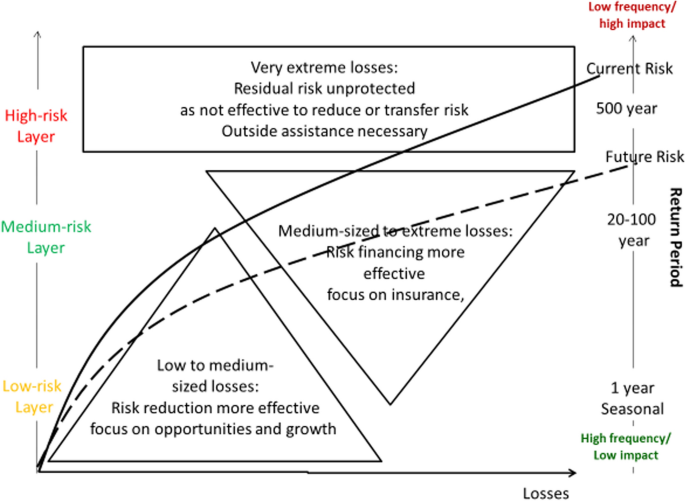
Of the diverse liabilities that governments face (from direct to contingent, explicit, and implicit, see Sect. 1), we want to specifically focus at the beginning on contingent liabilities arising from multi-hazard events. Our objective is to examine which risks have the potential to induce fiscal stress on governments using a risk-layer approach. By employing risk-layering, we differentiate between various layers of risk, characterized by probabilities and corresponding losses. Each of these layers can be further related to specific options to manage risk, most broadly between risk reduction (e.g., structural flood protection), risk financing (e.g., insurance and other financial instruments) and residual risk (e.g., public and donor post-disaster assistance). The idea is that while a government might initially be able to finance the risks it is exposed to with the resources at hand, there might come a point where it becomes a challenge to continue doing so, e.g., due to the sheer levels of losses. To identify this point, we use a risk measure which functions as a proxy of fiscal risk known as the fiscal resource gap year event, defined to be the probability that the government (for the first time) cannot finance losses from a disaster anymore (Hochrainer-Stigler et al. [2015](/article/10.1007/s11069-024-06678-y#ref-CR18 "Hochrainer-Stigler S, Mechler R, Mochizuki J (2015) A risk management tool for tackling country-wide contingent disasters: a case study on Madagascar. Environ Model Softw 72:44–55. https://doi.org/10.1016/j.envsoft.2015.06.004
")). For example, a 100 fiscal resource gap year event is an event that happens, on average, every 100 years, or with 1 percent probability each year.In this study, we expand this approach to include multi-hazards. Additionally, we incorporate the analysis of other non-natural hazard-related risks, such as the allocation of Covid-19 monetary resources, which effectively reduces the government's available funds to cover costs associated with natural hazard events. Due to this decrease in the financial resources, there is an increase in risk that natural hazards cannot be coped with anymore. As indicated above, we conduct separate analyses for different hazards, linking the fiscal gap with the risk-layering approach to illustrate the most effective risk management options for mitigating losses caused by hazards. Figure 1 illustrates the methodology used in this paper.
Applying a risk perspective requires data which provides probabilistic assessments of possible natural hazard events and corresponding losses, ideally in the form of a loss distribution (Fig. 1, Step 2). In our study, we use available country level risk estimates for important natural hazard types (earthquakes, winds, storm surges and tsunamis) from the Global Assessment Report on Disaster Risk Reduction (UNISDR 2015) as well as flood risk estimates from Hochrainer-Stigler et al. (2017). We also combine these risk estimates to derive at a single multi-hazard loss distribution for all the aforementioned hazards in our study area (see Table 3 and Sect. 3 for a description of the study area). It should be noted that merely summing up the corresponding return period losses from the loss distributions would lead to an overestimation of risk (as these hazards would be implicitly assumed to be dependent). Therefore, convoluting the distributions was necessary (i.e., we assumed independence between hazard events and no losses for events below the 10 year return period for all loss distributions). This was done by adopting a numerical convolution approach discussed in Hochrainer-Stigler et al. (2017).
The resulting total loss distribution (in constant 2011 USD) was subsequently used as input for the direct risk assessment. Direct risk is defined as the risk related to losses that occur when exposed and vulnerable elements of the system are in direct contact with a single or multiple natural hazard event (Hochrainer-Stigler et al. [2023](/article/10.1007/s11069-024-06678-y#ref-CR19 "Hochrainer-Stigler S, Trogrlić RŠ, Reiter K, Ward PJ, de Ruiter MC, Duncan MJ et al (2023) Toward a framework for systemic multi-hazard and multi-risk assessment and management. iScience 26(5):106736. https://doi.org/10.1016/j.isci.2023.106736
")). Resources to finance the losses (Fig. [1](/article/10.1007/s11069-024-06678-y#Fig1), Step 1) were estimated and averaged over the years 2017–2019 (referred to as the pre Covid-19 period) using the CatSim approach (Step 1 indicates the instruments considered) (see Hochrainer-Stigler et al. [2017](/article/10.1007/s11069-024-06678-y#ref-CR20 "Hochrainer-Stigler S, Mechler R, Laurien F (2017) Fiscal resilience challenged. In The GAR Atlas: Unveiling Global Disaster Risk, pp. 47–52, United Nations International Strategy for Disaster Reduction (UNISDR), Geneva, Switzerland")). For example, budget diversion is assumed to be possible only if expenditure does not exceed revenue by more than 5 percent. In the case of a surplus or a small deficit, it is assumed that the government will be able to divert part of the budget towards relief. Estimates of country specific costs due to Covid-19 for the years 2020 to 2022 were obtained from applications submitted to the European Solidarity Fund (EUSF) to assist countries in dealing with the pandemic (see Hochrainer-Stigler et al. 2022 for a summary).We establish a relationship (Fig. 1, Step 3) between direct risk (see Fig. 1, Step 2) and the available resources to finance these risks (Fig. 1, Step 1) using the fiscal resource gap year event. Subsequently, this risk metric is related to the risk-layer approach (Fig. 1, Step 4). The concept of risk-layering was originally introduced in the insurance sector (Hochrainer-Stigler and Reiter [2021](/article/10.1007/s11069-024-06678-y#ref-CR17 "Hochrainer-Stigler S, Reiter K (2021) Risk-layering for indirect effects. In Int J Disaster Risk Sci 12(5):770–778. https://doi.org/10.1007/s13753-021-00366-2
            ")) and is used here to determine risk mitigation as well as risk management options based on the occurrence probability (e.g., return period) of losses (Fig. [2](/article/10.1007/s11069-024-06678-y#Fig2)). As suggested in Mechler et al. ([2014](/article/10.1007/s11069-024-06678-y#ref-CR30 "Mechler R, Bouwer LM, Linnerooth-Bayer J, Hochrainer-Stigler S, Aerts JCJH, Surminski S, Williges K (2014) Managing unnatural disaster risk from climate extremes. Nat Clim Change 4(4):235–237.
              https://doi.org/10.1038/nclimate2137

            ")), we examine three different risk layers, namely low, middle, and high-risk layers to identify a portfolio of different risk management options, focusing on risk reduction, risk financing as well as assistance.
Fig. 2
The alternative text for this image may have been generated using AI.
The risk-layering approach for risk reduction and risk financing using a loss distribution. Source: Adapted from Mechler et al. ([2014](/article/10.1007/s11069-024-06678-y#ref-CR30 "Mechler R, Bouwer LM, Linnerooth-Bayer J, Hochrainer-Stigler S, Aerts JCJH, Surminski S, Williges K (2014) Managing unnatural disaster risk from climate extremes. Nat Clim Change 4(4):235–237. https://doi.org/10.1038/nclimate2137
"))In more detail, we assume that the low-risk layer includes events up to the 100-year return period (i.e., the low-risk layer is here defined to include all loss events between the 1- and 100-year event). For the middle-risk layer, all events up to the 500-year events (i.e., all events between the 100- and 500-year event) are considered. Typically, risk reduction options are too expensive for this layer, so risk financing instruments are used instead. Finally, as shown in the uppermost layer of Fig. 2, the high-risk layer comprises all events larger than the 500-year return event. Usually, one can assume that individuals and governments find it too costly to use risk-financing instruments for such events, as these very extreme risks occur too infrequently. Thus, they are often treated as residual risk (Linnerooth-Bayer and Hochrainer-Stigler 2015). It should be noted that the risk layers can change depending on the risk-bearer and the specific case considered. Here, we use the aforementioned return periods for defining the respective risk layers as suggested by Mechler et al. ([2014](/article/10.1007/s11069-024-06678-y#ref-CR30 "Mechler R, Bouwer LM, Linnerooth-Bayer J, Hochrainer-Stigler S, Aerts JCJH, Surminski S, Williges K (2014) Managing unnatural disaster risk from climate extremes. Nat Clim Change 4(4):235–237. https://doi.org/10.1038/nclimate2137
")), but assume that risk financing is possible up to the 500-year event loss (an optimistic assumption). Other possible risk layers can also be considered, as we provide in the Table [3](/article/10.1007/s11069-024-06678-y#Tab3) the specific fiscal resource gap year events for each country in our case study region (i.e., Danube Region).By using the estimated fiscal resource gap return period, it is now possible to determine the risk-layer a country belongs to. This information can be used to gain further insights into changes concerning the different hazards as well as available resources (Fig. 1, Step 4). Additionally, such information can be used to estimate costs for applying risk instruments to each layer (Fig. 1, Step 5), following a methodology explained in Hochrainer-Stigler et al. ([2021](/article/10.1007/s11069-024-06678-y#ref-CR17 "Hochrainer-Stigler S, Reiter K (2021) Risk-layering for indirect effects. In Int J Disaster Risk Sci 12(5):770–778. https://doi.org/10.1007/s13753-021-00366-2
            ")) which uses cost–benefit estimates from systematic literature reviews as done by Mechler ([2014](/article/10.1007/s11069-024-06678-y#ref-CR30 "Mechler R, Bouwer LM, Linnerooth-Bayer J, Hochrainer-Stigler S, Aerts JCJH, Surminski S, Williges K (2014) Managing unnatural disaster risk from climate extremes. Nat Clim Change 4(4):235–237.
              https://doi.org/10.1038/nclimate2137

            ")). As indicated, the proposed methodology, also called CatSim (Catastrophe Simulation model)-approach (in Fig. [1](/article/10.1007/s11069-024-06678-y#Fig1)), was not yet tested for the case of multi-risks under different time steps as done here. To avoid confusion, the full approach and each step involved is explained with some examples in the following section. Before this, we introduce the case study region where we applied the approach.
3 Case study region
The Danube Region is one of the most diverse and dynamic regions in Europe, spanning over more than 800,000 square kilometers and encompassing the territories of 19 countriesFootnote 1 (ICPDR 2021) (Fig. 3). It is a region with a high level of socio-economic heterogeneity, with some of the richest and poorest regions in the European Union (EUSDR Communication Document [2010](/article/10.1007/s11069-024-06678-y#ref-CR52 "EUSDR Communication Document (2010) European Union strategy for Danube Region, Brussels. Available online at https://danube-region.eu/download/communication_from_the_commission_2010/?wpdmdl=625&refresh=5d5fe189964b61566564745
            . Accessed 01 April 2024"); Kádár and Gede [2021](/article/10.1007/s11069-024-06678-y#ref-CR58 "Kádár B, Gede M (2021) Tourism flows in large-scale destination systems. Annals Tour Res 87.
              https://doi.org/10.1016/j.annals.2020.103113

            ")), presenting a challenge for achieving coherence across the region from a macro-regional perspective (Müller and Leo [2015](/article/10.1007/s11069-024-06678-y#ref-CR31 "Müller B, Leo H (2015) Socio‐economic assessment of the danube region: state of the region, challenges and strategy development. Future Strategic orientation of the EUSDR. Centre for European Economic Research; Institute for Applied Economic Research (IAW); The Vienna Institute for International Economic. ZEW, Mannheim")). In response to this challenge, the European Commission established the European Union Strategy for the Danube Region (EUSDR) in 2010 to achieve economic, social, and territorial cohesion (i.e., reduce socio-economic heterogeneity). The EUSDR operates through 12 priority areas (e.g., Water Quality, Sustainable Energy, Institutional Capacity and Cooperation, Security etc.). Of these 12 Priority Areas (PAs), PA5 is concerned with Environmental Risks (primarily focusing on floods and droughts), which plays a crucial role in dealing with another dimension of heterogeneity to consider in the context of coherent regional development: exposures and the ability to cope with natural hazards. We will discuss the importance of the EUSDR within this policy context in the discussion section in more detail.
Fig. 3

The alternative text for this image may have been generated using AI.
The countries of the Danube Region. Source: https://danube-region.eu/ (last access: May 1st, 2024)
The Danube Region is susceptible to a variety of natural hazards, including, amongst others, floods, droughts, landslides, and earthquakes. These hazards can be interrelated (e.g., compound or amplifying hazards) and can have significant impacts on human settlements, infrastructure, and the environment (ICPDR 2019). For instance, the international disaster database EM-DAT reports 566 disaster events in the region for the period from 1970 to 2022, with the number of disasters per disaster type presented in Table 1 together with total damages in this period per disaster type. The average annual loss for all disasters in the period from 1970 to 2022 was 4.11 billion US dollars. Flooding accounts for most of the total damages and is the most frequent hazard. However, storms and earthquakes also cause significant losses. Among the 100 costliest disasters in the Danube Region for the defined period (i.e., from 1970 to 2022), floods constitute 54% of the total damage and are also the most frequent hazard event (42 out of 100). In terms of the total damages, they are followed by storms (27%), and earthquakes (12%) that are large scale events that cause a lot of damage despite occurring not as frequently as floods and storms (Table 1).
Table 1 Overvi ew of disasters and associated total damages in the countries of the Danube Region for the period from 1970 to 2022. Source: Own Authors based on EM-DAT ([2022](/article/10.1007/s11069-024-06678-y#ref-CR9 "EURtat (2022): Losses from climate change: €145 billion in a decade. With assistance of European Commission. Available online at https://ec.europa.eu/EURtat/web/products-EURtat-news/-/ddn-20221024-1
. Accessed 01 April 2024"))
The Danube Region has experienced several multi-hazard events in recent years that have had significant impacts on human settlements, infrastructure, and the environment. In 2002, for instance, the Danube River experienced severe flooding that affected several countries and resulted in the evacuation of thousands of people and several billion EUR of damages (ICPDR 2002). This was followed by flooding and landslides in the Sava River Basin in 2014, which affected several countries in the region and caused four billion EUR of economic losses (ICPDR 2015a). In 2020, Croatia was hit by a series of consecutive earthquakes that caused significant damage to infrastructure and displacement (approximately 15 billion EUR) (Government of Croatia [2020](/article/10.1007/s11069-024-06678-y#ref-CR15 "Government of Croatia (2020) Croatia Earthquake. Rapid Damage and Needs Assessment 2020. Government of Croatia. Available online at https://www.preventionweb.net/media/81886/download
            . Accessed 01 April 2024")). In addition to flooding and earthquakes, the region has also experienced compound droughts and heatwaves, such as the one in 2022, which had serious impacts on agriculture, water resources, and public health (Copernicus [2022](/article/10.1007/s11069-024-06678-y#ref-CR2 "Copernicus (2022) OBSERVER: A wrap-up of Europe’s summer 2022 heatwave. European Commission. Available online at
              https://www.copernicus.eu/en/news/news/observer-wrap-europes-summer-2022-heatwave

            . Accessed 01 April 2024")). Due to climate change, but also of social, demographic, and economic developments (e.g., population growth, economic change), the frequency and severity of natural hazard events are projected to increase in the Danube Region (ICPDR [2019](/article/10.1007/s11069-024-06678-y#ref-CR24 "ICPDR (2019) Climate Change Adaptation Strategy. With assistance of ICPDR River Basin Management Expert Group with support of Ludwig-Maximilians-Universität. ICPDR, Vienna"))—as are the economic damages associated with them (EURtat [2022](/article/10.1007/s11069-024-06678-y#ref-CR9 "EURtat (2022): Losses from climate change: €145 billion in a decade. With assistance of European Commission. Available online at
              https://ec.europa.eu/EURtat/web/products-EURtat-news/-/ddn-20221024-1

            . Accessed 01 April 2024")). This will also most probably increase the likelihood of multi-hazard events and pose significant challenges to the region's sustainable development. Without taking appropriate adaptation measures, this can have serious consequences (ICPDR [2019](/article/10.1007/s11069-024-06678-y#ref-CR24 "ICPDR (2019) Climate Change Adaptation Strategy. With assistance of ICPDR River Basin Management Expert Group with support of Ludwig-Maximilians-Universität. ICPDR, Vienna")). For all these reasons, the Danube region provides an excellent case study for applying our suggested approach as discussed in the previous section.
4 Results
We first introduce one detailed country example to best illustrate our suggested approach. We selected Romania as an example since it is heavily exposed to two major hazards within the Danube Region, namely earthquakes and floods. According to the data available in EM-DAT from 1970 to 2022, Romania saw four earthquake events with a total damage of 8.05 billion USD and 52 flood events with a total damage of 8.94 billion USD.
As a first step, we determined the loss distribution of losses for different return period events. Return periods are related to probabilities, for example, an event with a 100-year (annual) return period would happen, on average, every 100 years, or with 1 percent probability each year. Table 2 shows the corresponding losses for earthquake and flood events for different return periods for Romania. For example, a 100-year earthquake related loss would cause damages of around 3.6 billion USD while a flood related loss with the same return period would cause nearly double these losses with around 7.5 billion USD. Note that the total losses from both hazards would cause losses of around 8.3 billion USD. Using a multi-hazard related analysis, it becomes possible to compare the varying increases in losses for each hazard as the events become more extreme, indicated by larger return periods. This comparison yields interesting insights. For instance, we observe that while floods cause more damages for more frequent events, the most damaging events for the very infrequent occurrences are attributed to earthquake (e.g. the 500-year event). This indicates that there may be different risk management strategies needed to deal with these events.
Table 2 Return periods and corresponding losses (in millions USD) for earthquakes and flooding in Romania. Source: Hochrainer-Stigler et al. (2017)
Such detailed risk information is also beneficial when considering actual events rather than just average losses. For example, the average annual losses (estimated by integrating the loss distribution to get the area above the curve) for earthquakes is 140 million USD and for floods it is 272 million USD. It is evident that preparing for average losses will not suffice in tackling the event losses as they are several magnitudes higher. This also indicates that the loss distribution should be used for risk management purposes.
Table 2 represents public and private sector related losses, but for the purpose of assessing fiscal risk, we are only interested in a subset of these losses, namely public sector losses as well as losses the government covers due to moral obligations (for example to help the most vulnerable). It is commonly assumed, and also assumed here, that 50 percent of total losses need to be covered by the government. The CatSim framework estimates the financial resources to cover these losses (for details about the estimation procedure we refer to Hochrainer-Stigler et al. [2015](/article/10.1007/s11069-024-06678-y#ref-CR18 "Hochrainer-Stigler S, Mechler R, Mochizuki J (2015) A risk management tool for tackling country-wide contingent disasters: a case study on Madagascar. Environ Model Softw 72:44–55. https://doi.org/10.1016/j.envsoft.2015.06.004
            ")). We found that around 550 million USD are available from diversions from the budget, around 850 million can be obtained from loans and an additional 320 million can be accessed through domestic credits. Furthermore, we assume that around 10 percent of total losses will be covered through outside assistance. Thus, the maximum resources available for the government amount to approximately 1.72 billion USD. We already want to indicate here that for a case specific fiscal risk analysis, a close interaction with the finance ministry needs to be set up so that the actual amounts, based on expert assessment within the ministries, can be established. Therefore, also a standalone software package is available which can be applied by governments as well to assess their fiscal risk in more detail (see Hochrainer-Stigler et al. [2015](/article/10.1007/s11069-024-06678-y#ref-CR18 "Hochrainer-Stigler S, Mechler R, Mochizuki J (2015) A risk management tool for tackling country-wide contingent disasters: a case study on Madagascar. Environ Model Softw 72:44–55.
              https://doi.org/10.1016/j.envsoft.2015.06.004

            ")).
By combining this information (Fig. 1, Step 3), we can estimate the fiscal gap return period for each hazard as well as the multi-hazard loss distribution. According to these calculations, Romania would experience a fiscal gap due to earthquakes for a return period (RP) of 321 years, for flooding RP of 178 years as well as for the total risk (i.e., floods and earthquakes) RP of 114 years. These findings are intriguing, as they suggest that Romania would be situated in the medium risk-layer but with quite distinct fiscal risks for the different hazards as well as total risk. When it comes to managing risks, it is important to consider these differences and consequently different approaches needed based on the nature of each hazard. For individual hazards, it is advisable to develop financing options that can effectively address the more extreme events. However, when considering the total risk encompassing both hazards, the losses incurred are significant, making risk reduction options worthwhile to be considered as well. The rationale behind this is that for more frequent events and risks that cannot be adequately managed, prioritizing risk reduction is essential since they occur on a regular basis and should be mitigated. Conversely, financing options may be more suitable for addressing moderate risks. In essence, the results obtained from our analysis can provide valuable insights into the risk-layer to which each hazard, as well as the total risk, belongs. This information can then guide the selection of appropriate risk management options tailored to the specific characteristics of each hazard.
As a graphical visualization of these results, one could use traffic stop lights to represent the level of urgency for addressing risk management of a particular hazard and its corresponding risk layer. In our case, we are using red for the first risk-layer (coded as 1), yellow for the second (coded as 2) and green for the third risk-layer (coded as 3). The interpretation is as follows: Red indicates a greater risk level, signifying that the hazard is more likely to lead to fiscal stress. Conversely, hazards falling within the moderate and extreme layers (denoted by the yellow and green color) indicate a lower risk of fiscal stress, resulting in reduced urgency. These color codes and their corresponding meanings can be found in Table 3, which presents the results for all Danube Region countries.
Table 3 Danube Region countries and fiscal gap return period, Risk-Layer and Color coding for earthquakes (EQ), flooding (FL) and Multi-Hazards (ALL)
Examining the dynamics of fiscal risks, risk layers, and their associated urgencies, we also conducted a comparative analysis across different significant time periods: the pre-Covid-19 and Covid-19 periods. For the pre-Covid-19 analysis, we utilized data from 2019. To estimate the resources available during the Covid-19 era, we calculated available resources by subtracting the costs incurred by each country in response to the pandemic, as estimated for EUSF assistance applications.
Specifically, for EUSF funding eligibility, countries were required to provide an estimate of their government costs associated with combating the Covid-19 pandemic. For instance, Romania estimated pandemic-related costs to be approximately 840 million EUR and received 13.9 million EUR in funding from the EUSF to cover part of these expenses. This data is accessible for all countries within the Danube Region (EC 2022). Additionally, considering the decrease in economic growth during this period, we follow Hochrainer-Stigler ([2021](/article/10.1007/s11069-024-06678-y#ref-CR16 "Hochrainer-Stigler S (2021) Changes in fiscal risk against natural disasters due to Covid-19. Progr Disaster Sci 10:100176. https://doi.org/10.1016/j.pdisas.2021.100176
")) and adjusted the availability for obtaining domestic credits. Assuming that the direct risk did not significantly change during this time frame, we re-conducted our analysis using the updated resource estimates and compared the findings with those from the pre-Covid era. Table [4](/article/10.1007/s11069-024-06678-y#Tab4) displays the results, indicating each country's placement within different risk layers for each hazard, along with the corresponding color-coded scheme.Table 4 Changes in risk layers (color coded) from Pre-Covid to the Covid-19 period for countries in the Danube Region
In general, the situation regarding fiscal risks stemming from natural hazards deteriorated during the pandemic, with nearly all countries encountering increased fiscal risk related to floods, earthquakes, or both types of hazards. For example, in Romania, flood risks are now classified in the first risk-layer, increasing the likelihood of financial challenges associated with covering losses, the same is true for total risk. Meanwhile, earthquake risks remained at a moderate level and still belongs to the medium risk-layer. In Bulgaria, earthquake risks became more pronounced in terms of potential fiscal strain compared to flooding. The multi-risk situation exacerbated due to substantial losses, highlighting issues related to compound effects when both hazards occur simultaneously in the same area. Wealthier countries, such as Germany, did not experience drastic changes in their fiscal risk levels for individual hazards, however, still for multi-hazards.
With the evolving financial landscape, the need to consider additional risk management strategies becomes more urgent, especially for hazards classified in the red category. Since changes in risk layers are solely linked to available financial resources, it is vital to explore options independent of current financial resilience. Risk reduction measures may prove essential, particularly for countries transitioning from risk layers 2 and 3 to the high-frequency risk layer 1. Another viable approach is to consider instruments that remain in place regardless of the prevailing economic conditions, such as reserve funds, contingent credits, or insurance arrangements. Given the assumption of independence between earthquake and flood risk, regional pooling arrangements should also be considered. However, for flooding, which exhibits spatial correlation in this region (as noted by Jongman et al. (2014)), regional pooling may present challenges, and global pooling arrangements involving countries with lower correlation might be more suitable.
The scenario illustrated in Table 4 highlights the importance of considering iterative approaches that can accommodate rapid shifts in resilience levels within policy development. This entails promoting investments in sustainable development and the concept of 'building back better.' The European Union and the Danube Region Strategy Point, which places emphasis on addressing the multifaceted dimensions of risk, opportunities, and resilience within the region, can assume a pivotal role in addressing these challenges. More in-depth discussions on these subjects are provided in the following section.
5 Discussion
Our research findings reveal that some countries have high fiscal resilience with fiscal resource gaps occurring at high return periods (e.g., Germany), while others experience such gaps at much shorter return periods (e.g., Serbia, Hungary, Slovakia). Furthermore, our analysis indicates that fiscal gaps occur at earlier intervals when considering multi-hazards and multi-risks (as compared to single hazards and single risks). When other types of disasters apart from natural hazards are accounted for, these fiscal gaps are even larger, as the case of the pandemics has shown. In our analysis, we only considered a joint risk-based analysis of floods and earthquakes, assuming their independence. However, the region is also prone to other types of natural hazards (e.g., droughts, landslides, extreme temperatures, wildfires) and these hazards can interact in time and space in different ways (Gill and Malamud [2014](/article/10.1007/s11069-024-06678-y#ref-CR14 "Gill JC, Malamud BD (2014) Reviewing and visualizing the interactions of natural hazards. Rev Geophys 52(4):680–722. https://doi.org/10.1002/2013RG000445
            "); Tilloy et al. [2019](/article/10.1007/s11069-024-06678-y#ref-CR38 "Tilloy A, Malamud BD, Winter H, Joly-Laugel A (2019) A review of quantification methodologies for multi-hazard interrelationships. Earth Sci Rev 196:102881.
              https://doi.org/10.1016/j.earscirev.2019.102881

            "); Angeli et al. [2022](/article/10.1007/s11069-024-06678-y#ref-CR4 "De Angeli S, Malamud BD, Rossi L, Taylor FE, Trasforini E, Rudari R (2022) A multi-hazard framework for spatial-temporal impact analysis. Int J Disas Risk Reduct 73:102829.
              https://doi.org/10.1016/j.ijdrr.2022.102829

            "); Hochrainer-Stigler et al. [2023](/article/10.1007/s11069-024-06678-y#ref-CR19 "Hochrainer-Stigler S, Trogrlić RŠ, Reiter K, Ward PJ, de Ruiter MC, Duncan MJ et al (2023) Toward a framework for systemic multi-hazard and multi-risk assessment and management. iScience 26(5):106736.
              https://doi.org/10.1016/j.isci.2023.106736

            ")). For example, these types of events can amplify a hazard’s overall effect and exacerbate the fiscal resource gaps.
In addition, our analysis highlights fiscal resource gaps across three different risk layers, thus indicating the need for long-term risk management strategies. From a policy perspective, this has implications at both country and regional levels. From the country perspective, it helps to identify what type of risk management options should be prioritized for investments to reduce the stress on fiscal resources. For instance, it can inform the selection of various structural and non-structural management options as part of the implementation of the EU Flood Directive, which recognizes flooding in the Danube Region already as a regional issue. The International Commission for the Protection of the Danube River (ICPDR) has been established as a dedicated platform for implementing the EU Flood Directive and dealing with various aspects of water management in the Danube River. However, various challenges remain which include limited coordination and cooperation between different layers of government and limited funding and resources (Rajacic et al. [2014](/article/10.1007/s11069-024-06678-y#ref-CR33 "Rajacic Á, Sik A, Horváth A, Uzzoli A, Milošević A, Czikora E, Balázs et al. (2014) Guideline on climate change adaptation and risk assessment in the Danube Macro-Region. Edited by Marko Pavlović. Available online at http://www.seevccc.rs/docs/SEERISK_SEE%20Guideline.pdf
. Accessed 01 April 2024")).From a regional level perspective, given the macroeconomic and cross-sectoral connectedness of the Danube Region countries, natural hazards occurring in one country can have far-reaching regional implications through indirect risks (Ward et al. [2022](/article/10.1007/s11069-024-06678-y#ref-CR43 "Ward PJ, Daniell J, Duncan M, Dunne A, Hananel C, Hochrainer-Stigler S et al (2022) Invited perspectives: a research agenda towards disaster risk management pathways in multi-(hazard-)risk assessment. Nat Hazards Earth Syst Sci 22(4):1487–1497. https://doi.org/10.5194/nhess-22-1487-2022
            "); Hochrainer-Stigler et al. [2023](/article/10.1007/s11069-024-06678-y#ref-CR19 "Hochrainer-Stigler S, Trogrlić RŠ, Reiter K, Ward PJ, de Ruiter MC, Duncan MJ et al (2023) Toward a framework for systemic multi-hazard and multi-risk assessment and management. iScience 26(5):106736.
              https://doi.org/10.1016/j.isci.2023.106736

            ")). This means that the impacts of a hazard in one country can reverberate across borders, affecting neighboring countries and the overall regional system. However, these regional perspectives are often overlooked, particularly in the case of earthquakes and floods, despite the transboundary impacts they can have (Polese et al. [2023](/article/10.1007/s11069-024-06678-y#ref-CR32 "Polese M, Tocchi G, Dolsek M, Babič A, Faravelli M, Quaroni D et al (2023) Seismic risk assessment in transboundary areas: the case study on the border between Italy and Slovenia. Procedia Struct Integrity 44:123–130.
              https://doi.org/10.1016/j.prostr.2023.01.017

            "); Zeitoun et al. [2013](/article/10.1007/s11069-024-06678-y#ref-CR46 "Zeitoun M, Goulden M, Tickner D (2013) Current and future challenges facing transboundary river basin management. Wires Clim Change 4(5):331–349.
              https://doi.org/10.1002/wcc.228

            ")). Floods, for example, can have significant impacts on critical infrastructures across borders and lead to the displacement of populations, water pollution, and disruption of transportation networks, all of which can have transboundary effects and require coordinated responses among affected countries (Liska [2015](/article/10.1007/s11069-024-06678-y#ref-CR29 "Liska I (2015) Managing an international river basin towards water quality protection: the danube case. In: Hutzinger O, Barceló D, evič Kostjanoj AG, Liska I, Aggarwal PK (eds) The Danube River Basin, vol. 39. Heidelberg, New York, Dordrecht, Springer, pp 1–19")). Recognizing and considering the regional implications of earthquakes, floods and other natural hazards is of utmost importance. It emphasizes the need for collaboration and coordination among countries in the Danube Region to collectively address the challenges posed by these hazards. This includes recognizing the interdependencies between critical infrastructure, such as energy networks, transportation systems, and telecommunications, and their potential susceptibility to earthquake and flood-induced disruptions. By adopting a regional perspective, countries can work together to enhance early warning systems, share best practices in preparedness and response, and develop joint strategies for risk reduction and resilience building. The fiscal gap estimates can indicate the risk of possible stress in the system (e.g., events that are causing fiscal gaps) and therefore can be used as a first-order proxy if and when indirect risks need to be assumed to become significant due to lack of funding (Hochrainer-Stigler et al. [2024a](/article/10.1007/s11069-024-06678-y#ref-CR54 "Hochrainer-Stigler S, Mechler R, Deubelli-Hwang T, Calliari E, Šakić Trogrlić R (2024a) A gap approach for preventing stress in complex systems: managing natural hazard induced fiscal risks under a changing climate. Front Sustain Res Manag 3.
              https://doi.org/10.3389/fsrma.2024.1393667

            ")).
In that regard, it seems evident that to help close fiscal gaps, various stakeholders need to be involved and risk management tools should be looked at to address the appropriate risk layers. In other words, which tools to be used is to be determined based on the risk layer at hand. Governments and international organizations, for instance, could allocate dedicated funds within national budgets and seek assistance from international entities such as the European Union, the World Bank, and the United Nations. The European Union and the European Investment Bank (EIB) play a crucial role in mobilizing financial resources. They can utilize funds from the EU's Cohesion Policy (see below), European Regional Development Fund, and other relevant programs to support multi-hazard risk reduction initiatives. Integration of multi-risk considerations into eligibility criteria for EU funds should be promoted. The EU and EIB can also provide technical assistance and financial support for capacity building and the development of regional risk assessment and management frameworks (European Investment Bank [2023](/article/10.1007/s11069-024-06678-y#ref-CR7 "European Investment Bank (2023) The EIB Group Operational Plan 2023–2025. European Investment Bank. Available online at https://www.eib.org/attachments/lucalli/20220289_eib_group_operational_plan_2023_en.pdf
            . Accessed 01 April 2024")). Engaging regional development banks like the European Bank for Reconstruction and Development (EBRD) and the International Finance Corporation (IFC) can also provide additional financial resources for multi-hazard resilience projects (European Bank for Reconstruction and Development [2019](/article/10.1007/s11069-024-06678-y#ref-CR5 "European Bank for Reconstruction and Development (2019) Environmental and Social Policy. Available online at
              https://www.ebrd.com/news/publications/policies/environmental-and-social-policy-esp.html

            . Accessed 01 April 2024"), International Finance Corporation [2016](/article/10.1007/s11069-024-06678-y#ref-CR26 "International Finance Corporation (2016) IFC Climate Implementation Plan. World Bank Group. Available online at
              https://documents1.worldbank.org/curated/en/756571467998822347/pdf/104191-BR-IFC-SecM2016-0044-Box394875B-OUO-9.pdf

            . Accessed 01 April 2024")). Local banks and financial institutions can offer preferential financing schemes and insurance products to encourage investments in multi-risk management by businesses and communities. Additionally, funding mechanisms, grants, and subsidies can incentivize private entities and communities to invest in multi-hazard resilience. Public–private partnerships (PPPs), for instance, are vital in pooling financial resources and sharing responsibilities. Governments, private sector entities, and civil society organizations can form partnerships to implement multi-hazard risk reduction projects. Innovative financing mechanisms such as impact investing and blended finance should be explored to attract private sector investments. This also should include an analysis of multiple-benefits due to disaster risk management which is a growing research field and may be embedded using a systems-approach (Hochrainer-Stigler et al. [2024b](/article/10.1007/s11069-024-06678-y#ref-CR55 "Hochrainer-Stigler S, Bachner G, Knittel N, Poledna S, Reiter K, Bosello F (2024b) Risk management against indirect risks from disasters: A multi-model and participatory governance framework applied to flood risk in Austria International. J Dis Risk Red 106.
              https://doi.org/10.1016/j.ijdrr.2024.104425

            ")).
As indicated above, the recognition of the importance of finance is in line with the Cohesion Policy, the main policy framework for enhancing economic, social, and territorial cohesion in the European Union (European Commission [2021a](/article/10.1007/s11069-024-06678-y#ref-CR6 "European Commission (2021a) New Cohesion Policy. Available online at https://ec.europa.eu/regional_policy/2021-2027_en#inline-nav-12
            . Accessed 01 April 2024")). The Cohesion Policy for 2021–2027, whose budget amounted to €392 billion (Krausova and Walsh [2021](/article/10.1007/s11069-024-06678-y#ref-CR28 "Krausova T, Walsh J (2021) 2021-2027: Initial Cohension Policy EU Budget Allocations. EU. Available online at
              https://cohesiondata.ec.europa.eu/stories/s/2021-2027-EU-allocations-available-for-programming/2w8s-ci3y/

            . Accessed 01 April 2024")), has five specific objectives. Under Policy Objective 2 (“A greener, low carbon transitioning towards a net zero carbon economy”), disaster risk management is included in as “_promoting climate change adaptation, risk reduction and disaster resilience_” (European Commission [2021b](/article/10.1007/s11069-024-06678-y#ref-CR1 "European Commission (2021b) Why does the EU invest in risk prevention? Available online at
              https://cohesiondata.ec.europa.eu/stories/s/Cohesion-policy-preventing-risks/j9ce-3mtn/

            . Accessed 01 April 2024")). The EU's Cohesion Policy can contribute significantly to reducing heterogeneity in the Danube Region in terms of disaster exposure and impacts through various means. Firstly, the policy provides financial support to invest in disaster risk reduction measures such as improving infrastructure resilience and early warning systems. It also offers technical assistance to enhance countries' capacities in disaster risk management, supporting them in developing strategies, risk assessments, and action plans. Moreover, cross-border projects involving multiple countries in the Danube Region help address transboundary hazards through joint risk assessments, coordinated emergency response mechanisms, and shared infrastructure development. Additionally, the policy recognizes the importance of climate change adaptation by integrating it as a key component, thereby reducing vulnerabilities to climate-related disasters such as flooding and droughts. Our fiscal gap estimations for the region showed quite some dynamics over a relatively short time period indicating that short- as well as long-term goals and policies have to be aligned in a flexible manner to adapt to ongoing and future challenges. A monitoring system which is easy to grasp, such as exemplified in this paper through traffic lights as well as risk-layers and corresponding risk-management options, may serve well in that regard. Especially the adaptation against future climate change risks could be embedded using our estimates as the baseline and future changes and adaptation to it through risk-based or adaptation policy pathways (Schlumberger et al. [2022](/article/10.1007/s11069-024-06678-y#ref-CR37 "Schlumberger J, Haasnoot M, Aerts J, de Ruiter M (2022) Proposing DAPP-MR as a disaster risk management pathways framework for complex, dynamic multi-risk. iScience 25(10):105219.
              https://doi.org/10.1016/j.isci.2022.105219

            ")).
6 Conclusion
This article examined the impacts of multi-hazard events on a region's fiscal position and possible strategies to deal with it. The analysis was based on the CatSim model which was up-to now only applied for single and total risk. In doing so we identified risk management strategies and polices for disaster risk reduction for our case study region, the Danube Region, according to different hazards as well as stress levels. To further foster regional cohesion, it is crucial to incorporate the observed heterogeneity in fiscal resilience to natural hazards into operational strategies. The EUSDR and its governance structure provide a starting point for addressing the issue of heterogeneity in the region. However, to effectively manage and mitigate the impacts of natural hazards, there is a need to place greater emphasis on finance for risk management. In addition to its role as coordinator and connector, it may be beneficial that the Danube Strategy Point can also support financial resource mobilization through the allocation of funds within the strategy's budget. For example, the strategy can prioritize multi-hazard resilience initiatives and allocate financial resources accordingly. It can also seek additional funding from the European Union, international financial institutions, and other donors to support multi-risk management efforts in the region. Additionally, the Danube Strategy Point can also promote integration of multi-hazard resilience considerations into the eligibility criteria for EU funds. This can incentivize countries and regions to invest in multi-risk management initiatives and access financial resources. Within the EUSDR, the Danube Strategy Point serves as the coordinating entity for all stakeholders engaged in the implementation of the Danube Strategy. It could therefore play a significant role in helping to close fiscal resource gaps resulting from multi-hazards in the Danube Region by facilitating collaboration and partnership among governments, private sector entities, civil society organizations, and research institutions. This way, it can help identify options to mobilize financial resources and implement multi-hazard resilience initiatives (Danube Strategy Point [2020](/article/10.1007/s11069-024-06678-y#ref-CR3 "Danube Strategy Point (2020): EU Strategy for the Danube Region Governance Architecture. Prepared under the Croatian EUSDR Presidency 2020. Final endorsed version as of 22nd July 2020. Available online at https://danube-region.eu/download/eusdr-governance-architecture-paper/?wpdmdl=4319&refresh=64ad43dab607a1689076698
. Accessed 01 April 2024")).The above discussion already highlights the importance of implementing a collaborative and adaptive approach to disaster risk reduction, which can help build resilience and ensure sustainable development in the face of multi-hazard events and changing risks. We depart from the point of view that increasing resilience to the impact of natural hazards through reducing risks is one of the prerequisites of socio-economic development across scales (Toya and Skidmore [2007](/article/10.1007/s11069-024-06678-y#ref-CR39 "Toya H, Skidmore M (2007) Economic development and the impacts of natural disasters. Econ Lett 94(1):20–25. https://doi.org/10.1016/j.econlet.2006.06.020
            ")). Moreover, management and reduction of natural hazard risk can contribute to the implementation of all 17 Sustainable Development Goals (Sakic Trogrlic et al. [2022](/article/10.1007/s11069-024-06678-y#ref-CR35 "Šakić Trogrlić R, Donovan A, Malamud BD (2022) Invited perspectives: views of 350 natural hazard community members on key challenges in natural hazards research and the sustainable development goals. Nat Hazard 22(8):2771–2790.
              https://doi.org/10.5194/nhess-22-2771-2022

            ")). Iterative risk management frameworks, such as those proposed by Hochrainer-Stigler et al. ([2023](/article/10.1007/s11069-024-06678-y#ref-CR19 "Hochrainer-Stigler S, Trogrlić RŠ, Reiter K, Ward PJ, de Ruiter MC, Duncan MJ et al (2023) Toward a framework for systemic multi-hazard and multi-risk assessment and management. iScience 26(5):106736.
              https://doi.org/10.1016/j.isci.2023.106736

            ")), Schlumberger et al. ([2022](/article/10.1007/s11069-024-06678-y#ref-CR37 "Schlumberger J, Haasnoot M, Aerts J, de Ruiter M (2022) Proposing DAPP-MR as a disaster risk management pathways framework for complex, dynamic multi-risk. iScience 25(10):105219.
              https://doi.org/10.1016/j.isci.2022.105219

            ")) and Schinko et al. ([2017](/article/10.1007/s11069-024-06678-y#ref-CR36 "Schinko T, Mechler R, Hochrainer-Stigler S (2017) A methodological framework to operationalize climate risk management: managing sovereign climate-related extreme event risk in Austria. Mitig Adapt Strateg Glob Change 22(7):1063–1086.
              https://doi.org/10.1007/s11027-016-9713-0

            ")) could offer valuable support in tackling multi-hazards in the Danube Region by providing a systematic and adaptable approach to risk assessment, communication, planning, and resource allocation. By employing these frameworks, policymakers and stakeholders can effectively address the complexities of multi-hazard scenarios. Additionally, these frameworks offer a comprehensive understanding of the risks faced by the region by continuously assessing and evaluating various types of hazards and their interactions. This comprehensive assessment helps prioritize and allocate resources more effectively.
Multi-hazard risk management requires adaptive planning and response strategies. Given the dynamic nature of multi-hazard situations, frameworks need to allow for regular updates and adjustments based on new information and changing circumstances. This flexibility enables the development of resilient risk management strategies that can be adapted over time. By continuously monitoring and reassessing risks, such frameworks can help to identify gaps and allocate resources where they are most needed. The allocation of financial, human, and technical resources across various risk layers should enhance the effectiveness of addressing multi-hazards. By conducting regular reviews and evaluations of risk management measures, best practices and lessons learned can be identified and shared. This continuous improvement and capacity building should contribute to the overall resilience of the Danube Region but is also applicable to other countries and regions as well. Adopting a toolbox-based approach that integrates different methodologies and tools proves helpful in tackling these diverse set of challenges.
References
- Copernicus (2022) OBSERVER: A wrap-up of Europe’s summer 2022 heatwave. European Commission. Available online at https://www.copernicus.eu/en/news/news/observer-wrap-europes-summer-2022-heatwave. Accessed 01 April 2024
- Danube Strategy Point (2020): EU Strategy for the Danube Region Governance Architecture. Prepared under the Croatian EUSDR Presidency 2020. Final endorsed version as of 22nd July 2020. Available online at https://danube-region.eu/download/eusdr-governance-architecture-paper/?wpdmdl=4319&refresh=64ad43dab607a1689076698. Accessed 01 April 2024
- De Angeli S, Malamud BD, Rossi L, Taylor FE, Trasforini E, Rudari R (2022) A multi-hazard framework for spatial-temporal impact analysis. Int J Disas Risk Reduct 73:102829. https://doi.org/10.1016/j.ijdrr.2022.102829
Article Google Scholar - Djalante R, Shaw R, DeWit A (2020) Building resilience against biological hazards and pandemics: COVID-19 and its implications for the Sendai Framework. Prog Dis Sci 6. https://doi.org/10.1016/j.pdisas.2020.100080
- EC (2022) Beneficiary States of the EU Solidarity Fund Interventions since 2020 - only major public health emergency. Brussels
- European Bank for Reconstruction and Development (2019) Environmental and Social Policy. Available online at https://www.ebrd.com/news/publications/policies/environmental-and-social-policy-esp.html. Accessed 01 April 2024
- European Commission (2021a) New Cohesion Policy. Available online at https://ec.europa.eu/regional_policy/2021-2027_en#inline-nav-12. Accessed 01 April 2024
- European Commission (2021b) Why does the EU invest in risk prevention? Available online at https://cohesiondata.ec.europa.eu/stories/s/Cohesion-policy-preventing-risks/j9ce-3mtn/. Accessed 01 April 2024
- European Investment Bank (2023) The EIB Group Operational Plan 2023–2025. European Investment Bank. Available online at https://www.eib.org/attachments/lucalli/20220289_eib_group_operational_plan_2023_en.pdf. Accessed 01 April 2024
- European Union (2015) Transforming our world: the 2030 Agenda for Sustainable Development. Resolution adopted by the General Assembly on 25 September 2015. Available online at https://documents-dds-ny.un.org/doc/UNDOC/GEN/N15/291/89/PDF/N1529189.pdf?OpenElement. Accessed 01 April 2024
- EURtat (2022): Losses from climate change: €145 billion in a decade. With assistance of European Commission. Available online at https://ec.europa.eu/EURtat/web/products-EURtat-news/-/ddn-20221024-1. Accessed 01 April 2024
- EUSDR Communication Document (2010) European Union strategy for Danube Region, Brussels. Available online at https://danube-region.eu/download/communication_from_the_commission_2010/?wpdmdl=625&refresh=5d5fe189964b61566564745. Accessed 01 April 2024
- Gagliardi N, Arévalo P, Pamies-Sumner S (2022) The fiscal impact of extreme weather and climate events: evidence for EU Countries. Publications Office of the European Union
- Gallina V, Torresan S, Critto A, Sperotto A, Glade T, Marcomini A (2016) A review of multi-risk methodologies for natural hazards: consequences and challenges for a climate change impact assessment. J Environ Manag 168:123–132. https://doi.org/10.1016/j.jenvman.2015.11.011
Article Google Scholar - Geiß C, Schoepfer E, Riedlinger T, Taubenböck H (2023) Novel tools for multi-risk assessment. Nat Hazards 119:773–778. https://doi.org/10.1007/s11069-023-06204-6
Article Google Scholar - Gill JC, Duncan M, Roxana C, Lara S, Dana S, Julius S et al (2022) Handbook of Multi-Hazard, Multi-Risk Definitions and Concepts. H2020 MYRIAD-EU Project, grant agreement number 101003276, pp 75
- Gill JC, Malamud BD (2014) Reviewing and visualizing the interactions of natural hazards. Rev Geophys 52(4):680–722. https://doi.org/10.1002/2013RG000445
Article Google Scholar - Government of Croatia (2020) Croatia Earthquake. Rapid Damage and Needs Assessment 2020. Government of Croatia. Available online at https://www.preventionweb.net/media/81886/download. Accessed 01 April 2024
- Hochrainer-Stigler S (2021) Changes in fiscal risk against natural disasters due to Covid-19. Progr Disaster Sci 10:100176. https://doi.org/10.1016/j.pdisas.2021.100176
Article Google Scholar - Hochrainer-Stigler S, Bachner G, Knittel N, Poledna S, Reiter K, Bosello F (2024b) Risk management against indirect risks from disasters: A multi-model and participatory governance framework applied to flood risk in Austria International. J Dis Risk Red 106. https://doi.org/10.1016/j.ijdrr.2024.104425
- Hochrainer-Stigler S, Mechler R, Deubelli-Hwang T, Calliari E, Šakić Trogrlić R (2024a) A gap approach for preventing stress in complex systems: managing natural hazard induced fiscal risks under a changing climate. Front Sustain Res Manag 3. https://doi.org/10.3389/fsrma.2024.1393667
- Hochrainer-Stigler S, Mechler R, Mochizuki J (2015) A risk management tool for tackling country-wide contingent disasters: a case study on Madagascar. Environ Model Softw 72:44–55. https://doi.org/10.1016/j.envsoft.2015.06.004
Article Google Scholar - Hochrainer-Stigler S, Reiter K (2021) Risk-layering for indirect effects. In Int J Disaster Risk Sci 12(5):770–778. https://doi.org/10.1007/s13753-021-00366-2
Article Google Scholar - Hochrainer-Stigler S, Schinko T, Hof A, Ward PJ (2021) Adaptive risk management strategies for governments under future climate and socioeconomic change: An application to riverine flood risk at the global level. Environ Sci Policy 125:10–20. https://doi.org/10.1016/j.envsci.2021.08.010
Article Google Scholar - Hochrainer-Stigler S, Trogrlić RŠ, Reiter K, Ward PJ, de Ruiter MC, Duncan MJ et al (2023) Toward a framework for systemic multi-hazard and multi-risk assessment and management. iScience 26(5):106736. https://doi.org/10.1016/j.isci.2023.106736
Article Google Scholar - Hochrainer-Stigler S, Mechler R, Laurien F (2017) Fiscal resilience challenged. In The GAR Atlas: Unveiling Global Disaster Risk, pp. 47–52, United Nations International Strategy for Disaster Reduction (UNISDR), Geneva, Switzerland
- Hochrainer-Stigler S, Zhu Q, Ciullo A, Reiter K (2022) EU tools to respond to natural disasters. European Parliament, Policy Department for Structural and Cohesion Policies, Brussels. https://www.europarl.europa.eu/thinktank/en/document/IPOL_STU(2022)699637. Accessed 01 April 2024
- ICPDR (2015a) Floods in May 2014 in the Sava River Basin. Brief overview of key events and lessons learned. ICPDR, Vienna
Google Scholar - ICPDR (2002) Overview of Impacts Caused by the 2002 Floods in the Danube River Basin. ICPDR
- ICPDR (2015b) The Danube River Basin District Management Plan. Part A – Basin-wide overview. ICPDR. Vienna
- ICPDR (2019) Climate Change Adaptation Strategy. With assistance of ICPDR River Basin Management Expert Group with support of Ludwig-Maximilians-Universität. ICPDR, Vienna
- ICPDR (2021) Danube Flood Risk Management Plan. Update 2021. Vienna
- IMF (2020) Global Financial Stability Report: Bridge to Recovery. Washington, DC
- International Finance Corporation (2016) IFC Climate Implementation Plan. World Bank Group. Available online at https://documents1.worldbank.org/curated/en/756571467998822347/pdf/104191-BR-IFC-SecM2016-0044-Box394875B-OUO-9.pdf. Accessed 01 April 2024
- Jongman B, Hochrainer-Stigler S, Feyen L, Aerts JCJH, Mechler R, Botzen WJW, Bouwer LM, Pflug G, Rojas R, Ward PJ (2014) Increasing stress on disaster-risk finance due to large floods. Nat Clim Change 4(4):264–268
Article Google Scholar - Kádár B, Gede M (2021) Tourism flows in large-scale destination systems. Annals Tour Res 87. https://doi.org/10.1016/j.annals.2020.103113
- Kappes MS, Keiler M, von Elverfeldt K, Glade T (2012) Challenges of analyzing multi-hazard risk: a review. Nat Hazards 64(2):1925–1958. https://doi.org/10.1007/s11069-012-0294-2
Article Google Scholar - Krausova T, Walsh J (2021) 2021-2027: Initial Cohension Policy EU Budget Allocations. EU. Available online at https://cohesiondata.ec.europa.eu/stories/s/2021-2027-EU-allocations-available-for-programming/2w8s-ci3y/. Accessed 01 April 2024
- Liska I (2015) Managing an international river basin towards water quality protection: the danube case. In: Hutzinger O, Barceló D, evič Kostjanoj AG, Liska I, Aggarwal PK (eds) The Danube River Basin, vol. 39. Heidelberg, New York, Dordrecht, Springer, pp 1–19
- Mechler R, Bouwer LM, Linnerooth-Bayer J, Hochrainer-Stigler S, Aerts JCJH, Surminski S, Williges K (2014) Managing unnatural disaster risk from climate extremes. Nat Clim Change 4(4):235–237. https://doi.org/10.1038/nclimate2137
Article Google Scholar - Mechler R, Hochrainer-Stigler S (2014) Revisiting arrow-lind: managing sovereign disaster risk. J Nat Res Policy Res 6(1):93–100. https://doi.org/10.1080/19390459.2013.873186
Article Google Scholar - Müller B, Leo H (2015) Socio‐economic assessment of the danube region: state of the region, challenges and strategy development. Future Strategic orientation of the EUSDR. Centre for European Economic Research; Institute for Applied Economic Research (IAW); The Vienna Institute for International Economic. ZEW, Mannheim
- Polese M, Tocchi G, Dolsek M, Babič A, Faravelli M, Quaroni D et al (2023) Seismic risk assessment in transboundary areas: the case study on the border between Italy and Slovenia. Procedia Struct Integrity 44:123–130. https://doi.org/10.1016/j.prostr.2023.01.017
Article Google Scholar - Rajacic Á, Sik A, Horváth A, Uzzoli A, Milošević A, Czikora E, Balázs et al. (2014) Guideline on climate change adaptation and risk assessment in the Danube Macro-Region. Edited by Marko Pavlović. Available online at http://www.seevccc.rs/docs/SEERISK_SEE%20Guideline.pdf. Accessed 01 April 2024
- Ruiter MC, Couasnon A, Homberg MJC, Daniell JE, Gill JC, Ward PJ (2020) Why we can no longer ignore consecutive disasters. Earth’s Fut. https://doi.org/10.1029/2019EF001425
Article Google Scholar - Šakić Trogrlić R, Donovan A, Malamud BD (2022) Invited perspectives: views of 350 natural hazard community members on key challenges in natural hazards research and the sustainable development goals. Nat Hazard 22(8):2771–2790. https://doi.org/10.5194/nhess-22-2771-2022
Article Google Scholar - Schinko T, Mechler R, Hochrainer-Stigler S (2017) A methodological framework to operationalize climate risk management: managing sovereign climate-related extreme event risk in Austria. Mitig Adapt Strateg Glob Change 22(7):1063–1086. https://doi.org/10.1007/s11027-016-9713-0
Article Google Scholar - Schlumberger J, Haasnoot M, Aerts J, de Ruiter M (2022) Proposing DAPP-MR as a disaster risk management pathways framework for complex, dynamic multi-risk. iScience 25(10):105219. https://doi.org/10.1016/j.isci.2022.105219
Article CAS Google Scholar - Tilloy A, Malamud BD, Winter H, Joly-Laugel A (2019) A review of quantification methodologies for multi-hazard interrelationships. Earth Sci Rev 196:102881. https://doi.org/10.1016/j.earscirev.2019.102881
Article Google Scholar - Toya H, Skidmore M (2007) Economic development and the impacts of natural disasters. Econ Lett 94(1):20–25. https://doi.org/10.1016/j.econlet.2006.06.020
Article Google Scholar - United Nations Framework Convention on Climate Change (2016) The Paris Agreement. United Nations Framework Convention on Climate Change. Denmark. Available online at https://unfccc.int/sites/default/files/resource/parisagreement_publication.pdf. Accessed 01 April 2024
- United Nations Office for Disaster Risk Reduction (2015): Sendai Framework for Disaster Risk Reduction 2015-2030. United Nations. Geneva. Available online at https://www.preventionweb.net/files/43291_sendaiframeworkfordrren.pdf. Accessed 01 April 2024
- UNISDR (2015) Global Assessment Report on Disaster Risk Reduction. Geneva, Switzerland
- van den Hurk BJJM, White CJ, Ramos AM, Ward PJ, Martius O, Olbert I et al (2023) Consideration of compound drivers and impacts in the disaster risk reduction cycle. iScience 26(3):106030. https://doi.org/10.1016/j.isci.2023.106030
Article Google Scholar - Ward PJ, Daniell J, Duncan M, Dunne A, Hananel C, Hochrainer-Stigler S et al (2022) Invited perspectives: a research agenda towards disaster risk management pathways in multi-(hazard-)risk assessment. Nat Hazards Earth Syst Sci 22(4):1487–1497. https://doi.org/10.5194/nhess-22-1487-2022
Article Google Scholar - World Bank (2021) Financial Risk and opportunities to build resilience in Europe. World Bank. https://doi.org/10.1596/35685
- Yagi M, Managi S (2023) The spillover effects of rising energy prices following 2022 Russian invasion of Ukraine. Econ Anal Policy 77:680–695. https://doi.org/10.1016/j.eap.2022.12.025
Article Google Scholar - Zeitoun M, Goulden M, Tickner D (2013) Current and future challenges facing transboundary river basin management. Wires Clim Change 4(5):331–349. https://doi.org/10.1002/wcc.228
Article Google Scholar