Obstructive sleep apnea as a risk factor for coronary events or cardiovascular death (original) (raw)
Abstract
Purpose
This study aims to determine whether obstructive sleep apnea independently increases the risk of coronary events, including death from cardiovascular causes.
Methods
We conducted an observational cohort study among consecutive patients ≥50 years of age who were referred during 1997–2001 to the Yale Center for Sleep Medicine for suspected sleep-disordered breathing and were followed longitudinally for subsequent coronary events or cardiovascular death. Each study participant underwent an overnight polysomnography; obstructive sleep apnea was defined as an apnea–hypopnea index ≥5/h. The composite outcome during a mean duration of follow-up of 2.9 years was myocardial infarction, coronary artery revascularization procedures (angioplasty, stent placement, or coronary artery bypass graft surgery), or death from cardiovascular causes.
Results
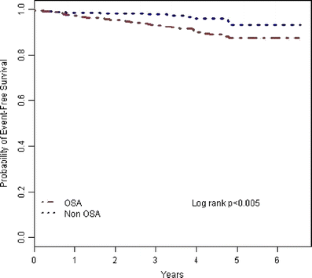
Among 1,436 enrolled patients, 1,024 (71%) had an apnea–hypopnea index ≥5/h. In an unadjusted analysis, obstructive sleep apnea was associated with an increased risk of coronary events or cardiovascular death (hazard ration (HR) 2.57, 95% confidence interval (CI) 1.39–4.72, P = 0.003). After adjustment for traditional cardiovascular risk factors (including body mass index and hypertension), obstructive sleep apnea retained a statistically significant association with this composite outcome (HR 2.06, 95% CI 1.10–3.86, P = 0.024).
Conclusion
Obstructive sleep apnea increases the risk of coronary events or death from cardiovascular causes.
Access this article
Subscribe and save
- Starting from 10 chapters or articles per month
- Access and download chapters and articles from more than 300k books and 2,500 journals
- Cancel anytime View plans
Buy Now
Price excludes VAT (USA)
Tax calculation will be finalised during checkout.
Instant access to the full article PDF.
Fig. 1
References
- Rosamond W, Flegal K, Friday G et al (2007) Heart and stroke statistics—2007 update. Circulation 115:e69–e171
Article PubMed Google Scholar - Young T, Palta M, Dempsey J, Skatrud J, Weber S, Badr S (1993) The occurrence of sleep-disordered breathing among middle-aged adults. N Engl J Med 328:1230–1235
Article CAS PubMed Google Scholar - Mooe T, Rabben T, Wiklund U, Franklin KA, Eriksson P (1996) Sleep-disordered breathing in women: occurrence and association with coronary artery disease. Am J Med 101(3):251–256
Article CAS PubMed Google Scholar - Marin JM, Carrizo SJ, Vicente E, Agusti AG (2005) Long-term cardiovascular outcomes in men with obstructive sleep apnoea–hypopnoea with or without treatment with continuous positive airway pressure: an observational study. Lancet 365(9464):1046–1053
PubMed Google Scholar - Peker Y, Carlson J, Hedner J (2006) Increased incidence of coronary artery disease in sleep apnoea: a long-term follow-up. Eur Respir J 28(3):596–602
Article CAS PubMed Google Scholar - Johns MW (1991) A new method for measuring daytime sleepiness: the Epworth sleepiness scale. Sleep 14:540–545
CAS PubMed Google Scholar - Yaggi H, Concato J, Kernan W, Lichtman J, Brass L, Mohsenin V (2005) Obstructive sleep apnea as a risk factor for stroke and death. New Engl J Med 353:2034–2041
Article CAS PubMed Google Scholar - American Academy of Sleep Medicine Task Force (1999) Sleep-related breathing disorders in adults: recommendations for syndrome definition and measurement techniques in clinical research. The report of an American Academy of Sleep Medicine Task Force. Sleep 22(5):667–689
Google Scholar - Meoli AL, Casey KR, Clark RW et al (2001) Hypopnea in sleep-disordered breathing in adults. Sleep 24(4):469–470
CAS PubMed Google Scholar - Joint European Society of Cardiology/American College of Cardiology Committee for the Redefinition of Myocardial Infarction (2002) Myocardial infarction redefined—a consensus document of the Joint European society of cardiology/American College of Cardiology Committee for the Redefinition of Myocardial Infarction. Eur Heart J 21:1502–1513
Google Scholar - Hill ME, Rosenwaike I (2001) The social security administration’s death master file: the completeness of death reporting at older ages. Soc Secur Bull 64(1):45–51
PubMed Google Scholar - ancestry.com (1999) Social Security Death Index. http://www.ancestry.com/search/rectype/vital/ssdi/main.htm]. Accessed 15 February 2009
- Young T, Finn L, Peppard PE et al (2008) Sleep disordered breathing and mortality: eighteen-year follow-up of the Wisconsin sleep cohort. Sleep 31(8):1071–1078
PubMed Google Scholar - Schoenfeld DA (1983) Sample-size formula for the proportional-hazards regression model. Biometrics 39(2):499–503
Article CAS PubMed Google Scholar - Davignon J, Ganz P (2004) Role of endothelial dysfunction in atherosclerosis. Circulation 109(23 Suppl 1):III27–III32
PubMed Google Scholar - Lorenzi-Filho G, Drager LF (2007) Obstructive sleep apnea and atherosclerosis: a new paradigm. Am J Respir Crit Care Med 175(12):1219–1221
Article PubMed Google Scholar - Savransky V, Nanayakkara A, Li J et al (2007) Chronic intermittent hypoxia induces atherosclerosis. Am J Respir Crit Care Med 175(12):1290–1297
Article CAS PubMed Google Scholar - Ip MS, Lam B, Ng MM, Lam WK, Tsang KW, Lam KS (2002) Obstructive sleep apnea is independently associated with insulin resistance. Am J Respir Crit Care Med 165(5):670–676
PubMed Google Scholar - Punjabi N, Sorkin J, Katzel L, Goldberg A, Schwartz A, Smith P (2002) Sleep-disordered breathing and insulin resistance in middle-aged and overweight men. Am J Respir Crit Care Med 165:677–682
PubMed Google Scholar - Drager LF, Bortolotto LA, Figueiredo AC, Krieger EM, Lorenzi GF (2007) Effects of continuous positive airway pressure on early signs of atherosclerosis in obstructive sleep apnea. Am J Respir Crit Care Med 176(7):706–712
Article CAS PubMed Google Scholar - Peppard P, Young T, Palta M, Skatrud JB (2000) Prospective study of the association between sleep-disordered breathing and hypertension. NEJM 342(19):1378–1384
Article CAS PubMed Google Scholar
Sources of support
National Research Service Award Institutional Research Training Grant from the National Institutes of Health (T32 HL00778-12), Yale Center for Sleep Medicine, Career Development Award from the Veterans Affairs Health Services Research and Development Service
Author information
Authors and Affiliations
- Yale Center for Sleep Medicine, New Haven, CT, USA
Neomi A. Shah, Henry Klar Yaggi & Vahid Mohsenin - Section of Pulmonary and Critical Care Medicine, Yale University School of Medicine, 300 Cedar Street, TAC-441 South, P.O. Box 208057, New Haven, CT, 06520-8057, USA
Neomi A. Shah, Henry Klar Yaggi & Vahid Mohsenin - General Internal Medicine, Yale University School of Medicine, New Haven, CT, USA
John Concato - Clinical Epidemiology Research Center, Veterans Affairs Connecticut Healthcare System, West Haven, CT, USA
Henry Klar Yaggi & John Concato
Authors
- Neomi A. Shah
- Henry Klar Yaggi
- John Concato
- Vahid Mohsenin
Corresponding author
Correspondence toHenry Klar Yaggi.
Additional information
Dr. Henry Klar Yaggi and Dr. Neomi A. Shah contributed equally to this study and manuscript.
Rights and permissions
About this article
Cite this article
Shah, N.A., Yaggi, H.K., Concato, J. et al. Obstructive sleep apnea as a risk factor for coronary events or cardiovascular death.Sleep Breath 14, 131–136 (2010). https://doi.org/10.1007/s11325-009-0298-7
- Received: 18 May 2009
- Accepted: 18 August 2009
- Published: 24 September 2009
- Issue date: June 2010
- DOI: https://doi.org/10.1007/s11325-009-0298-7