Apnea bradycardia detection based on new coupled hidden semi Markov model (original) (raw)
Abstract
In this paper, a method for apnea bradycardia detection in preterm infants is presented based on coupled hidden semi Markov model (CHSMM). CHSMM is a generalization of hidden Markov models (HMM) used for modeling mutual interactions among different observations of a stochastic process through using finite number of hidden states with corresponding resting time. We introduce a new set of equations for CHSMM to be integrated in a detection algorithm. The detection algorithm was evaluated on a simulated data to detect a specific dynamic and on a clinical dataset of electrocardiogram signals collected from preterm infants for early detection of apnea bradycardia episodes. For simulated data, the proposed algorithm was able to detect the desired dynamic with sensitivity of 96.67_%_ and specificity of 98.98_%. Furthermore, the method detected the apnea bradycardia episodes with 94.87%_ sensitivity and 96.52_%_ specificity with mean time delay of 0.73 s. The results show that the algorithm based on CHSMM is a robust tool for monitoring of preterm infants in detecting apnea bradycardia episodes.
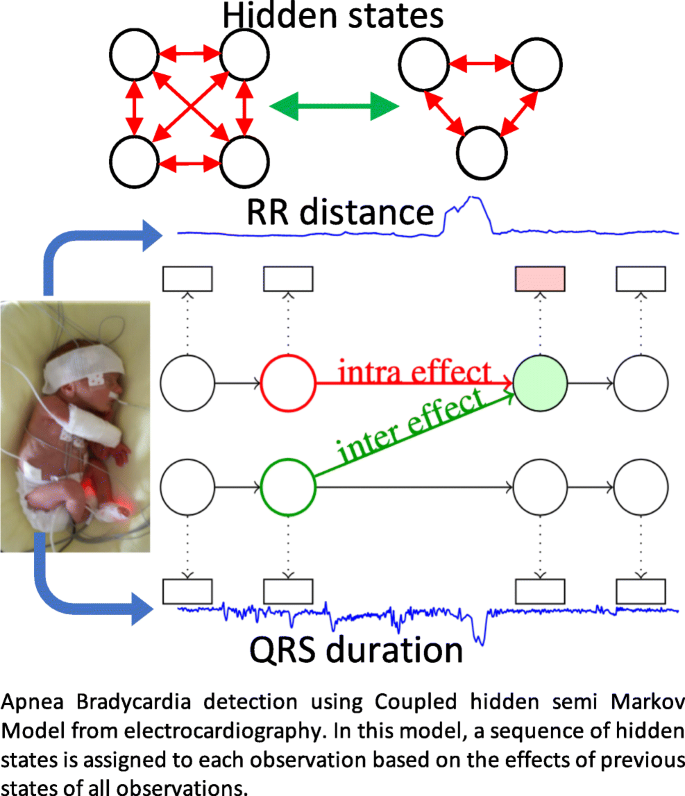
Apnea Bradycardia detection using Coupled hidden semi Markov Model from electrocardiography. In this model, a sequence of hidden states is assigned to each observation based on the effects of previous states of all observations
Access this article
Subscribe and save
- Starting from 10 chapters or articles per month
- Access and download chapters and articles from more than 300k books and 2,500 journals
- Cancel anytime View plans
Buy Now
Price excludes VAT (USA)
Tax calculation will be finalised during checkout.
Instant access to the full article PDF.
References
- Zhao Jing, Gonzalez Fernando, Dezhi M u (2011) Apnea of prematurity: from cause to treatment. Eur J pediatr 170(9):1097–1105
Article Google Scholar - Eichenwald EC et al (2016) Apnea of prematurity. Pediatrics, 137(1)
- Mathews TJ, et al. (2013) Infant mortality statistics from the 2010 period linked birth/infant death data set
- Janvier A, Khairy M, Kokkotis A, Cormier C, Messmer D, Barrington KJ (2004) Apnea is associated with neurodevelopmental impairment in very low birth weight infants. J Perinatol 24(12):763–768
Article Google Scholar - Poets CF, Stebbens VA, Samuels MP, Southall DP (1993) The relationship between bradycardia, apnea, and hypoxemia in preterm infants. Pediatric Res 34(2):144–147
Article CAS Google Scholar - Portet F, Gao F, Hunter J, Sripada S (2007) Evaluation of on-line bradycardia boundary detectors from neonatal clinical data. In: Engineering in medicine and biology society, 2007. EMBS 2007. 29th annual international conference of the IEEE, IEEE, pp 3288–3291
- Cruz J, Hernández A I, Wong S, Carrault G, Beuchee A (2006) Algorithm fusion for the early detection of apnea-bradycardia in preterm infants. In: Computers in cardiology, 2006, IEEE, pp 473–476
- Dumont J, Hernández AI, Fleureau J, Carrault G (2008) Modelling temporal evolution of cardiac electrophysiological features using hidden semi-markov models. In: Engineering in medicine and biology society, 2008. EMBS 2008. 30th annual international conference of the IEEE, IEEE, pp 165–168
- Altuve M, Carrault G, Beuchée A, Pladys P, Hernández AI (2014) Online apnea–bradycardia detection based on hidden semi-markov models. Medical & biomedical engineering & computing, pp 1–13
- Masoudi S, Montazeri N, Shamsollahi MB, Ge D, Beuchee A, Pladys P, Hernandez AI (2013) Early detection of apnea-bradycardia episodes in preterm infants based on coupled hidden markov model. In: 2013 IEEE international symposium on Signal processing and information technology (ISSPIT), IEEE, pp 000243–000248
- Rabiner L (1989) A tutorial on hidden markov models and selected applications in speech recognition. Proc IEEE 77(2):257– 286
Article Google Scholar - Yu S-Z, Kobayashi H (2006) Practical implementation of an efficient forward-backward algorithm for an explicit-duration hidden markov model. IEEE Tran Signal Process 54(5):1947–1951
Article Google Scholar - Ferguson JD (1980) Variable duration models for speech. In: Proc Symposium on the application of hidden markov models to text and speech, pp 143–179
- Brand M, Oliver N, Pentland A (1997) Coupled hidden markov models for complex action recognition. In: 1997 IEEE computer society conference on Computer vision and pattern recognition, 1997. Proceedings, IEEE, pp 994–999
- Brewer N, Liu N, De Vel O, Caelli T (2006) Using coupled hidden markov models to model suspect interactions in digital forensic analysis. In: International workshop on Integrating AI and data mining, 2006. AIDM’06, IEEE, pp 58–64
- Ghahjaverestan NM, Masoudi S, Shamsollahi M, Beuchee A, Pladys P, Ge D, Hernandez A (2015) Coupled hidden markov model based method forapnea bradycardia detection. Accepted in IEEE Journal of Biomedical and Health Informatics. https://doi.org/10.1109/JBHI.2015.2405075
- Natarajan P, Nevatia R (2007) Coupled hidden semi markov models for activity recognition. In: IEEE workshop on Motion and video computing, 2007. WMVC’07, IEEE, pp 10–10
- Brand M Coupled hidden markov models for modeling interacting processes, 1997. Technical Report 405
- Bradley AP (1997) The use of the area under the roc curve in the evaluation of machine learning algorithms. Pattern Recognition 30(7):1145–1159
Article Google Scholar - Neath AA, Cavanaugh JE (2012) The bayesian information criterion:, background, derivation, and applications. Wiley Interdisciplinary Reviews: Computational Statistics 4(2):199–203
Article Google Scholar - Rauch J, Smoller J (1978) Qualitative theory of the fitzhugh-nagumo equations. Adv Math 27(1):12–44
Article Google Scholar - Pan J, Tompkins WJ (1985) A real-time QRS detection algorithm. IEEE Transactions on Biomedical Engineering (3): 230–236
- Altuve M, Carrault G, Cruz J, Beuchée A, Pladys P, Hernandez A (2011) Multivariate ecg analysis for apnoea? bradycardia detection and characterisation in preterm infants. Int J Biomed Eng Technol 5(2):247–265
Article Google Scholar - Haskova K, Javorka K, Javorka M, Matasova K, Zibolen M (2013) Apnea in preterm newborns: determinants, pathophysiology, effects on cardiovascular parameters and treatment. Acta Medica Martiniana 13(3):5–17
Article Google Scholar - Poets CF (2010) Apnea of prematurity: what can observational studies tell us about pathophysiology. Sleep Med 11(7):701–707
Article Google Scholar
Funding
This work has been supported by the Center for International Scientific Studies and Collaboration (CISSC) and by Egide-Gundishapour program.
Author information
Authors and Affiliations
- NSERM, UMR 1099, F-35000, Rennes, France
Nasim Montazeri Ghahjaverestan, Di Ge, Alain Beuchée & Alfredo I. Hernández - University of Rennes 1, LTSI, F-35000, Rennes, France
Nasim Montazeri Ghahjaverestan, Di Ge, Alain Beuchée & Alfredo I. Hernández - The Biomedical Signal and Image Processing Laboratory (BiSIPL), School of Electrical Engineering, Sharif University of Technology, Azadi Avenue, Tehran, Iran
Nasim Montazeri Ghahjaverestan & Mohammad Bagher Shamsollahi - INSERM, UMR 1099, F-35000, Rennes, France
Alain Beuchée
Authors
- Nasim Montazeri Ghahjaverestan
- Mohammad Bagher Shamsollahi
- Di Ge
- Alain Beuchée
- Alfredo I. Hernández
Corresponding author
Correspondence toAlfredo I. Hernández.
Additional information
Publisher’s note
Springer Nature remains neutral with regard to jurisdictional claims in published maps and institutional affiliations.
Electronic supplementary material
Rights and permissions
About this article
Cite this article
Montazeri Ghahjaverestan, N., Shamsollahi, M.B., Ge, D. et al. Apnea bradycardia detection based on new coupled hidden semi Markov model.Med Biol Eng Comput 59, 1–11 (2021). https://doi.org/10.1007/s11517-020-02277-8
- Received: 03 February 2020
- Accepted: 14 October 2020
- Published: 12 November 2020
- Version of record: 12 November 2020
- Issue date: January 2021
- DOI: https://doi.org/10.1007/s11517-020-02277-8