Enhanced facial expression recognition using 3D point sets and geometric deep learning (original) (raw)
Abstract
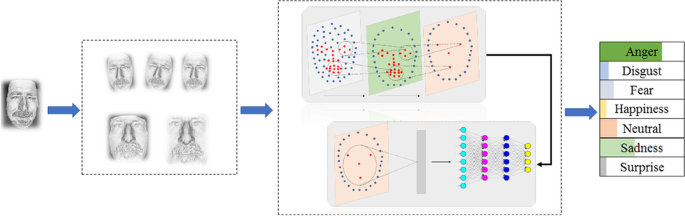
Facial expression recognition plays an essential role in human conversation and human–computer interaction. Previous research studies have recognized facial expressions mainly based on 2D image processing requiring sensitive feature engineering and conventional machine learning approaches. The purpose of the present study was to recognize facial expressions by applying a new class of deep learning called geometric deep learning directly on 3D point cloud data. Two databases (Bosphorus and SIAT-3DFE) were used. The Bosphorus database includes sixty-five subjects with seven basic expressions (i.e., anger, disgust, fearness, happiness, sadness, surprise, and neutral). The SIAT-3DFE database has 150 subjects and 4 basic facial expressions (neutral, happiness, sadness, and surprise). First, preprocessing procedures such as face center cropping, data augmentation, and point cloud denoising were applied on 3D face scans. Then, a geometric deep learning model called PointNet++ was applied. A hyperparameter tuning process was performed to find the optimal model parameters. Finally, the developed model was evaluated using the recognition rate and confusion matrix. The facial expression recognition accuracy on the Bosphorus database was 69.01% for 7 expressions and could reach 85.85% when recognizing five specific expressions (anger, disgust, happiness, surprise, and neutral). The recognition rate was 78.70% with the SIAT-3DFE database. The present study suggested that 3D point cloud could be directly processed for facial expression recognition by using geometric deep learning approach. In perspectives, the developed model will be applied for facial palsy patients to guide and optimize the functional rehabilitation program.
Graphical abstract
Access this article
Subscribe and save
- Starting from 10 chapters or articles per month
- Access and download chapters and articles from more than 300k books and 2,500 journals
- Cancel anytime View plans
Buy Now
Price excludes VAT (USA)
Tax calculation will be finalised during checkout.
Instant access to the full article PDF.
References
- Magagna J (2012) The silent child: communication without Words. Routledge, pp 394
- Dornaika, F, and Raducanu B (2007) Efficient facial expression recognition for human robot interaction. International Work-Conference on Artificial Neural Networks. Springer, Berlin, Heidelberg
- Hickson S et al (2019) Eyemotion: classifying facial expressions in VR using eye-tracking cameras. 2019 IEEE Winter Conference on Applications of Computer Vision (WACV) 1:1626–1635
- Chen CH, Lee I-J, Lin L-Y (2015) Augmented reality-based self-facial modeling to promote the emotional expression and social skills of adolescents with autism spectrum disorders. Res Dev Disabil 36:396–403
Article Google Scholar - Dulguerov P et al (1999) Review of objective topographic facial nerve evaluation methods. Am J Otol 20(5):672–8
CAS PubMed Google Scholar - Sonawane B, Sharma P (2021) Review of automated emotion-based quantification of facial expression in Parkinson’s patients. The Visual Computer 37:1151–1167
- An F, Liu Z (2020) Facial expression recognition algorithm based on parameter adaptive initialization of CNN and LSTM. Vis Comput 36(3):483–498
Article Google Scholar - Kumar S, Bhuyan MK, Iwahori Y (2021) Multi-level uncorrelated discriminative shared Gaussian process for multi-view facial expression recognition. The Visual Computer 37:143–159
- Li K et al (2020) Facial expression recognition with convolutional neural networks via a new face cropping and rotation strategy. Vis Comput 36(2):391–404
Article Google Scholar - Savran A, Sankur B (2017) Non-rigid registration based model-free 3D facial expression recognition. Comput Vis Image Underst 162:146–165
Article Google Scholar - Savran A, Sankur B (2008) Non-rigid registration of 3D surfaces by deformable 2D triangular meshes. 2008 IEEE Computer Society Conference on Computer Vision and Pattern Recognition Workshops. IEEE
- Savran A, Sankur B, Taha Bilge M (2012) Regression-based intensity estimation of facial action units. Image Vis Comput 30(10):774–784
Article Google Scholar - Savran A, Sankur B, Taha Bilge M (2012) Comparative evaluation of 3D vs. 2D modality for automatic detection of facial action units. Pattern Recogn 45(2):767–782
Article Google Scholar - Alyuz N et al (2008) Component-based registration with curvature descriptors for expression insensitive 3D face recognition. 2008 8th IEEE International Conference on Automatic Face & Gesture Recognition. IEEE
- Berretti S et al (2011) 3D facial expression recognition using SIFT descriptors of automatically detected keypoints. Vis Comput 27(11):1021
Article Google Scholar - Berretti S, Del Bimbo A, Pala P (2013) Automatic facial expression recognition in real-time from dynamic sequences of 3D face scans. Vis Comput 29(12):1333–1350
Article Google Scholar - Zarbakhsh P, Demirel H (2019) 4D facial expression recognition using multimodal time series analysis of geometric landmark-based deformations. Vis Comput: 1–15
- Qi CR et al (2017) Pointnet++: deep hierarchical feature learning on point sets in a metric space. Proceedings of the 31st Conference on Neural Information Processing Systems (NIPS 2017), Long Beach, pp 1–10
- Qi CR et al (2017) PointNet: Deep Learning on Point Sets for 3D Classification and Segmentation, IEEE Conference on Computer Vision and Pattern Recognition (CVPR), pp 77–85. https://doi.org/10.1109/CVPR.2017.16
- Savran A et al (2008) Bosphorus database for 3D face analysis. European workshop on biometrics and identity management. Springer, Berlin, Heidelberg
- Rusu RB et al (2007) Towards 3D object maps for autonomous household robots, IEEE/RSJ International Conference on Intelligent Robots and Systems, pp 3191–3198. https://doi.org/10.1109/IROS.2007.4399309
- Keskar NS et al (2016) On large-batch training for deep learning: generalization gap and sharp minima. arXiv preprint arXiv:1609.04836
- Wallace S, Coleman M, Bailey A (2008) An investigation of basic facial expression recognition in autism spectrum disorders. Cogn Emot 22(7):1353–1380
Article Google Scholar - Muhammad G et al (2017) A facial-expression monitoring system for improved healthcare in smart cities. IEEE Access 5:10871–10881
Article Google Scholar - Ko BC (2018) A brief review of facial emotion recognition based on visual information. Sensors 18(2):401
Article Google Scholar - Frowd C et al (2009) Towards a comprehensive 3D dynamic facial expression database. 113–119
- Matuszewski BJ, Quan W, Shark L-K (2011) High-resolution comprehensive 3-D dynamic database for facial articulation analysis. 2011 IEEE International Conference on Computer Vision Workshops (ICCV Workshops). IEEE
- Farnsworth B (2018) Facial Action Coding System (FACS)—a visual guidebook. https://imotions.com/blog/facial-action-coding-system/. Accessed on 2 July (2016)
- Singh SP et al (2020) 3D deep learning on medical images: a review. arXiv preprint arXiv:2004.00218
- Bello SA et al (2020) Deep learning on 3D point clouds. Remote Sens 12(11):1729
Article Google Scholar - Vretos N, Nikolaidis N, Pitas I (2011) 3D facial expression recognition using Zernike moments on depth images. 2011 18th IEEE International Conference on Image Processing. IEEE
- Azazi A et al (2015) Towards a robust affect recognition: automatic facial expression recognition in 3D faces. Expert Syst Appl 42(6):3056–3066
Article Google Scholar - Wang Y, Meng M, Zhen Q (2013) Learning encoded facial curvature information for 3D facial emotion recognition. 2013 Seventh International Conference on Image and Graphics. IEEE
- Hariri W, Tabia H, Farah N, Benouareth A, Declercq D (2017) 3D facial expression recognition using kernel methods on Riemannian manifold. Eng Appl Artif Intell 64:25–32
Article Google Scholar - Bronstein MM, Bruna J, LeCun Y, Szlam A, Vandergheynst P (2017) Geometric deep learning: going beyond euclidean data. IEEE Signal Process Mag 34(4):18–42
Article Google Scholar - Greengard S (2020) Geometric deep learning advances data science. Commun ACM 64(1):13–15
Article Google Scholar - Ye Y, Song Z, Guo J, Qiao Y (2020) SIAT-3DFE: a high-resolution 3D facial expression dataset. IEEE Access 8:48205–48211. https://doi.org/10.1109/ACCESS.2020.2979518
Article Google Scholar - Dao TT (2019) From deep learning to transfer learning for the prediction of skeletal muscle forces. Med Biol Eng Comput 57(5):1049–1058
Article Google Scholar
Funding
This work was financially supported by Sorbonne Center for Artificial Intelligence (SCAI).
Author information
Authors and Affiliations
- Université de technologie de Compiègne, CNRS, Biomechanics and Bioengineering, Centre de Recherche Royallieu, CS 60 319 - 60 203, Compiègne Cedex, France
Duc-Phong Nguyen & Marie-Christine Ho Ba Tho - Univ. Lille, CNRS, Centrale Lille, UMR 9013 - LaMcube - Laboratoire de Mécanique, Multiphysique, Multiéchelle, 59655 Villeneuve d’Ascq Cedex, F-59000, Lille, France
Tien-Tuan Dao
Authors
- Duc-Phong Nguyen
- Marie-Christine Ho Ba Tho
- Tien-Tuan Dao
Corresponding author
Correspondence toTien-Tuan Dao.
Ethics declarations
Competing interests
The authors declare no competing interests.
Additional information
Publisher’s note
Springer Nature remains neutral with regard to jurisdictional claims in published maps and institutional affiliations.
Rights and permissions
About this article
Cite this article
Nguyen, DP., Ho Ba Tho, MC. & Dao, TT. Enhanced facial expression recognition using 3D point sets and geometric deep learning.Med Biol Eng Comput 59, 1235–1244 (2021). https://doi.org/10.1007/s11517-021-02383-1
- Received: 04 November 2020
- Accepted: 08 May 2021
- Published: 24 May 2021
- Version of record: 24 May 2021
- Issue date: June 2021
- DOI: https://doi.org/10.1007/s11517-021-02383-1