The examination of stress shielding in a finite element lumbar spine inclusive of the thoracolumbar fascia (original) (raw)
Abstract
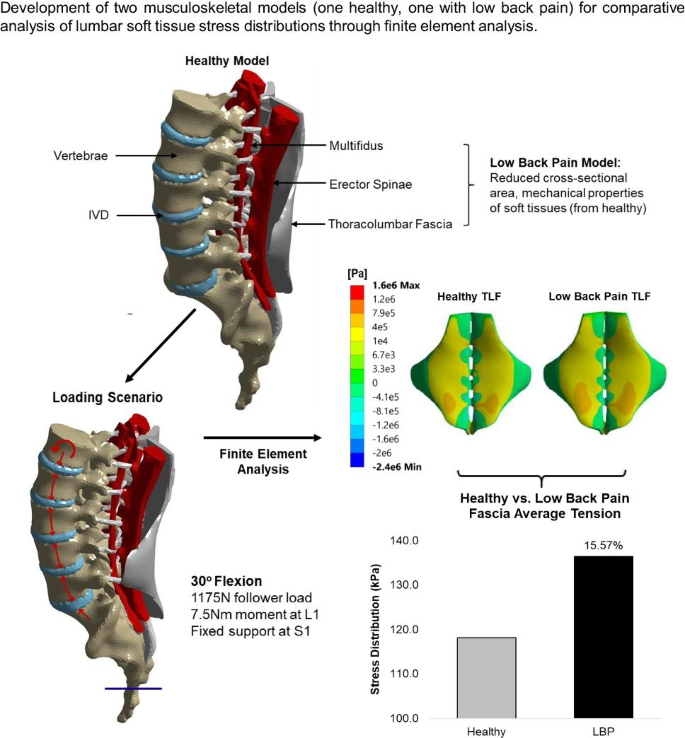
Despite the prevalence of low back pain (LBP) in society, the pathomechanism of LBP continues to elude researchers. LBP patients have demonstrated morphological and material property changes to their lumbar soft tissues, potentially leading to irregular load sharing within the lumbar spine. This study aims to analyze potential stress shielding consequential of augmented soft tissue properties via the comparison of a healthy and LBP finite element models. The models developed in this study include the vertebrae, intervertebral discs and soft tissues from L1–S1. Soft tissue morphology and material properties for the LBP model were augmented to reflect documented clinical findings. Model validation preceded testing and was confirmed through comparison to the available literature. Relative to the healthy model, the LBP model demonstrated an increase in stress by 15.6%, with 99.8% of this stress increase being distributed towards the thoracolumbar fascia. The majority of stress skewed towards the fascia may indicate a potential stress allocation bias whereby the lumbar muscles are unable to receive regular loading, leading to stress shielding. This load allocation bias and subsequent stress shielding may potentially contribute to the progression and pathomechanism of LBP but prospective studies would be required to make that link.
Graphical abstract
Access this article
Subscribe and save
- Starting from 10 chapters or articles per month
- Access and download chapters and articles from more than 300k books and 2,500 journals
- Cancel anytime View plans
Buy Now
Price excludes VAT (USA)
Tax calculation will be finalised during checkout.
Instant access to the full article PDF.
Low Back Pain
Chapter © 2017
References
- Andersson GBJ (1999) Epidemiological features of chronic low-back pain. The Lancet 354:581–585
Article CAS Google Scholar - Hestbaek L, Leboeuf-Yde C, Manniche C (2003) Low back pain: what is the long-term course? A review of studies of general patient populations. Eur Spine J 12:149–165. https://doi.org/10.1007/s00586-002-0508-5
Article PubMed PubMed Central Google Scholar - Croft PR, Macfarlane GJ, Papageorgiou AC et al (1998) Outcome of low back pain in general practice. Br Med J 316:1356–1359. https://doi.org/10.1136/bmj.317.7165.1083
Article CAS Google Scholar - Maher C, Underwood M, Buchbinder R (2017) Non-specific low back pain. The Lancet 389:736–747
Article Google Scholar - Katz JN (2006) Lumbar disc disorders and low-back pain: socioeconomic factors and consequences. J Bone Jt Surg 88:21–24. https://doi.org/10.2106/JBJS.E.01273
Article Google Scholar - Deyo RA, Weinstein JN (2001) Low back pain. N Engl J Med 344:363–370. https://doi.org/10.1136/bmj.322.7293.1027
Article CAS PubMed Google Scholar - Borenstein D, Calin A (2012) Causes of low back pain. In: Fast facts: low back pain, 2nd ed. Heath Press Ltd., Abingdon, UK, pp 46–72
- Driscoll M, Blyum L (2011) The presence of physiological stress shielding in the degenerative cycle of musculoskeletal disorders. J Bodyw Mov Ther 15:335–342. https://doi.org/10.1016/j.jbmt.2010.05.002
Article CAS PubMed Google Scholar - Driscoll M, Aubin CE, Moreau A et al (2009) The role of spinal concave-convex biases in the progression of idiopathic scoliosis. Eur Spine J 18:180–187. https://doi.org/10.1007/s00586-008-0862-z
Article PubMed PubMed Central Google Scholar - Langevin HM, Konofagou EE, Badger GJ et al (2011) Reduced thoracolumbar fascia shear strain in human chronic low back pain. BMC Musculoskelet Disord 12:1–11. https://doi.org/10.1186/1471-2474-12-203
Article Google Scholar - Kamaz M, Kireşi D, Oǧuz H et al (2007) CT measurement of trunk muscle areas in patients with chronic low back pain. Diagn Interv Radiol 13:144–148
PubMed Google Scholar - Masaki M, Aoyama T, Murakami T et al (2017) Association of low back pain with muscle stiffness and muscle mass of the lumbar back muscles, and sagittal spinal alignment in young and middle-aged medical workers. Clin Biomech 49:128–133. https://doi.org/10.1016/j.clinbiomech.2017.09.008
Article Google Scholar - Masaki M, Ji X, Yamauchi T et al (2019) Effects of the trunk position on muscle stiffness that reflects elongation of the lumbar erector spinae and multifidus muscles: an ultrasonic shear wave elastography study. Eur J Appl Physiol 119:1085–1091. https://doi.org/10.1007/s00421-019-04098-6
Article PubMed Google Scholar - Cholewicki J, McGill SM (1996) Mechanical stability of the in vivo lumbar spine: implications for injury and chronic low back pain. Clin Biomech 11:1–15. https://doi.org/10.1016/0268-0033(95)00035-6
Article CAS Google Scholar - Rayfield EJ (2007) Finite element analysis and understanding the biomechanics and evolution of living and fossil organisms. Annu Rev Earth Planet Sci 35:541–576. https://doi.org/10.1192/bjp.112.483.211-a
Article CAS Google Scholar - Driscoll M (2019) The impact of the finite element method on medical device design. J Med Biol Eng 39:171–172. https://doi.org/10.1192/bjp.112.483.211-a
Article Google Scholar - American Society of Mechanical Engineers (2018) Assessing credibility of computational modeling through verification and validation: application to medical devices. American Society of Mechanical Engineers, New York, NY, USA
Google Scholar - El Bojairami I, El Monajjed K, Driscoll M (2020) Development and validation of a timely and representative finite element human spine model for biomechanical simulations. Sci Rep 10:1–16. https://doi.org/10.1038/s41598-020-77469-1
Article CAS Google Scholar - Smit T, Odgaard A, Schneider E (1999) Structure and function of vertebral trabecular bone. Spine 22:2823–2833
Article Google Scholar - Yang H, Nawathe S, Fields AJ, Keaveny TM (2012) Micromechanics of the human vertebral body for forward flexion. J Biomech 45:2142–2148. https://doi.org/10.1016/j.jbiomech.2012.05.044
Article PubMed PubMed Central Google Scholar - Bonilla KA, Pardes AM, Freedman BR, Soslowsky LJ (2018) Supraspinatus tendons have different mechanical properties across sex. J Biomech Eng 141:011002. https://doi.org/10.1115/1.4041321
Article Google Scholar - Yahia LH, Pigeon P, DesRosiers EA (1993) Viscoelastic properties of the human lumbodorsal fascia. J Biomed Eng 15:425–429. https://doi.org/10.1016/0141-5425(93)90081-9
Article CAS PubMed Google Scholar - Creze M, Soubeyrand M, Yue JL et al (2018) Magnetic resonance elastography of the lumbar back muscles: a preliminary study. Clin Anat 31:514–520. https://doi.org/10.1002/ca.23065
Article PubMed Google Scholar - Marieb EN, Hoehn K (2013) The muscular system. In: Beauparlant S, Puttkamer G, Cutt S, et al (eds) Human anatomy & physiology, 9th ed. Pearson, Boston, USA, pp 319–386
- Rohlmann A, Zander T, Rao M, Bergmann G (2009) Realistic loading conditions for upper body bending. J Biomech 42:884–890. https://doi.org/10.1016/j.jbiomech.2009.01.017
Article CAS PubMed Google Scholar - Lin RM, Yu CY, Chang ZJ, Su FC (1994) Flexion-extension rhythm in the lumbosacral spine. Spine 19:2204–2209. https://doi.org/10.1097/00007632-199410000-00015
Article CAS PubMed Google Scholar - Dreischarf M, Zander T, Shirazi-Adl A et al (2014) Comparison of eight published static finite element models of the intact lumbar spine: predictive power of models improves when combined together. J Biomech 47:1757–1766. https://doi.org/10.1016/j.jbiomech.2014.04.002
Article CAS PubMed Google Scholar - Wilke H, Neef P, Caimi M et al (1999) New in vivo measurements of pressures in the intervertebral disc in daily life. Spine 24:755–762
Article CAS Google Scholar - Wong KWN, Leong JCY, Chan MK et al (2004) The flexion-extension profile of lumbar spine in 100 healthy volunteers. Spine 29:1636–1641. https://doi.org/10.1097/01.BRS.0000132320.39297.6C
Article PubMed Google Scholar - Schleip R, Naylor IL, Ursu D et al (2006) Passive muscle stiffness may be influenced by active contractility of intramuscular connective tissue. Med Hypotheses 66:66–71. https://doi.org/10.1016/j.mehy.2005.08.025
Article PubMed Google Scholar - Danneels LA, Vanderstraeten GG, Cambier DC et al (2000) CT imaging of trunk muscles in chronic low back pain patients and healthy control subjects. Eur Spine J 9:266–272
Article CAS Google Scholar - Newell E, Driscoll M (2021) Investigation of physiological stress shielding within lumbar spinal tissue as a contributor to unilateral low back pain: a finite element study. Comput Biol Med 133:1–8. https://doi.org/10.1016/j.compbiomed.2021.104351
Article Google Scholar - Okubo K, Tamura T, Takagi T et al (2008) BodyParts3D: 3D structure database for anatomical concepts. Nucleic Acids Res 37:D782–D785. https://doi.org/10.1093/nar/gkn613
Article CAS PubMed PubMed Central Google Scholar
Funding
This study was funded by the Fonds de Recherche du Québec – Nature et Technologies (FRQNT, grant no. NC-205220) and the Natural Science and Engineering Research Council (NSERC, grant no. NSERC GP514085-17).
Author information
Authors and Affiliations
- Musculoskeletal Biomechanics Research Lab, Department of Mechanical Engineering, McGill University, 817 Sherbrooke St. W, Montréal, QC, H3A 0C3, Canada
Emily Newell & Mark Driscoll - Orthopaedic Research Laboratory, Research Institute MUHC, Montreal General Hospital, 1650 Cedar Ave, LS1.409, Montreal, QC, H3G 1A4, Canada
Emily Newell & Mark Driscoll
Authors
- Emily Newell
- Mark Driscoll
Contributions
All authors contributed to the study conception and design. Methodology, data collection and analysis and validation were performed by Emily Newell. The first draft of the manuscript was written by Emily Newell. Review and editing were performed by all authors on previous versions of the manuscript. All authors read and approved the final manuscript.
Corresponding author
Correspondence toMark Driscoll.
Ethics declarations
Conflict of interest
The authors declare no competing interests.
Additional information
Publisher’s note
Springer Nature remains neutral with regard to jurisdictional claims in published maps and institutional affiliations.
Rights and permissions
About this article
Cite this article
Newell, E., Driscoll, M. The examination of stress shielding in a finite element lumbar spine inclusive of the thoracolumbar fascia.Med Biol Eng Comput 59, 1621–1628 (2021). https://doi.org/10.1007/s11517-021-02408-9
- Received: 26 November 2020
- Accepted: 04 July 2021
- Published: 17 July 2021
- Version of record: 17 July 2021
- Issue date: August 2021
- DOI: https://doi.org/10.1007/s11517-021-02408-9