Advancing stakeholder engagement in climate adaptation: a systematic review of structural barriers and operational enablers (original) (raw)
Introduction
Adaptation to climate change (hereafter adaptation) is steadily advancing across the globe, with ever more countries, regions, and municipalities developing and implementing policies and actions (IPCC 2022). Despite progress, adaptation remains fragmented, incremental and insufficient, leaving a glaring implementation gap that requires accelerating and mainstreaming the implementation of adaptation solutions (De Roeck et al. [2018](/article/10.1007/s11625-026-01843-7#ref-CR29 "De Roeck F, Orbie J, Delputte S (2018) Mainstreaming climate change adaptation into the European Union’s development assistance. Environ Sci Policy. https://doi.org/10.1016/j.envsci.2017.12.005
          "); Berrang-Ford et al. [2019](/article/10.1007/s11625-026-01843-7#ref-CR12 "Berrang-Ford L, Biesbroek R, Ford JD et al (2019) Tracking global climate change adaptation among governments. Nat Clim Chang 9:440–449.
            https://doi.org/10.1038/s41558-019-0490-0

          "); Haasnoot et al. [2020](/article/10.1007/s11625-026-01843-7#ref-CR44 "Haasnoot M, Biesbroek R, Lawrence J et al (2020) Defining the solution space to accelerate climate change adaptation. Reg Environ Change.
            https://doi.org/10.1007/s10113-020-01623-8

          ")). Simultaneously, there is an increasing emphasis on the importance of engaging stakeholders, and particularly citizens, in the process. Broadly understood as involving those affected by or influencing adaptation decisions (Reed [2008](/article/10.1007/s11625-026-01843-7#ref-CR81 "Reed MS (2008) Stakeholder participation for environmental management: a literature review. Biol Conserv 141:2417–2431")), engagement is seen as essential to ensure that adaptation planning and actions are inclusive, equitable, and tailored to the local context (Conde et al. [2005](/article/10.1007/s11625-026-01843-7#ref-CR28 "Conde C, Lonsdale K, Authors C et al (2005) Engaging stakeholders in the adaptation process. In: CAMBRIDGE UNIVERSITY PRESS (ed) Adaptation policy frameworks for climate change: Developing strategies, policies and measure. New York, NY, USA, pp 47–66"); Araos et al. [2021](/article/10.1007/s11625-026-01843-7#ref-CR8 "Araos M, Jagannathan K, Shukla R et al (2021) Equity in human adaptation-related responses: a systematic global review. One Earth 4:1454–1467.
            https://doi.org/10.1016/j.oneear.2021.09.001

          "); European Union [2024](/article/10.1007/s11625-026-01843-7#ref-CR35 "European Union (2024) CORPORATE GUIDANCE: Citizen Engagement. Luxembourg")). Stakeholder and citizen engagement in climate adaptation is gaining traction in both policy and research agendas (Hügel and Davies [2020](/article/10.1007/s11625-026-01843-7#ref-CR46 "Hügel S, Davies AR (2020) Public participation, engagement, and climate change adaptation: a review of the research literature. Wiley Interdiscip Rev Clim Change.
            https://doi.org/10.1002/wcc.645

          . 11:")).
This claim has been repeatedly reinforced in international frameworks, including in the Rio Declaration of 1992, the Paris Agreement (2015), the 2030 Agenda for Sustainable Development, the Sendai Framework for Disaster Risk Reduction (2015–2030), and in the IPCC 6th Assessment Report (AR6) Cycle (IPCC 2022). At the European level, the EU Mission on Adaptation to Climate Change reaffirmed the value of citizen and stakeholder engagement to support effective national planning and implementation (MI4ADAPT 2023; European Commission [2025](/article/10.1007/s11625-026-01843-7#ref-CR34 "European Commission (2025) EU Missions & citizen engagement activities. In: https://research-and-innovation.ec.europa.eu/funding/funding-opportunities/funding-programmes-and-open-calls/horizon-europe/eu-missions-horizon-europe/eu-missions-citizen-engagement-activities_en
")).This push for stakeholder engagement is driven by the expectation that it yields multiple and interconnected benefits. Yet, engagement is not a guarantee of success nor always appropriate. It represents one approach among others, such as top-down regulation or market-based incentives, which may be more efficient in contexts requiring urgent, standardized or large-scale infrastructural action (Lemos et al. 2018; Scheer et al. [2025](/article/10.1007/s11625-026-01843-7#ref-CR88 "Scheer D, Venghaus S, Sardo S et al (2025) No easy way out: towards a framework concept of long-term governance. Energy Sustain Soc. https://doi.org/10.1186/s13705-025-00513-3
          ")). Moreover, it must operate alongside other critical catalysts for adaptation such as proactive leadership, sufficient resourcing, supportive legal frameworks or enhanced knowledge (IPCC [2022](/article/10.1007/s11625-026-01843-7#ref-CR49 "IPCC (2022) Summary for Policymakers: Climate Change 2022_ Impacts, Adaptation and Vulnerability_Working Group II contribution to the Sixth Assessment Report of the Intergovernamental Panel on Climate Change"); Brullo et al. [2024](/article/10.1007/s11625-026-01843-7#ref-CR18 "Brullo T, Barnett J, Waters E, Boulter S (2024) The enablers of adaptation: a systematic review. npj Clim Action.
            https://doi.org/10.1038/s44168-024-00128-y

          ")).
Nevertheless, when strategically designed and effectively implemented, stakeholder engagement offers significant benefits, facilitating the successful implementation of climate related initiatives and enhancing their relevance and acceptance at the local level (Owen [2020](/article/10.1007/s11625-026-01843-7#ref-CR74 "Owen G (2020) What makes climate change adaptation effective? A systematic review of the literature. Glob Environ Change 62:102071. https://doi.org/10.1016/j.gloenvcha.2020.102071
          "); Cattino and Reckien [2021](/article/10.1007/s11625-026-01843-7#ref-CR24 "Cattino M, Reckien D (2021) Does public participation lead to more ambitious and transformative local climate change planning? Curr Opin Environ Sustain 52:100–110.
            https://doi.org/10.1016/j.cosust.2021.08.004

          ")). Engagement can be key to manage the unique characteristics of climate adaptation such as the high levels of uncertainty, long temporal horizons, localized impacts, and the need to manage risks that may not yet be visible (Few et al. [2007](/article/10.1007/s11625-026-01843-7#ref-CR37 "Few R, Brown K, Tompkins EL (2007) Public participation and climate change adaptation: avoiding the illusion of inclusion. Clim Policy 7:46–59.
            https://doi.org/10.1080/14693062.2007.9685637

          "); IPCC [2022](/article/10.1007/s11625-026-01843-7#ref-CR49 "IPCC (2022) Summary for Policymakers: Climate Change 2022_ Impacts, Adaptation and Vulnerability_Working Group II contribution to the Sixth Assessment Report of the Intergovernamental Panel on Climate Change")). Research demonstrates that early and continuous stakeholder engagement offers several interconnected advantages (Kujala et al. [2022](/article/10.1007/s11625-026-01843-7#ref-CR56 "Kujala J, Sachs S, Leinonen H et al (2022) Stakeholder engagement: past, present, and future. Bus Soc 61:1136–1196.
            https://doi.org/10.1177/00076503211066595

          ")). It promotes inclusivity, and better representation of diverse perspectives and of marginalized voices, which in turn contribute to equitable outcomes, legitimacy, acceptance and ownership of decisions (Chambers et al. [2021](/article/10.1007/s11625-026-01843-7#ref-CR25 "Chambers JM, Wyborn C, Ryan ME et al (2021) Six modes of co-production for sustainability. Nat Sustain 4:983–996.
            https://doi.org/10.1038/s41893-021-00755-x

          "); Wagner and Lima [2024](/article/10.1007/s11625-026-01843-7#ref-CR104 "Wagner PM, Lima V (2024) The interests, ideas, and institutions shaping public participation in local climate change governance in Ireland. Local Environ 29:1170–1184.
            https://doi.org/10.1080/13549839.2023.2284946

          ")). The process also improves transparency and accessibility in decision-making, overcoming technical and social barriers to allow for meaningful contributions (Doelle and Majekolagbe [2023](/article/10.1007/s11625-026-01843-7#ref-CR31 "Doelle M, Majekolagbe A (2023) Meaningful public engagement and the integration of climate considerations into impact assessment. Environ Impact Assess Rev 101:107103.
            https://doi.org/10.1016/j.eiar.2023.107103

          ")). Furthermore, engagement facilitates mutual learning and knowledge integration, allowing decision-makers to incorporate both scientific expertise and lived experiences (Chambers et al. [2021](/article/10.1007/s11625-026-01843-7#ref-CR25 "Chambers JM, Wyborn C, Ryan ME et al (2021) Six modes of co-production for sustainability. Nat Sustain 4:983–996.
            https://doi.org/10.1038/s41893-021-00755-x

          "); Newig et al. [2023](/article/10.1007/s11625-026-01843-7#ref-CR70 "Newig J, Jager NW, Challies E, Kochskämper E (2023) Does stakeholder participation improve environmental governance? Evidence from a meta-analysis of 305 case studies. Glob Environ Change.
            https://doi.org/10.1016/j.gloenvcha.2023.102705

          ")). This enriched understanding strengthens the effectiveness of adaptation initiatives by enabling tailored solutions based on local knowledge. Ultimately, engagement provides a crucial platform for navigating complex trade-offs, addressing power dynamics, and resolving potential conflicts (Burton and Mustelin [2013](/article/10.1007/s11625-026-01843-7#ref-CR21 "Burton P, Mustelin J (2013) Planning for climate change: Is greater public participation the key to success? Urban Policy Res 31:399–415.
            https://doi.org/10.1080/08111146.2013.778196

          ")).
Despite these benefits, the inherent complexity and challenges of stakeholder engagement have been widely acknowledged across multiple fields, to the extent that it is often described as a wicked problem (Few et al. [2007](/article/10.1007/s11625-026-01843-7#ref-CR37 "Few R, Brown K, Tompkins EL (2007) Public participation and climate change adaptation: avoiding the illusion of inclusion. Clim Policy 7:46–59. https://doi.org/10.1080/14693062.2007.9685637
          "); Sprain [2016](/article/10.1007/s11625-026-01843-7#ref-CR95 "Sprain L (2016) Paradoxes of public participation in climate change governance. Good Soc 25:62–80.
            https://doi.org/10.5325/goodsociety.25.1.0062

          "); Buhmann et al. [2024](/article/10.1007/s11625-026-01843-7#ref-CR20 "Buhmann K, Fonseca A, Andrews N, Amatulli G (2024) MEANINGFUL STAKEHOLDER ENGAGEMENT: the concept, practice and governance. In: The Routledge Handbook on Meaningful Stakeholder Engagement. Taylor and Francis, pp 3–40")). These challenges can lead to poor quality engagement and even generate adverse effects that hamper the achievement of the benefits highlighted above (Lemos et al. [2018](/article/10.1007/s11625-026-01843-7#ref-CR60 "Lemos MC, Arnott JC, Ardoin NM et al (2018) To co-produce or not to co-produce. Nat Sustain 1:722–724")). For example, the effectiveness of stakeholder engagement in adaptation decision-making can be undermined by unclear objectives, inadequate facilitation, and the exclusion of marginalized voices, leading to tokenistic participation and weaker, contested outcomes (Lemos et al. [2018](/article/10.1007/s11625-026-01843-7#ref-CR60 "Lemos MC, Arnott JC, Ardoin NM et al (2018) To co-produce or not to co-produce. Nat Sustain 1:722–724"); Wamsler et al. [2020](/article/10.1007/s11625-026-01843-7#ref-CR106 "Wamsler C, Alkan-Olsson J, Björn H et al (2020) Beyond participation: when citizen engagement leads to undesirable outcomes for nature-based solutions and climate change adaptation. Clim Change 158:235–254.
            https://doi.org/10.1007/s10584-019-02557-9

          "); Cattino and Reckien [2021](/article/10.1007/s11625-026-01843-7#ref-CR24 "Cattino M, Reckien D (2021) Does public participation lead to more ambitious and transformative local climate change planning? Curr Opin Environ Sustain 52:100–110.
            https://doi.org/10.1016/j.cosust.2021.08.004

          ")). Indeed, achieving meaningful engagement remains challenging for local authorities and practitioners.
Key barriers include a lack of motivation, appropriate knowledge, and trust in governance bodies (Khatibi et al. [2021](/article/10.1007/s11625-026-01843-7#ref-CR52 "Khatibi FS, Dedekorkut-Howes A, Howes M, Torabi E (2021) Can public awareness, knowledge and engagement improve climate change adaptation policies? Discover Sustain. https://doi.org/10.1007/s43621-021-00024-z
          ")); and conflicting interests, power asymmetries, difficulties in sustaining meaningful participation as well as structural challenges that arise from inadequate organizational and governance structures (Wamsler et al. [2020](/article/10.1007/s11625-026-01843-7#ref-CR106 "Wamsler C, Alkan-Olsson J, Björn H et al (2020) Beyond participation: when citizen engagement leads to undesirable outcomes for nature-based solutions and climate change adaptation. Clim Change 158:235–254.
            https://doi.org/10.1007/s10584-019-02557-9

          "); Scolobig and Gallagher [2020](/article/10.1007/s11625-026-01843-7#ref-CR90 "Scolobig A, Gallagher L (2020) Understanding, analysing and addressing conflicts in co-production. The Palgrave Handbook of Co-Production of Public Services and Outcomes. Edited by E. Loeffl erand T. Bovaird, Palgrave Macmillan. Springer, pp 613–636"); Glaas et al. [2022](/article/10.1007/s11625-026-01843-7#ref-CR41 "Glaas E, Hjerpe M, Wihlborg E, Storbjörk S (2022) Disentangling municipal capacities for citizen participation in transformative climate adaptation. Environ Policy Gov 32:179–191.
            https://doi.org/10.1002/eet.1982

          ")). Moreover, participatory processes may be co-opted by specific interests, impacting the legitimacy of the outcomes (Newman et al. [2004](/article/10.1007/s11625-026-01843-7#ref-CR71 "Newman J, Barnes M, Sullivan H, Knops A (2004) Public participation and collaborative governance. J Soc Policy 33:203–223.
            https://doi.org/10.1017/S0047279403007499

          "); André et al. [2023](/article/10.1007/s11625-026-01843-7#ref-CR7 "André K, Gerger Swartling Å, Englund M et al (2023) Improving stakeholder engagement in climate change risk assessments: insights from six co-production initiatives in Europe. Front Clim.
            https://doi.org/10.3389/fclim.2023.1120421

          ")). These failures are particularly concerning climate adaptation as they can reinforce existing power dynamics (Turnhout et al. [2020](/article/10.1007/s11625-026-01843-7#ref-CR101 "Turnhout E, Metze T, Wyborn C et al (2020) The politics of co-production: participation, power, and transformation. Curr Opin Environ Sustain 42:15–21")) or result in maladaptive outcomes that inadvertently increase the vulnerability of populations (Cattino and Reckien [2021](/article/10.1007/s11625-026-01843-7#ref-CR24 "Cattino M, Reckien D (2021) Does public participation lead to more ambitious and transformative local climate change planning? Curr Opin Environ Sustain 52:100–110.
            https://doi.org/10.1016/j.cosust.2021.08.004

          ")). Thus, while the potential for engagement to be transformative exists (IPCC [2022](/article/10.1007/s11625-026-01843-7#ref-CR49 "IPCC (2022) Summary for Policymakers: Climate Change 2022_ Impacts, Adaptation and Vulnerability_Working Group II contribution to the Sixth Assessment Report of the Intergovernamental Panel on Climate Change")), its actual contribution depends heavily on both the quality of the process and structural barriers that go beyond simple procedural design (Lemos et al. [2018](/article/10.1007/s11625-026-01843-7#ref-CR60 "Lemos MC, Arnott JC, Ardoin NM et al (2018) To co-produce or not to co-produce. Nat Sustain 1:722–724"); Murunga [2022](/article/10.1007/s11625-026-01843-7#ref-CR67 "Murunga M (2022) Public engagement for social transformation: informing or empowering? Environ Sci Policy 132:237–246.
            https://doi.org/10.1016/j.envsci.2022.02.031

          ")).
Given these challenges and potential pitfalls, engagement practices for adaptation remain fragmented and often limited to passive forms of participation, rather than being fully mainstreamed into policy and practice (Revez et al. [2022](/article/10.1007/s11625-026-01843-7#ref-CR84 "Revez A, Dunphy N, Harris C et al (2022) Mapping emergent public engagement in societal transitions: a scoping review. Energy Sustain Soc. https://doi.org/10.1186/s13705-021-00330-4
          ")). To address this gap, it is crucial to provide greater support for adaptation practitioners to foster climate ambition and action (Owen [2020](/article/10.1007/s11625-026-01843-7#ref-CR74 "Owen G (2020) What makes climate change adaptation effective? A systematic review of the literature. Glob Environ Change 62:102071.
            https://doi.org/10.1016/j.gloenvcha.2020.102071

          "); Cattino and Reckien [2021](/article/10.1007/s11625-026-01843-7#ref-CR24 "Cattino M, Reckien D (2021) Does public participation lead to more ambitious and transformative local climate change planning? Curr Opin Environ Sustain 52:100–110.
            https://doi.org/10.1016/j.cosust.2021.08.004

          ")). This requires developing targeted policies and practical recommendations better aligned with practitioners needs that acknowledge the conditions, challenges, and enabling factors associated with engagement practices implementation (Wamsler [2017](/article/10.1007/s11625-026-01843-7#ref-CR105 "Wamsler C (2017) Stakeholder involvement in strategic adaptation planning: transdisciplinarity and co-production at stake? Environ Sci Policy 75:148–157.
            https://doi.org/10.1016/j.envsci.2017.03.016

          ")).
Carried out as part of the EU-funded Adaptation AGORA project, this study aims to identify key challenges and priorities that can support practitioners and affected stakeholders in meaningfully engaging in adaptation actions. It builds upon both existing scientific knowledge and practitioner experience to understand the diverse contexts in which engagement processes occur and to identify transversal factors hindering or facilitating its implementation across a wide spectrum of adaptation initiatives, engagement approaches and contexts. To address these objectives, we combined a systematic review of scientific literature, an online survey and semi-structured interviews to gather the experience of adaptation practitioners. Specifically, this study investigates the following research questions: (1) How are stakeholder engagement processes currently operationalized in climate adaptation? (2) What are the main barriers and enablers influencing the implementation of stakeholder engagement processes? And (3) In what ways can adaptation practitioners and stakeholders be better supported to foster and sustain effective engagement practices? The following sections outline the conceptual framing, the methodology of the study, describes key findings, and discusses the scope of stakeholder engagement practices in adaptation, highlighting operational and structural gaps. The paper concludes by identifying policy and practice windows of opportunity to leverage stakeholder engagement for climate adaptation action.
Conceptual framing
To navigate the complex landscape of engagement in climate adaptation, we established a conceptual framing that guided our data collection and analysis. We structured our work around four core dimensions: the stakeholders, the process (levels of engagement), the context of the adaptation initiatives, and the influencing factors (barriers and enablers).
First, regarding the stakeholders, the literature and practice refer to diverse and sometimes overlapping terminology to describe stakeholder engagement in climate governance, with terms such as public participation, co-creation, co-production, and transdisciplinarity often used interchangeably to describe deliberative decision-making processes (Alford [2014](/article/10.1007/s11625-026-01843-7#ref-CR6 "Alford J (2014) The multiple facets of co-production: building on the work of Elinor Ostrom. Public Manage Rev 16:299–316. https://doi.org/10.1080/14719037.2013.806578
          "); Loeffler and Bovaird [2021](/article/10.1007/s11625-026-01843-7#ref-CR61 "Loeffler E, Bovaird T (2021) The Palgrave Handbook of Co.-Production of Public Services and Outcomes"); Kujala et al. [2022](/article/10.1007/s11625-026-01843-7#ref-CR56 "Kujala J, Sachs S, Leinonen H et al (2022) Stakeholder engagement: past, present, and future. Bus Soc 61:1136–1196.
            https://doi.org/10.1177/00076503211066595

          ")). These terms reflect different theoretical bases and normative assumptions, ranging from democratic theory emphasizing rights, equity, and empowerment (Arnstein [1969](/article/10.1007/s11625-026-01843-7#ref-CR10 "Arnstein SR (1969) A Ladder Of Citizen Participation. J Am Plann Assoc 35:216–224.
            https://doi.org/10.1080/01944366908977225

          ")) to management and instrumental governance approaches prioritizing effectiveness, learning, and conflict resolution (Reed [2008](/article/10.1007/s11625-026-01843-7#ref-CR81 "Reed MS (2008) Stakeholder participation for environmental management: a literature review. Biol Conserv 141:2417–2431")). To navigate this complex linguistic landscape and to enable systematic analysis across heterogeneous practices, this paper adopts a deliberately broad and integrative understanding of stakeholder engagement. Consistent with the definition proposed by Reed ([2008](/article/10.1007/s11625-026-01843-7#ref-CR81 "Reed MS (2008) Stakeholder participation for environmental management: a literature review. Biol Conserv 141:2417–2431")) in the context of environmental challenges, we refer to _stakeholder engagement_ as a process through which individuals, groups, or organizations are involved to take an active role in making decisions that affect them or the related outcomes they can influence.
Although a distinction is frequently made in both research and practice between citizen participation and stakeholder participation — with tailored engagement processes designed for each group — in the context of adaptation, this distinction becomes increasingly problematic (Kahane et al. [2013](/article/10.1007/s11625-026-01843-7#ref-CR51 "Kahane D, Loptson K, Herriman J, Hardy M (2013) Stakeholder and citizen roles in public deliberation. J Public Deliberation. https://doi.org/10.16997/jdd.164
          "); OECD [2022](/article/10.1007/s11625-026-01843-7#ref-CR73 "OECD (2022) OECD guidelines for citizen participation processes. OECD, Paris")). Indeed, climate change affects all societal levels, blurring the boundary between the public and stakeholders (Reed et al. [2018](/article/10.1007/s11625-026-01843-7#ref-CR82 "Reed MS, Vella S, Challies E et al (2018) A theory of participation: what makes stakeholder and public engagement in environmental management work? Restor Ecol 26:S7–S17")), and effective adaptation depends on bridging technical and scientific expertise with experiential and place-based knowledge held by citizens and local communities (Reed et al. [2018](/article/10.1007/s11625-026-01843-7#ref-CR82 "Reed MS, Vella S, Challies E et al (2018) A theory of participation: what makes stakeholder and public engagement in environmental management work? Restor Ecol 26:S7–S17"); Murunga [2022](/article/10.1007/s11625-026-01843-7#ref-CR67 "Murunga M (2022) Public engagement for social transformation: informing or empowering? Environ Sci Policy 132:237–246.
            https://doi.org/10.1016/j.envsci.2022.02.031

          ")). Accordingly, this study conceptualizes citizens as stakeholders, alongside the overall civil society with NGOs, organizations, and/or local communities, and professional actors such as government officials, managers, experts, businesses, investors, and media (Buhmann et al. [2024](/article/10.1007/s11625-026-01843-7#ref-CR20 "Buhmann K, Fonseca A, Andrews N, Amatulli G (2024) MEANINGFUL STAKEHOLDER ENGAGEMENT: the concept, practice and governance. In: The Routledge Handbook on Meaningful Stakeholder Engagement. Taylor and Francis, pp 3–40")). Integrating these actors under a unified stakeholder engagement framing allows the identification of systemic barriers and enablers across adaptation processes.
Second, concerning the engagement process, we acknowledge that engagement takes many forms and exists on a spectrum of participation approaches. To categorize this continuum in our analysis, we draw upon the frameworks of Arnstein’s Ladder (1969) and the IAP2 Spectrum (2018). We thus considered engagement processes ranging from passive or tokenistic approaches like informing and consultation, where stakeholders receive or provide input but lack decision-making power, to more active forms such as collaboration or empowerment where stakeholders share decision-making authority and co-produce outcomes (Arnstein [1969](/article/10.1007/s11625-026-01843-7#ref-CR10 "Arnstein SR (1969) A Ladder Of Citizen Participation. J Am Plann Assoc 35:216–224. https://doi.org/10.1080/01944366908977225
          "); IAP2 [2018](/article/10.1007/s11625-026-01843-7#ref-CR48 "IAP2 (2018) Spectrum of public participation. In: International Association for Public Participation.
            https://cdn.ymaws.com/www.iap2.org/resource/resmgr/pillars/Spectrum_8.5x11_Print.pdf

          . Accessed 20 Feb 2025")).
Third, regarding the context of adaptation, given that climate adaptation is often inherently cross-cutting, this study adopts a broad analytical scope to capture the diversity of adaptation efforts (Berrang-Ford et al. [2021](/article/10.1007/s11625-026-01843-7#ref-CR13 "Berrang-Ford L, Siders AR, Lesnikowski A et al (2021) A systematic global stocktake of evidence on human adaptation to climate change. Nat Clim Chang 11:989–1000. https://doi.org/10.1038/s41558-021-01170-y
")). We therefore analyze initiatives across diverse sectors (e.g., agriculture, water, urban planning) and type of action. These include policymaking, planning processes, on-the-ground actions, climate services, knowledge co-production, and financial mechanisms.Ultimately, to understand the influencing factors that shape engagement, we analyze barriers as factors that obstruct the implementation of stakeholder engagement process, whereas enablers are factors that facilitate it. We conceptually distinguish between operational factors, which relate to the internal design, facilitation, and management of the engagement process, and structural factors, which encompass the broader institutional, financial, and social context in which the engagement is embedded.
This non-restrictive conceptualization allows to analyze engagement practices across the entire landscape of adaptation efforts, rather than limiting our scope to a single approach or type of action.
Methodology
We employed both quantitative and qualitative methods to comprehensively understand the context in which stakeholder engagement occurs within adaptation processes, as well as the barriers and enablers to its implementation. To do so, the research combined a systematic literature review, online surveys and semi-structured interviews.
Systematic literature review
We first conducted a systematic review of the scientific literature in accordance with the Preferred Reporting Items for Systematic Reviews and Meta-Analysis (PRISMA) guidelines (Page et al. [2021](/article/10.1007/s11625-026-01843-7#ref-CR76 "Page MJ, McKenzie JE, Bossuyt PM et al (2021) The PRISMA 2020 statement: an updated guideline for reporting systematic reviews. BMJ. https://doi.org/10.1136/bmj.n71
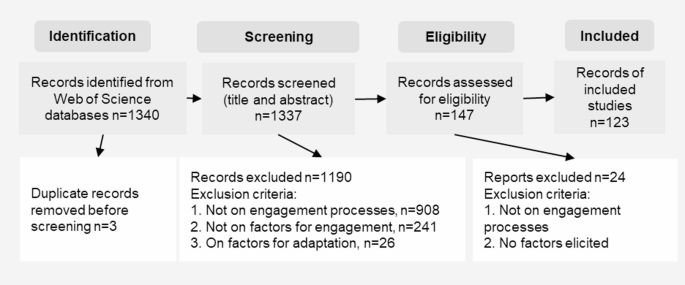
")) to identify relevant studies from the Web of Science database. To align with the scope of our research, five groups of keywords were selected (for more details on keywords selection, see ESM-S1). Initially, we narrowed our focus to the domain of climate change adaptation, recognizing that the literature on citizen and stakeholder engagement is extensive and spans various contexts. Subsequently, we identified studies that concurrently address adaptation initiatives, engagement processes, enablers and barriers, and the typology of involved actors. The search was restricted to peer-reviewed articles published in English prior to 19 June 2023, with the relevant keywords appearing in their title, abstract or keywords section. Despite our efforts to select a comprehensive set of keywords, we are conscious that the wide range of terminology used to describe engagement processes likely resulted in the omission of relevant studies.The preliminary search of the Web of Science database yielded 1,340 records, from which 3 duplicates were removed (see Fig. 1). To assess the eligibility of each article we then screened their title and abstract. The eligibility criteria required articles to report on at least one stakeholder engagement process in an adaptation initiative, as well as on the barriers and/or enablers experienced during this process. A total of 1,190 papers were excluded for one or more of the following three reasons: (1) they did not address stakeholder engagement processes; (2) they lacked a description of enablers or barriers; or (3) they focused on enablers and barriers related to the implementation of adaptation solutions rather than on stakeholder engagement. By isolating the engagement process as our primary unit of analysis, we ensured that the extracted factors remained comparable across the heterogeneous range of adaptation initiatives and geographic contexts.
Fig. 1
The alternative text for this image may have been generated using AI.
PRISMA diagram reflecting systematic review process
As a result, 147 articles were retrieved for content analysis, of which 24 were subsequently excluded for one of the above reasons following a thorough review. Thus, 123 articles were included in our analysis (the full list is available in ESM-S2).
Each article was examined by one co-author, with a second co-author reviewing the coding in case of uncertainties to ensure the robustness of the analysis. The coding framework was collaboratively developed based on research questions, associated hypotheses, and the collective expertise (see ESM-S3). The coding framework was divided into four main sections: (1) information about the paper (i.e., date, journal, authors, type of study, and methods for data collection); (2) the context of the adaptation initiatives (i.e., the adaptation solutions type, sectors, benefits, scale, and location); (3) the engagement processes (i.e., engagement definition provided, the type, outputs, and the methods used for stakeholders’ engagement); and (4) factors influencing the engagement process, specifically each factor’s name, description, broad category (e.g., institutional, financial, socio-cultural, relational), and influence (barriers or enablers). As these initial broad categories proved insufficient to capture the nuance of the 173 barriers and 471 enablers identified, we developed a refined categorization using inductive thematic analysis. Therefore, to ensure consistency and comparability, new specific categories were derived based on factors original terminology and underlying semantic meaning (e.g. merging “favorable institutional structure” and “government leadership” into “Institutional support”). To ensure distinct delimitation between categories, the specific scope of each category was explicitly defined (see detailed descriptions in ESM-S7) and subsequently used to recode the entire dataset. The raw dataset used for the literature review is available in an open repository at https://doi.org/10.5281/zenodo.14265645. A frequency analysis was then conducted to explore trends among the coded variables.
To complement and compare the findings of the literature review, we designed an online survey and conducted semi-structured interviews to capture the experiences of practitioners in engaging stakeholders in climate change adaptation. Here, practitioners refers to actors responsible for designing or implementing adaptation policies or actions, which may include project leaders, public officials, civil servants, or researchers.
Practitioners survey
To empirically validate the findings from the literature review, the survey was structured into four sections (details on survey protocol are available in ESM-S4). The first section included a consent form that confirmed the respondents’ legal age, ensured confidentiality, and obtained approval for the use of the collected information for research purposes. From then respondents were asked to reflect and report on a specific experience. The second part focused on collecting content about the adaptation initiatives (e.g., location, type, objectives, sectors) and the engagement process (e.g., respondent’s role, engagement type, stakeholders involved, and outcomes achieved). The third part used Likert scales to assess the role of the barriers and enablers using the same categories identified in the systematic literature review.
The last section collected demographic and socio-economic data (e.g., age group, gender, education, residence, and sector of activity) to evaluate the inclusiveness of the sample. The survey was built using Microsoft Forms, conducted anonymously and aimed at European adaptation practitioners with experience in stakeholder engagement. Between December 2023 and June 2024 it was widely disseminated via various networks and media, such as adaptation projects and platforms newsletters, communities of practice, forums, social media, conferences, and personal emails. Identifying practitioners with dual expertise in stakeholder engagement and climate adaptation proved to be challenging.
Despite efforts to boost participation by incorporating practitioner feedback to enhance accessibility, specifically by shortening the survey and providing multilingual translations, the survey yielded a relatively small sample size of 51 responses. We quantitatively analysed the survey responses using a descriptive analysis approach, calculating each variable frequencies, and the Likert scales mean scores and standard deviations. The raw dataset of survey responses is available in an open repository at: https://doi.org/10.5281/zenodo.14265946.
Practitioners’ interviews
To explore how public policies support stakeholder engagement in adaptation, we conducted twenty semi-structured interviews with municipal and regional practitioners that have experience in both policymaking and engagement (details on interview protocol and interviewee profile are available in ESM-S5). The interview pool included experts from climate mitigation, environmental management, water management, mobility, land planning, and urban sustainability, all of whom contribute to adaptation efforts. Interviewees were from the Adaptation AGORA project’s four pilot regions (5 interviews per region: Dresden, Malmö, Rome, and Zaragoza).
The interviews aimed to explore policy support for adaptation engagement, identifying contextual barriers and enablers. A co-designed protocol guided discussions through respondent roles/experience, local engagement examples, and perspectives on policy framework challenges and opportunities (funding, resources, support mechanisms). Interviews were carried out online or in-person in native languages during March and April 2024. Anonymized content was analysed using thematic content analysis (Braun and Clarke [2006](/article/10.1007/s11625-026-01843-7#ref-CR17 "Braun V, Clarke V (2006) Using thematic analysis in psychology. Qual Res Psychol 3:77–101. https://doi.org/10.1191/1478088706qp063oa
")) in _MAXQDA_ which focused on engagement experiences, scales, objectives, policies, tools, barriers, and enablers. Further details on analysis codes are available in ESM-S6.Results
By combining the outputs of the literature review, surveys, and interviews, this study provides a comprehensive description and analysis of the context in which stakeholder engagement for adaptation occurs, as well as key barriers and enablers shaping these processes.
Figure 2 shows that scientific interest in adaptation and engagement processes increased steadily between 2009 and 2023. Most of the reviewed papers are based on single case study (68%) or compilations of multiple cases (11%). Fewer papers focused on literature reviews (9%) or comparative studies (6%). Data collection predominantly involved mixed methods (41%), combining stakeholder elicitation, literature, and document analysis; or stakeholder-focused approaches (37%) such as workshops, interviews, or surveys. Papers based on scientific or grey literature (11% and 2% respectively) or authors’ accumulated experience (7%) alone were relatively rare, indicating that most papers were grounded in engagement processes experienced or observed by the authors.
Fig. 2

The alternative text for this image may have been generated using AI.
Distribution of paper published by year from 1 January 2009–19 June 2023 (n = 123)
In the following sections, we describe the main findings by topic. We present the systematic literature review, practitioners surveys and interviews’ results separately. Importantly, the interviews results are not available for all the selected topics (e.g. adaptation context or stakeholder engagement practices) because these issues were not the focus of the interviews with practitioners.
Adaptation context
Systematic literature review
To understand the nature and scope of the adaptation initiatives for which engagement processes were implemented, the analysis characterized the type of climate change adaptation measure, the sector to which it applied, and the implementation of location and scale. According to the literature review, stakeholders are primarily engaged in four main types of adaptation initiatives (Fig. 3a): (i) institutional solutions (24%), which focus on policies, regulations, and public strategies; (ii) social and behavioural solutions (17%), which aim to change practices, provide education, and support capacity building; (iii) research and innovation solutions (15%), which support knowledge co-production and service development; and (iv) on-the-ground solutions (14%), such as nature-based solutions. Technical and infrastructural solutions appear slightly less frequently (13%), whereas financial solutions are rarely identified (4%). Regarding the sector addressed by the adaptation initiatives (Fig. 3b), many of the reviewed papers (29%) do not explicitly refer to a specific sector. When cited, the sectors are mainly linked to natural areas management such as water (14%), agriculture and forestry (10%), and environment/biodiversity (9%), and to land management domains, including infrastructure/building (8%), disaster risk reduction (8%) and land use planning (5%). Adaptation solutions in business and industry, cultural, and financial sectors were the least reported (less than 3%). The most frequent location of the reported adaptation initiatives was Europe (30%) (Fig. 3c). However, adaptation initiatives were also identified in North and South America (18%), Africa (15%), Oceania (13%), and Asia (10%). Approximately half of the initiatives were implemented at the local scale (50%), followed by the regional (21%), national (18%) and international scales (less than 5%) (Fig. 3d).
Fig. 3

The alternative text for this image may have been generated using AI.
Percentages of adaptation initiatives by type (a), sector (b), location (c) and scale (d) according to the literature review outputs (blue bars) and to the survey’s outputs (orange bars). Note: Data on implementation scale (d) was only collected for literature review
Practitioners survey
The findings from the literature analysis broadly align with those for the practitioners’ survey (Fig. 3). Regarding the type of adaptation initiatives, practitioners (N = 51) most commonly reported initiatives related to research and innovation (26%), followed by institutional solutions (21%) and, to a lesser extent, to on-the-ground (18%) and social interventions (17%) (Fig. 3a). The predominant sectors related to natural areas and land management, including environment and biodiversity (19%), water management (15%), disaster risk reduction (14%), agriculture and forestry (13%) and land use planning (11%) (Fig. 3b). The vast majority of responses originated from Europe (80%), reflecting the fact that the survey was specifically targeted at European practitioners (Fig. 3c).
Stakeholder engagement practices
The characteristics of stakeholder engagement practices in relation to adaptation initiatives were examined. The literature review assessed engagement processes stated purpose, and the methods employed (Fig. 4). Complementing this overview, the survey assessed the purpose, approach, and origin of stakeholder engagement processes (Fig. 5).
Fig. 4

The alternative text for this image may have been generated using AI.
Percentages of depicted engagement process’s purpose (a) and methods used (b) according to the literature review outputs
Fig. 5

The alternative text for this image may have been generated using AI.
Percentages of depicted engagement process’s purpose (a), approach (b) and origin (c) according to the survey outputs
Systematic literature review
All of the articles reviewed linked stakeholder engagement to collaboration, inclusivity, iteration, and enabling diverse groups to engage in decision-making and problem-solving. However, these aspects were clustered under different concepts. These concepts included co-production, as described by Ostrom (1996), but also knowledge co-production; community-based adaptation; public participation; collaborative governance; and social learning.
The most common reason for stakeholder engagement was co-producing adaptations plans/strategies (23%) and adaptation knowledge (19%) (Fig. 4a). Other objectives included implementing on-the-ground initiatives (13%), capacity building (11%), and policy instrument design (9%). The articles documented a wide range of stakeholder engagement methods (Fig. 4b), with more conventional methods being most frequently employed, including workshops (17%), meetings (11%), surveys (11%), interviews (9%), and focus groups (7%). Importantly, 22% of the analysed papers did not provide details on either the specific objectives of engagement or on the methods used, underscoring the need for improved reporting about co-production processes.
Practitioners survey
The purpose of the engagement process is consistent between the literature review and the survey results (Fig. 5a). Indeed, survey respondents indicate that stakeholder engagement predominantly aimed at the co-production of knowledge (34%) and adaptation plans/strategies (31%), followed by on-the-ground initiatives implementation (17%). Two other variables depicting the engagement context were added to the survey, i.e. engagement process approach and origin. Survey results revealed that the two most frequent employed approaches relate to active stakeholder engagement (Fig. 5b) (IAP2 [2018](/article/10.1007/s11625-026-01843-7#ref-CR48 "IAP2 (2018) Spectrum of public participation. In: International Association for Public Participation. https://cdn.ymaws.com/www.iap2.org/resource/resmgr/pillars/Spectrum_8.5x11_Print.pdf
. Accessed 20 Feb 2025")). These include to “collaborate” (33%), meaning to partner with stakeholders in each aspect of the decision, and to “involve” (33%), meaning to work directly with stakeholders throughout the process ensuring that their perspectives are included. Then, reported processes aimed to “inform” (16%), meaning to provide stakeholders with balanced and objective information to assist in understanding the problems and solutions. Of the last three options, two are among the least engaging forms, i.e. “extract” (6%) and “consult” (6%), and one is the strongest form of engagement, i.e. “empower” (6%). Finally, the origin of the engagement process was also examined (Fig. [5](/article/10.1007/s11625-026-01843-7#Fig5)c). Most of the reported processes were developed on a voluntary basis (82%) rather than being linked to binding mechanisms or legal requirements (8%).Practitioners’ interviews
Interviewees widely acknowledged the importance of citizen engagement in climate adaptation but noted that it is often treated as a procedural requirement with limited influence on decision-making. Voluntary forms of engagement were most common, and mandatory processes occurred either as part of an official responsibility, or as mandated by law. Engagement practices tended to rely on passive consultation methods rather than fostering genuine collaboration. Nonetheless, some active forms of engagement were reported, including collaborative municipal projects and grassroots initiatives led by NGOs. Digital platforms and tools are increasingly used to facilitate participation, though concerns were raised about digital exclusion due to varying levels of access and digital literacy among citizens.
Stakeholder engagement process barriers and enablers
Systematic literature review
The systematic literature review identified 173 barriers and 471 enablers to stakeholder engagement processes for adaptation, which were synthesized into thematic categories, seven for barriers (Fig. 6), and eleven for enablers (Fig. 7). A detailed description of these categories is provided in the ESM-S7.
Fig. 6

The alternative text for this image may have been generated using AI.
Percentages of stakeholder engagement barriers identified in the literature review attributed to each category
Fig. 7

The alternative text for this image may have been generated using AI.
Percentages of stakeholder engagement enablers identified in the literature review attributed to each category
Our analysis revealed that the most cited barrier category was inadequate institutional and governance systems (21% of identified barriers - Fig. 6). This category includes well documented institutional, structural, and cultural lock-ins, such as siloed thinking, poor internal coordination and collaboration, bureaucratic hurdles, frequent staff turnover, and insufficient human resources (e.g., in Regmi et al. [2016](/article/10.1007/s11625-026-01843-7#ref-CR83 "Regmi BR, Star C, Leal Filho W (2016) Effectiveness of the local adaptation plan of action to support climate change adaptation in Nepal. Mitig Adapt Strateg Glob Chang 21:461–478. https://doi.org/10.1007/s11027-014-9610-3
          "); Johannessen and Mostert [2020](/article/10.1007/s11625-026-01843-7#ref-CR50 "Johannessen Å, Mostert E (2020) Urban water governance and learning-Time for more systemic approaches? Sustainability (Switzerland).
            https://doi.org/10.3390/SU12176916

          ")). Furthermore, external challenges were found to compound these internal issues, these included non-supportive political, legal and funding frameworks, constraints imposed by higher levels of governance, and a lack of clear mandates for climate adaptation (Dowsley [2009](/article/10.1007/s11625-026-01843-7#ref-CR33 "Dowsley M (2009) Community clusters in wildlife and environmental management: using TEK and community involvement to improve co-management in an era of rapid environmental change. Polar Res 28:43–59.
            https://doi.org/10.1111/j.1751-8369.2008.00093.x

          "); Mackay et al. [2019](/article/10.1007/s11625-026-01843-7#ref-CR63 "Mackay S, Brown R, Gonelevu M et al (2019) Overcoming barriers to climate change information management in small island developing states: lessons from pacific SIDS. Clim Policy 19:125–138.
            https://doi.org/10.1080/14693062.2018.1455573

          "); Piggott-Mckellar et al. [2020](/article/10.1007/s11625-026-01843-7#ref-CR77 "Piggott-Mckellar AE, Mcnamara KE, Nunn PD (2020) Who defines good climate change adaptation and why it matters: a case study from Abaiang Island, Kiribati.
            https://doi.org/10.1007/s10113-020-01614-9/Published

          ")). The second-most-reported barrier category relates to the _engagement process internal complexity_ (17%). This encompasses the dominance of technical or scientific language and concepts, discrepancies among working habits and professional practices, and a lack of engagement experience and training among organizers and facilitators (Castellanos et al. [2013](/article/10.1007/s11625-026-01843-7#ref-CR23 "Castellanos EJ, Tucker C, Eakin H et al (2013) Assessing the adaptation strategies of farmers facing multiple stressors: lessons from the coffee and global changes project in Mesoamerica. Environ Sci Policy 26:19–28.
            https://doi.org/10.1016/j.envsci.2012.07.003

          "); Baer et al. [2019](/article/10.1007/s11625-026-01843-7#ref-CR11 "Baer KC, Latola K, Scheepstra AJM (2019) Tell us how to engage you! Asking polar stakeholders about their engagement preferences. Polar Record 55:245–250.
            https://doi.org/10.1017/S0032247419000354

          "); Carmen et al. [2022](/article/10.1007/s11625-026-01843-7#ref-CR22 "Carmen E, Fazey I, Caniglia G et al (2022) The social dynamics in establishing complex community climate change initiatives: the case of a community fridge in Scotland. Sustain Sci 17:259–273.
            https://doi.org/10.1007/s11625-021-01075-x

          ")). Engaging stakeholders late in the process, fragmented approaches that lack continuity, and insufficient accountability and monitoring mechanisms were also found to limit the effectiveness of engagement processes (Ryan and Bustos [2019](/article/10.1007/s11625-026-01843-7#ref-CR87 "Ryan D, Bustos E (2019) Knowledge gaps and climate adaptation policy: a comparative analysis of six Latin American countries. Clim Policy 19:1297–1309.
            https://doi.org/10.1080/14693062.2019.1661819

          "); Piggott-Mckellar et al. [2020](/article/10.1007/s11625-026-01843-7#ref-CR77 "Piggott-Mckellar AE, Mcnamara KE, Nunn PD (2020) Who defines good climate change adaptation and why it matters: a case study from Abaiang Island, Kiribati.
            https://doi.org/10.1007/s10113-020-01614-9/Published

          ")). A third major barrier category identified was the _lack of capacities for people to engage_ (16%). This category includes factors limiting individuals’ access and ability to participate in adaptation such as limited financial resources, mobility constraints, educational gaps, and low self-confidence (Wood et al. [2018](/article/10.1007/s11625-026-01843-7#ref-CR110 "Wood BT, Dougill AJ, Stringer LC, Quinn CH (2018) Implementing climate-compatible development in the context of power: lessons for encouraging procedural justice through community-based projects. Resources.
            https://doi.org/10.3390/resources7020036

          "); Gladfelter [2018](/article/10.1007/s11625-026-01843-7#ref-CR42 "Gladfelter S (2018) The politics of participation in community-based early warning systems: building resilience or precarity through local roles in disseminating disaster information? Int J Disaster Risk Reduct 30:120–131.
            https://doi.org/10.1016/j.ijdrr.2018.02.022

          "); (Akanksha) Patnaik [2021](/article/10.1007/s11625-026-01843-7#ref-CR5 "Patnaik H (2021) Gender and participation in community based adaptation: evidence from the decentralized climate funds project in Senegal. World Dev.
            https://doi.org/10.1016/j.worlddev.2021.105448

          ")). Furthermore, the reported limited availability of reliable knowledge, data, and information on climate adaptation was identified as a factor restricting informed engagement and decision-making (Tudose et al. [2023](/article/10.1007/s11625-026-01843-7#ref-CR100 "Tudose NC, Marin M, Cheval S et al (2023) Challenges and opportunities of knowledge co-creation for the water-energy-land nexus. Clim Serv.
            https://doi.org/10.1016/j.cliser.2023.100340

          "); Areia et al. [2023](/article/10.1007/s11625-026-01843-7#ref-CR9 "Areia NP, Tavares AO, Costa PJM (2023) Public perception and preferences for coastal risk management: evidence from a convergent parallel mixed-methods study. Sci Total Environ.
            https://doi.org/10.1016/j.scitotenv.2023.163440

          ")).
Other reported engagement barriers include: different interests and expectations among stakeholders (12%) arising from conflicting objectives, prioritization of self-interest, and uneven perceptions of the benefits of participation (Castellanos et al. [2013](/article/10.1007/s11625-026-01843-7#ref-CR23 "Castellanos EJ, Tucker C, Eakin H et al (2013) Assessing the adaptation strategies of farmers facing multiple stressors: lessons from the coffee and global changes project in Mesoamerica. Environ Sci Policy 26:19–28. https://doi.org/10.1016/j.envsci.2012.07.003
          "); Wamsler et al. [2020](/article/10.1007/s11625-026-01843-7#ref-CR106 "Wamsler C, Alkan-Olsson J, Björn H et al (2020) Beyond participation: when citizen engagement leads to undesirable outcomes for nature-based solutions and climate change adaptation. Clim Change 158:235–254.
            https://doi.org/10.1007/s10584-019-02557-9

          ")); _low motivation and engagement_ (10%) attributed to co-production fatigue, time constraints, limited awareness about climate change adaptation, and a perceived lack of influence over outcomes (Wood et al. [2018](/article/10.1007/s11625-026-01843-7#ref-CR110 "Wood BT, Dougill AJ, Stringer LC, Quinn CH (2018) Implementing climate-compatible development in the context of power: lessons for encouraging procedural justice through community-based projects. Resources.
            https://doi.org/10.3390/resources7020036

          "); Singletary and Sterle [2020](/article/10.1007/s11625-026-01843-7#ref-CR93 "Singletary L, Sterle K (2020) Supporting local adaptation through the co-production of climate information: an evaluation of collaborative research processes and outcomes. Clim Serv.
            https://doi.org/10.1016/j.cliser.2020.100201

          ")); _scepticism about the process or participants_ (10%) that stems from the neglect of local knowledge, exclusion of community perspectives, and a narrow, instrumental view of participation (Fitton and Moncaster [2018](/article/10.1007/s11625-026-01843-7#ref-CR38 "Fitton SL, Moncaster AM (2018) Arguments for a co-production approach to community flood protection. Proc Inst Civ Eng 172:335–344.
            https://doi.org/10.1680/jensu.17.00014

          "); Putra et al. [2022](/article/10.1007/s11625-026-01843-7#ref-CR79 "Putra AL, Martinez J, Verplanke J (2022) Integrating climate service co-production into spatial planning in Jakarta. Int J Urban Sustain Dev 14:225–241.
            https://doi.org/10.1080/19463138.2020.1843043

          ")); and finally, _power imbalances and distrust_ (10%) originating from entrenched and invisible power structures, reluctance to share decision-making, and a lack of legitimacy and public ownership in adaptation processes (Myers et al. [2012](/article/10.1007/s11625-026-01843-7#ref-CR69 "Myers SA, Blackmore MJ, Smith TF, Bill Carter RW (2012) Climate change and stewardship: strategies to build community resilience in the Capricorn Coast. Australasian J Environ Manage 19:164–181.
            https://doi.org/10.1080/14486563.2011.646755

          "); Wood et al. [2018](/article/10.1007/s11625-026-01843-7#ref-CR110 "Wood BT, Dougill AJ, Stringer LC, Quinn CH (2018) Implementing climate-compatible development in the context of power: lessons for encouraging procedural justice through community-based projects. Resources.
            https://doi.org/10.3390/resources7020036

          ")).
Furthermore, the identified enablers (Fig. 7) can be distinguished according to whether they are operational or external to the engagement activities process. Operational enablers, more frequently reported, are largely influenced by process organisers and often relate to process design, in contrast, external enablers are less common and typically lie beyond the direct control of organisers.
The most common operational enablers category was flexible process design (14% of identified enablers). This category involves the creation of context-specific, adaptive, and reflexive processes that can accommodate uncertainty (Sherman and Ford [2014](/article/10.1007/s11625-026-01843-7#ref-CR91 "Sherman MH, Ford J (2014) Stakeholder engagement in adaptation interventions: an evaluation of projects in developing nations. Clim Policy 14:417–441. https://doi.org/10.1080/14693062.2014.859501
          "); Goodess et al. [2019](/article/10.1007/s11625-026-01843-7#ref-CR43 "Goodess CM, Troccoli A, Acton C et al (2019) Advancing climate services for the European renewable energy sector through capacity building and user engagement. Clim Serv.
            https://doi.org/10.1016/j.cliser.2019.100139

          ")). Such processes were described as promoting learning-by-doing, encouraging innovation, and supporting systemic thinking through the integration of both short- and long-term considerations (Wiseman et al. [2010](/article/10.1007/s11625-026-01843-7#ref-CR108 "Wiseman J, Williamson L, Fritze J (2010) Community engagement and climate change: learning from recent Australian experience. Int J Clim Chang Strateg Manag 2:134–147.
            https://doi.org/10.1108/17568691011040399

          "); Simon et al. [2020](/article/10.1007/s11625-026-01843-7#ref-CR92 "Simon K, Diprose G, Thomas AC (2020) Community-led initiatives for climate adaptation and mitigation. Kotuitui 15:93–105.
            https://doi.org/10.1080/1177083X.2019.1652659

          ")). Additionally, the development of a conducive working environment and the provision of user-friendly tools were identified as playing a critical role in enhancing collaboration and sustaining engagement processes (Lemieux et al. [2014](/article/10.1007/s11625-026-01843-7#ref-CR59 "Lemieux CJ, Gray PA, Douglas AG et al (2014) From science to policy: the making of a watershed-scale climate change adaptation strategy. Environ Sci Policy 42:123–137.
            https://doi.org/10.1016/j.envsci.2014.06.004

          "); Tudose et al. [2023](/article/10.1007/s11625-026-01843-7#ref-CR100 "Tudose NC, Marin M, Cheval S et al (2023) Challenges and opportunities of knowledge co-creation for the water-energy-land nexus. Clim Serv.
            https://doi.org/10.1016/j.cliser.2023.100340

          ")).
The second most-common category was strong collaboration and communication (14%). This category emphasizes the creation of safe spaces for dialogue, trust-building, and mutual learning through transparent, iterative, and non-hierarchical interactions (Ryan and Bustos [2019](/article/10.1007/s11625-026-01843-7#ref-CR87 "Ryan D, Bustos E (2019) Knowledge gaps and climate adaptation policy: a comparative analysis of six Latin American countries. Clim Policy 19:1297–1309. https://doi.org/10.1080/14693062.2019.1661819
          "); Zarei et al. [2020](/article/10.1007/s11625-026-01843-7#ref-CR111 "Zarei Z, Karami E, Keshavarz M (2020) Co-production of knowledge and adaptation to water scarcity in developing countries. J Environ Manage.
            https://doi.org/10.1016/j.jenvman.2020.110283

          ")). Effective communication strategies were found to include co-developing shared, non-technical language and ensuring access to clear and continuous information tailored to diverse audiences (Murti et al. [2020](/article/10.1007/s11625-026-01843-7#ref-CR66 "Murti R, Mathez-Stiefel SL, Rist S (2020) A methodological orientation for social learning based adaptation planning: lessons from pilot interventions in rural communities of Burkina Faso, Chile and Senegal. Syst Pract Action Res 33:409–434.
            https://doi.org/10.1007/s11213-019-09495-8

          "); Buchori et al. [2022](/article/10.1007/s11625-026-01843-7#ref-CR19 "Buchori I, Zaki A, Pangi P et al (2022) Adaptation strategies and community participation in government-led mitigation projects: A comparison between urban and suburban communities in Pekalongan, Indonesia. Int J Disaster Risk Reduct.
            https://doi.org/10.1016/j.ijdrr.2022.103271

          . 81:")).
Other operational enablers categories were identified, operating in synergy to create inclusive, robust, and adaptive engagement processes that underpin successful climate adaptation efforts. The recognition and integration of participants’ diversity (10%) involves embracing diverse knowledge systems, context, perspectives and worldviews and developing cross-sectoral collaboration (Hegger et al. [2014](/article/10.1007/s11625-026-01843-7#ref-CR45 "Hegger D, Van Zeijl-Rozema A, Dieperink C (2014) Toward design principles for joint knowledge production projects: lessons from the deepest polder of The Netherlands. Reg Environ Change 14:1049–1062. https://doi.org/10.1007/s10113-012-0382-6
          "); Carmen et al. [2022](/article/10.1007/s11625-026-01843-7#ref-CR22 "Carmen E, Fazey I, Caniglia G et al (2022) The social dynamics in establishing complex community climate change initiatives: the case of a community fridge in Scotland. Sustain Sci 17:259–273.
            https://doi.org/10.1007/s11625-021-01075-x

          ")). Building _inclusive approaches_ (10%) entails the engagement of a broad range of stakeholders across gender, age, vulnerability, social roles, and sectoral dimensions, while ensuring that participation platforms are accessible to all (Kythreotis et al. [2019](/article/10.1007/s11625-026-01843-7#ref-CR57 "Kythreotis AP, Mantyka-Pringle C, Mercer TG et al (2019) Citizen social science for more integrative and effective climate action: a science-policy perspective. Front Environ Sci 7"); Masud-All-Kamal and Nursey-Bray [2022](/article/10.1007/s11625-026-01843-7#ref-CR64 "Masud-All-Kamal M, Nursey-Bray M (2022) Best intentions and local realities: unseating assumptions about implementing planned community-based adaptation in Bangladesh. Clim Dev 14:794–803.
            https://doi.org/10.1080/17565529.2021.2003177

          ")). The _co-definition of roles and responsibilities_ (10%) underscores the importance to clarify participants’ roles in process shared decision-making and governance, and to promote early and continuous engagement (Kolstad et al. [2019](/article/10.1007/s11625-026-01843-7#ref-CR55 "Kolstad EW, Sofienlund ON, Kvamsås H et al (2019) Trials, errors, and improvements in coproduction of climate services. Bull Am Meteorol Soc 100:1419–1428.
            https://doi.org/10.1175/BAMS-D-18-0201.1

          "); Clarke et al. [2019](/article/10.1007/s11625-026-01843-7#ref-CR26 "Clarke T, McNamara KE, Clissold R, Nunn PD (2019) Community-based adaptation to climate change: lessons from Tanna Island, Vanuatu. Island Stud J.
            https://doi.org/10.24043/isj.80

          ")). Finally, _intermediarie_s’ involvement (9%) relates to the engagement of boundary organizations, trained facilitators, local champions or leaders, and knowledge brokers to inspire and create commitment among participants and bridge science, policy, and local action (Sitas et al. [2016](/article/10.1007/s11625-026-01843-7#ref-CR94 "Sitas N, Reyers B, Cundill G et al (2016) Fostering collaboration for knowledge and action in disaster management in South Africa. Curr Opin Environ Sustain 19:94–102"); Diep et al. [2022](/article/10.1007/s11625-026-01843-7#ref-CR30 "Diep L, Parikh P, dos Duarte BPS, et al (2022) It won’t work here: lessons for just nature-based stream restoration in the context of urban informality. Environ Sci Policy 136:542–554.
            https://doi.org/10.1016/j.envsci.2022.06.020

          ")).
The most common external enabler category was people’s motivation to engage and act for adaptation (10%). Motivation is reported to be driven by individuals’ perception of vulnerability, awareness and lived experiences of climate impacts, and a range of intrinsic drivers including personal values, beliefs, sense of responsibility, and place attachment (Ford et al. [2016](/article/10.1007/s11625-026-01843-7#ref-CR39 "Ford JD, Stephenson E, Cunsolo Willox A et al (2016) Community-based adaptation research in the Canadian Arctic. Wiley Interdiscip Rev Clim Change 7:175–191. https://doi.org/10.1002/wcc.376
          "); Scholz and Methner [2020](/article/10.1007/s11625-026-01843-7#ref-CR89 "Scholz G, Methner N (2020) A social learning and transition perspective on a climate change project in South Africa. Environ Innov Soc Transit 34:322–335.
            https://doi.org/10.1016/j.eist.2019.10.011

          ")). Previous engagement experience was reported to encourage continued participation, and perceived benefits, such as learning opportunities, social innovation and incentives to sustain engagement (Doh et al. [2019](/article/10.1007/s11625-026-01843-7#ref-CR32 "Doh JP, Tashman P, Benischke MH (2019) Adapting to grand environmental challenges through collective entrepreneurship. Academy of Management Perspectives. Academy of Management, 33(4):450–468"); Wojewska et al. [2021](/article/10.1007/s11625-026-01843-7#ref-CR109 "Wojewska AN, Singh C, Hansen CP (2021) A policy tool for monitoring and evaluation of participation in adaptation projects. Clim Risk Manag.
            https://doi.org/10.1016/j.crm.2021.100326

          ")). _Institutional support_ (8%) emphasizes the importance of clear and coherent policies, guidelines, and mandates that prioritize adaptation and engagement across governance levels (Kythreotis et al. [2019](/article/10.1007/s11625-026-01843-7#ref-CR57 "Kythreotis AP, Mantyka-Pringle C, Mercer TG et al (2019) Citizen social science for more integrative and effective climate action: a science-policy perspective. Front Environ Sci 7")), as well as local authorities’ long-term commitment and inter-municipal cooperation (Stott and Huq [2014](/article/10.1007/s11625-026-01843-7#ref-CR97 "Stott C, Huq S (2014) Knowledge flows in climate change adaptation: exploring friction between scales. Clim Dev 6:382–387.
            https://doi.org/10.1080/17565529.2014.951014

          ")).
Other external enabler categories contribute to the broader context in which engagement processes unfold. Leveraging existing social capital and norms (6%) highlights the importance of leveraging existing community ties, trust networks, and culturally embedded practices to increase public ownership and promote grassroots initiatives (Ford et al. [2016](/article/10.1007/s11625-026-01843-7#ref-CR39 "Ford JD, Stephenson E, Cunsolo Willox A et al (2016) Community-based adaptation research in the Canadian Arctic. Wiley Interdiscip Rev Clim Change 7:175–191. https://doi.org/10.1002/wcc.376
          "); Doh et al. [2019](/article/10.1007/s11625-026-01843-7#ref-CR32 "Doh JP, Tashman P, Benischke MH (2019) Adapting to grand environmental challenges through collective entrepreneurship. Academy of Management Perspectives. Academy of Management, 33(4):450–468")). _Supportive funding schemes_ (6%) includes the development of innovative incentives, dedicated funding streams, private sector involvement and accountability mechanisms to support engagement in adaptation (Biagini and Miller [2013](/article/10.1007/s11625-026-01843-7#ref-CR14 "Biagini B, Miller A (2013) Engaging the private sector in adaptation to climate change in developing countries: importance, status, and challenges. Clim Dev 5:242–252.
            https://doi.org/10.1080/17565529.2013.821053

          "); Hegger et al. [2014](/article/10.1007/s11625-026-01843-7#ref-CR45 "Hegger D, Van Zeijl-Rozema A, Dieperink C (2014) Toward design principles for joint knowledge production projects: lessons from the deepest polder of The Netherlands. Reg Environ Change 14:1049–1062.
            https://doi.org/10.1007/s10113-012-0382-6

          ")). Finally, the _knowledge and capacity to engage_ category (6%) emphasizes the need for context-specific, clear, and reliable data and information on climate risks and adaptation options (Stein and Moser [2014](/article/10.1007/s11625-026-01843-7#ref-CR96 "Stein A, Moser C (2014) Asset planning for climate change adaptation: lessons from Cartagena, Colombia. Environ Urban 26:166–183.
            https://doi.org/10.1177/0956247813519046

          ")), as well as capacity-building initiatives that improve access to information, foster digital and civic literacy (Areia et al. [2023](/article/10.1007/s11625-026-01843-7#ref-CR9 "Areia NP, Tavares AO, Costa PJM (2023) Public perception and preferences for coastal risk management: evidence from a convergent parallel mixed-methods study. Sci Total Environ.
            https://doi.org/10.1016/j.scitotenv.2023.163440

          ")).
Practitioners’ survey
Barriers and enablers categories emerging from the systematic literature review were then evaluated by the surveyed practitioners using a 1–5 Likert scale to assess their importance during the engagement process implementation (Table 1). Regarding barriers, the results indicate a relatively lower perceived importance compared to enablers, yet with substantial variability between respondents. The highest-rated barrier categories were low engagement and motivation (mean score [ms]: 3.20) and inadequate institutional system (ms: 3.01). These were followed by lack of capacity and resource (ms: 2.93) and co-production process complexities (ms: 2.93). The remaining three barriers’ categories - different interests and expectations (ms: 2.60), scepticism about people and processes (ms: 2.57) and power imbalances and distrust (ms: 2.50) - received lower mean scores. However, associated high standard deviation scores (SD > 1; Table 1) indicates substantial variation between responses, reflecting a lack of consensus on these barriers’ roles.
Table 1 Likert-scale mean scores based on survey responses (n = 51) about the role, on a scale from 1 (none) to 5 (very important), played by each barrier and enabler categories during the stakeholder engagement process implementation measurement (Pimentel 2010)
In contrast, enablers received consistently higher scores, with rather less variability within responses. The most prominent enabler was motivation to engage (ms:4.42), rated as having a very important role by 56% of respondents. This was followed closely by strong collaboration and communication (ms:4.15), recognition and integration (ms:4.10), and flexible process design (ms:3.89) - which were all highly rated with lower variability in responses (SD < 1; Table 1). While most enablers scored highly, building an inclusive approach (ms:3.27) and supportive funding schemes (ms:3.15) received the lowest score among enablers associated with the highest variability (SD < 1.2).
Practitioners’ interviews
Practitioners interviewed reinforced the understanding of barriers and enablers identified in the analyzed literature, offering significant insights on the challenges they face when implementing climate-related engagement activities.
Responses covered several key barriers. A key aspect was inadequate institutional and governance systems. These do not arise from a lack of regulations, but because policies lack specificity and operational guidance. Engagement is also often mandated without the necessary resources, incentives, or training for authorities, leading to fragmented efforts and bureaucratic delays. For instance, in Malmö, while the municipal budget includes citizen consultations, no resources are specifically allocated to adaptation engagement, leaving municipalities to decide how to structure these processes. This resource constraint was echoed by a practitioner in Spain who noted: “I would like to have some funding, a team and more institutional support to advance more effectively in the process of collaborative adaptation […] We are trying, _we are making some progress but much more slowly than I think would be necessary_” (INTSP2).
This lack of operational policies is particularly problematic in multilevel governance contexts and is further exacerbated by shifting political priorities, which hinder the institutionalization of engagement practices. Power imbalances and distrust between authorities and citizens further affect engagement processes, and – as a result – they are often dominated by organized or already engaged groups. An official from a national office dealing with public building regeneration revealed that participation tends to exclude younger and older populations, with a prevalence of middle-aged individuals with higher incomes. This highlights the need for more inclusive mechanisms such as random selection to ensure gender and generational balance. Moreover, interviewees suggested there is rarely sufficient pressure to incorporate the engagement processes of outcomes into formal decision-making, and little monitoring of whether public input is acted upon. Additionally, local political cultures also play a key role. For instance, in Sweden, a prevailing trust in elected representatives may reduce public demand for direct involvement, whereas in contexts marked by institutional distrust, like reported in Spain, citizens may be reluctant to engage. One interviewee explained: “We have still built it on the idea that politicians should represent the people and the people’s interests […] But other countries have a different approach to this. It doesn’t come as naturally in Sweden to co-create with residents. […] It’s just that culturally, the way our institutions are built, _it’s not as natural_” (INTSW1).
Interviewees frequently reported low motivation and engagement among citizens as a key challenge. They highlighted significant limitations in citizens’ capacities to engage including limited access to clear and science-based knowledge to support informed participation and persistent structural exclusions with a lack of incentives for communities, already limited in capacity and tools. Interviewees also suggested that information about engagement opportunities was not always communicated effectively to the public, as specified in the case of Aragon, “More than a problem of lack of tools, it is the social ignorance of their existence. The problem is that the information does not arrive […] Something bidirectional is needed, _the administration must promote the information and citizens must be interested_” (INTSP3), pointing out this disconnect between institutions and the public, further compounded by citizens’ distrust toward authorities. Finally, interviewees noted that engagement efforts often occur in isolated phases, lacking continuity and sustained follow-up, evaluation, or monitoring of the outcomes, which may further discourage engagement due to a low perceived influence over outcomes.
Interviewees provided fewer insights into enablers, though several recognized that institutional support is foundational to effective engagement. Despite many countries having legal frameworks and processes for engagement (such as Italy and Spain) stronger implementation, adaptability and continuity are needed to overcome political polarization and foster effective initiatives. Concrete strategies such as stakeholder pacts, mandatory participation mechanisms, and long-term planning tools, such as river contracts or territorial plans, can enhance these efforts. For instance, the institutional framework in Aragón was described as facilitating consistent and structured citizen engagement. Moreover, regarding existing social capital, interviewees pointed to the role of municipal, regional, and international networks in enhancing engagement.
For example, Malmö’s role as a resilience hub in the UN’s “Making Cities Resilient” initiative and its involvement in the EU Mission on Adaptation were cited as fostering knowledge sharing and active communities of practice (INTSW3). Additionally, access to supportive funding schemes through a well-resourced political-administrative system was emphasized as crucial. As illustrated in the Municipality of Rome, effective engagement can be supported through interdepartmental collaboration, such as between the Rome Climate Office department and the Participation and Communication departments with the support of a local company for citizen engagement to develop the City Adaptation Strategy.
Furthermore, interviewees emphasized that fostering a shared vision of long-term benefits and a sense of community among participants can strengthen collaboration and motivation. As specified by a respondent from Rome, “There is a bad habit of not discussing the overall vision but rather focusing on daily problems. This causes citizens not to understand why certain choices were made. We need to have a vision! […] It remains a vague topic, and for this reason, citizens cannot verify what a municipality or administration is doing concretely_” (INTIT1). Meaningful participation was reported to be further supported by appointing staff dedicated to the inclusion of participants’ inputs, which helps to build trust and reciprocity. As a practitioner from Dresden noted, this engagement is crucial because it “_increases the acceptance of measures, _[which] can also be better designed… according to the demands and needs of the citizens_” (INTGE3).
Ensuring inclusivity, especially by incorporating marginalized and dissenting voices, was seen as crucial for equitable engagement, and raising awareness of climate risks was identified as a key step in motivating individuals, particularly in a context of growing disinformation.
Discussion
Our combined methodological approach provides a robust lens to critically discuss stakeholder engagement practices in climate adaptation. Our analysis reveals that while widely promoted operational enablers offer valuable guidelines for conducting stakeholder engagement in climate adaptation, their implementation is ultimately constrained by often-overlooked structural institutional and social barriers, resulting in the rather narrow scope of current engagement practices.
Operational enablers and structural gaps to stakeholder engagement
Scientific literature analysed tends to focus on leveraging operational enablers and surveyed practitioners widely acknowledge their importance in implementing engagement processes (Conde et al. 2005; Gerlak et al. [2023](/article/10.1007/s11625-026-01843-7#ref-CR40 "Gerlak AK, Guido Z, Owen G et al (2023) Stakeholder engagement in the co-production of knowledge for environmental decision-making. World Dev. https://doi.org/10.1016/j.worlddev.2023.106336
          "); Aili et al. [2024](/article/10.1007/s11625-026-01843-7#ref-CR4 "Aili F, Francois C, Guardado D et al (2024) Policy Brief - Stakeholder engagement in climate adaptation & resilience. Learnings from EU Mission on Adaptation projects")). These operational enablers commonly include effective communication, inclusive stakeholder representation, trust and accountability mechanisms, skilled facilitation, and co-defining the decision-making process and distribution of power (Gerlak et al. [2023](/article/10.1007/s11625-026-01843-7#ref-CR40 "Gerlak AK, Guido Z, Owen G et al (2023) Stakeholder engagement in the co-production of knowledge for environmental decision-making. World Dev.
            https://doi.org/10.1016/j.worlddev.2023.106336

          ")). Such enablers, commonly used in engagement practices are particularly acknowledged to address critical barriers encountered in adaptation initiatives, such as uncertainty mitigation, conflict management, and power imbalances (Cattino and Reckien [2021](/article/10.1007/s11625-026-01843-7#ref-CR24 "Cattino M, Reckien D (2021) Does public participation lead to more ambitious and transformative local climate change planning? Curr Opin Environ Sustain 52:100–110.
            https://doi.org/10.1016/j.cosust.2021.08.004

          ")), and are deemed essential for achieving locally relevant and context-sensitive adaptive responses (Few et al. [2007](/article/10.1007/s11625-026-01843-7#ref-CR37 "Few R, Brown K, Tompkins EL (2007) Public participation and climate change adaptation: avoiding the illusion of inclusion. Clim Policy 7:46–59.
            https://doi.org/10.1080/14693062.2007.9685637

          "); Chambers et al. [2021](/article/10.1007/s11625-026-01843-7#ref-CR25 "Chambers JM, Wyborn C, Ryan ME et al (2021) Six modes of co-production for sustainability. Nat Sustain 4:983–996.
            https://doi.org/10.1038/s41893-021-00755-x

          ")). However, the findings suggest that these enablers are challenging to implement in real-world settings. Their application is constrained by the “no one size fits all” nature of engagement processes, and by deeper structural barriers, notably those related to governance arrangements, resource or capacity constraints (Glaas et al. [2022](/article/10.1007/s11625-026-01843-7#ref-CR41 "Glaas E, Hjerpe M, Wihlborg E, Storbjörk S (2022) Disentangling municipal capacities for citizen participation in transformative climate adaptation. Environ Policy Gov 32:179–191.
            https://doi.org/10.1002/eet.1982

          "); Adams et al. [2024](/article/10.1007/s11625-026-01843-7#ref-CR3 "Adams C, Moglia M, Frantzeskaki N (2024) Design principles for mainstreaming of nature-based solutions in cities: a proposal for future pathways. Nature-Based Solutions 6:100155.
            https://doi.org/10.1016/j.nbsj.2024.100155

          ")).
Although necessary, operational enablers on their own are insufficient to catalyse transformative engagement and adaptation, which fundamentally require systemic changes in institutional and governance structures (Termeer et al. [2017](/article/10.1007/s11625-026-01843-7#ref-CR98 "Termeer CJAM, Dewulf A, Biesbroek GR et al (2017) Transformational change: governance interventions for climate change adaptation from a continuous change perspective. 0568. https://doi.org/10.1080/09640568.2016.1168288
          "); Colloff et al. [2021](/article/10.1007/s11625-026-01843-7#ref-CR27 "Colloff MJ, Gorddard R, Abel N et al (2021) Adapting transformation and transforming adaptation to climate change using a pathways approach. Environ Sci Policy 124:163–174.
            https://doi.org/10.1016/j.envsci.2021.06.014

          ")). Despite well-documented institutional barriers and their acknowledged importance by practitioners, we find very few concrete enablers to overcome them. The findings indicate that, even where supportive policy frameworks exist, the primary impediment to meaningful and sustained engagement lies in the lack of associated resources and implementation-oriented policy guidance. Indeed, local public administrations, like municipalities, often lack the inherent capacity for effective stakeholder engagement and transformative adaptation (Wamsler [2017](/article/10.1007/s11625-026-01843-7#ref-CR105 "Wamsler C (2017) Stakeholder involvement in strategic adaptation planning: transdisciplinarity and co-production at stake? Environ Sci Policy 75:148–157.
            https://doi.org/10.1016/j.envsci.2017.03.016

          "); Glaas et al. [2022](/article/10.1007/s11625-026-01843-7#ref-CR41 "Glaas E, Hjerpe M, Wihlborg E, Storbjörk S (2022) Disentangling municipal capacities for citizen participation in transformative climate adaptation. Environ Policy Gov 32:179–191.
            https://doi.org/10.1002/eet.1982

          ")). Thus, engagement is often impeded by diverging working habits and views, lack of cross-sectoral cooperation, limited knowledge on both engagement practices and climate adaptation, administrative burdens and financial and human resources scarcity (Glaas et al. [2022](/article/10.1007/s11625-026-01843-7#ref-CR41 "Glaas E, Hjerpe M, Wihlborg E, Storbjörk S (2022) Disentangling municipal capacities for citizen participation in transformative climate adaptation. Environ Policy Gov 32:179–191.
            https://doi.org/10.1002/eet.1982

          "); Abas et al. [2023](/article/10.1007/s11625-026-01843-7#ref-CR1 "Abas A, Arifin K, Ali MAM, Khairil M (2023) A systematic literature review on public participation in decision-making for local authority planning: a decade of progress and challenges. Environ Dev.
            https://doi.org/10.1016/j.envdev.2023.100853

          ")).
This resource scarcity is exacerbated by the specific temporal nature of climate adaptation. Adaptation requires sustaining engagement over time, yet current institutional structures, shaped by short-term political cycles, are not equipped to support the long-term horizons necessary for effective adaptation planning (Huitema et al. [2016](/article/10.1007/s11625-026-01843-7#ref-CR47 "Huitema D, Adger WN, Berkhout F et al (2016) The governance of adaptation: Choices, reasons, and effects. Introduction to the special feature. Ecol Soc. https://doi.org/10.5751/ES-08797-210337
")). Interestingly, funding is often cited as a prominent barrier in the general discourse (UNEP [2024](/article/10.1007/s11625-026-01843-7#ref-CR102 "UNEP (2024) Adaptation Gap Report 2024: come hell and high water—as fires and floods hit the poor hardest, it is time for the world to step up adaptation actions. United Nations Environment Programme, Nairobi")), however our findings suggest it may play a comparatively less critical role in the implementation of engagement processes.While climate adaptation presents unique challenges, these operational enablers and structural barriers are remarkably consistent with the broader environmental governance literature (Reed et al. 2018). This suggests that adaptation practitioners face “universal” governance deficits (Termeer et al. [2017](/article/10.1007/s11625-026-01843-7#ref-CR98 "Termeer CJAM, Dewulf A, Biesbroek GR et al (2017) Transformational change: governance interventions for climate change adaptation from a continuous change perspective. 0568. https://doi.org/10.1080/09640568.2016.1168288
          ")). However, these deficits are particularly detrimental in the adaptation context where delays lead to increased population vulnerabilities (Biesbroek et al. [2013](/article/10.1007/s11625-026-01843-7#ref-CR15 "Biesbroek GR, Klostermann JEM, Termeer CJAM, Kabat P (2013) On the nature of barriers to climate change adaptation. Reg Environ Change 13:1119–1129.
            https://doi.org/10.1007/s10113-013-0421-y

          ")). The solutions, therefore, may lie less in inventing new adaptation-specific engagement methods and more in resolving these structural barriers to allow for the rapid and flexible responses that climate adaptation requires. Given the pivotal role of local institutions in climate adaptation and stakeholder inclusion, further research is required to better understand how public administrations should progress in this direction (Nordgren et al. [2016](/article/10.1007/s11625-026-01843-7#ref-CR72 "Nordgren J, Stults M, Meerow S (2016) Supporting local climate change adaptation: Where we are and where we need to go. Environ Sci Policy 66:344–352.
            https://doi.org/10.1016/j.envsci.2016.05.006

          "); Rogers et al. [2023](/article/10.1007/s11625-026-01843-7#ref-CR85 "Rogers NJL, Adams VM, Byrne JA (2023) Factors affecting the mainstreaming of climate change adaptation in municipal policy and practice: a systematic review. Clim Policy 23:1327–1344.
            https://doi.org/10.1080/14693062.2023.2208098

          ")).
Our combined analysis underscores the critical role of low engagement, motivation, and capacity, especially to citizens engagement, a finding consistently validated by practitioners in our survey and across various studies (Thaker et al. [2019](/article/10.1007/s11625-026-01843-7#ref-CR99 "Thaker J, Howe P, Leiserowitz A, Maibach E (2019) Perceived collective efficacy and trust in government influence public engagement with climate change-related water conservation policies. Environ Commun 13:681–699. https://doi.org/10.1080/17524032.2018.1438302
          "); Khatibi et al. [2021](/article/10.1007/s11625-026-01843-7#ref-CR52 "Khatibi FS, Dedekorkut-Howes A, Howes M, Torabi E (2021) Can public awareness, knowledge and engagement improve climate change adaptation policies? Discover Sustain.
            https://doi.org/10.1007/s43621-021-00024-z

          ")). However, interpreting this primarily as a motivational issue risk oversimplifying the complex interconnection among multiple factors. First, at the individual level, a public knowledge and information deficit, compounded by limited trust in public authorities and institutional processes, can reduce the sense of urgency and willingness to engage (Lorenzoni et al. [2007](/article/10.1007/s11625-026-01843-7#ref-CR62 "Lorenzoni I, Nicholson-Cole S, Whitmarsh L (2007) Barriers perceived to engaging with climate change among the UK public and their policy implications. Glob Environ Change 17:445–459.
            https://doi.org/10.1016/j.gloenvcha.2007.01.004

          ")). Second, even when knowledge is present, engagement may remain low, as the assumption that informed individuals will automatically translate knowledge into action through rational choices is unrealistic (Rask [2022](/article/10.1007/s11625-026-01843-7#ref-CR80 "Rask N (2022) An intersectional reading of circular economy policies: towards just and sufficiency-driven sustainabilities. Local Environ 27:1287–1303.
            https://doi.org/10.1080/13549839.2022.2040467

          ")).
Moreover, engagement is constrained by tangible capacity and resource limitations experienced by citizens. These encompass limited time, mobility, skills, viable options for action, self-confidence, financial means, or even basic material resources (Few et al. [2007](/article/10.1007/s11625-026-01843-7#ref-CR37 "Few R, Brown K, Tompkins EL (2007) Public participation and climate change adaptation: avoiding the illusion of inclusion. Clim Policy 7:46–59. https://doi.org/10.1080/14693062.2007.9685637
          ")). While adaptation practitioners often focus on improving engagement methods, capacity-building, and awareness initiatives, they frequently lack the mandates or resources to offer substantial material, social, or financial incentives that could genuinely empower citizen participation (Williams et al. [2020](/article/10.1007/s11625-026-01843-7#ref-CR107 "Williams DS, Celliers L, Unverzagt K et al (2020) A method for enhancing capacity of local governance for climate change adaptation. Earths Future.
            https://doi.org/10.1029/2020EF001506

          "); André et al. [2023](/article/10.1007/s11625-026-01843-7#ref-CR7 "André K, Gerger Swartling Å, Englund M et al (2023) Improving stakeholder engagement in climate change risk assessments: insights from six co-production initiatives in Europe. Front Clim.
            https://doi.org/10.3389/fclim.2023.1120421

          ")).
Consequently, greater emphasis should be placed on fostering citizens’ agency to actively participate in adaptation efforts through robust engagement design processes (Bobbio [2019](/article/10.1007/s11625-026-01843-7#ref-CR16 "Bobbio L (2019) Designing effective public participation. Policy Soc 38:41–57. https://doi.org/10.1080/14494035.2018.1511193
")). This capacity gap is particularly pronounced in climate adaptation where stakeholders must navigate high scientific uncertainty, technically complex climate data, and abstract future scenarios. This raises the threshold for meaningful engagement and necessitates support from intermediaries, identified in our analysis as a key enabler, to translate scientific knowledge into local relevance (Lemos et al. [2018](/article/10.1007/s11625-026-01843-7#ref-CR60 "Lemos MC, Arnott JC, Ardoin NM et al (2018) To co-produce or not to co-produce. Nat Sustain 1:722–724")).Ultimately, our findings reveal a notable symmetry where many enablers (e.g. fostering inclusive approaches or strong communication) directly counteract specific barriers (e.g. power imbalance and distrust). However, structural barriers like institutional inertia and resource scarcity introduce a critical asymmetry. These factors are not simply the reciprocal of institutional support as they fundamentally constrain the effectiveness of operational enablers. While overcoming these structural barriers is an essential precondition, it is not sufficient on its own. Transformative adaptation thus demands a dual approach that resolves foundational structural constraints while strategically deploying operational enablers to foster meaningful and sustained engagement.
Narrow scope of stakeholder engagement practices in adaptation
Our results suggest that stakeholder engagement practice is as, if not more, fragmented than climate adaptation efforts. Significant operational and structural gaps identified previously provide key insights on this narrow scope of current stakeholder engagement practices.
First, if stakeholder engagement spans across the different types of adaptation responses, i.e. institutional, academic, behavioural and on-the-ground (Berrang-Ford et al. [2021](/article/10.1007/s11625-026-01843-7#ref-CR13 "Berrang-Ford L, Siders AR, Lesnikowski A et al (2021) A systematic global stocktake of evidence on human adaptation to climate change. Nat Clim Chang 11:989–1000. https://doi.org/10.1038/s41558-021-01170-y
          ")), they are confined to the co-production of adaptation strategies and plans (Wamsler [2017](/article/10.1007/s11625-026-01843-7#ref-CR105 "Wamsler C (2017) Stakeholder involvement in strategic adaptation planning: transdisciplinarity and co-production at stake? Environ Sci Policy 75:148–157.
            https://doi.org/10.1016/j.envsci.2017.03.016

          ")), knowledge for research and innovation purpose (Gerlak et al. [2023](/article/10.1007/s11625-026-01843-7#ref-CR40 "Gerlak AK, Guido Z, Owen G et al (2023) Stakeholder engagement in the co-production of knowledge for environmental decision-making. World Dev.
            https://doi.org/10.1016/j.worlddev.2023.106336

          ")), capacity building and nature-based solutions (Ferreira et al. [2020](/article/10.1007/s11625-026-01843-7#ref-CR36 "Ferreira V, Barreira AP, Loures L et al (2020) Stakeholders’ engagement on nature-based solutions: a systematic literature review. Sustain (Switzerland).
            https://doi.org/10.3390/su12020640

          "); Kiss et al. [2022](/article/10.1007/s11625-026-01843-7#ref-CR53 "Kiss B, Sekulova F, Hörschelmann K et al (2022) Citizen participation in the governance of nature-based solutions. Environ Policy Gov 32:247–272.
            https://doi.org/10.1002/eet.1987

          ")). Engagement in higher-level policymaking and in the co-creation of financial mechanisms remains notably limited, despite the widely recognized potential of engagement to foster stakeholder ownership and long-term adaptation success (Burton and Mustelin [2013](/article/10.1007/s11625-026-01843-7#ref-CR21 "Burton P, Mustelin J (2013) Planning for climate change: Is greater public participation the key to success? Urban Policy Res 31:399–415.
            https://doi.org/10.1080/08111146.2013.778196

          ")).
Additionally, despite the inherently cross-cutting nature of climate change impacts across all socio-economic sectors (Abbass et al. [2022](/article/10.1007/s11625-026-01843-7#ref-CR2 "Abbass K, Qasim MZ, Song H et al (2022) A review of the global climate change impacts, adaptation, and sustainable mitigation measures. Environ Sci Pollut Res 29:42539–42559. https://doi.org/10.1007/s11356-022-19718-6
          ")), engagement practices for adaptation predominantly focus on the environmental sectors (water, agriculture, forestry, biodiversity) and disaster risk reduction (population and infrastructure protection). In contrast, fewer engagement practices are reported in sectors increasingly recognized as central to climate resilience such as economic, cultural, financial, health, and energy sectors (Rotter et al. [2012](/article/10.1007/s11625-026-01843-7#ref-CR86 "Rotter M, Hoffmann E, Hirschfeld J et al (2012) Stakeholder participation in adaptation to climate change-lessons and experience from Germany")). This sectoral bias reflects the dominance of public-sector-led adaptation initiatives, where adaptation is often siloed within environmental and disaster management action, and the established but also limited scope of transdisciplinary research agendas (Klein et al. [2018](/article/10.1007/s11625-026-01843-7#ref-CR54 "Klein J, Araos M, Karimo A et al (2018) The role of the private sector and citizens in urban climate change adaptation: evidence from a global assessment of large cities. Glob Environ Change 53:127–136.
            https://doi.org/10.1016/j.gloenvcha.2018.09.012

          "); Chambers et al. [2021](/article/10.1007/s11625-026-01843-7#ref-CR25 "Chambers JM, Wyborn C, Ryan ME et al (2021) Six modes of co-production for sustainability. Nat Sustain 4:983–996.
            https://doi.org/10.1038/s41893-021-00755-x

          "); Pachoud et al. [2023](/article/10.1007/s11625-026-01843-7#ref-CR75 "Pachoud C, Bruley E, Grosinger J et al (2023) Joint problem framing: a transdisciplinary methodology for a sustainable future in mountain areas. Sustain Sci 18:1291–1309.
            https://doi.org/10.1007/s11625-022-01285-x

          "); Murunga et al. [2024](/article/10.1007/s11625-026-01843-7#ref-CR68 "Murunga M, Macleod C, Pecl G (2024) Assumptions and contradictions shape public engagement on climate change. Nat Clim Chang 14:126–133.
            https://doi.org/10.1038/s41558-023-01904-0

          ")). Although the absence of explicit private sector keywords in our systematic review search string (e.g., “corporate”, “private sector”) may have exacerbated their low visibility in our results, the persistent under-involvement of the private actors aligns with previous studies (Klein et al. [2018](/article/10.1007/s11625-026-01843-7#ref-CR54 "Klein J, Araos M, Karimo A et al (2018) The role of the private sector and citizens in urban climate change adaptation: evidence from a global assessment of large cities. Glob Environ Change 53:127–136.
            https://doi.org/10.1016/j.gloenvcha.2018.09.012

          "); Berrang-Ford et al. [2021](/article/10.1007/s11625-026-01843-7#ref-CR13 "Berrang-Ford L, Siders AR, Lesnikowski A et al (2021) A systematic global stocktake of evidence on human adaptation to climate change. Nat Clim Chang 11:989–1000.
            https://doi.org/10.1038/s41558-021-01170-y

          "); UNEP [2023](/article/10.1007/s11625-026-01843-7#ref-CR103 "UNEP (2023) Adaptation Gap Report 2023 Inadequate investment and planning on climate adaptation leaves world exposed.
            https://doi.org/10.59117/20.500.11822/43796

          ")).
Furthermore, as exemplified in our results, engagement practices are frequently concentrated in the early phases of the adaptation cycle, such as vulnerability assessments and planning, rather than the more complex and demanding phases of solution implementation, monitoring, and evaluation. This reduces further adaptation initiatives’ ownership and legitimacy (Nordgren et al. [2016](/article/10.1007/s11625-026-01843-7#ref-CR72 "Nordgren J, Stults M, Meerow S (2016) Supporting local climate change adaptation: Where we are and where we need to go. Environ Sci Policy 66:344–352. https://doi.org/10.1016/j.envsci.2016.05.006
          "); Khatibi et al. [2021](/article/10.1007/s11625-026-01843-7#ref-CR52 "Khatibi FS, Dedekorkut-Howes A, Howes M, Torabi E (2021) Can public awareness, knowledge and engagement improve climate change adaptation policies? Discover Sustain.
            https://doi.org/10.1007/s43621-021-00024-z

          ")). Another critical point lies in the lack of co-development of financial mechanisms supporting adaptation, which could otherwise promote a higher engagement of the private sector as our findings suggest. Given that financing is a major barrier to scaling adaptation, actively engaging private and financial sector stakeholders appear essential for sustained and comprehensive adaptation efforts across all sectors and phases of the adaptation cycle (UNEP [2024](/article/10.1007/s11625-026-01843-7#ref-CR102 "UNEP (2024) Adaptation Gap Report 2024: come hell and high water—as fires and floods hit the poor hardest, it is time for the world to step up adaptation actions. United Nations Environment Programme, Nairobi")).
Finally, even if active stakeholder engagement is widely recognized as a cornerstone of effective climate adaptation outcomes (Few et al. [2007](/article/10.1007/s11625-026-01843-7#ref-CR37 "Few R, Brown K, Tompkins EL (2007) Public participation and climate change adaptation: avoiding the illusion of inclusion. Clim Policy 7:46–59. https://doi.org/10.1080/14693062.2007.9685637
          ")), persistent challenges in engagement format remains. Our survey indicated a trend towards active approaches like involving and collaborating, however, broader evidence reveals the continued prevalence of passive methods like informing and consulting (Khatibi et al. [2021](/article/10.1007/s11625-026-01843-7#ref-CR52 "Khatibi FS, Dedekorkut-Howes A, Howes M, Torabi E (2021) Can public awareness, knowledge and engagement improve climate change adaptation policies? Discover Sustain.
            https://doi.org/10.1007/s43621-021-00024-z

          "); Kiss et al. [2022](/article/10.1007/s11625-026-01843-7#ref-CR53 "Kiss B, Sekulova F, Hörschelmann K et al (2022) Citizen participation in the governance of nature-based solutions. Environ Policy Gov 32:247–272.
            https://doi.org/10.1002/eet.1987

          "); Abas et al. [2023](/article/10.1007/s11625-026-01843-7#ref-CR1 "Abas A, Arifin K, Ali MAM, Khairil M (2023) A systematic literature review on public participation in decision-making for local authority planning: a decade of progress and challenges. Environ Dev.
            https://doi.org/10.1016/j.envdev.2023.100853

          ")). This issue is further exacerbated by the dominance of the voluntary approach of engagement, with a few binding mechanisms generally linked to rather passive participation. However, if passive engagement can be relevant in certain context, it often falls short of delivering transformative outcomes (Owen [2020](/article/10.1007/s11625-026-01843-7#ref-CR74 "Owen G (2020) What makes climate change adaptation effective? A systematic review of the literature. Glob Environ Change 62:102071.
            https://doi.org/10.1016/j.gloenvcha.2020.102071

          ")). Traditional methods of engagement such as surveys and workshops seem to prevail, though innovative approaches, especially digital tools for citizen engagement to foster democracy, are emerging (Lawrence et al. [2017](/article/10.1007/s11625-026-01843-7#ref-CR58 "Lawrence S, Ventura JL, Doody L, Peracio P (2017) Polisdigitocracy: citizen engagement for climate action through digital technologies"); OECD [2022](/article/10.1007/s11625-026-01843-7#ref-CR73 "OECD (2022) OECD guidelines for citizen participation processes. OECD, Paris"); MI4ADAPT [2023](/article/10.1007/s11625-026-01843-7#ref-CR65 "MI4ADAPT (2023) Stakeholder and citizen engagement in climate adaptation: a DIY manual for mobilising and engaging stakeholders and citizens in climate change adaptation planning and implementation")). Practitioners should be supported in adopting these innovations while mitigating the risks of digital exclusion (Murunga et al. [2024](/article/10.1007/s11625-026-01843-7#ref-CR68 "Murunga M, Macleod C, Pecl G (2024) Assumptions and contradictions shape public engagement on climate change. Nat Clim Chang 14:126–133.
            https://doi.org/10.1038/s41558-023-01904-0

          ")).
These discrepancies reinforce the importance of accessible operational tools and guidance to support practitioners in developing tailored, context-specific and active engagement mechanisms that effectively address both their needs and those of the participants (Murunga [2022](/article/10.1007/s11625-026-01843-7#ref-CR67 "Murunga M (2022) Public engagement for social transformation: informing or empowering? Environ Sci Policy 132:237–246. https://doi.org/10.1016/j.envsci.2022.02.031
")). However, addressing the deeper structural, social and institutional barriers remains the paramount challenge. This aspect is essential to fully realize the transformative potential of stakeholder engagement for advancing climate adaptation.Study limitations
Our findings should be interpreted considering certain methodological limitations regarding the scope and nature of the study. First, we acknowledge that the delineation of our systematic literature review introduces specific biases. The review was restricted to English-language peer-reviewed scientific literature. Given that valuable knowledge and lessons learned are often documented in local languages or grey literature (e.g., internal municipal reports, EU project reports), a broader scope might have revealed additional factors and operational nuances of these practices.
Second, our empirical data collection (survey and interviews) was targeted at European practitioners, particularly within the Adaptation AGORA project’s pilot regions. The recruitment channels primarily reached public administrators and researchers rather than civil society or private sector representatives. Consequently, some of our results may be particularly reflective of the European public governance adaptation context. Further research should explore whether similar barriers and enablers persist in non-European contexts or within community-led initiatives, thus reinforcing the literature review findings.
Finally, regarding the analytical scope, this study aggregated a wide range of adaptation initiatives (from nature-based solutions to policy making) and engagement approaches (from information to full co-production) across diverse contexts. While this approach successfully highlights transversal patterns and systemic factors influencing the implementation of engagement processes, it necessarily limits the specificity of our findings. Statistical analysis of the systematic review data did not reveal specific correlations between contextual variables (adaptation initiatives or engagement process characteristics), and barriers and enablers. Therefore, we cannot claim that a specific enabler is more effective for a specific adaptation solution or a particular governance context, without conducting further disaggregated analysis.
However, our research, encompassing practitioner interviews and survey analyses as well, underscores that the perceived impact of the barriers and enablers depends on regional and local specificities, particularly on existing institutional frameworks, prevailing cultural practices, the degree of political commitment, and pre-existing participants’ capacities. This context dependency highlights the limitations of universally applicable “one-size-fits-all” approaches. To build upon the data from our survey and interviews, which has limited generalizability, future comparative studies across a wider array of local and regional contexts would be valuable to develop more tailored and context-sensitive engagement recommendations.
Conclusion
Our analysis of stakeholder engagement practices in climate adaptation reveals a critical dichotomy: while operational enablers are readily identified and broadly supported, persistent structural gaps impede truly transformative engagement required to cope with the climate crisis. Our review highlights a multitude of operational enablers, acknowledged by practitioners as valuable for designing and implementing engagement processes thus addressing an important set of operational barriers. However, these often prove insufficient to overcome systemic challenges and navigate the complexity of adaptation.
Specifically, significant gaps remain in the broader context necessary to effectively support and scale up engagement efforts, particularly concerning the governance, financial, and social frameworks required for their meaningful and sustained implementation. These interlinked barriers suggest a reinforcing dynamic in which institutional weaknesses, top-down approaches, procedural shortcomings, and social inequalities act together to undermine the inclusiveness, effectiveness, and long-term sustainability of stakeholder engagement in adaptation and disproportionately discards vulnerable populations.
These findings offer valuable insights to support policy and practice in climate change adaptation and engagement practice. Firstly, policymakers should move beyond a primary focus on promoting operational engagement guidelines and prioritize addressing underlying structural barriers. This includes strengthening institutional capacity within local public administrations through dedicated resources, training, and inter-sectoral coordination mechanisms. Secondly, adaptation strategies and funding mechanisms should be expanded beyond traditional environmental sectors to encompass all socio-economic sectors and throughout all phases of the adaptation cycle, actively engaging the private sector. Thirdly, practitioners should critically evaluate and diversify their engagement formats, moving beyond passive methods towards more active and innovative approaches, including digital tools, and address digital literacy. Finally, efforts to enhance citizen engagement must go beyond awareness-raising and knowledge dissemination to genuinely empower citizens through capacity building, resource provision, and the fostering of agency and trust. A shift towards systemic and context-sensitive approaches is essential to unlock the full potential of stakeholder engagement for transformative climate adaptation.
References
- Abas A, Arifin K, Ali MAM, Khairil M (2023) A systematic literature review on public participation in decision-making for local authority planning: a decade of progress and challenges. Environ Dev. https://doi.org/10.1016/j.envdev.2023.100853
- Abbass K, Qasim MZ, Song H et al (2022) A review of the global climate change impacts, adaptation, and sustainable mitigation measures. Environ Sci Pollut Res 29:42539–42559. https://doi.org/10.1007/s11356-022-19718-6
Article Google Scholar - Adams C, Moglia M, Frantzeskaki N (2024) Design principles for mainstreaming of nature-based solutions in cities: a proposal for future pathways. Nature-Based Solutions 6:100155. https://doi.org/10.1016/j.nbsj.2024.100155
Article Google Scholar - Aili F, Francois C, Guardado D et al (2024) Policy Brief - Stakeholder engagement in climate adaptation & resilience. Learnings from EU Mission on Adaptation projects
- Alford J (2014) The multiple facets of co-production: building on the work of Elinor Ostrom. Public Manage Rev 16:299–316. https://doi.org/10.1080/14719037.2013.806578
Article Google Scholar - André K, Gerger Swartling Å, Englund M et al (2023) Improving stakeholder engagement in climate change risk assessments: insights from six co-production initiatives in Europe. Front Clim. https://doi.org/10.3389/fclim.2023.1120421
- Araos M, Jagannathan K, Shukla R et al (2021) Equity in human adaptation-related responses: a systematic global review. One Earth 4:1454–1467. https://doi.org/10.1016/j.oneear.2021.09.001
Article Google Scholar - Areia NP, Tavares AO, Costa PJM (2023) Public perception and preferences for coastal risk management: evidence from a convergent parallel mixed-methods study. Sci Total Environ. https://doi.org/10.1016/j.scitotenv.2023.163440
Article Google Scholar - Arnstein SR (1969) A Ladder Of Citizen Participation. J Am Plann Assoc 35:216–224. https://doi.org/10.1080/01944366908977225
Article Google Scholar - Baer KC, Latola K, Scheepstra AJM (2019) Tell us how to engage you! Asking polar stakeholders about their engagement preferences. Polar Record 55:245–250. https://doi.org/10.1017/S0032247419000354
Article Google Scholar - Berrang-Ford L, Biesbroek R, Ford JD et al (2019) Tracking global climate change adaptation among governments. Nat Clim Chang 9:440–449. https://doi.org/10.1038/s41558-019-0490-0
Article Google Scholar - Berrang-Ford L, Siders AR, Lesnikowski A et al (2021) A systematic global stocktake of evidence on human adaptation to climate change. Nat Clim Chang 11:989–1000. https://doi.org/10.1038/s41558-021-01170-y
Article Google Scholar - Biagini B, Miller A (2013) Engaging the private sector in adaptation to climate change in developing countries: importance, status, and challenges. Clim Dev 5:242–252. https://doi.org/10.1080/17565529.2013.821053
Article Google Scholar - Biesbroek GR, Klostermann JEM, Termeer CJAM, Kabat P (2013) On the nature of barriers to climate change adaptation. Reg Environ Change 13:1119–1129. https://doi.org/10.1007/s10113-013-0421-y
Article Google Scholar - Bobbio L (2019) Designing effective public participation. Policy Soc 38:41–57. https://doi.org/10.1080/14494035.2018.1511193
Article Google Scholar - Braun V, Clarke V (2006) Using thematic analysis in psychology. Qual Res Psychol 3:77–101. https://doi.org/10.1191/1478088706qp063oa
Article Google Scholar - Brullo T, Barnett J, Waters E, Boulter S (2024) The enablers of adaptation: a systematic review. npj Clim Action. https://doi.org/10.1038/s44168-024-00128-y
- Buchori I, Zaki A, Pangi P et al (2022) Adaptation strategies and community participation in government-led mitigation projects: A comparison between urban and suburban communities in Pekalongan, Indonesia. Int J Disaster Risk Reduct. https://doi.org/10.1016/j.ijdrr.2022.103271. 81:
Article Google Scholar - Buhmann K, Fonseca A, Andrews N, Amatulli G (2024) MEANINGFUL STAKEHOLDER ENGAGEMENT: the concept, practice and governance. In: The Routledge Handbook on Meaningful Stakeholder Engagement. Taylor and Francis, pp 3–40
- Burton P, Mustelin J (2013) Planning for climate change: Is greater public participation the key to success? Urban Policy Res 31:399–415. https://doi.org/10.1080/08111146.2013.778196
Article Google Scholar - Carmen E, Fazey I, Caniglia G et al (2022) The social dynamics in establishing complex community climate change initiatives: the case of a community fridge in Scotland. Sustain Sci 17:259–273. https://doi.org/10.1007/s11625-021-01075-x
Article Google Scholar - Castellanos EJ, Tucker C, Eakin H et al (2013) Assessing the adaptation strategies of farmers facing multiple stressors: lessons from the coffee and global changes project in Mesoamerica. Environ Sci Policy 26:19–28. https://doi.org/10.1016/j.envsci.2012.07.003
Article Google Scholar - Cattino M, Reckien D (2021) Does public participation lead to more ambitious and transformative local climate change planning? Curr Opin Environ Sustain 52:100–110. https://doi.org/10.1016/j.cosust.2021.08.004
Article Google Scholar - Chambers JM, Wyborn C, Ryan ME et al (2021) Six modes of co-production for sustainability. Nat Sustain 4:983–996. https://doi.org/10.1038/s41893-021-00755-x
Article Google Scholar - Clarke T, McNamara KE, Clissold R, Nunn PD (2019) Community-based adaptation to climate change: lessons from Tanna Island, Vanuatu. Island Stud J. https://doi.org/10.24043/isj.80
- Colloff MJ, Gorddard R, Abel N et al (2021) Adapting transformation and transforming adaptation to climate change using a pathways approach. Environ Sci Policy 124:163–174. https://doi.org/10.1016/j.envsci.2021.06.014
Article Google Scholar - Conde C, Lonsdale K, Authors C et al (2005) Engaging stakeholders in the adaptation process. In: CAMBRIDGE UNIVERSITY PRESS (ed) Adaptation policy frameworks for climate change: Developing strategies, policies and measure. New York, NY, USA, pp 47–66
- De Roeck F, Orbie J, Delputte S (2018) Mainstreaming climate change adaptation into the European Union’s development assistance. Environ Sci Policy. https://doi.org/10.1016/j.envsci.2017.12.005
- Diep L, Parikh P, dos Duarte BPS, et al (2022) It won’t work here: lessons for just nature-based stream restoration in the context of urban informality. Environ Sci Policy 136:542–554. https://doi.org/10.1016/j.envsci.2022.06.020
Article Google Scholar - Doelle M, Majekolagbe A (2023) Meaningful public engagement and the integration of climate considerations into impact assessment. Environ Impact Assess Rev 101:107103. https://doi.org/10.1016/j.eiar.2023.107103
Article Google Scholar - Doh JP, Tashman P, Benischke MH (2019) Adapting to grand environmental challenges through collective entrepreneurship. Academy of Management Perspectives. Academy of Management, 33(4):450–468
- Dowsley M (2009) Community clusters in wildlife and environmental management: using TEK and community involvement to improve co-management in an era of rapid environmental change. Polar Res 28:43–59. https://doi.org/10.1111/j.1751-8369.2008.00093.x
Article Google Scholar - European Commission (2025) EU Missions & citizen engagement activities. In: https://research-and-innovation.ec.europa.eu/funding/funding-opportunities/funding-programmes-and-open-calls/horizon-europe/eu-missions-horizon-europe/eu-missions-citizen-engagement-activities_en
- European Union (2024) CORPORATE GUIDANCE: Citizen Engagement. Luxembourg
- Ferreira V, Barreira AP, Loures L et al (2020) Stakeholders’ engagement on nature-based solutions: a systematic literature review. Sustain (Switzerland). https://doi.org/10.3390/su12020640
- Few R, Brown K, Tompkins EL (2007) Public participation and climate change adaptation: avoiding the illusion of inclusion. Clim Policy 7:46–59. https://doi.org/10.1080/14693062.2007.9685637
Article Google Scholar - Fitton SL, Moncaster AM (2018) Arguments for a co-production approach to community flood protection. Proc Inst Civ Eng 172:335–344. https://doi.org/10.1680/jensu.17.00014
- Ford JD, Stephenson E, Cunsolo Willox A et al (2016) Community-based adaptation research in the Canadian Arctic. Wiley Interdiscip Rev Clim Change 7:175–191. https://doi.org/10.1002/wcc.376
Article Google Scholar - Gerlak AK, Guido Z, Owen G et al (2023) Stakeholder engagement in the co-production of knowledge for environmental decision-making. World Dev. https://doi.org/10.1016/j.worlddev.2023.106336
- Glaas E, Hjerpe M, Wihlborg E, Storbjörk S (2022) Disentangling municipal capacities for citizen participation in transformative climate adaptation. Environ Policy Gov 32:179–191. https://doi.org/10.1002/eet.1982
Article Google Scholar - Gladfelter S (2018) The politics of participation in community-based early warning systems: building resilience or precarity through local roles in disseminating disaster information? Int J Disaster Risk Reduct 30:120–131. https://doi.org/10.1016/j.ijdrr.2018.02.022
Article Google Scholar - Goodess CM, Troccoli A, Acton C et al (2019) Advancing climate services for the European renewable energy sector through capacity building and user engagement. Clim Serv. https://doi.org/10.1016/j.cliser.2019.100139
- Haasnoot M, Biesbroek R, Lawrence J et al (2020) Defining the solution space to accelerate climate change adaptation. Reg Environ Change. https://doi.org/10.1007/s10113-020-01623-8
Article Google Scholar - Hegger D, Van Zeijl-Rozema A, Dieperink C (2014) Toward design principles for joint knowledge production projects: lessons from the deepest polder of The Netherlands. Reg Environ Change 14:1049–1062. https://doi.org/10.1007/s10113-012-0382-6
Article Google Scholar - Hügel S, Davies AR (2020) Public participation, engagement, and climate change adaptation: a review of the research literature. Wiley Interdiscip Rev Clim Change. https://doi.org/10.1002/wcc.645. 11:
Article Google Scholar - Huitema D, Adger WN, Berkhout F et al (2016) The governance of adaptation: Choices, reasons, and effects. Introduction to the special feature. Ecol Soc. https://doi.org/10.5751/ES-08797-210337
- IAP2 (2018) Spectrum of public participation. In: International Association for Public Participation. https://cdn.ymaws.com/www.iap2.org/resource/resmgr/pillars/Spectrum_8.5x11_Print.pdf. Accessed 20 Feb 2025
- IPCC (2022) Summary for Policymakers: Climate Change 2022_ Impacts, Adaptation and Vulnerability_Working Group II contribution to the Sixth Assessment Report of the Intergovernamental Panel on Climate Change
- Johannessen Å, Mostert E (2020) Urban water governance and learning-Time for more systemic approaches? Sustainability (Switzerland). https://doi.org/10.3390/SU12176916
- Kahane D, Loptson K, Herriman J, Hardy M (2013) Stakeholder and citizen roles in public deliberation. J Public Deliberation. https://doi.org/10.16997/jdd.164
- Khatibi FS, Dedekorkut-Howes A, Howes M, Torabi E (2021) Can public awareness, knowledge and engagement improve climate change adaptation policies? Discover Sustain. https://doi.org/10.1007/s43621-021-00024-z
- Kiss B, Sekulova F, Hörschelmann K et al (2022) Citizen participation in the governance of nature-based solutions. Environ Policy Gov 32:247–272. https://doi.org/10.1002/eet.1987
Article Google Scholar - Klein J, Araos M, Karimo A et al (2018) The role of the private sector and citizens in urban climate change adaptation: evidence from a global assessment of large cities. Glob Environ Change 53:127–136. https://doi.org/10.1016/j.gloenvcha.2018.09.012
Article Google Scholar - Kolstad EW, Sofienlund ON, Kvamsås H et al (2019) Trials, errors, and improvements in coproduction of climate services. Bull Am Meteorol Soc 100:1419–1428. https://doi.org/10.1175/BAMS-D-18-0201.1
Article Google Scholar - Kujala J, Sachs S, Leinonen H et al (2022) Stakeholder engagement: past, present, and future. Bus Soc 61:1136–1196. https://doi.org/10.1177/00076503211066595
Article Google Scholar - Kythreotis AP, Mantyka-Pringle C, Mercer TG et al (2019) Citizen social science for more integrative and effective climate action: a science-policy perspective. Front Environ Sci 7
- Lawrence S, Ventura JL, Doody L, Peracio P (2017) Polisdigitocracy: citizen engagement for climate action through digital technologies
- Lemieux CJ, Gray PA, Douglas AG et al (2014) From science to policy: the making of a watershed-scale climate change adaptation strategy. Environ Sci Policy 42:123–137. https://doi.org/10.1016/j.envsci.2014.06.004
Article Google Scholar - Lemos MC, Arnott JC, Ardoin NM et al (2018) To co-produce or not to co-produce. Nat Sustain 1:722–724
Article Google Scholar - Loeffler E, Bovaird T (2021) The Palgrave Handbook of Co.-Production of Public Services and Outcomes
- Lorenzoni I, Nicholson-Cole S, Whitmarsh L (2007) Barriers perceived to engaging with climate change among the UK public and their policy implications. Glob Environ Change 17:445–459. https://doi.org/10.1016/j.gloenvcha.2007.01.004
Article Google Scholar - Mackay S, Brown R, Gonelevu M et al (2019) Overcoming barriers to climate change information management in small island developing states: lessons from pacific SIDS. Clim Policy 19:125–138. https://doi.org/10.1080/14693062.2018.1455573
Article Google Scholar - Masud-All-Kamal M, Nursey-Bray M (2022) Best intentions and local realities: unseating assumptions about implementing planned community-based adaptation in Bangladesh. Clim Dev 14:794–803. https://doi.org/10.1080/17565529.2021.2003177
Article Google Scholar - MI4ADAPT (2023) Stakeholder and citizen engagement in climate adaptation: a DIY manual for mobilising and engaging stakeholders and citizens in climate change adaptation planning and implementation
- Murti R, Mathez-Stiefel SL, Rist S (2020) A methodological orientation for social learning based adaptation planning: lessons from pilot interventions in rural communities of Burkina Faso, Chile and Senegal. Syst Pract Action Res 33:409–434. https://doi.org/10.1007/s11213-019-09495-8
Article Google Scholar - Murunga M (2022) Public engagement for social transformation: informing or empowering? Environ Sci Policy 132:237–246. https://doi.org/10.1016/j.envsci.2022.02.031
Article Google Scholar - Murunga M, Macleod C, Pecl G (2024) Assumptions and contradictions shape public engagement on climate change. Nat Clim Chang 14:126–133. https://doi.org/10.1038/s41558-023-01904-0
Article Google Scholar - Myers SA, Blackmore MJ, Smith TF, Bill Carter RW (2012) Climate change and stewardship: strategies to build community resilience in the Capricorn Coast. Australasian J Environ Manage 19:164–181. https://doi.org/10.1080/14486563.2011.646755
Article Google Scholar - Newig J, Jager NW, Challies E, Kochskämper E (2023) Does stakeholder participation improve environmental governance? Evidence from a meta-analysis of 305 case studies. Glob Environ Change. https://doi.org/10.1016/j.gloenvcha.2023.102705
- Newman J, Barnes M, Sullivan H, Knops A (2004) Public participation and collaborative governance. J Soc Policy 33:203–223. https://doi.org/10.1017/S0047279403007499
Article Google Scholar - Nordgren J, Stults M, Meerow S (2016) Supporting local climate change adaptation: Where we are and where we need to go. Environ Sci Policy 66:344–352. https://doi.org/10.1016/j.envsci.2016.05.006
Article Google Scholar - OECD (2022) OECD guidelines for citizen participation processes. OECD, Paris
Book Google Scholar - Owen G (2020) What makes climate change adaptation effective? A systematic review of the literature. Glob Environ Change 62:102071. https://doi.org/10.1016/j.gloenvcha.2020.102071
Article Google Scholar - Pachoud C, Bruley E, Grosinger J et al (2023) Joint problem framing: a transdisciplinary methodology for a sustainable future in mountain areas. Sustain Sci 18:1291–1309. https://doi.org/10.1007/s11625-022-01285-x
Article Google Scholar - Page MJ, McKenzie JE, Bossuyt PM et al (2021) The PRISMA 2020 statement: an updated guideline for reporting systematic reviews. BMJ. https://doi.org/10.1136/bmj.n71
- Patnaik H (2021) Gender and participation in community based adaptation: evidence from the decentralized climate funds project in Senegal. World Dev. https://doi.org/10.1016/j.worlddev.2021.105448
- Piggott-Mckellar AE, Mcnamara KE, Nunn PD (2020) Who defines good climate change adaptation and why it matters: a case study from Abaiang Island, Kiribati. https://doi.org/10.1007/s10113-020-01614-9/Published
- Pimentel JL (2010) A note on the usage of Likert scaling for research data analysis. USM R&D J 18(2):109–112
Google Scholar - Putra AL, Martinez J, Verplanke J (2022) Integrating climate service co-production into spatial planning in Jakarta. Int J Urban Sustain Dev 14:225–241. https://doi.org/10.1080/19463138.2020.1843043
Article Google Scholar - Rask N (2022) An intersectional reading of circular economy policies: towards just and sufficiency-driven sustainabilities. Local Environ 27:1287–1303. https://doi.org/10.1080/13549839.2022.2040467
Article Google Scholar - Reed MS (2008) Stakeholder participation for environmental management: a literature review. Biol Conserv 141:2417–2431
Article Google Scholar - Reed MS, Vella S, Challies E et al (2018) A theory of participation: what makes stakeholder and public engagement in environmental management work? Restor Ecol 26:S7–S17
Article Google Scholar - Regmi BR, Star C, Leal Filho W (2016) Effectiveness of the local adaptation plan of action to support climate change adaptation in Nepal. Mitig Adapt Strateg Glob Chang 21:461–478. https://doi.org/10.1007/s11027-014-9610-3
Article Google Scholar - Revez A, Dunphy N, Harris C et al (2022) Mapping emergent public engagement in societal transitions: a scoping review. Energy Sustain Soc. https://doi.org/10.1186/s13705-021-00330-4
- Rogers NJL, Adams VM, Byrne JA (2023) Factors affecting the mainstreaming of climate change adaptation in municipal policy and practice: a systematic review. Clim Policy 23:1327–1344. https://doi.org/10.1080/14693062.2023.2208098
Article Google Scholar - Rotter M, Hoffmann E, Hirschfeld J et al (2012) Stakeholder participation in adaptation to climate change-lessons and experience from Germany
- Ryan D, Bustos E (2019) Knowledge gaps and climate adaptation policy: a comparative analysis of six Latin American countries. Clim Policy 19:1297–1309. https://doi.org/10.1080/14693062.2019.1661819
Article Google Scholar - Scheer D, Venghaus S, Sardo S et al (2025) No easy way out: towards a framework concept of long-term governance. Energy Sustain Soc. https://doi.org/10.1186/s13705-025-00513-3
- Scholz G, Methner N (2020) A social learning and transition perspective on a climate change project in South Africa. Environ Innov Soc Transit 34:322–335. https://doi.org/10.1016/j.eist.2019.10.011
Article Google Scholar - Scolobig A, Gallagher L (2020) Understanding, analysing and addressing conflicts in co-production. The Palgrave Handbook of Co-Production of Public Services and Outcomes. Edited by E. Loeffl erand T. Bovaird, Palgrave Macmillan. Springer, pp 613–636
- Sherman MH, Ford J (2014) Stakeholder engagement in adaptation interventions: an evaluation of projects in developing nations. Clim Policy 14:417–441. https://doi.org/10.1080/14693062.2014.859501
Article Google Scholar - Simon K, Diprose G, Thomas AC (2020) Community-led initiatives for climate adaptation and mitigation. Kotuitui 15:93–105. https://doi.org/10.1080/1177083X.2019.1652659
Article Google Scholar - Singletary L, Sterle K (2020) Supporting local adaptation through the co-production of climate information: an evaluation of collaborative research processes and outcomes. Clim Serv. https://doi.org/10.1016/j.cliser.2020.100201
- Sitas N, Reyers B, Cundill G et al (2016) Fostering collaboration for knowledge and action in disaster management in South Africa. Curr Opin Environ Sustain 19:94–102
Article Google Scholar - Sprain L (2016) Paradoxes of public participation in climate change governance. Good Soc 25:62–80. https://doi.org/10.5325/goodsociety.25.1.0062
Article Google Scholar - Stein A, Moser C (2014) Asset planning for climate change adaptation: lessons from Cartagena, Colombia. Environ Urban 26:166–183. https://doi.org/10.1177/0956247813519046
Article Google Scholar - Stott C, Huq S (2014) Knowledge flows in climate change adaptation: exploring friction between scales. Clim Dev 6:382–387. https://doi.org/10.1080/17565529.2014.951014
Article Google Scholar - Termeer CJAM, Dewulf A, Biesbroek GR et al (2017) Transformational change: governance interventions for climate change adaptation from a continuous change perspective. 0568. https://doi.org/10.1080/09640568.2016.1168288
- Thaker J, Howe P, Leiserowitz A, Maibach E (2019) Perceived collective efficacy and trust in government influence public engagement with climate change-related water conservation policies. Environ Commun 13:681–699. https://doi.org/10.1080/17524032.2018.1438302
Article Google Scholar - Tudose NC, Marin M, Cheval S et al (2023) Challenges and opportunities of knowledge co-creation for the water-energy-land nexus. Clim Serv. https://doi.org/10.1016/j.cliser.2023.100340
- Turnhout E, Metze T, Wyborn C et al (2020) The politics of co-production: participation, power, and transformation. Curr Opin Environ Sustain 42:15–21
Article Google Scholar - UNEP (2024) Adaptation Gap Report 2024: come hell and high water—as fires and floods hit the poor hardest, it is time for the world to step up adaptation actions. United Nations Environment Programme, Nairobi
Google Scholar - UNEP (2023) Adaptation Gap Report 2023 Inadequate investment and planning on climate adaptation leaves world exposed. https://doi.org/10.59117/20.500.11822/43796
- Wagner PM, Lima V (2024) The interests, ideas, and institutions shaping public participation in local climate change governance in Ireland. Local Environ 29:1170–1184. https://doi.org/10.1080/13549839.2023.2284946
Article Google Scholar - Wamsler C (2017) Stakeholder involvement in strategic adaptation planning: transdisciplinarity and co-production at stake? Environ Sci Policy 75:148–157. https://doi.org/10.1016/j.envsci.2017.03.016
Article Google Scholar - Wamsler C, Alkan-Olsson J, Björn H et al (2020) Beyond participation: when citizen engagement leads to undesirable outcomes for nature-based solutions and climate change adaptation. Clim Change 158:235–254. https://doi.org/10.1007/s10584-019-02557-9
Article Google Scholar - Williams DS, Celliers L, Unverzagt K et al (2020) A method for enhancing capacity of local governance for climate change adaptation. Earths Future. https://doi.org/10.1029/2020EF001506
- Wiseman J, Williamson L, Fritze J (2010) Community engagement and climate change: learning from recent Australian experience. Int J Clim Chang Strateg Manag 2:134–147. https://doi.org/10.1108/17568691011040399
Article Google Scholar - Wojewska AN, Singh C, Hansen CP (2021) A policy tool for monitoring and evaluation of participation in adaptation projects. Clim Risk Manag. https://doi.org/10.1016/j.crm.2021.100326
- Wood BT, Dougill AJ, Stringer LC, Quinn CH (2018) Implementing climate-compatible development in the context of power: lessons for encouraging procedural justice through community-based projects. Resources. https://doi.org/10.3390/resources7020036
- Zarei Z, Karami E, Keshavarz M (2020) Co-production of knowledge and adaptation to water scarcity in developing countries. J Environ Manage. https://doi.org/10.1016/j.jenvman.2020.110283