What is a Book? (original) (raw)
Abstract
The aim of this paper is to reach a level of conceptual clarity about what we call a book. The motivation for this exercise lies in the desire to chart the trajectory of the book as a cultural phenomenon in light of the gradual move to shorter textual expression that is taking place alongside the delivery of stories in other forms besides text. For this purpose the article takes a historical perspective without, however, attempting to chart all the phases in the development of the book. Concurrently with the move to shorter textual expression, in the digital reading environment the basic elements of the 1964 UNESCO definition of the book (printed, a minimum number of pages) have had to be left behind. Alongside the arrival of new publishing business models, the entire notion of the book is in jeopardy. This set of developments calls for a fundamental reconsideration of how we define a book in relation to other book-like objects and text forms. The approach taken is iterative, moving closer towards a definition of the book whilst acknowledging the arrival of offspring such as the ebook and audiobook.
Access this article
Subscribe and save
- Starting from 10 chapters or articles per month
- Access and download chapters and articles from more than 300k books and 2,500 journals
- Cancel anytime View plans
Buy Now
Price excludes VAT (USA)
Tax calculation will be finalised during checkout.
Instant access to the full article PDF.
Fig. 1
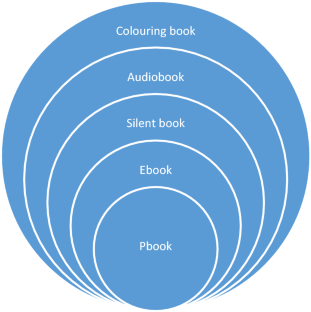
The alternative text for this image may have been generated using AI.
Conclusion
Chapter © 2018

References
- Baron N. Words on screen. New York: Oxford University Press; 2014.
Google Scholar - Chartier R. The order of books. Palo Alto: Stanford University Press; 1994.
Google Scholar - Clark G, Phillips A. Inside book publishing. 6th ed. Abingdon: Routledge; 2019.
Google Scholar - Clinton V. Reading from paper compared to screens: a systematic review and metaanalysis. J Res Read. 2019;42(288–325):2019.
Google Scholar - Darnton R. The forbidden bestsellers of pre-revolutionary France. New York: W. W. Norton; 1996.
Google Scholar - Delgado P, Vargas C, Ackerman R, Salmerón L. Don’t throw away your printed books: a meta-analysis on the effects of reading media on comprehension. Educ Res Rev. 2018;25:23–38. https://doi.org/10.1016/j.edurev.2018.09.003.
Article Google Scholar - Escarpit R. The book revolution. Paris and London: Harrap and UNESCO; 1966.
Google Scholar - Eisenstein E. The printing press as an agent of change. Cambridge: Cambridge University Press; 1979.
Google Scholar - Howard N. The book: the lifestory of a technology. Baltimore: Johns Hopkins University Press; 2009.
Google Scholar - Johnson MJ. What is a book? Publ Res Q. 2019. https://doi.org/10.1007/s12109-018-9622-z.
Google Scholar - Johnston C, editor. The concept of the book. London: School of English Studies, University of London; 2019.
Google Scholar - Kovač M, Phillips A, van der Weel A, Wischenbart R. Book statistics: what are they good for? Logos. 2017;4:7–17.
Google Scholar - Kovač M, van der Weel A. Reading in the post-textual era. First Monday. 2018. https://doi.org/10.5210/fm.v23i10.9416.
Google Scholar - Kovač M, Wischenbart R. Globalization and publishing. In: Bhaskar M, Phillips A, editors. Handbook on publishing. New York: Oxford University Press; 2019.
Google Scholar - Mangen A, et al. Reading linear texts on paper versus computer screen: effects on reading comprehension. Int J Educ Res. 2013;58:61–8.
Article Google Scholar - McLauglin T. Reading and the body: the physical practice of reading. New York: Palgrave McMillan; 2015.
Book Google Scholar - Phillips A. Turning the page: the evolution of the book. Abingdon: Routledge; 2014.
Book Google Scholar - Phillips A, Cope B, editors. The future of the book in the digital age. Oxford: Chandos; 2006.
Google Scholar - Singer LM, Alexander PA. Reading on paper and digitally: what the past decades of empirical research reveal. Rev Educ Res. 2017. https://doi.org/10.3102/0034654317722961.
Google Scholar - Van der Weel A. Changing our textual minds. Manchester: Manchester University Press; 2011.
Google Scholar - Velagić Z. The discourse on printed and electronic books: analogies, oppositions and perspectives. Inf Res. 2014;19(2).
- Wischenbart R. Ripping off the covers. Logos. 2008;19(4):196–202.
Article Google Scholar - Wolf M. Reader come home. New York: Harper; 2018.
Google Scholar
Author information
Authors and Affiliations
- Filozofska fakulteta UL, Aškerčeva 2, 1000, Ljubljana, Slovenia
Miha Kovač - Headington Hill Hall, Oxford Brookes University, Headington, Oxford, OX3 0BP, UK
Angus Phillips - Leiden University, Postbus 9515, 2300 RA, Leiden, The Netherlands
Adriaan van der Weel - Rüdiger Wischenbart Content and Consulting, Laudongasse 50-7, 1080, Vienna, Austria
Ruediger Wischenbart
Authors
- Miha Kovač
- Angus Phillips
- Adriaan van der Weel
- Ruediger Wischenbart
Corresponding author
Correspondence toMiha Kovač.
Additional information
Publisher's Note
Springer Nature remains neutral with regard to jurisdictional claims in published maps and institutional affiliations.
Rights and permissions
About this article
Cite this article
Kovač, M., Phillips, A., van der Weel, A. et al. What is a Book?.Pub Res Q 35, 313–326 (2019). https://doi.org/10.1007/s12109-019-09665-5
- Published: 19 July 2019
- Version of record: 19 July 2019
- Issue date: 15 September 2019
- DOI: https://doi.org/10.1007/s12109-019-09665-5