Quantitative visualization study on diffusion of oxygen using UV-LED induced phosphorescence (original) (raw)
Abstract
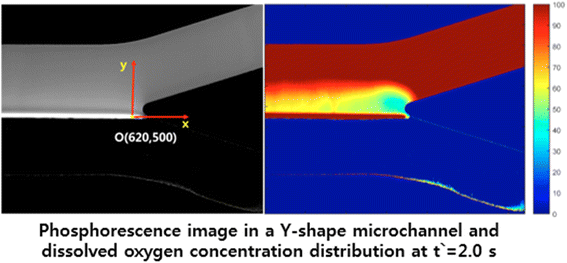
The aims of this study are to visualize gas diffusion process between gas–liquid interface and measure a diffusion coefficient of dissolved oxygen in water by using a microscale UV-LED-induced phosphorescence method. The mass transfer between air and water was visualized qualitatively in a Y-shaped microchannel and the diffusion coefficient D L was measured quantitatively. Oxygen-sensitive phosphorescence dye (tris (2, 2′-bipyridine) ruthenium (II) chloride hexahydrate) and a 450 nm UV-LED were used for the optical measurement of a dissolved oxygen concentration (DOC) field. In-situ pixel-by-pixel calibration was carried out to obtain Stern–Volmer constant and phosphorescent intensity was converted to DOC field with a spatial resolution of 0.625 μm/pixel. Instantaneous dissolved oxygen concentration field and diffusion coefficient D L were successfully measured and compared to the theoretical prediction based on the one-dimensional Fick’s law. It was confirmed that the experimental results were in good agreement with the numerical prediction.
Graphical abstract
Access this article
Subscribe and save
- Starting from 10 chapters or articles per month
- Access and download chapters and articles from more than 300k books and 2,500 journals
- Cancel anytime View plans
Buy Now
Price excludes VAT (USA)
Tax calculation will be finalised during checkout.
Instant access to the full article PDF.
References
- Crank J (1975) The mathematics of diffusion, 2nd edn. Oxford University Press, London
MATH Google Scholar - Danckwerts PV (1951) Significance of liquid-film coefficients in gas absorption. Ind Eng Chem 43:1460
Article Google Scholar - Francois J, Dietrich N, Guiraud P, Cockx A (2011) Direct measurement of mass transfer around a single bubble by micro-PLIFI. Chem Eng Sci 66:3328
Article Google Scholar - Geddes CD (2001) Optical halide sensing using fluorescence quenching: theory, simulations and applications—a review. Meas Sci Technol 12:53
Article Google Scholar - Higbie R (1935) The rate of absorption of a pure gas into a still liquid during short periods of exposure. Trans Am Inst Chem Engrs 35:360
Google Scholar - Hoffmann M, Schluter M, Rabiger N (2006) Experimental investigation of liquid–liquid mixing in T-shaped micro-mixers using μ-LIF and μ-PIV. Chem Eng Sci 61:2968
Article Google Scholar - Jimenez M, Dietrich N, Cockx A, Hebrard G (2013) Experimental study of O2 diffusion coefficient measurement at a planar gas–liquid interface by planar laser-induced fluorescence with inhibition. AIChE J 59(1):325
Article Google Scholar - Ma Y, Yu G, Li HZ (2005) Note on the mechanism of interfacial mass transfer of absorption processes. Int J Heat Mass Transfer 48:3454
Article Google Scholar - Morf WE, Van Der Wal PD, De Rooij NF (2008) Computer simulation and theory of the diffusion and flow induced concentration dispersion in microfluidic devices and HPLC systems based on rectangular microchannels. Anal Chim Acta 633(1–2):175
Article Google Scholar - Peter A, Julio DP (2006) Physical chemistry for the life science. Oxford University Press, London
Google Scholar - Sinton D (2004) Microscale flow visualization. Microfluid Nanofluid 1:2
Article Google Scholar - St-Denis CE, Fell CJD (1971) Diffusivity of oxygen in water. Can J Chem Eng 49(6):885
Article Google Scholar - Sullivan SP, Akpa BS, Matthews SM, Fisher AC, Gladden LF, Johns ML (2007) Simulation of miscible diffusive mixing in microchannels. Sens Act B 123:1142
Article Google Scholar - Toor HL, Marchello JM (1958) Film-penetration model for mass and heat transfer. AIChE J 4:97
Article Google Scholar - Wang J, Langemann H (1994) Unsteady two-film model for mass transfer. Chem. Eng. Techn. 17:280
Article Google Scholar - Whitman WG (1923) A preliminary experimental confirmation of the two-film theory of gas absorption. Chem Metall Eng 29(4):146
Google Scholar - Woodrow PT, Duke SR (2001) Laser-induced fluorescence studies of oxygen transfer across unsheared flat and wavy air-water interfaces. Ind Eng Chem Res 40:1985
Article Google Scholar
Acknowledgments
This work was supported by the Energy Efficiency & Resources Core Technology Program of the Korea Institute of Energy Technology Evaluation and Planning (KETEP) granted financial resource from the Ministry of Trade, Industry & Energy, Republic of Korea (No. 20132020000390) and was supported by the National Research Foundation of Korea (NRF) grant funded by the Korea government (MSIP) (No. NRF-2012R1A2A4A01008749 and No. 2013R1A1A2065648).
Author information
Authors and Affiliations
- School of Mechanical Engineering, Pusan National University, Busan, 609-735, South Korea
Jinkyu Kim, Kyung Chun Kim & Hyun Dong Kim
Authors
- Jinkyu Kim
- Kyung Chun Kim
- Hyun Dong Kim
Corresponding author
Correspondence toHyun Dong Kim.
Rights and permissions
About this article
Cite this article
Kim, J., Kim, K.C. & Kim, H.D. Quantitative visualization study on diffusion of oxygen using UV-LED induced phosphorescence.J Vis 19, 591–601 (2016). https://doi.org/10.1007/s12650-016-0343-0
- Received: 15 April 2015
- Revised: 22 November 2015
- Accepted: 29 November 2015
- Published: 16 February 2016
- Issue date: November 2016
- DOI: https://doi.org/10.1007/s12650-016-0343-0