Assessing public organic food procurement: the case of Zurich (CH) (original) (raw)
Abstract
Organic food is increasingly promoted among authorities and governments to tackle global sustainability challenges and support an agri-ecological transition. An important policy instrument in this endeavour is the purchase of food or food services by public institutions, the so-called public food procurement (PFP). While PFP policies often promote organic food, few studies quantify the actual share of organic products in PFP systems. This study applies an adapted city food flow analysis to evaluate the organic share of 12 product groups in public catering, using Zurich as a case study. Based on a typology of procurement channels, we show that Zurich’s PFP system is highly centralised with internal coordinated procurement (INT–coord) and external coordinated procurement (EX–coord) providing 70% and 25% of total annual meals respectively. As Zurich procures 11% (INT–coord) and 9% (EX–coord) of organic produce, the city has considerable potential to increase organic PFP. Leverage points to this aim include internal product-specific thresholds, supply development and developments in digital procurement. This study provides a methodology to conceptualise municipal PFP systems and measure city-wide levels of organic PFP. The insights from Zurich offer a blueprint for PFP systems in other municipalities and reveal potential challenges when defining and monitoring organic PFP policies based on total purchases.
Introduction
Our current food choices contribute to global sustainability challenges, such as climate change and biodiversity loss (Intergovernmental Panel on Climate Change [2019](/article/10.1007/s13165-022-00402-5#ref-CR26 "Intergovernmental Panel on Climate Change (2019) Special report on climate change and land. UNEP. https://www.ipcc.ch/srccl-report-download-page/
            . Accessed 21 May 2020"); McIntyre et al. [2009](/article/10.1007/s13165-022-00402-5#ref-CR32 "McIntyre B, Herren H, Wakhungu J, Watson R (2009) Agriculture at a crossroads: synthesis report. International Assessment of Agricultural Knowledge, Science and Technology for Development.
              https://www.weltagrarbericht.de/original-berichte.html

            . Accessed 21 May 2020")). In response to this development, authorities and governments aim to promote organic food, as its production offers advantages in regard to sustainability such as preserving biodiversity and improving soil health (European Union [2020](/article/10.1007/s13165-022-00402-5#ref-CR15 "European Union (2020) From to Fork Strategy. For a fair, healthy and environmentally-friendly food system.
              https://ec.europa.eu/food/horizontal-topics/farm-fork-strategy_de

            . Accessed 7.9.2021"); Niggli [2015](/article/10.1007/s13165-022-00402-5#ref-CR42 "Niggli U (2015) Sustainability of organic food production: challenges and innovations. (Ed.),^(Eds.). Conference of sustainable diet and food security, Lille"); Reganold and Wachter [2016](/article/10.1007/s13165-022-00402-5#ref-CR49 "Reganold JP, Wachter JM (2016) Organic agriculture in the twenty-first century. Nature Plants 2(2):15221.
              https://doi.org/10.1038/nplants.2015.221

            "); Seufert and Ramankutty [2017](/article/10.1007/s13165-022-00402-5#ref-CR56 "Seufert V, Ramankutty N (2017) Many shades of gray-the context-dependent performance of organic agriculture. Sci Adv 3(3):e1602638.
              https://doi.org/10.1126/sciadv.1602638

            ")). According to the European Commission, ‘organic production is an overall system of farm management and food production that combines best environmental practices, a high level of biodiversity, the preservation of natural resources and the application of high animal welfare standards’ (European Parliament [2018](/article/10.1007/s13165-022-00402-5#ref-CR14 "European Parliament (2018) The EU's organic food market: facts and rules (infographic). Retrieved June 16, 2022, from
              https://www.europarl.europa.eu/news/en/headlines/society/20180404STO00909/the-eu-s-organic-food-market-facts-and-rules-infographic

            ")). The term _organic_ is protected, and therefore, organic products need to fulfil basic requirements, e.g. identified by the European regulation 2018/848 on organic production, and are subject to certification processes (Alföldi and Nowack [2017](/article/10.1007/s13165-022-00402-5#ref-CR1 "Alföldi T, Nowack K (2017) Biowissen - Fakten und Hintergründe zur biologischen Landwirtschaft und Verarbeitung [Organic knowledge - facts and background on organic farming and processing]. Forschungsinstitut für biologischen Landbau & Bio Suisse.
              https://www.bio-suisse.ch/de/biowissen.php

            . Accessed 21 May 2020")). This improves their identifiability within food systems compared to non-certified, sustainably produced products.
While there are a variety of organic support policies on the supply side, an important policy instrument on the demand side is the purchase of food or food services by public institutions, which is called public food procurement (PFP) (Candel [2020](/article/10.1007/s13165-022-00402-5#ref-CR6 "Candel JJL (2020) What’s on the menu? A global assessment of MUFPP signatory cities’ food strategies. Agroecol Sustain Food Syst 44(7):919–946. https://doi.org/10.1080/21683565.2019.1648357
            "); Doernberg et al. [2019](/article/10.1007/s13165-022-00402-5#ref-CR13 "Doernberg A, Horn P, Zasada I, Piorr A (2019) Urban food policies in German city regions: an overview of key players and policy instruments. Food Policy 89:101782.
              https://doi.org/10.1016/j.foodpol.2019.101782

            "); Morgan and Morley [2014](/article/10.1007/s13165-022-00402-5#ref-CR36 "Morgan K, Morley A (2014) The public plate: harnessing the power of purchase. In: Marsden TK, Morley AS (eds) Sustainable food systems. Routledge, pp 84–102"); Sonnino [2016](/article/10.1007/s13165-022-00402-5#ref-CR58 "Sonnino R (2016) The new geography of food security: exploring the potential of urban food strategies. Geogr J 182(2):190–200.
              https://doi.org/10.1111/geoj.12129

            ")). Also, the Farm to Fork Strategy of the European Union foresees a considerable role of PFP to drive organic food consumption (European Union [2020](/article/10.1007/s13165-022-00402-5#ref-CR15 "European Union (2020) From to Fork Strategy. For a fair, healthy and environmentally-friendly food system.
              https://ec.europa.eu/food/horizontal-topics/farm-fork-strategy_de

            . Accessed 7.9.2021")). As research shows, PFP policies impact markets (Cerutti et al. [2018](/article/10.1007/s13165-022-00402-5#ref-CR8 "Cerutti AK, Ardente F, Contu S, Donno D, Beccaro GL (2018) Modelling, assessing, and ranking public procurement options for a climate-friendly catering service. Int J Life Cycle Assess 23(1):95–115.
              https://doi.org/10.1007/s11367-017-1306-y

            "); Saxe et al. [2019](/article/10.1007/s13165-022-00402-5#ref-CR54 "Saxe H, Jensen JD, Bølling Laugesen SM, Bredie WLP (2019) Environmental impact of meal service catering for dependent senior citizens in Danish municipalities. Int J Life Cycle Assess 24(4):654–666.
              https://doi.org/10.1007/s11367-018-1487-z

            ")) and have a broader influence on the sustainability of food systems by shaping the dietary habits of the guests (Morgan and Morley [2014](/article/10.1007/s13165-022-00402-5#ref-CR36 "Morgan K, Morley A (2014) The public plate: harnessing the power of purchase. In: Marsden TK, Morley AS (eds) Sustainable food systems. Routledge, pp 84–102"); Sonnino [2009](/article/10.1007/s13165-022-00402-5#ref-CR59 "Sonnino R (2009) Quality food, public procurement, and sustainable development: the school meal revolution in Rome. Environ Plan A: Econ Space 41(2):425–440.
              https://doi.org/10.1068/a40112

            "); Swensson and Tartanac [2020](/article/10.1007/s13165-022-00402-5#ref-CR64 "Swensson LFJ, Tartanac F (2020) Public food procurement for sustainable diets and food systems: the role of the regulatory framework [Article]. Global Food Security, 25, Article 100366.
              https://doi.org/10.1016/j.gfs.2020.100366

            "); Wahlen et al. [2012](/article/10.1007/s13165-022-00402-5#ref-CR67 "Wahlen S, Heiskanen E, Aalto K (2012) Endorsing sustainable food consumption: prospects from public catering. J Consum Policy 35(1):7–21.
              https://doi.org/10.1007/s10603-011-9183-4

            ")) and the local food supply (Swensson and Tartanac [2020](/article/10.1007/s13165-022-00402-5#ref-CR64 "Swensson LFJ, Tartanac F (2020) Public food procurement for sustainable diets and food systems: the role of the regulatory framework [Article]. Global Food Security, 25, Article 100366.
              https://doi.org/10.1016/j.gfs.2020.100366

            ")). Moreover, the growing importance of public organic food procurement can be seen as an aspect of a broader endeavour for sustainable public procurement. In sustainable public procurement, environmental and social criteria are included in the purchasing decisions of public actors (O'Rourke et al. [2013](/article/10.1007/s13165-022-00402-5#ref-CR43 "O'Rourke A, Leire C, Bowden T (2013) Sustainable public procurement: a global review (No. ISBN: 978–92–807–3332–7). United Nations Environment Programme"); Perera et al. [2007](/article/10.1007/s13165-022-00402-5#ref-CR46 "Perera O, Chowdhury N, Goswami A (2007) State of play in sustainable public procurement. International Institute for Sustainable Development, Winnipeg")). Thereby, public organic food procurement contributes also to the Sustainable Development Goal 12.7 about promoting sustainable public procurement practices (United Nations [2015](/article/10.1007/s13165-022-00402-5#ref-CR65 "United Nations (2015) Transforming our world: the 2030 agenda for sustainable development (No. A/RES/70/1).
              https://sdgs.un.org/publications/transforming-our-world-2030-agenda-sustainable-development-17981

            . Accessed 21 May 2020")).
PFP policies are often in the area of influence of cities and municipalities (Candel [2020](/article/10.1007/s13165-022-00402-5#ref-CR6 "Candel JJL (2020) What’s on the menu? A global assessment of MUFPP signatory cities’ food strategies. Agroecol Sustain Food Syst 44(7):919–946. https://doi.org/10.1080/21683565.2019.1648357
            "); Moragues-Faus and Morgan [2015](/article/10.1007/s13165-022-00402-5#ref-CR35 "Moragues-Faus A, Morgan K (2015) Reframing the foodscape: the emergent world of urban food policy. Environ Plan 47(7):1558–1573.
              https://doi.org/10.1177/0308518X15595754

            ")). As part of the ‘metropolitan revolution’ (Sonnino [2016](/article/10.1007/s13165-022-00402-5#ref-CR58 "Sonnino R (2016) The new geography of food security: exploring the potential of urban food strategies. Geogr J 182(2):190–200.
              https://doi.org/10.1111/geoj.12129

            ")) or ‘new municipalism’ (Morley and Morgan [2021](/article/10.1007/s13165-022-00402-5#ref-CR38 "Morley A, Morgan K (2021) Municipal foodscapes: urban food policy and the new municipalism. Food Policy 103:102069.
              https://doi.org/10.1016/j.foodpol.2021.102069

            ")), cities are becoming active in food politics and use PFP to increase the sustainability of the food system by, among other things, promoting organic food (Barling et al. [2013](/article/10.1007/s13165-022-00402-5#ref-CR3 "Barling D, Andersson G, Bock B, Canjels A, Galli F, Gourlay R, Hoekstra F, de Iacovo F, Karner S, Mikkelsen B (2013) Revaluing public sector food procurement in Europe: an action plan for sustainability.
              http://www.foodlinkscommunity.net/cop-public-procurement.html

            . Accessed 21 May 2020"); Candel [2020](/article/10.1007/s13165-022-00402-5#ref-CR6 "Candel JJL (2020) What’s on the menu? A global assessment of MUFPP signatory cities’ food strategies. Agroecol Sustain Food Syst 44(7):919–946.
              https://doi.org/10.1080/21683565.2019.1648357

            "); Chandler et al. [2015](/article/10.1007/s13165-022-00402-5#ref-CR9 "Chandler C, Franklin A, Ochoa A, Clement S (2015) Sustainable public procurement of school catering services - a good practice report. INNOCAT.
              https://www.sustainable-catering.eu/publications/

            . Accessed 21 May 2020"); Doernberg et al. [2019](/article/10.1007/s13165-022-00402-5#ref-CR13 "Doernberg A, Horn P, Zasada I, Piorr A (2019) Urban food policies in German city regions: an overview of key players and policy instruments. Food Policy 89:101782.
              https://doi.org/10.1016/j.foodpol.2019.101782

            "); Morgan and Sonnino [2010](/article/10.1007/s13165-022-00402-5#ref-CR37 "Morgan K, Sonnino R (2010) The urban foodscape: world cities and the new food equation. Camb J Reg Econ Soc 3(2):209–224.
              https://doi.org/10.1093/cjres/rsq007

            ")). For example, school catering facilities in Rome buy 70% of their food in organic quality (Sonnino [2009](/article/10.1007/s13165-022-00402-5#ref-CR59 "Sonnino R (2009) Quality food, public procurement, and sustainable development: the school meal revolution in Rome. Environ Plan A: Econ Space 41(2):425–440.
              https://doi.org/10.1068/a40112

            ")). The cities of Malmö, Vienna and Copenhagen spend 40%, 50% and 90% of their purchasing budgets on organic products respectively (Barling et al. [2013](/article/10.1007/s13165-022-00402-5#ref-CR3 "Barling D, Andersson G, Bock B, Canjels A, Galli F, Gourlay R, Hoekstra F, de Iacovo F, Karner S, Mikkelsen B (2013) Revaluing public sector food procurement in Europe: an action plan for sustainability.
              http://www.foodlinkscommunity.net/cop-public-procurement.html

            . Accessed 21 May 2020"); Smith et al. [2016](/article/10.1007/s13165-022-00402-5#ref-CR57 "Smith J, Andersson G, Gourlay R, Karner S, Mikkelsen BE, Sonnino R, Barling D (2016) Balancing competing policy demands: the case of sustainable public sector food procurement. J Clean Prod 112(2016):249–256.
              https://doi.org/10.1016/j.jclepro.2015.07.065

            ")). German initiatives also advocate for increased organic and sustainable procurement (Fülles et al. [2017](/article/10.1007/s13165-022-00402-5#ref-CR22 "Fülles M, Roehl R, Strassner C, Hermann A, Teufel J (2017) Mehr Bio in Kommunen: Ein Praxisleitfaden des Netzwerks deutscher Biostädte [More organic in municipalities: a practical guide by the network of german organic cities]. Netzwerk deutscher Biostädte.
              https://www.biostaedte.de/images/pdf/leitfaden_V4_verlinkt.pdf

            . Accessed 21 May 2020")). The city of Berlin aims to have 30% organic food in public catering facilities by 2030, while Heidelberg already serves 30% of organic products in their childcare centres. The commitments of these European municipalities and cities to organic PFP are ambitious and have potentially far-reaching impacts on urban food systems and the pace of agroecological transition.
Despite the growing number of cities that have set targets for organic food in PFP, studies that quantify the actual share of organic products in such systems are still rare. The majority of studies about PFP of local governments have taken qualitative approaches (Bloomfield [2015](/article/10.1007/s13165-022-00402-5#ref-CR5 "Bloomfield C (2015) Putting sustainable development into practice: hospital food procurement in Wales. Reg Stud Reg Sci 2(1):552–558. https://doi.org/10.1080/21681376.2015.1100094
            "); Krivašonoka [2019](/article/10.1007/s13165-022-00402-5#ref-CR28 "Krivašonoka I (2019) Local food procurement tendencies in Latvia. (Ed.),^(Eds.). 12th International Scientific and Practical Conference, Rezekne"); Mikkelsen [2018](/article/10.1007/s13165-022-00402-5#ref-CR33 "Mikkelsen B (2018) Organic and local? - caseinsights from a two-in-one approach to regional public food sourcing for the public in the city of Aalborg. (Ed.),^(Eds.). 2nd International Workshop “Organic farming and agroecology as a response to global challenges”, Capri"); Risku-Norja [2015](/article/10.1007/s13165-022-00402-5#ref-CR51 "Risku-Norja H (2015) Full case study report: Kiuruvesi municipal catering-Finland. Natural Resources Institute Finland.
              https://orgprints.org/29244/

            . Accessed 21 May 2020"); Sonnino [2009](/article/10.1007/s13165-022-00402-5#ref-CR59 "Sonnino R (2009) Quality food, public procurement, and sustainable development: the school meal revolution in Rome. Environ Plan A: Econ Space 41(2):425–440.
              https://doi.org/10.1068/a40112

            ")), while there have only been few quantitative studies (Fairchild and Collins [2011](/article/10.1007/s13165-022-00402-5#ref-CR19 "Fairchild R, Collins A (2011) Serving up healthy and sustainable school meals? An analysis of school meal provision in Cardiff (UK). J Environ Planning Policy Manage 13(3):209–229.
              https://doi.org/10.1080/1523908X.2011.578402

            "); Payot et al. [2018](/article/10.1007/s13165-022-00402-5#ref-CR44 "Payot D, Litzistorf N, Seiler J, Dubar S (2018) Restauration Collective Durable. Bilan Final 2017 [Sustainable public catering. Final Report 2017]. Unité développement durable et Service d’accueil de jour de l’enfance"); Sørensen et al. [2016](/article/10.1007/s13165-022-00402-5#ref-CR60 "Sørensen NN, Tetens I, Løje H, Lassen AD (2016) The effectiveness of the Danish Organic Action Plan 2020 to increase the level of organic public procurement in Danish public kitchens. Public Health Nutr 19(18):3428–3435.
              https://doi.org/10.1017/S1368980016001737

            ")). The lack of quantitative studies has hindered comparative monitoring and benchmarking of existing goals, which are needed to guide the development of organic PFP goals, especially given the diversity of procurement systems and their contexts.
This study aims to demonstrate a viable methodological approach to the quantitative analysis of municipal PFP systems by applying it to the city of Zurich, Switzerland, which is the first Swiss city to have developed an urban food policy (City of Zurich [2019](/article/10.1007/s13165-022-00402-5#ref-CR12 "City of Zurich (2019) Strategie nachhaltige Ernährung Stadt Zürich [Sustainable food strategy city of Zurich]. Umwelt und Gesundheitsschutz. https://www.stadt-zuerich.ch/gud/de/index/umwelt_energie/ernaehrung/ernaehrungsstrategie.html
            . Accessed 21 May 2020")). The case study of Zurich serves as a model for other medium to large cities in Europe. Specifically, the study aims to quantify the amount of organic food procured in Zurich’s PFP and to identify the levers to increase the shares of organic food. To address this aim, we firstly review the mechanisms through which PFP contributes to sustainability goals and analyse scientific literature on drivers of, and barriers to, the inclusion of organic food in PFP. Analysis of the structure of the PFP system then enables quantification of the proportion of organic food in PFP using the city food flow analysis method (Moschitz and Frick [2020](/article/10.1007/s13165-022-00402-5#ref-CR40 "Moschitz H, Frick R (2020) City food flow analysis. A new method to study local consumption. Renew Agric Food Syst 1–13.
              https://doi.org/10.1017/S1742170520000150

            ")) and identification of points that may be leveraged to increase the proportion of organic food in Zurich’s PFP.
Barriers and drivers of organic food in PFP
Apart from economic considerations, Swiss public procurement law allows to consider sustainability criteria for the award decision (Steiner 2013, [2015](/article/10.1007/s13165-022-00402-5#ref-CR62 "Steiner M (2015) Die Berücksichtigung sozialer Aspekte im Rahmen der öffentlichen Beschaffung [The consideration of social aspects within the framework of public procurement]. Interessengemeinschaft Ökologische Beschaffung Schweiz. http://www.nachhaltige-beschaffung.ch/pdf/Sozialpapier_Zusammenfassung_update_20171212_FINAL.pdf
            . Accessed 21 May 2020")). In Switzerland, sustainability criteria can be integrated in the public tendering process as eligibility criteria, product-related technical specifications or evaluation criteria (City of Zurich [2014](/article/10.1007/s13165-022-00402-5#ref-CR11 "City of Zurich (2014) "Richtlinie Ökologische Anforderungen im Beschaffungsprozess" für die Beschaffungsverantwortlichen der Stadt Zürich ["Guideline ecological requirements in the procurement process" for the procurement officers of the city of Zurich] (STRB Nr. 0976/2014). Finanzdepartement.
              https://www.stadt-zuerich.ch/portal/de/index/politik_u_recht/stadtrat/geschaefte-des-stadtrates/stadtratsbeschluesse/2014/Nov/StZH_STRB_2014_0976.html

            . Accessed 21 May 2020"); Steiner [2015](/article/10.1007/s13165-022-00402-5#ref-CR62 "Steiner M (2015) Die Berücksichtigung sozialer Aspekte im Rahmen der öffentlichen Beschaffung [The consideration of social aspects within the framework of public procurement]. Interessengemeinschaft Ökologische Beschaffung Schweiz.
              http://www.nachhaltige-beschaffung.ch/pdf/Sozialpapier_Zusammenfassung_update_20171212_FINAL.pdf

            . Accessed 21 May 2020")). Organic labels, for example, can be listed as technical specifications (Huber et al. [2019](/article/10.1007/s13165-022-00402-5#ref-CR25 "Huber K, Frick R, Obrist R, Schmid O (2019) Nachhaltige Beschaffung–Mehr Bioprodukte in Gemeinden und Städten [Sustainable procurement-more organic products in municipalities and cities]. Forschungsinstitut für biologischen Landbau.
              https://orgprints.org/35234/

            . Accessed 21 May 2020")). The award goes ultimately to the bidder who fulfils the eligibility criteria, whose offered products and services meet the technical specifications and whose bid performs well in the weighted evaluation criteria. According to the revised Swiss public procurement law which entered into force 1st of January 2021, the winning bid needs to be the most ‘advantageous’ bid and not anymore the ‘most economically advantageous’ as defined in the previous revision of the law (Federal Procurement Conference [2020](/article/10.1007/s13165-022-00402-5#ref-CR20 "Federal Procurement Conference (2020) Revision des öffentlichen Beschaffungsrechts [Revision of public procurement law].
              https://www.bkb.admin.ch/

            . Accessed 7.9.2021")).
Although economic viability does not need to be the key determinant for award decisions, the scientific literature still identifies cost as one of the most prominent factors for the successful introduction of organic food in PFP. Even in the public domain, catering facilities are subject to significant economic pressure to keep the costs at a low level. However, cost mitigation strategies, such as reduction of meat or purchase of seasonal produce, have proven successful in compensating for the higher costs for quality food, such as organic food (Barling et al. [2013](/article/10.1007/s13165-022-00402-5#ref-CR3 "Barling D, Andersson G, Bock B, Canjels A, Galli F, Gourlay R, Hoekstra F, de Iacovo F, Karner S, Mikkelsen B (2013) Revaluing public sector food procurement in Europe: an action plan for sustainability. http://www.foodlinkscommunity.net/cop-public-procurement.html
            . Accessed 21 May 2020"); Risku-Norja [2015](/article/10.1007/s13165-022-00402-5#ref-CR51 "Risku-Norja H (2015) Full case study report: Kiuruvesi municipal catering-Finland. Natural Resources Institute Finland.
              https://orgprints.org/29244/

            . Accessed 21 May 2020"); Väänänen and Tossavainen [2014](/article/10.1007/s13165-022-00402-5#ref-CR66 "Väänänen S, Tossavainen H (2014) More local food for the customers of public-sector kitchens - grounds and guidelines for procurement. EkoCentria.
              http://www.ekocentria.fi/resources/public/Aineistot/LahiruokaopasENG.pdf

            . Accessed 21 May 2020")). Using self-administered questionnaires, Filippini et al. ([2018](/article/10.1007/s13165-022-00402-5#ref-CR21 "Filippini R, De Noni I, Corsi S, Spigarolo R, Bocchi S (2018) Sustainable school food procurement: what factors do affect the introduction and the increase of organic food? Food Policy 76:109–119.
              https://doi.org/10.1016/j.foodpol.2018.03.011

            ")) analysed the PFP system of 524 municipalities in Northern Italy and found that price is not a limitation to introducing organic food but does hinder an increase in its share.
Procurement channels are another important factor (Filippini et al. [2018](/article/10.1007/s13165-022-00402-5#ref-CR21 "Filippini R, De Noni I, Corsi S, Spigarolo R, Bocchi S (2018) Sustainable school food procurement: what factors do affect the introduction and the increase of organic food? Food Policy 76:109–119. https://doi.org/10.1016/j.foodpol.2018.03.011
            ")), with centralised procurements better compensating the costs of organic food than small catering businesses. Centralised catering facilities profit from efficiency gains due to the large volumes of food procured (Filippini et al. [2018](/article/10.1007/s13165-022-00402-5#ref-CR21 "Filippini R, De Noni I, Corsi S, Spigarolo R, Bocchi S (2018) Sustainable school food procurement: what factors do affect the introduction and the increase of organic food? Food Policy 76:109–119.
              https://doi.org/10.1016/j.foodpol.2018.03.011

            "); Sonnino [2009](/article/10.1007/s13165-022-00402-5#ref-CR59 "Sonnino R (2009) Quality food, public procurement, and sustainable development: the school meal revolution in Rome. Environ Plan A: Econ Space 41(2):425–440.
              https://doi.org/10.1068/a40112

            ")). Moreover, privately managed public catering facilities that are contracted by a public authority seem to adopt organic food faster than catering facilities under direct public management (Filippini et al. [2018](/article/10.1007/s13165-022-00402-5#ref-CR21 "Filippini R, De Noni I, Corsi S, Spigarolo R, Bocchi S (2018) Sustainable school food procurement: what factors do affect the introduction and the increase of organic food? Food Policy 76:109–119.
              https://doi.org/10.1016/j.foodpol.2018.03.011

            ")).
Another crucial factor for organic food in catering is the commitment and motivation of actors in PFP (Filippini et al. [2018](/article/10.1007/s13165-022-00402-5#ref-CR21 "Filippini R, De Noni I, Corsi S, Spigarolo R, Bocchi S (2018) Sustainable school food procurement: what factors do affect the introduction and the increase of organic food? Food Policy 76:109–119. https://doi.org/10.1016/j.foodpol.2018.03.011
            ")). Public administrations are one of the most powerful drivers of change, as they are in charge of the tendering process (Morgan and Morley [2014](/article/10.1007/s13165-022-00402-5#ref-CR36 "Morgan K, Morley A (2014) The public plate: harnessing the power of purchase. In: Marsden TK, Morley AS (eds) Sustainable food systems. Routledge, pp 84–102")). Also Doernberg et al. ([2019](/article/10.1007/s13165-022-00402-5#ref-CR13 "Doernberg A, Horn P, Zasada I, Piorr A (2019) Urban food policies in German city regions: an overview of key players and policy instruments. Food Policy 89:101782.
              https://doi.org/10.1016/j.foodpol.2019.101782

            ")) show that implementation of urban food policies is often guided by individuals in administration. In addition, catering professionals are important drivers since they implement the policies while ensuring adequate quality and volumes of requested meals (Wahlen et al. [2012](/article/10.1007/s13165-022-00402-5#ref-CR67 "Wahlen S, Heiskanen E, Aalto K (2012) Endorsing sustainable food consumption: prospects from public catering. J Consum Policy 35(1):7–21.
              https://doi.org/10.1007/s10603-011-9183-4

            "); Walker and Preuss [2008](/article/10.1007/s13165-022-00402-5#ref-CR68 "Walker H, Preuss L (2008) Fostering sustainability through sourcing from small businesses: public sector perspectives. J Clean Prod 16(15):1600–1609.
              https://doi.org/10.1016/j.jclepro.2008.04.014

            ")). The catering professionals also need to creatively mitigate increased costs and adapt the catering system to the requirements (Barling et al. [2013](/article/10.1007/s13165-022-00402-5#ref-CR3 "Barling D, Andersson G, Bock B, Canjels A, Galli F, Gourlay R, Hoekstra F, de Iacovo F, Karner S, Mikkelsen B (2013) Revaluing public sector food procurement in Europe: an action plan for sustainability.
              http://www.foodlinkscommunity.net/cop-public-procurement.html

            . Accessed 21 May 2020")). Finally, the end consumers can be important actors of change by exerting pressure on food providers. For example, parents can exert pressure on school food catering and induce, or demand, change (Filippini et al. [2018](/article/10.1007/s13165-022-00402-5#ref-CR21 "Filippini R, De Noni I, Corsi S, Spigarolo R, Bocchi S (2018) Sustainable school food procurement: what factors do affect the introduction and the increase of organic food? Food Policy 76:109–119.
              https://doi.org/10.1016/j.foodpol.2018.03.011

            ")). Such as is the case of school food in Rome, in which a ‘canteen commission’, formed by parents, facilitates consumer involvement (Sonnino [2009](/article/10.1007/s13165-022-00402-5#ref-CR59 "Sonnino R (2009) Quality food, public procurement, and sustainable development: the school meal revolution in Rome. Environ Plan A: Econ Space 41(2):425–440.
              https://doi.org/10.1068/a40112

            ")).
Ultimately, digitalisation may provide additional opportunities to improve public procurement services. Digitalisation in public procurement can lead to a professionalisation, to cost reduction and to structural changes in the bidding process which accelerate opportunities for smaller bidders (Pekolj et al. [2019](/article/10.1007/s13165-022-00402-5#ref-CR45 "Pekolj N, Hodošček K, Valjavec L, Ferk P (2019) Digital transformation of public procurement as an opportunity for the economy. LeXonomica 11(1). https://journals.um.si/index.php/lexonomica/article/view/134
. Accessed 21 May 2020")). However, the influence of digitalisation on PFP and how it might drive organic purchasing has yet barely been studied.While this review of relevant literature has been able to identify some drivers and barriers to the inclusion of organic food in PFP, prior study has been hampered by the lack of a theoretical framework to guide the analysis of food systems. To address the aims of this study, primary research is needed to develop and test such a framework.
Method
Case study description
The city of Zurich is one of the most important cities in Switzerland in terms of population and economy. With 434,008 inhabitants (as of 2019), Zurich is the country’s most populous city and has been growing constantly since the 1990s (Rosin [2020](/article/10.1007/s13165-022-00402-5#ref-CR53 "Rosin K (2020) Die 2010er-Jahre im Fokus: Warum Zürich wächst und schweizerischer wird [The 2010s in focus: why Zurich is growing and becoming more Swiss ] [Webartikel]. https://www.stadt-zuerich.ch
            . Accessed 21 May 2020")). In order to provide food in its public catering facilities, the city of Zurich spends approximately 22 million Swiss francs annually on food (Piguet [2007](/article/10.1007/s13165-022-00402-5#ref-CR47 "Piguet S (2007) Nachhaltige Beschaffung. Gute Beispiele im Bereich Nachhaltige Entwicklung [Sustainable procurement. Good examples in the field of sustainable development]. Bundesamt für Raumentwicklung.
              https://www.are.admin.ch/dam/are/de/dokumente/nachhaltige_entwicklung/dokumente/

            . Accessed 21 May 2020")). Overall, PFP in Zurich serves seven million menus annually in 450 catering facilities (City of Zurich [2019](/article/10.1007/s13165-022-00402-5#ref-CR12 "City of Zurich (2019) Strategie nachhaltige Ernährung Stadt Zürich [Sustainable food strategy city of Zurich]. Umwelt und Gesundheitsschutz.
              https://www.stadt-zuerich.ch/gud/de/index/umwelt_energie/ernaehrung/ernaehrungsstrategie.html

            . Accessed 21 May 2020")).
Food politics in Zurich have gained momentum following a successful referendum in November 2017 demanding the promotion of environmentally friendly food by public authorities. The urban food policy, which followed the referendum in June 2019, elaborates the measures for sustainable development of the food system in the city (City of Zurich [2019](/article/10.1007/s13165-022-00402-5#ref-CR12 "City of Zurich (2019) Strategie nachhaltige Ernährung Stadt Zürich [Sustainable food strategy city of Zurich]. Umwelt und Gesundheitsschutz. https://www.stadt-zuerich.ch/gud/de/index/umwelt_energie/ernaehrung/ernaehrungsstrategie.html
            . Accessed 21 May 2020")). The city is committed to ‘promoting healthy and safe food that is produced in an environmentally sound manner \[and\] \[…\] ethically responsible and accessible to all. Being aware that this development must be economically viable’ (City of Zurich [2019](/article/10.1007/s13165-022-00402-5#ref-CR12 "City of Zurich (2019) Strategie nachhaltige Ernährung Stadt Zürich [Sustainable food strategy city of Zurich]. Umwelt und Gesundheitsschutz.
              https://www.stadt-zuerich.ch/gud/de/index/umwelt_energie/ernaehrung/ernaehrungsstrategie.html

            . Accessed 21 May 2020")). In the food policy, PFP and the public catering facilities have an important role. As a central goal, 50% of purchased foods in municipal catering facilities should be certified with a sustainability label by 2030\. Sustainability labels are labels classified as ‘recommended’ or higher by the Swiss Consumer Protection Foundation (Stiftung Konsumentenschutz [2021](/article/10.1007/s13165-022-00402-5#ref-CR63 "Stiftung Konsumentenschutz, Pusch, Helvetas, WWF (2021) Online-Ratgeber - Welche Lebensmittel-Labels sind nachhaltig? [Online guide - which food labels are sustainable?].
              https://www.konsumentenschutz.ch/online-ratgeber/welche-lebensmittel-labels-sind-nachhaltig/

            . Accessed 7.9.2021")). These categories include organic labels, fairtrade labels, ‘MSC’ and ‘IP Suisse’. This development shows that, also in Zurich, organic food becomes a focus of sustainable food politics.
The ‘City Food Flow Analysis’
The analysis of the PFP system in Zurich was based on an adapted City Food Flow Analysis (Moschitz and Frick [2020](/article/10.1007/s13165-022-00402-5#ref-CR40 "Moschitz H, Frick R (2020) City food flow analysis. A new method to study local consumption. Renew Agric Food Syst 1–13. https://doi.org/10.1017/S1742170520000150
            ")). The methodology addresses food flows in a city and its surrounding region. In comparison with methods analysing single catering facilities, the city food flow analysis is a suitable citywide approach. With adaptations, the methodology is suitable to estimate the amount of organic food procured in Zurich’s PFP and to identify levers to increase the shares of organic food. Figure [1](/article/10.1007/s13165-022-00402-5#Fig1) gives an overview of the steps followed in the present study. Step 1 is based on the city food flow analysis methodology as presented in Moschitz and Frick ([2020](/article/10.1007/s13165-022-00402-5#ref-CR40 "Moschitz H, Frick R (2020) City food flow analysis. A new method to study local consumption. Renew Agric Food Syst 1–13.
              https://doi.org/10.1017/S1742170520000150

            ")). It involves defining the places of consumption and food product groups analysed. Step 2 has been added to the method. Here, we first develop a typology of procurement channels for PFP and estimate the relevance of each channel for PFP in the study area. Step 3 is based on the city food flow analysis methodology but has been adapted as we focus on organic food, instead of regional food. In this step, we calculate the share of organic food per food product group within each procurement channel identified under Step 2\. The detailed approach of each step is elaborated hereafter.
Fig. 1

The alternative text for this image may have been generated using AI.
Flow chart of the adapted City Food Flow Analysis method used in this study. The approach is based on Moschitz and Frick ([2020](/article/10.1007/s13165-022-00402-5#ref-CR40 "Moschitz H, Frick R (2020) City food flow analysis. A new method to study local consumption. Renew Agric Food Syst 1–13. https://doi.org/10.1017/S1742170520000150
"))Analysing PFP in Zurich
Step 1: Definition of the object of investigation
The object of investigation is defined on two dimensions. First, the places of consumption are limited to the public catering facilities owned by Zurich’s city administration. Catering facilities coordinated by another municipality, or a higher level of government on the terrain of the city, were excluded from the analysis. Second, twelve food product groups were selected for the analysis of the share of organic food: beef, pork, chicken, milk, hard cheese, soft cheese, bread, tomatoes, salad, potatoes, carrots and apples. The selection of the products was based on three main criteria: (1) part of the Swiss diet (Bisig-Inanir et al. [2021](/article/10.1007/s13165-022-00402-5#ref-CR4 "Bisig-Inanir D, Pestoni G, Rohrmann S (2021) Portionsgrössen in der ersten Schweizerischen Ernährungserhebung menuCH [Portion sizes in the first Swiss Nutrition Survey menuCH] ( https://www.blv.admin.ch/blv/de/home/lebensmittel-und-ernaehrung/ernaehrung/schweizer-ernaehrungsbulletin/schweizer-ernaehrungsbulletin-2021.html
")), (2) agricultural production in the region surrounding the city and (3) representation of the food groups vegetables, meat and milk products. Table [1](/article/10.1007/s13165-022-00402-5#Tab1) provides a more precise definition of the food product groups by also clarifying what is excluded in each product group.Table 1 List and definition of the product groups considered for the organic consumption
Step 2: Understanding the procurement channels
To understand and analyse the procurement channels of the municipal catering facilities in Zurich, a typology of procurement channels was developed. It was based on an expert interview with a PFP representative of the city administration conducted in January 2020. Each municipal catering facility was classified based on the management of the catering service into internally managed by the city administration (INT) or externally managed by a private catering company (EX). On a second dimension, the facilities were classified based on their procurement strategy into facilities that purchase foods as individual entities (ind) and facilities where a central body coordinates the purchase of foods (coord). Based on these attributes, the classification distinguished four procurement channels, which are also summarised in Table 2: ‘INT–coord’, ‘INT–ind, ‘EX–coord’ and ‘EX–ind'.
Table 2 Typology of the procurement channels for public food in Zurich
In addition, the catering facilities were distinguished into the five facility types: ‘aged care centres’, ‘care centres’, ‘city hospitals’, ‘schools and day-care centres’ and ‘staff restaurants’. Missing information about the number of catering facilities within each facility type was complemented with desk research. The resulting procurement typology and the assignment of Zurich’s public catering facilities to it were sent to representatives from the city administration for validation. Inconsistencies were adapted.
To understand the contribution of each procurement channel to the overall PFP in Zurich, a relevance indicator was calculated based on Eq. (1) below: {Relevance\:of \ procurement\:channel \:(x)}= \frac{annual\:meals\:of\:procurement\:channel\: (x)}{total\:annual\:meals\:of\: Zuric{h}^{{\prime}}s\:PFP}$$
(1)
The calculation of the relevance indicator was based on the previously developed typology and classification of the municipal catering facilities. For each facility type, certain assumptions were made about the number of daily meals; for aged care centres, care centres and city hospitals, the number of daily meals corresponded to the number of residents or patient beds, multiplied by three and by 365 open days. The number of daily meals served in schools and day-care centres was derived from personal requests to city departments or specific catering facilities and was multiplied by 195 regular schooldays in a year (Canton of Zürich [2020](/article/10.1007/s13165-022-00402-5#ref-CR7 "Canton of Zürich (2020) Ferien- & Weiterbildungsdaten [Holiday & further education dates]. Kanton Zürich. https://vsa.zh.ch/internet/bildungsdirektion/vsa/de/aktuell/feriendaten.html
. Accessed 7.9.2021")). For the facility type of staff restaurants, the number of daily meals was surveyed by telephone and multiplied with 260 days in a year (number of weekdays per year). Due to insufficient data availability, five of the 17 staff restaurants could not be considered in the relevance calculation.Step 3: Calculation of organic food consumption
Based on the results of Step 2, particularly the relevance indicator calculation (see Eq. 1), the procurement channels EX–coord and INT–coord were analysed for their share of organic food. The procurement channels INT–ind and EX–ind were excluded in the analysis. The procurement channel EX–ind does not exist in Zurich’s PFP. INT–ind catering facilities do exist in Zurich but play only a minor role. Only four staff restaurants and the housing groups of care centres belong to this procurement channel. Because of that and because of a weak data basis, the analysis excluded the amount of organic food within the INT–ind procurement channel.
To analyse the share of organic consumption in EX–coord, we conducted four semi-structured interviews with catering facility managers between February and May of 2020. The interviews focused on the volumes bought within each food group per week and the share of organic produce within each food group. In addition, the interview elicited barriers to organic food procurement. The complete interview guide can be found in the supplementary material. Based on the volumes of each food group bought per week, the yearly consumption volumes were calculated by multiplying with the number of operated weeks per year (39 weeks for ‘schools and day-care centres’, 52 weeks for all others). The overall yearly volumes were then extrapolated to all EX–coord catering facilities based on daily meals. The average share of organic food for each product group in the EX–coord procurement channel was calculated weighting the mean answers of the interviewed catering facilities within each facility type with their yearly consumption volumes.
The analysis of the organic shares in the INT–coord procurement channel was based on purchasing data of 2019 of the common purchasing platform of the city’s Health and Environment Department. Since INT–coord catering facilities must purchase at least 80% of their expenditures via this platform, the share of organic was assumed to be representative of all purchases made within this procurement channel. For the meat food groups, the data indicated only purchase prices. Therefore, these data entries were transformed to weights of produce assuming average prices per kilo (see Table 3). The purchasing data of staff restaurants was excluded in the evaluation, also given the low relevance of this type within the INT–coord procurement channel.
Table 3 Assumptions regarding the market prices of meat products
Results
Understanding PFP channels in Zurich
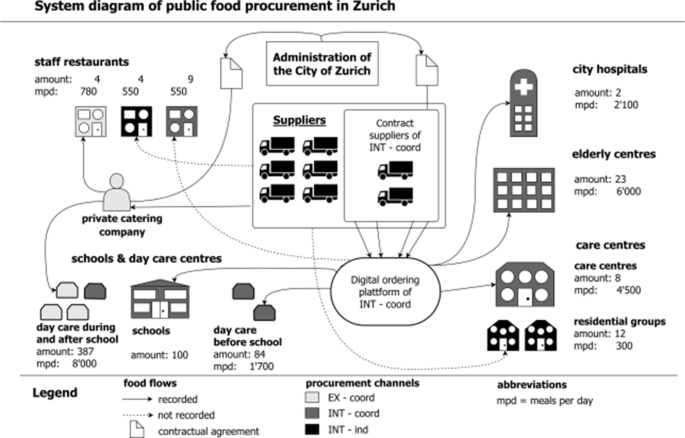
Public food procurement in Zurich takes place through three different procurement channels: INT–coord, INT–ind and EX–coord. Figure 2 gives an overview over the PFP system in Zurich, and Table 4 describes the operation of the three procurement channels. According to the calculated relevance of each procurement channel, INT–coord procurement contributes 70% to the overall PFP by Zurich. The relevance of INT–ind and EX–coord is 5% and 25%, respectively. It is evident that the three procurement channels contribute unevenly to the overall PFP by Zurich.
Fig. 2
The alternative text for this image may have been generated using AI.
System diagram of public food procurement in Zurich. The catering facilities not included in the analysis of organic consumption are indicated with dashed arrows
Table 4 Overview of the procurement channels for public food in Zurich and their calculated relevance
As seen in Fig. 2, the procurement INT-coord is organised by the internal procurement body at the Health and Environmental Department of the city administration. The following elaboration is based on the information provided by the expert interview: the internal procurement body compiles a basket of approximately 3500 ‘contract products’ and searches suppliers through public tenders for these products. The tender is divided into a variety of commodity groups and linked to various criteria, such as price, logistics or the equipment of the supplier’s vehicles. Organic food is integrated as a technical specification in the tender process. Winning bidders, called ‘contract suppliers’, deliver the products within the commodity group to all INT-coord catering facilities at a fixed price for the next 4–6 years. The procurement of the contract products is organised through a digital ordering platform, where also non-contract products are offered. This platform offers an online one-stop shop for catering facility managers. INT–coord catering facilities are obliged to buy contract products for 60% of their purchasing volume and purchase 80% of their food from the ordering platform. Catering facilities also need to purchase annually at least 5% of organic produce.
Share of organic food in PFP in Zurich
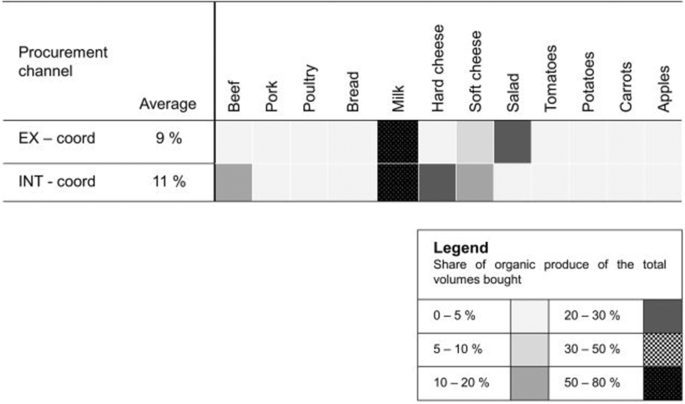
Figure 3 shows the relative share of organic products within each product group for the two procurement channels INT–coord and EX–coord. On average, INT–coord catering facilities purchase 11% and EX–coord 9% of organic produce within a product group. The slightly higher share of organic food in the INT–coord procurement channel might be explained by the internal policy for 5% of organic food in these catering facilities. However, the share of organic produce is unevenly distributed between the product groups. In both procurement channels, mainly dairy products are purchased in organic quality, especially milk. More than 50% of the milk is organic, while pork and poultry meat are rarely bought in organic quality. Also, vegetables and fruits, except for salad, have low organic shares. Overall, the results do not show a substantial difference in the purchase of organic food between the INT–coord and EX–coord procurement channel.
Fig. 3
The alternative text for this image may have been generated using AI.
Relative share of organic produce for the procurement channels and selected product groups
Barriers of organic food in PFP in Zurich
In the interviews with the catering facility managers, several reasons were mentioned for the low share of organic produce in certain product groups. First, all interviewed catering facility managers mentioned the price premium of organic products as an important barrier for purchase. Second, also quality differences between organic and conventional products, such as stains on organic apples or quality differences of organic meat, play a role. Several catering facilities indicated that customers’ acceptance of quality differences is low. Third, several catering facility managers mentioned that extra planning efforts are required when including organic meat into meals due to a limited selection and availability of organic meat in the wholesale trade.
Discussion
The results show that Zurich’s PFP system is highly centralised. Based on the estimate of relevance, 95% of annual meals provided by public services have a coordinated procurement strategy. The INT–coord procurement channel is clearly the most important procurement channel in terms of total annual meals provided. Coordinated procurement within the city administration is a unique form of organisation in Swiss PFP (Bänninger et al. [2020](/article/10.1007/s13165-022-00402-5#ref-CR2 "Bänninger A, Baume CdL, Sàrl B, Bolliger U, Scherraus T, Culinarium T (2020). PHR-Projekt Nachhaltige, vermehrt regionale Versorgung der Gemeinschaftsgastronomie: Fachlicher Schlussbericht - Projektergebnisse und -empfehlungen [PHR project sustainable, increased regional supply of community catering: final technical report - project results and recommendations] AGRIDEA. https://www.agridea.ch/de/themen/maerkte-agrar-und-lebensmittelsektor/gemeinschaftsgastronomie/
            . Accessed 7.9.2021"); Réviron and Gerz [2012](/article/10.1007/s13165-022-00402-5#ref-CR50 "Réviron S, Gerz A (2012) Produits de proximité dans la restauration collective : Vaud [Local products in community catering: Canton of Vaud]. AGRIDEA.
              https://www.agridea.ch/fileadmin/AGRIDEA/Theme/Marches__filieres_agricoles_et_alimentaires/

            . Accessed 21 May 2020")) and also throughout Europe. In other municipalities, external management of catering facilities via contracted catering companies seems to be the dominating PFP channel (Barling et al. [2013](/article/10.1007/s13165-022-00402-5#ref-CR3 "Barling D, Andersson G, Bock B, Canjels A, Galli F, Gourlay R, Hoekstra F, de Iacovo F, Karner S, Mikkelsen B (2013) Revaluing public sector food procurement in Europe: an action plan for sustainability.
              http://www.foodlinkscommunity.net/cop-public-procurement.html

            . Accessed 21 May 2020"); Sonnino [2009](/article/10.1007/s13165-022-00402-5#ref-CR59 "Sonnino R (2009) Quality food, public procurement, and sustainable development: the school meal revolution in Rome. Environ Plan A: Econ Space 41(2):425–440.
              https://doi.org/10.1068/a40112

            ")). Even though five staff restaurants could not be considered in the relevance calculation, the results can be considered as robust. Staff restaurants serve substantially fewer daily meals compared to the other facility types.
The unique organisation of the INT–coord procurement channel offers opportunities and challenges for organic PFP. First, the internal procurement body of Zurich’s city administration has a fundamental influence on a major share of PFP within Zurich. The body regulates the choice of suppliers and products of INT–coord catering facilities and can monitor, inform and steer procurement decisions through the digital ordering platform. Second, as coordinated procurement is professional, the coordinating body can develop expertise about the market and the sustainability of certain products (Schweiter 2018). Third, coordinated procurement is efficient and able to negotiate volume discounts and optimise logistics and payment processes (Rohner 2014). This might help to reduce costs when procuring organic food. Various authors emphasise the potential of professional food procurement to drive sustainable procurement (Bloomfield [2015](/article/10.1007/s13165-022-00402-5#ref-CR5 "Bloomfield C (2015) Putting sustainable development into practice: hospital food procurement in Wales. Reg Stud Reg Sci 2(1):552–558. https://doi.org/10.1080/21681376.2015.1100094
            "); Réviron and Gerz [2012](/article/10.1007/s13165-022-00402-5#ref-CR50 "Réviron S, Gerz A (2012) Produits de proximité dans la restauration collective : Vaud [Local products in community catering: Canton of Vaud]. AGRIDEA.
              https://www.agridea.ch/fileadmin/AGRIDEA/Theme/Marches__filieres_agricoles_et_alimentaires/

            . Accessed 21 May 2020")). However, coordinated purchasing also poses some challenges. Given the larger quantities procured in coordinated procurement, the 4-year contracts with suppliers have the potential to influence the supply chain considerably (Hamann et al. [2018](/article/10.1007/s13165-022-00402-5#ref-CR24 "Hamann K, Iannetta P, Tran F, Varandas E, Balázs B, Eszter K (2018) Public and Private Procurement. European Union.
              https://ec.europa.eu/research/participants/documents/downloadPublic?documentIds=080166e5be29a176&appId=PPGMS

            . Accessed 21 May 2020")). Moreover, the centralised and high demand can potentially exclude small suppliers and therefore may stand in conflict with sustainability goals (Lebel [2010](/article/10.1007/s13165-022-00402-5#ref-CR29 "Lebel A (2010) Utopie et réalité de l'approvisionnement de masse en produits locaux [Utopia and reality of mass supply of local products]. GREP.
              https://www.cairn.info/revue-pour-2010-2-3-page-195.htm

            . Accessed 21 May 2020"); Mikkelsen [2018](/article/10.1007/s13165-022-00402-5#ref-CR33 "Mikkelsen B (2018) Organic and local? - caseinsights from a two-in-one approach to regional public food sourcing for the public in the city of Aalborg. (Ed.),^(Eds.). 2nd International Workshop “Organic farming and agroecology as a response to global challenges”, Capri"); Mikkelsen and Ruge [2012](/article/10.1007/s13165-022-00402-5#ref-CR34 "Mikkelsen B, Ruge D (2012) The public as political consumer - case insights from developing regional public food strategies in Danish region Nord. (Ed.),^(Eds.). International Farming Systems Association, Arhus, Dänemark"); Sonnino [2009](/article/10.1007/s13165-022-00402-5#ref-CR59 "Sonnino R (2009) Quality food, public procurement, and sustainable development: the school meal revolution in Rome. Environ Plan A: Econ Space 41(2):425–440.
              https://doi.org/10.1068/a40112

            "); Walker and Preuss [2008](/article/10.1007/s13165-022-00402-5#ref-CR68 "Walker H, Preuss L (2008) Fostering sustainability through sourcing from small businesses: public sector perspectives. J Clean Prod 16(15):1600–1609.
              https://doi.org/10.1016/j.jclepro.2008.04.014

            ")).
Despite the above-mentioned opportunities of an internally managed coordinated procurement, the share of organic products in Zurich’s INT–coord procurement channel is comparably low in the international context and is only above average in a Swiss context. A study analysing the procurement of organic products by the city of Lausanne finds only 3.65% of organic food (Payot et al. 2018). Another study of ten large-scale kitchens in the canton of Zurich found under 2% of foods to have the organic label ‘Bio Suisse’ (Bänninger et al. [2020](/article/10.1007/s13165-022-00402-5#ref-CR2 "Bänninger A, Baume CdL, Sàrl B, Bolliger U, Scherraus T, Culinarium T (2020). PHR-Projekt Nachhaltige, vermehrt regionale Versorgung der Gemeinschaftsgastronomie: Fachlicher Schlussbericht - Projektergebnisse und -empfehlungen [PHR project sustainable, increased regional supply of community catering: final technical report - project results and recommendations] AGRIDEA. https://www.agridea.ch/de/themen/maerkte-agrar-und-lebensmittelsektor/gemeinschaftsgastronomie/
            . Accessed 7.9.2021")). According to the city’s own information, INT–coord purchased between 6 and 7% of organic food in 2014 (Rohner [2014](/article/10.1007/s13165-022-00402-5#ref-CR52 "Rohner E (2014) Synergien nutzen dank Koordination [Using synergies thanks to coordination]. Thema Umwelt, 1/2014, 12–13")). On the international level, organic PFP in Zurich remains considerably lower than the procurement in cities such as Rome, Malmö, Vienna and Copenhagen (Smith et al. [2016](/article/10.1007/s13165-022-00402-5#ref-CR57 "Smith J, Andersson G, Gourlay R, Karner S, Mikkelsen BE, Sonnino R, Barling D (2016) Balancing competing policy demands: the case of sustainable public sector food procurement. J Clean Prod 112(2016):249–256.
              https://doi.org/10.1016/j.jclepro.2015.07.065

            "); Sonnino [2009](/article/10.1007/s13165-022-00402-5#ref-CR59 "Sonnino R (2009) Quality food, public procurement, and sustainable development: the school meal revolution in Rome. Environ Plan A: Econ Space 41(2):425–440.
              https://doi.org/10.1068/a40112

            ")). Their organic procurement practices could serve as an inspiration for Zurich.
Levers to increase the share of organic food
Based on the results of this study, several leverage points to increase the share of organic food in Zurich’s PFP appear. The city administration may set or raise internal thresholds for organic shares in PFP, as otherwise cost seems to be a major decision factor in PFP (Filippini et al. [2018](/article/10.1007/s13165-022-00402-5#ref-CR21 "Filippini R, De Noni I, Corsi S, Spigarolo R, Bocchi S (2018) Sustainable school food procurement: what factors do affect the introduction and the increase of organic food? Food Policy 76:109–119. https://doi.org/10.1016/j.foodpol.2018.03.011
            ")). The results show that INT–coord and EX–coord procurement channels purchase primarily dairy products in organic quality and only seldomly organic vegetables and fruits. This observation is likely caused by the price pressure in PFP and the relative price difference between organic and conventional products (Marktanalysen [2020](/article/10.1007/s13165-022-00402-5#ref-CR17 "Fachbereich Marktanalysen (2020) Marktbericht Bio: Bio-Preise 2019: Warenkorb Milch und Früchte günstiger, Warenkorb Fleisch, Eier, Gemüse und Kartoffeln teurer [Organic market report: organic prices 2019: milk and fruit cheaper, meat, eggs, vegetables and potatoes more expensive ] (1. Quartal). Bundesamt für Landwirtschaft.
              https://www.blw.admin.ch/blw/de/home/markt/marktbeobachtung/bio.html

            . Accessed 21 May 2020")). If Zurich’s city administration was to define organic thresholds per product or commodity group (Huber et al. [2019](/article/10.1007/s13165-022-00402-5#ref-CR25 "Huber K, Frick R, Obrist R, Schmid O (2019) Nachhaltige Beschaffung–Mehr Bioprodukte in Gemeinden und Städten [Sustainable procurement-more organic products in municipalities and cities]. Forschungsinstitut für biologischen Landbau.
              https://orgprints.org/35234/

            . Accessed 21 May 2020")), the organic vegetable and fruit market could also benefit from the procurement efforts of Zurich.
Apart from the costs, many interviewed catering facility managers mentioned limited selection and availability of organic produce. PFP can help to overcome these constraints by actively developing the organic market. The literature identifies two strategies for supply development. A first strategy, which has proven successful in many cases, is exchange and cooperation with suppliers (Bloomfield [2015](/article/10.1007/s13165-022-00402-5#ref-CR5 "Bloomfield C (2015) Putting sustainable development into practice: hospital food procurement in Wales. Reg Stud Reg Sci 2(1):552–558. https://doi.org/10.1080/21681376.2015.1100094
            "); Haack et al. [2017](/article/10.1007/s13165-022-00402-5#ref-CR23 "Haack M, Häring AM, von Münchhausen S (2017) Umsetzung des EU-Vergaberechts: eine Chance für ökologische und regionale Lebensmittel in der Gemeinschaftsverpflegung? [Implementation of EU public procurement law: an opportunity for organic and regional food in community catering?]. (Ed.),^(Eds.). 14. Wissenschaftstagung Ökologischer Landbau, Freising"); Mikkelsen [2018](/article/10.1007/s13165-022-00402-5#ref-CR33 "Mikkelsen B (2018) Organic and local? - caseinsights from a two-in-one approach to regional public food sourcing for the public in the city of Aalborg. (Ed.),^(Eds.). 2nd International Workshop “Organic farming and agroecology as a response to global challenges”, Capri"); Mikkelsen and Ruge [2012](/article/10.1007/s13165-022-00402-5#ref-CR34 "Mikkelsen B, Ruge D (2012) The public as political consumer - case insights from developing regional public food strategies in Danish region Nord. (Ed.),^(Eds.). International Farming Systems Association, Arhus, Dänemark"); Sonnino [2009](/article/10.1007/s13165-022-00402-5#ref-CR59 "Sonnino R (2009) Quality food, public procurement, and sustainable development: the school meal revolution in Rome. Environ Plan A: Econ Space 41(2):425–440.
              https://doi.org/10.1068/a40112

            "); Sørensen et al. [2016](/article/10.1007/s13165-022-00402-5#ref-CR60 "Sørensen NN, Tetens I, Løje H, Lassen AD (2016) The effectiveness of the Danish Organic Action Plan 2020 to increase the level of organic public procurement in Danish public kitchens. Public Health Nutr 19(18):3428–3435.
              https://doi.org/10.1017/S1368980016001737

            "); Walker and Preuss [2008](/article/10.1007/s13165-022-00402-5#ref-CR68 "Walker H, Preuss L (2008) Fostering sustainability through sourcing from small businesses: public sector perspectives. J Clean Prod 16(15):1600–1609.
              https://doi.org/10.1016/j.jclepro.2008.04.014

            ")). For this strategy, it is important to consider all steps along the value chain, including production, processing and trade (Krivašonoka [2019](/article/10.1007/s13165-022-00402-5#ref-CR28 "Krivašonoka I (2019) Local food procurement tendencies in Latvia. (Ed.),^(Eds.). 12th International Scientific and Practical Conference, Rezekne"); Moschitz and Frick [2018](/article/10.1007/s13165-022-00402-5#ref-CR39 "Moschitz H, Frick R (2018) KERNiG-AP1. 1 Bestandsaufnahme der kommunalen Ernährungssysteme–Landwirtschaftliches Produktionspotenzial und Lebensmittelflüsse. Forschungsinstitut für biologischen Landbau.
              https://orgprints.org/32087/

            . Accessed 21 May 2020")). Another approach to build up the supply is to increase the demand for organic food incrementally (Sonnino [2009](/article/10.1007/s13165-022-00402-5#ref-CR59 "Sonnino R (2009) Quality food, public procurement, and sustainable development: the school meal revolution in Rome. Environ Plan A: Econ Space 41(2):425–440.
              https://doi.org/10.1068/a40112

            ")).
Unique to the situation in Zurich is the digital ordering platform used to procure food for around 70% of Zurich’s PFP. This system might transform into an important leverage point to increase the share of organic food (Pekolj et al. [2019](/article/10.1007/s13165-022-00402-5#ref-CR45 "Pekolj N, Hodošček K, Valjavec L, Ferk P (2019) Digital transformation of public procurement as an opportunity for the economy. LeXonomica 11(1). https://journals.um.si/index.php/lexonomica/article/view/134
. Accessed 21 May 2020")). The platform can be further developed to support the goals of the food policy. Concrete steps are to integrate other online platforms for sustainable food, for example platforms for direct marketing of smaller organic businesses. Thereby, PFP could purchase food more directly from producers and processors and extend the range of products. Also, the platform can monitor the share of organic produce purchased by each catering facility and provide information and support for organic food procurement. Ultimately, digitalisation offers further opportunities in terms of logistics and administration. However, scientific analyses of such systems are rare.The presented approach in this study offers a suitable first step to design and improve organic PFP policies and tailor to the local institutional conditions. Such policies are an important piece in a broader food system strategy which goes beyond organic food also accounting for other levers for transformation such as eating habits and food waste (Jungbluth et al. 2012; Poore and Nemecek [2018](/article/10.1007/s13165-022-00402-5#ref-CR48 "Poore J, Nemecek T (2018) Reducing foods environmental impacts through producers and consumers. Science 360(6392):987–992. https://doi.org/10.1126/science.aaq0216
            "); Willett et al. [2019](/article/10.1007/s13165-022-00402-5#ref-CR69 "Willett W, Rockström J, Loken B, Springmann M, Lang T, Vermeulen S, Garnett T, Tilman D, DeClerck F, Wood A (2019) Food in the Anthropocene: the EAT–Lancet Commission on healthy diets from sustainable food systems. Lancet 393(10170):447–492.
              https://doi.org/10.1016/S0140-6736(18)31788-4

            ")). However, as Doernberg et al. ([2019](/article/10.1007/s13165-022-00402-5#ref-CR13 "Doernberg A, Horn P, Zasada I, Piorr A (2019) Urban food policies in German city regions: an overview of key players and policy instruments. Food Policy 89:101782.
              https://doi.org/10.1016/j.foodpol.2019.101782

            ")) and Cheng et al. ([2018](/article/10.1007/s13165-022-00402-5#ref-CR10 "Cheng W, Appolloni A, D’Amato A, Zhu Q (2018) Green public procurement, missing concepts and future trends–a critical review. J Clean Prod 176:770–784")) point out, an evaluation of the effects of such food policies is lacking. Evidence from single cases is promising, like increased conversion of farmland after the introduction of organic PFP (Lindström et al. [2020](/article/10.1007/s13165-022-00402-5#ref-CR30 "Lindström H, Lundberg S, Marklund P-O (2020) How green public procurement can drive conversion of farmland: an empirical analysis of an organic food policy. Ecol Econ 172:106622.
              https://doi.org/10.1016/j.ecolecon.2020.106622

            ")) and reduced obesity among schoolchildren (Barling et al. [2013](/article/10.1007/s13165-022-00402-5#ref-CR3 "Barling D, Andersson G, Bock B, Canjels A, Galli F, Gourlay R, Hoekstra F, de Iacovo F, Karner S, Mikkelsen B (2013) Revaluing public sector food procurement in Europe: an action plan for sustainability.
              http://www.foodlinkscommunity.net/cop-public-procurement.html

            . Accessed 21 May 2020")). Nevertheless, future research is crucial to better understand the effects of such policies on the market and consumers and their efficiency in achieving environmental and health goals (Lundberg et al. [2016](/article/10.1007/s13165-022-00402-5#ref-CR31 "Lundberg S, Marklund P-O, Strömbäck E (2016) Is environmental policy by public procurement effective? Public Financ Rev 44(4):478–499.
              https://doi.org/10.1177/1091142115588977

            ")).
Conclusion and policy implications
This study offers a quantitative approach to measure the consumption of organic food in public catering facilities and uses the approach exemplarily with the city of Zurich. The study reveals the major role of internal coordinated procurement (INT–coord) in Zurich, being responsible for 70% of all meals served annually. Given the importance of the channel and its unique organisational structure, the INT–coord procurement channel has great potential to drive organic food procurement in Zurich. However, in comparison with organic PFP in other European cities, Zurich has considerable potential to increase organic PFP. To achieve this aim, we identified the following leverage points: (1) set or raise internal product-specific thresholds for organic food, (2) actively develop the supply and (3) exploit the potential of the digital ordering platform in the INT–coord procurement channel. These levers indicate fields of action for the city of Zurich not only to implement their food strategy and reach their PFP goals but also to further exploit the potential of PFP to contribute to an agroecological transition.
To the international debate around PFP and organic food procurement in particular, this study contributes two main aspects. First, Zurich’s unique PFP system with strong internally managed coordinated procurement may serve as a blueprint for other municipalities and cities as it offers the advantages of professionalisation and efficiency gains (Rohner 2014; Schweiter 2018). The centralization enables an increased share of organic food procurement, which has previously been associated mainly with private caterers (Filippini et al. [2018](/article/10.1007/s13165-022-00402-5#ref-CR21 "Filippini R, De Noni I, Corsi S, Spigarolo R, Bocchi S (2018) Sustainable school food procurement: what factors do affect the introduction and the increase of organic food? Food Policy 76:109–119. https://doi.org/10.1016/j.foodpol.2018.03.011
            ")). This case study extends the findings of Filippini et al. ([2018](/article/10.1007/s13165-022-00402-5#ref-CR21 "Filippini R, De Noni I, Corsi S, Spigarolo R, Bocchi S (2018) Sustainable school food procurement: what factors do affect the introduction and the increase of organic food? Food Policy 76:109–119.
              https://doi.org/10.1016/j.foodpol.2018.03.011

            ")) by specifying that not the public or private management of a procurement channel but the level of centralization is key to increase the provision of organic food.
Second, the definition of organic PFP policies based on total purchases can hide important patterns. As the case of Zurich shows, the organic share within individual product groups can vary considerably. Cities and municipalities aiming to increase the share of organic produce in PFP should define the policy in order for outcomes to reflect the initial sustainability goals. Defining organic targets per product group might be advisable. Nevertheless, additional market development in order to ensure availability of supply is central to support successful organic PFP (Bloomfield [2015](/article/10.1007/s13165-022-00402-5#ref-CR5 "Bloomfield C (2015) Putting sustainable development into practice: hospital food procurement in Wales. Reg Stud Reg Sci 2(1):552–558. https://doi.org/10.1080/21681376.2015.1100094
            "); Mikkelsen [2018](/article/10.1007/s13165-022-00402-5#ref-CR33 "Mikkelsen B (2018) Organic and local? - caseinsights from a two-in-one approach to regional public food sourcing for the public in the city of Aalborg. (Ed.),^(Eds.). 2nd International Workshop “Organic farming and agroecology as a response to global challenges”, Capri"); Sonnino [2009](/article/10.1007/s13165-022-00402-5#ref-CR59 "Sonnino R (2009) Quality food, public procurement, and sustainable development: the school meal revolution in Rome. Environ Plan A: Econ Space 41(2):425–440.
              https://doi.org/10.1068/a40112

            "); Walker and Preuss [2008](/article/10.1007/s13165-022-00402-5#ref-CR68 "Walker H, Preuss L (2008) Fostering sustainability through sourcing from small businesses: public sector perspectives. J Clean Prod 16(15):1600–1609.
              https://doi.org/10.1016/j.jclepro.2008.04.014

            ")).
References
- Alföldi T, Nowack K (2017) Biowissen - Fakten und Hintergründe zur biologischen Landwirtschaft und Verarbeitung [Organic knowledge - facts and background on organic farming and processing]. Forschungsinstitut für biologischen Landbau & Bio Suisse. https://www.bio-suisse.ch/de/biowissen.php. Accessed 21 May 2020
- Bänninger A, Baume CdL, Sàrl B, Bolliger U, Scherraus T, Culinarium T (2020). PHR-Projekt Nachhaltige, vermehrt regionale Versorgung der Gemeinschaftsgastronomie: Fachlicher Schlussbericht - Projektergebnisse und -empfehlungen [PHR project sustainable, increased regional supply of community catering: final technical report - project results and recommendations] AGRIDEA. https://www.agridea.ch/de/themen/maerkte-agrar-und-lebensmittelsektor/gemeinschaftsgastronomie/. Accessed 7.9.2021
- Barling D, Andersson G, Bock B, Canjels A, Galli F, Gourlay R, Hoekstra F, de Iacovo F, Karner S, Mikkelsen B (2013) Revaluing public sector food procurement in Europe: an action plan for sustainability. http://www.foodlinkscommunity.net/cop-public-procurement.html. Accessed 21 May 2020
- Bisig-Inanir D, Pestoni G, Rohrmann S (2021) Portionsgrössen in der ersten Schweizerischen Ernährungserhebung menuCH [Portion sizes in the first Swiss Nutrition Survey menuCH] (https://www.blv.admin.ch/blv/de/home/lebensmittel-und-ernaehrung/ernaehrung/schweizer-ernaehrungsbulletin/schweizer-ernaehrungsbulletin-2021.html
- Bloomfield C (2015) Putting sustainable development into practice: hospital food procurement in Wales. Reg Stud Reg Sci 2(1):552–558. https://doi.org/10.1080/21681376.2015.1100094
Article Google Scholar - Candel JJL (2020) What’s on the menu? A global assessment of MUFPP signatory cities’ food strategies. Agroecol Sustain Food Syst 44(7):919–946. https://doi.org/10.1080/21683565.2019.1648357
Article Google Scholar - Canton of Zürich (2020) Ferien- & Weiterbildungsdaten [Holiday & further education dates]. Kanton Zürich. https://vsa.zh.ch/internet/bildungsdirektion/vsa/de/aktuell/feriendaten.html. Accessed 7.9.2021
- Cerutti AK, Ardente F, Contu S, Donno D, Beccaro GL (2018) Modelling, assessing, and ranking public procurement options for a climate-friendly catering service. Int J Life Cycle Assess 23(1):95–115. https://doi.org/10.1007/s11367-017-1306-y
Article Google Scholar - Chandler C, Franklin A, Ochoa A, Clement S (2015) Sustainable public procurement of school catering services - a good practice report. INNOCAT. https://www.sustainable-catering.eu/publications/. Accessed 21 May 2020
- Cheng W, Appolloni A, D’Amato A, Zhu Q (2018) Green public procurement, missing concepts and future trends–a critical review. J Clean Prod 176:770–784
Article Google Scholar - City of Zurich (2014) "Richtlinie Ökologische Anforderungen im Beschaffungsprozess" für die Beschaffungsverantwortlichen der Stadt Zürich ["Guideline ecological requirements in the procurement process" for the procurement officers of the city of Zurich] (STRB Nr. 0976/2014). Finanzdepartement. https://www.stadt-zuerich.ch/portal/de/index/politik_u_recht/stadtrat/geschaefte-des-stadtrates/stadtratsbeschluesse/2014/Nov/StZH_STRB_2014_0976.html. Accessed 21 May 2020
- City of Zurich (2019) Strategie nachhaltige Ernährung Stadt Zürich [Sustainable food strategy city of Zurich]. Umwelt und Gesundheitsschutz. https://www.stadt-zuerich.ch/gud/de/index/umwelt_energie/ernaehrung/ernaehrungsstrategie.html. Accessed 21 May 2020
- Doernberg A, Horn P, Zasada I, Piorr A (2019) Urban food policies in German city regions: an overview of key players and policy instruments. Food Policy 89:101782. https://doi.org/10.1016/j.foodpol.2019.101782
Article Google Scholar - European Parliament (2018) The EU's organic food market: facts and rules (infographic). Retrieved June 16, 2022, from https://www.europarl.europa.eu/news/en/headlines/society/20180404STO00909/the-eu-s-organic-food-market-facts-and-rules-infographic
- European Union (2020) From to Fork Strategy. For a fair, healthy and environmentally-friendly food system. https://ec.europa.eu/food/horizontal-topics/farm-fork-strategy_de. Accessed 7.9.2021
- Fachbereich Marktanalysen (2019) Marktbericht Bio: Wenn Biofleisch, dann Gehacktes [Organic market report: If organic meat, then minced meat]. Bundesamt für Landwirtschaft. https://www.blw.admin.ch/blw/de/home/markt/marktbeobachtung/bio.html. Accessed 21 May 2020
- Fachbereich Marktanalysen (2020) Marktbericht Bio: Bio-Preise 2019: Warenkorb Milch und Früchte günstiger, Warenkorb Fleisch, Eier, Gemüse und Kartoffeln teurer [Organic market report: organic prices 2019: milk and fruit cheaper, meat, eggs, vegetables and potatoes more expensive ] (1. Quartal). Bundesamt für Landwirtschaft. https://www.blw.admin.ch/blw/de/home/markt/marktbeobachtung/bio.html. Accessed 21 May 2020
- Fachbereich Marktanalysen, Proviande (2020) Marktbericht Fleisch. Grosshandelspreise Fleisch ab Verarbeiter [Meat market report. Wholesale prices meat ex processor].Bundesamt für Landwirtschaft. https://www.blw.admin.ch/blw/de/home/markt/marktbeobachtung/fleisch.html. Accessed 21 May 2020
- Fairchild R, Collins A (2011) Serving up healthy and sustainable school meals? An analysis of school meal provision in Cardiff (UK). J Environ Planning Policy Manage 13(3):209–229. https://doi.org/10.1080/1523908X.2011.578402
Article Google Scholar - Federal Procurement Conference (2020) Revision des öffentlichen Beschaffungsrechts [Revision of public procurement law]. https://www.bkb.admin.ch/. Accessed 7.9.2021
- Filippini R, De Noni I, Corsi S, Spigarolo R, Bocchi S (2018) Sustainable school food procurement: what factors do affect the introduction and the increase of organic food? Food Policy 76:109–119. https://doi.org/10.1016/j.foodpol.2018.03.011
Article Google Scholar - Fülles M, Roehl R, Strassner C, Hermann A, Teufel J (2017) Mehr Bio in Kommunen: Ein Praxisleitfaden des Netzwerks deutscher Biostädte [More organic in municipalities: a practical guide by the network of german organic cities]. Netzwerk deutscher Biostädte. https://www.biostaedte.de/images/pdf/leitfaden_V4_verlinkt.pdf. Accessed 21 May 2020
- Haack M, Häring AM, von Münchhausen S (2017) Umsetzung des EU-Vergaberechts: eine Chance für ökologische und regionale Lebensmittel in der Gemeinschaftsverpflegung? [Implementation of EU public procurement law: an opportunity for organic and regional food in community catering?]. (Ed.),^(Eds.). 14. Wissenschaftstagung Ökologischer Landbau, Freising
- Hamann K, Iannetta P, Tran F, Varandas E, Balázs B, Eszter K (2018) Public and Private Procurement. European Union. https://ec.europa.eu/research/participants/documents/downloadPublic?documentIds=080166e5be29a176&appId=PPGMS. Accessed 21 May 2020
- Huber K, Frick R, Obrist R, Schmid O (2019) Nachhaltige Beschaffung–Mehr Bioprodukte in Gemeinden und Städten [Sustainable procurement-more organic products in municipalities and cities]. Forschungsinstitut für biologischen Landbau. https://orgprints.org/35234/. Accessed 21 May 2020
- Intergovernmental Panel on Climate Change (2019) Special report on climate change and land. UNEP. https://www.ipcc.ch/srccl-report-download-page/. Accessed 21 May 2020
- Jungbluth N, Itten R, Stucki M (2012) Umweltbelastungen des privaten Konsums und Reduktionspotenziale: Schlussbericht [Environmental impacts of private consumption and reduction potentials: final report]. Im Auftrag des Schweizer Bundesamtes für Umwelt
- Krivašonoka I (2019) Local food procurement tendencies in Latvia. (Ed.),^(Eds.). 12th International Scientific and Practical Conference, Rezekne
- Lebel A (2010) Utopie et réalité de l'approvisionnement de masse en produits locaux [Utopia and reality of mass supply of local products]. GREP. https://www.cairn.info/revue-pour-2010-2-3-page-195.htm. Accessed 21 May 2020
- Lindström H, Lundberg S, Marklund P-O (2020) How green public procurement can drive conversion of farmland: an empirical analysis of an organic food policy. Ecol Econ 172:106622. https://doi.org/10.1016/j.ecolecon.2020.106622
Article Google Scholar - Lundberg S, Marklund P-O, Strömbäck E (2016) Is environmental policy by public procurement effective? Public Financ Rev 44(4):478–499. https://doi.org/10.1177/1091142115588977
Article Google Scholar - McIntyre B, Herren H, Wakhungu J, Watson R (2009) Agriculture at a crossroads: synthesis report. International Assessment of Agricultural Knowledge, Science and Technology for Development. https://www.weltagrarbericht.de/original-berichte.html. Accessed 21 May 2020
- Mikkelsen B (2018) Organic and local? - caseinsights from a two-in-one approach to regional public food sourcing for the public in the city of Aalborg. (Ed.),^(Eds.). 2nd International Workshop “Organic farming and agroecology as a response to global challenges”, Capri
- Mikkelsen B, Ruge D (2012) The public as political consumer - case insights from developing regional public food strategies in Danish region Nord. (Ed.),^(Eds.). International Farming Systems Association, Arhus, Dänemark
- Moragues-Faus A, Morgan K (2015) Reframing the foodscape: the emergent world of urban food policy. Environ Plan 47(7):1558–1573. https://doi.org/10.1177/0308518X15595754
Article Google Scholar - Morgan K, Morley A (2014) The public plate: harnessing the power of purchase. In: Marsden TK, Morley AS (eds) Sustainable food systems. Routledge, pp 84–102
Google Scholar - Morgan K, Sonnino R (2010) The urban foodscape: world cities and the new food equation. Camb J Reg Econ Soc 3(2):209–224. https://doi.org/10.1093/cjres/rsq007
Article Google Scholar - Morley A, Morgan K (2021) Municipal foodscapes: urban food policy and the new municipalism. Food Policy 103:102069. https://doi.org/10.1016/j.foodpol.2021.102069
Article Google Scholar - Moschitz H, Frick R (2018) KERNiG-AP1. 1 Bestandsaufnahme der kommunalen Ernährungssysteme–Landwirtschaftliches Produktionspotenzial und Lebensmittelflüsse. Forschungsinstitut für biologischen Landbau. https://orgprints.org/32087/. Accessed 21 May 2020
- Moschitz H, Frick R (2020) City food flow analysis. A new method to study local consumption. Renew Agric Food Syst 1–13. https://doi.org/10.1017/S1742170520000150
- Nielsen Schweiz (2020) Marktzahlen Bio [Figures of the organic market]. https://www.blw.admin.ch/blw/de/home/markt/marktbeobachtung/bio.html. Accessed 7.9.2021
- Niggli U (2015) Sustainability of organic food production: challenges and innovations. (Ed.),^(Eds.). Conference of sustainable diet and food security, Lille
- O'Rourke A, Leire C, Bowden T (2013) Sustainable public procurement: a global review (No. ISBN: 978–92–807–3332–7). United Nations Environment Programme
- Payot D, Litzistorf N, Seiler J, Dubar S (2018) Restauration Collective Durable. Bilan Final 2017 [Sustainable public catering. Final Report 2017]. Unité développement durable et Service d’accueil de jour de l’enfance
- Pekolj N, Hodošček K, Valjavec L, Ferk P (2019) Digital transformation of public procurement as an opportunity for the economy. LeXonomica 11(1). https://journals.um.si/index.php/lexonomica/article/view/134. Accessed 21 May 2020
- Perera O, Chowdhury N, Goswami A (2007) State of play in sustainable public procurement. International Institute for Sustainable Development, Winnipeg
- Piguet S (2007) Nachhaltige Beschaffung. Gute Beispiele im Bereich Nachhaltige Entwicklung [Sustainable procurement. Good examples in the field of sustainable development]. Bundesamt für Raumentwicklung. https://www.are.admin.ch/dam/are/de/dokumente/nachhaltige_entwicklung/dokumente/. Accessed 21 May 2020
- Poore J, Nemecek T (2018) Reducing foods environmental impacts through producers and consumers. Science 360(6392):987–992. https://doi.org/10.1126/science.aaq0216
Article CAS PubMed Google Scholar - Reganold JP, Wachter JM (2016) Organic agriculture in the twenty-first century. Nature Plants 2(2):15221. https://doi.org/10.1038/nplants.2015.221
Article PubMed Google Scholar - Réviron S, Gerz A (2012) Produits de proximité dans la restauration collective : Vaud [Local products in community catering: Canton of Vaud]. AGRIDEA. https://www.agridea.ch/fileadmin/AGRIDEA/Theme/Marches__filieres_agricoles_et_alimentaires/. Accessed 21 May 2020
- Risku-Norja H (2015) Full case study report: Kiuruvesi municipal catering-Finland. Natural Resources Institute Finland. https://orgprints.org/29244/. Accessed 21 May 2020
- Rohner E (2014) Synergien nutzen dank Koordination [Using synergies thanks to coordination]. Thema Umwelt, 1/2014, 12–13
- Rosin K (2020) Die 2010er-Jahre im Fokus: Warum Zürich wächst und schweizerischer wird [The 2010s in focus: why Zurich is growing and becoming more Swiss ] [Webartikel]. https://www.stadt-zuerich.ch. Accessed 21 May 2020
- Saxe H, Jensen JD, Bølling Laugesen SM, Bredie WLP (2019) Environmental impact of meal service catering for dependent senior citizens in Danish municipalities. Int J Life Cycle Assess 24(4):654–666. https://doi.org/10.1007/s11367-018-1487-z
Article CAS Google Scholar - Schweiter K (2018) Innovative Beschaffung von morgen [Innovative procurement of tomorrow]. Thema Umwelt 1(2018):4–5
Google Scholar - Seufert V, Ramankutty N (2017) Many shades of gray-the context-dependent performance of organic agriculture. Sci Adv 3(3):e1602638. https://doi.org/10.1126/sciadv.1602638
Article PubMed PubMed Central Google Scholar - Smith J, Andersson G, Gourlay R, Karner S, Mikkelsen BE, Sonnino R, Barling D (2016) Balancing competing policy demands: the case of sustainable public sector food procurement. J Clean Prod 112(2016):249–256. https://doi.org/10.1016/j.jclepro.2015.07.065
Article Google Scholar - Sonnino R (2016) The new geography of food security: exploring the potential of urban food strategies. Geogr J 182(2):190–200. https://doi.org/10.1111/geoj.12129
Article Google Scholar - Sonnino R (2009) Quality food, public procurement, and sustainable development: the school meal revolution in Rome. Environ Plan A: Econ Space 41(2):425–440. https://doi.org/10.1068/a40112
Article Google Scholar - Sørensen NN, Tetens I, Løje H, Lassen AD (2016) The effectiveness of the Danish Organic Action Plan 2020 to increase the level of organic public procurement in Danish public kitchens. Public Health Nutr 19(18):3428–3435. https://doi.org/10.1017/S1368980016001737
Article PubMed Google Scholar - Steiner M (2013) Is there a Swiss approach towards sustainable public procurement. Eur Procurement Pub Private Partnership L Rev 8(1):73–78
Google Scholar - Steiner M (2015) Die Berücksichtigung sozialer Aspekte im Rahmen der öffentlichen Beschaffung [The consideration of social aspects within the framework of public procurement]. Interessengemeinschaft Ökologische Beschaffung Schweiz. http://www.nachhaltige-beschaffung.ch/pdf/Sozialpapier_Zusammenfassung_update_20171212_FINAL.pdf. Accessed 21 May 2020
- Stiftung Konsumentenschutz, Pusch, Helvetas, WWF (2021) Online-Ratgeber - Welche Lebensmittel-Labels sind nachhaltig? [Online guide - which food labels are sustainable?]. https://www.konsumentenschutz.ch/online-ratgeber/welche-lebensmittel-labels-sind-nachhaltig/. Accessed 7.9.2021
- Swensson LFJ, Tartanac F (2020) Public food procurement for sustainable diets and food systems: the role of the regulatory framework [Article]. Global Food Security, 25, Article 100366. https://doi.org/10.1016/j.gfs.2020.100366
- United Nations (2015) Transforming our world: the 2030 agenda for sustainable development (No. A/RES/70/1). https://sdgs.un.org/publications/transforming-our-world-2030-agenda-sustainable-development-17981. Accessed 21 May 2020
- Väänänen S, Tossavainen H (2014) More local food for the customers of public-sector kitchens - grounds and guidelines for procurement. EkoCentria. http://www.ekocentria.fi/resources/public/Aineistot/LahiruokaopasENG.pdf. Accessed 21 May 2020
- Wahlen S, Heiskanen E, Aalto K (2012) Endorsing sustainable food consumption: prospects from public catering. J Consum Policy 35(1):7–21. https://doi.org/10.1007/s10603-011-9183-4
Article Google Scholar - Walker H, Preuss L (2008) Fostering sustainability through sourcing from small businesses: public sector perspectives. J Clean Prod 16(15):1600–1609. https://doi.org/10.1016/j.jclepro.2008.04.014
Article Google Scholar - Willett W, Rockström J, Loken B, Springmann M, Lang T, Vermeulen S, Garnett T, Tilman D, DeClerck F, Wood A (2019) Food in the Anthropocene: the EAT–Lancet Commission on healthy diets from sustainable food systems. Lancet 393(10170):447–492. https://doi.org/10.1016/S0140-6736(18)31788-4
Article PubMed Google Scholar
Acknowledgements
The authors thank the representatives of the Zurich’s Health and Environment Department for their support of this study. The representatives provided information on the PFP system in Zurich, contacts to catering facility managers and ordering data of the internal platform. The authors also thank Robert Home for proofreading.
Funding
Open access funding provided by Research Institute of Organic Agriculture The research leading to these results received funding from the Mercator Foundation Switzerland and the city of Zurich as part of the research project: ‘Was isst Zürich? [What does Zurich eat?]’ (Grant Agreement No. 2019–2340).
Author information
Author notes
- Heidrun Moschitz
Present address: Natur Park Parc Ela, Stradung 11, Tiefencastel, 7450, Switzerland
Authors and Affiliations
- Research Institute of Organic Agriculture (FiBL), Ackerstrasse 113, Postfach 219, 5070, Frick, Switzerland
Mirjam Schleiffer, Jan Landert & Heidrun Moschitz
Authors
- Mirjam Schleiffer
- Jan Landert
- Heidrun Moschitz
Contributions
Mirjam Schleiffer: Conceptualization, Investigation, Writing – original draft. Jan Landert: Project administration, Writing – review & editing. Heidrun Moschitz: Conceptualization, Writing – review & editing.
Corresponding author
Correspondence toMirjam Schleiffer.
Ethics declarations
Competing interests
The authors declare no competing interests.
Additional information
Publisher's note
Springer Nature remains neutral with regard to jurisdictional claims in published maps and institutional affiliations.
Supplementary Information
Rights and permissions
Open Access This article is licensed under a Creative Commons Attribution 4.0 International License, which permits use, sharing, adaptation, distribution and reproduction in any medium or format, as long as you give appropriate credit to the original author(s) and the source, provide a link to the Creative Commons licence, and indicate if changes were made. The images or other third party material in this article are included in the article's Creative Commons licence, unless indicated otherwise in a credit line to the material. If material is not included in the article's Creative Commons licence and your intended use is not permitted by statutory regulation or exceeds the permitted use, you will need to obtain permission directly from the copyright holder. To view a copy of this licence, visit http://creativecommons.org/licenses/by/4.0/.
About this article
Cite this article
Schleiffer, M., Landert, J. & Moschitz, H. Assessing public organic food procurement: the case of Zurich (CH).Org. Agr. 12, 461–474 (2022). https://doi.org/10.1007/s13165-022-00402-5
- Received: 23 May 2022
- Accepted: 07 August 2022
- Published: 22 August 2022
- Version of record: 22 August 2022
- Issue date: September 2022
- DOI: https://doi.org/10.1007/s13165-022-00402-5