Navigating the participatory turn in agricultural and food research: Best practice from citizen science (original) (raw)
Abstract
Food systems have enormous impacts on people and the planet, with agriculture and food research becoming strategic for many countries. However, the way this research is conducted and the rise of new agri-food technologies have ethical and socio-economic implications. To address these, many scholars are gaining interest in participatory methods, such as citizen science, but are unfamiliar with the latest debates on ethical and methodological issues surrounding non-academic stakeholder engagement. In this perspective paper, we revisit the European Citizen Science Association’s (ECSA) Ten Principles of Citizen Science under the specific lens of agri-food research. The discussion presented is based on a review of the state of the art from academic literature, secondary data from agri-food citizen science projects, and the reflections of 11 scientist and practitioners, members of ECSA’s Agri-Food Working Group. The findings reflect theoretical, methodological, and practical implications for navigating the participatory turn in agriculture and food research.
Introduction: The expansion of citizen science in agriculture and food system research
Agriculture and food systemsFootnote 1agri-food systems henceforth are key to human and environmental health (Willett et al. [2019](/article/10.1007/s13280-025-02151-7#ref-CR58 "Willett, W., J. Rockström, B. Loken, M. Springmann, T. Lang, S. Vermeulen, T. Garnett, D. Tilman, et al. 2019. Food in the anthropocene: The EAT–lancet commission on healthy diets from sustainable food systems. The Lancet 393: 447–492. https://doi.org/10.1016/S0140-6736(18)31788-4
            .")), and their significance reaches beyond questions of food security (Mehrabi et al. [2022](/article/10.1007/s13280-025-02151-7#ref-CR33 "Mehrabi, Z., R. Delzeit, A. Ignaciuk, C. Levers, G. Braich, K. Bajaj, A. Amo-Aidoo, W. Anderson, et al. 2022. Research priorities for global food security under extreme events. One Earth 5: 756–766.
              https://doi.org/10.1016/j.oneear.2022.06.008

            .")), or food sovereignty (Levkoe et al. [2019](/article/10.1007/s13280-025-02151-7#ref-CR32 "Levkoe, C.Z., J. Brem-Wilson, and C.R. Anderson. 2019. People, power, change: Three pillars of a food sovereignty research praxis. Journal of Peasant Studies 46: 1389–1412.
              https://doi.org/10.1080/03066150.2018.1512488

            .")). From the transmission of livestock diseases to humans, to agriculture’s impact on land use, soil health, water, climate and biodiversity (Fanzo and Miachon [2023](/article/10.1007/s13280-025-02151-7#ref-CR23 "Fanzo, J., and L. Miachon. 2023. Harnessing the connectivity of climate change, food systems and diets: Taking action to improve human and planetary health. Anthropocene 42: 100381.
              https://doi.org/10.1016/J.ANCENE.2023.100381

            .")), as well as issues of land-ownership, public health, or forced migration (Nyantakyi-Frimpong and Bezner Kerr [2017](/article/10.1007/s13280-025-02151-7#ref-CR37 "Nyantakyi-Frimpong, H., and R. Bezner Kerr. 2017. Land grabbing, social differentiation, intensified migration and food security in northern Ghana. Journal of Peasant Studies 44: 421–444.
              https://doi.org/10.1080/03066150.2016.1228629

            .")), the agri-food system is inherently transversal to our ecosystems and societies. Moreover, the importance of food for humanity is reflected in the central position these topics have in public and private research and innovation systems, with large amounts of funding being dedicated to agri-food research each year, from seed development to understanding consumer behaviour (Prasad et al. [2023](/article/10.1007/s13280-025-02151-7#ref-CR43 "Prasad, P.V.V., N. Bhatnagar, V. Bhandari, G. Jacob, K. Narayan, R. Echeverría, N. Beintema, P. Farah Cox, et al. 2023. Patterns of investment in agricultural research and innovation for the Global South, with a focus on sustainable agricultural intensification. Frontiers in Sustainable Food Systems 7: 1108949.
              https://doi.org/10.3389/FSUFS.2023.1108949/BIBTEX

            .")).
Agri-food research entails a specific history of engagement with society. From traditional farmer-led breeding to top-down extension services, and more recently, agri-food citizen science, stakeholder groups beyond professional researchers have been part of this vast area of research for a long time (van de Gevel et al. [2020](/article/10.1007/s13280-025-02151-7#ref-CR52 "van de Gevel, J., J. van Etten, and S. Deterding. 2020. Citizen science breathes new life into participatory agricultural research. A review. Agronomy for Sustainable Development 40: 1–17. https://doi.org/10.1007/s13593-020-00636-1
            .")). The knowledge and localised experience of farmers, agricultural input companies, processors, farm advisers, or consumers has been, throughout the decades, a key contribution to agri-food research, be it through the expertise on growing conditions and methods, food diaries, etc. However, such participation has not always been acknowledged or compensated (Cook et al. [2021](/article/10.1007/s13280-025-02151-7#ref-CR14 "Cook, B.R., P. Satizábal, and J. Curnow. 2021. Humanising agricultural extension: A review. World Development 140: 105337.
              https://doi.org/10.1016/J.WORLDDEV.2020.105337

            .")). In fact, the widespread market-oriented framing of food as a commodity rather than as a human right has, on many occasions, led to the exploitation of this tacit or informal knowledge to exacerbate corporate control over plant genetic resources or dietary data, severely affecting farmers’ livelihoods, consumer privacy, and increasing corporate power concentration (Ajates [2023](/article/10.1007/s13280-025-02151-7#ref-CR1 "Ajates, R. 2023. From land enclosures to lab enclosures: Digital sequence information, cultivated biodiversity and the movement for open source seed systems. Journal of Peasant Studies 50: 1–29.
              https://doi.org/10.1080/03066150.2022.2121648

            .")). Indeed, recent technological developments, such as new genomic techniques or big data used in consumer behaviour research, raise concerns over how commercial interests and non-public interest could be steering agri-food research (Sumberg [2017](/article/10.1007/s13280-025-02151-7#ref-CR48 "Sumberg, J. 2017. Agronomy for development: The politics of knowledge in agricultural research. Routledge: Taylor & Francis.
              https://doi.org/10.4324/9781315284057

            .")). Thus, food production and consumption are not only technical, but political issues, and existing power relations must be taken into account, from corporate food regimes, to former colonial relations and hierarchies of epistemological systems that are ingrained still today in our research practices and institutions (Kimura and Kinchy [2020](/article/10.1007/s13280-025-02151-7#ref-CR30 "Kimura, A.H., and A. Kinchy. 2020. Citizen science in North American agri-food systems: Lessons learned. Citizen Science: Theory and Practice 5: 1–12.
              https://doi.org/10.5334/CSTP.246

            .")).
Addressing agri-food research challenges requires systemic, long-term, and transdisciplinary approaches that incorporate diverse stakeholders´ perspectives (Lamine [2018](/article/10.1007/s13280-025-02151-7#ref-CR31 "Lamine, C. 2018. Transdisciplinarity in research about agrifood systems transitions: A pragmatist approach to processes of attachment. Sustainability (Switzerland) 10: 1241. https://doi.org/10.3390/su10041241
            .")). In this line, Citizen Science (_CS_ henceforth) is a research approach that involves citizens in different stages of the research process. When this involvement goes beyond contributive citizen science—which only focuses on enabling the contribution of data—and promotes long-term active involvement in research, CS can be very effective in generating changes in practice and policy, particularly in food and agriculture (Benyei et al. [2023](/article/10.1007/s13280-025-02151-7#ref-CR9 "Benyei, P., A. Skarlatidou, D. Argyriou, R. Hall, I. Theilade, N. Turreira-García, D. Latreche, A. Albert, et al. 2023. Challenges, strategies, and impacts of doing citizen science with marginalised and indigenous communities: Reflections from project coordinators. Citizen Science: Theory and Practice 8: 21.
              https://doi.org/10.5334/cstp.514

            .")). Numerous studies suggest that engaging society in participatory scientific knowledge generation is likely to increase the effectiveness and efficiency of the research process itself. Participation can empower marginalised social groups and improve environmental sustainability (van de Gevel et al. [2020](/article/10.1007/s13280-025-02151-7#ref-CR52 "van de Gevel, J., J. van Etten, and S. Deterding. 2020. Citizen science breathes new life into participatory agricultural research. A review. Agronomy for Sustainable Development 40: 1–17.
              https://doi.org/10.1007/s13593-020-00636-1

            .")). However, not all forms of societal engagement in agri-food research devote sufficient attention to inclusiveness, equity, and empowerment of participants. Indeed, some authors suggest that there is a growing trend of “citizen washing” in research and policy-making that appears to involve the public without, in fact, taking their views into account (Oleart [2023](/article/10.1007/s13280-025-02151-7#ref-CR38 "Oleart, A. 2023. The contrast between the EU’s technocratic conception of ‘Citizen Participation’ and the democratic pluralism of the decolonial multitude. In Democracy without politics in EU citizen participation.
              https://doi.org/10.1007/978-3-031-38583-4_8

            .")). For instance, certain applications of citizen science have been criticised as a utilitarian approach to gather data for free in projects that only involve citizens in data collection (Vohland et al. [2019](/article/10.1007/s13280-025-02151-7#ref-CR54 "Vohland, K., M. Weißpflug, and L. Pettibone. 2019. Citizen science and the neoliberal transformation of science–an Ambivalent relationship. Citizen Science: Theory and Practice.
              https://doi.org/10.5334/cstp.186

            .")). Furthermore, research into the participation patterns in CS suggests a participation bias towards older and more educated men (Paleco et al. [2021](/article/10.1007/s13280-025-02151-7#ref-CR39 "Paleco, C., S.G. Peter, N.S. Seoane, J. Kaufmann, and P. Argyri. 2021. Inclusiveness and diversity in citizen science. In The science of citizen science, ed. K. Vohland, A. Land-zandstra, L. Ceccaroni, R. Lemmens, J. Perelló, M. Ponti, R. Samson, and K. Wagenknecht, 261–281. Cham: Springer.
              https://doi.org/10.1007/978-3-030-58278-4_14

            .")). Thus, despite the growing and outstanding efforts to produce documentation supporting good practices in scientific communication and engagement (de Vries et al. [2019](/article/10.1007/s13280-025-02151-7#ref-CR55 "de Vries, M., A. Land-Zandstra, and I. Smeets. 2019. Citizen scientists’ preferences for communication of scientific output: A literature review. Citizen Science: Theory and Practice 4.
              https://doi.org/10.5334/cstp.136

            .")), substantial efforts are still needed to ensure inclusive and equitable research practices, particularly in agri-food research involving activities and outcomes that are crucial to people’s lives.
With these considerations in mind, in this perspective paper, we propose a guiding framework for participatory agri-food research, with the aim of contributing to a transition towards just, empowering and equitable food systems research. The framework draws on the European Citizen Science Association’s (ECSA) 10 principles for citizen science (ECSA [2015](/article/10.1007/s13280-025-02151-7#ref-CR21 "ECSA. 2015. ECSA 10 principles of citizen science. https://doi.org/10.17605/OSF.IO/XPR2N
.")), which we introduce in the next section. We then discuss the theoretical, methodological, and practical implications of the principles, organised in three keystones, to reflect on their meanings, highlighting potential synergies between principles and how they can be applied to agri-food research. We end by providing recommendations for future research.ECSA principles guiding framework—three keystones to highlight synergies between principles and maximise uptake
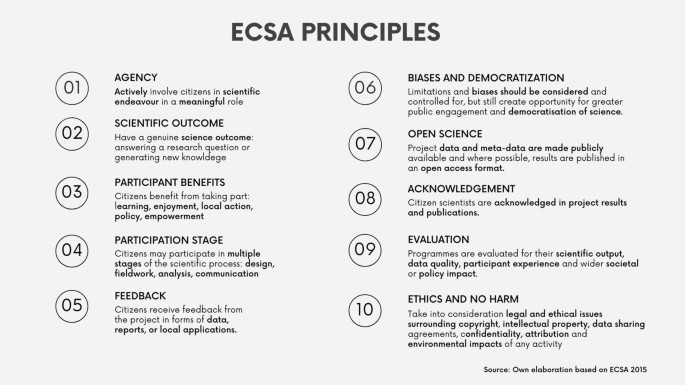
The ECSA principles for citizen science—illustrated in Fig. 1—were developed by the “Sharing best practice and building capacity” ECSA Working Group in 2015, led by the Natural History Museum of London (ECSA [2015](/article/10.1007/s13280-025-02151-7#ref-CR21 "ECSA. 2015. ECSA 10 principles of citizen science. https://doi.org/10.17605/OSF.IO/XPR2N
            .")). Communicating these principles with the wider agri-food system research community is becoming crucial, as many scholars and disciplines are gaining interest in participatory and CS methods while unaware of the existing principles that inform these practices (Ryan et al. [2018](/article/10.1007/s13280-025-02151-7#ref-CR46 "Ryan, S.F., N.L. Adamson, A. Aktipis, L.K. Andersen, R. Austin, L. Barnes, M.R. Beasley, K.D. Bedell, et al. 2018. The role of citizen science in addressing grand challenges in food and agriculture research. Proceedings of the Royal Society B: Biological Sciences 285: 20181977.
              https://doi.org/10.1098/rspb.2018.1977

            .")). Being aware of the principles is also important for funding agencies and evaluators who develop and evaluate agricultural and food systems research funding calls that include a societal engagement priority, as well as for authorities, organisations, and businesses that engage in participatory agri-food research projects or have interest in their outcomes.
Fig. 1
The alternative text for this image may have been generated using AI.
ECSA ten principles of citizen science ([2015](/article/10.1007/s13280-025-02151-7#ref-CR21 "ECSA. 2015. ECSA 10 principles of citizen science. https://doi.org/10.17605/OSF.IO/XPR2N
.")). Own elaboration using CanvaAs outlined above, this paper sets out to re-examine the ECSA principles under the specific lens of agricultural and food system research. This analysis is based on academic literature on agri-food CS, secondary data from agri-food CS projects (such as deliverables, website content, etc.) and the reflections of 11 scientists and practitioners from seven countries who are members of ECSA’s Agri-Food Working Group and who have participated in numerous agri-food CS projects. Additionally, the Agri-Food Working Group held a face-to-face two-day workshop in June 2023, which included an extended discussion and group work to map how the ECSA principles related to and can strengthen CS practices in agri-food research. Small groups were created and assigned one ECSA principle each to be discussed from an agri-food perspective. When the joint output was analysed, we identified similar arguments and themes across several principles, based on which, we put forward the following keystones, summarised in Fig. 2.
Fig. 2

The alternative text for this image may have been generated using AI.
Keystones guiding participatory research and their connection to ECSA principles. Own elaboration using Canva
Keystone 1. Meaningful participation and active inclusivity, is related to the role of citizens as citizen scientists and the promotion of greater public engagement in science. It includes principles that promote CS inclusivity, active, and meaningful engagement opportunities for citizens, and the acknowledgement and reduction of research biases to support science democratisation. Keystone 2. Measurable Outcomes and Benefits, refers to the expected types of results, their impacts, and the ways to measure such impacts. It includes principles that promote reflexive impacts of CS projects, or the promotion of scientific and non-scientific outcomes and benefits, and the encouragement of evaluation as a tool to measure the multiple effects of projects. Finally, keystone 3. Responsible Research and Innovation Processes, relates to the research process itself in the context of implementing a CS approach. It includes principles that promote responsible processes in CS design and development, including giving meaningful feedback to participants, acknowledging their participation, and following ethical research standards.
We propose the use of these keystones not to replace, but to more easily communicate the ECSA principles to researchers new to CS approaches and keen on adopting them, and for those who use them regularly and would like a briefer framework to apply and share in their practice. The main goal of the piece is to contribute to the discussion on how to better guide participatory agri-food research, and the new keystone framework is used as a mechanism to support this objective, while rooting the discussion in the wider citizen science literature. In the next sections, we discuss how each of these complementary and non-vertical keystones is relevant to agri-food research, in the hope that our work stimulates debate and fosters the implementation of the ECSA principles in this field.
Keystone 1: Meaningful participation and active inclusivity
Agri-food research has used participatory approaches and engaged citizens, including members of rural communities, for a long time, albeit often in roles with limited acknowledged agency in the research process itself (Davidson [2007](/article/10.1007/s13280-025-02151-7#ref-CR16 "Davidson, A.P. 2007. Participation, education, and pluralism: Towards a new extension ethic. Development in Practice 17: 39–50. https://doi.org/10.1080/09614520601092584
            .")). For example, farmers may contribute knowledge and information as part of field trials, surveys, interviews, storytelling, or focus groups, but are not always included in decisions on research questions and methods. Citizen science, in some cases, has also struggled with biased and non-inclusive engagement, limiting its potential impacts by engaging mainly predominantly white, male participants from higher education and affluent socio-economic backgrounds (Allf et al. [2022](/article/10.1007/s13280-025-02151-7#ref-CR3 "Allf, B.C., C.B. Cooper, L.R. Larson, R.R. Dunn, S.E. Futch, M. Sharova, and D. Cavalier. 2022. Citizen science as an ecosystem of engagement: Implications for learning and broadening participation. BioScience 72: 651–663.
              https://doi.org/10.1093/biosci/biac035

            .")). This pattern would exclude many agricultural and food service workers from agri-food citizen science. A similar pattern of lower levels of female participation has also been identified in agricultural research (Dey de Pryck and Elias [2023](/article/10.1007/s13280-025-02151-7#ref-CR18 "Dey de Pryck, J., and M. Elias. 2023. Promoting inclusive facilitation of participatory agricultural research for development. Development in Practice.
              https://doi.org/10.1080/09614524.2021.2013445

            .")). Several efforts are currently underway to make CS practices more accessible and inclusive for everyone, leading to best practice guidelines and inclusive design methods that promote science democratisation (Benyei et al. [2023](/article/10.1007/s13280-025-02151-7#ref-CR9 "Benyei, P., A. Skarlatidou, D. Argyriou, R. Hall, I. Theilade, N. Turreira-García, D. Latreche, A. Albert, et al. 2023. Challenges, strategies, and impacts of doing citizen science with marginalised and indigenous communities: Reflections from project coordinators. Citizen Science: Theory and Practice 8: 21.
              https://doi.org/10.5334/cstp.514

            ."); Veeckman et al. [2023](/article/10.1007/s13280-025-02151-7#ref-CR53 "Veeckman, C., S. Claes, L. Van Audenhove, and S. van der Graaf. 2023. A framework for making citizen science inclusive with storytelling methods. Frontiers in Environmental Science 11: 1211213.
              https://doi.org/10.3389/fenvs.2023.1211213

            .")), which research in the agri-food domain can benefit from.
From our analysis, three topics emerge as fundamental in this keystone: the agency of participants (practitioners from the food system), the availability of diverse and meaningful project roles, and the reduction of participation barriers and biases. Regarding participants’ agency, the definition of “active” participation is essential. Although the level of participation may vary among projects, it helps to differentiate projects where citizens are “being studied” (traditional social science) from projects where citizens are “those who study” (citizen science). For example, in agri-food research, a focus group might be used as a method to investigate farmers´ choice of crop varieties. However, if attending a focus group is the only role farmers play in the project, lacking any agency on how the research is conducted, it cannot be considered CS, and some would argue that it is not even “participatory” (Cornwall [2008](/article/10.1007/s13280-025-02151-7#ref-CR15 "Cornwall, A. 2008. Unpacking “Participation” models, meanings and practices. Community Development Journal 43: 269–283. https://doi.org/10.1093/cdj/bsn010
            .")). This keystone and the CS literature also suggest different possible roles for participants, depending on their level of involvement (Haklay et al. [2021](/article/10.1007/s13280-025-02151-7#ref-CR27 "Haklay, M., D. Fraisl, B. Greshake Tzovaras, S. Hecker, M. Gold, G. Hager, L. Ceccaroni, B. Kieslinger, et al. 2021. Contours of citizen science: A vignette study. Royal Society Open Science 8: 0–2.
              https://doi.org/10.1098/rsos.202108

            .")), and that every role taken should be meaningful, both to the participant and to achieving the goals of the research activity itself. However, CS participants in agriculture and food research often mostly provide data and are rarely involved in other stages of the research process. This could be due to a prevalence of “short-term” project formats, as deeper engagement levels require more in-depth training, trust, and commitment from citizen scientists (Ebitu et al. [2021](/article/10.1007/s13280-025-02151-7#ref-CR20 "Ebitu, L., H. Avery, K.A. Mourad, and J. Enyetu. 2021. Citizen science for sustainable agriculture–a systematic literature review. Land Use Policy 103: 105326.
              https://doi.org/10.1016/j.landusepol.2021.105326

            .")). Finally, this keystone also acknowledges the need to democratise science in order to avoid biases. In CS, anyone can take the role of a citizen scientist or co-researcher, independently of a citizens’ legal status, gender, age, education, or expertise. This is particularly significant in the agri-food sector, which employs about 40% of the global workforce, in many cases with poor and illegal working conditions (Davis et al. [2023](/article/10.1007/s13280-025-02151-7#ref-CR17 "Davis, B., E. Mane, L.Y. Gurbuzer, G. Caivano, N. Piedrahita, K. Schneider, N. Azhar, M. Benali, et al. 2023. Estimating global and country-level employment in agrifood systems. Rome: Food & Agriculture Org.
              https://doi.org/10.4060/cc4337en

            .")). Thus, citizen scientists in agri-food can be food consumers as well as agricultural workers and anyone else across the entire food system (Parsons et al. [2019](/article/10.1007/s13280-025-02151-7#ref-CR40 "Parsons, K., C. Hawkes, and R. Wells. 2019. Brief 2. What is the food system? A food policy perspective. In Rethinking food policy: A fresh approach to policy and practice. London: Centre for Food Policy.")), including those with less power and who might be more transient: migrant farm workers, agricultural students, elderly traditional farmers, female food vendors, food self-reliant indigenous communities, food community groups, food bank users, hobby food growers, food waste composting networks, amongst others. Broadening the diversity of participants’ profiles contributes not only to more equitable research frameworks, but also to a reduction in scientific biases, and thus, improved data quality and relevance (Graham et al. [2014](/article/10.1007/s13280-025-02151-7#ref-CR26 "Graham, M., B. Hogan, R.K. Straumann, and A. Medhat. 2014. Uneven geographies of user-generated information: Patterns of increasing informational poverty. Annals of the Association of American Geographers 104: 746–764.
              https://doi.org/10.1080/00045608.2014.910087

            ."); Nature [2015](/article/10.1007/s13280-025-02151-7#ref-CR35 "Nature. 2015. Rise of the citizen scientist. Nature Editorial.
              https://doi.org/10.1038/524265a

            .")).
Some key issues must be considered with regard to this keystone. From an implementation viewpoint, it is important to clarify expectations and priorities, including the overall aim and expected outcomes of the project (e.g. pest control monitoring for a farm, on-farm experiments for testing the rollout of a new technology, monitoring societal impact in food deserts, etc.). Also, CS methods and training must be offered in order to foster citizen participation throughout the different research stages. Tailoring such training to the specific context and audience will enable wider participation, remove barriers, and reduce biases. An inclusive training strategy during an agri-food CS project can support citizens moving from collecting data, to analysing them, and even setting up their own bottom-up experiments (Woods et al. [2020b](/article/10.1007/s13280-025-02151-7#ref-CR60 "Woods, M., D. Hemment, R. Ajates, A. Cobley, A. Xaver, and G. Konstantakopoulos. 2020b. GROW Citizens’ observatory: Leveraging the power of citizens, open data and technology to generate engagement, and action on soil policy and soil moisture monitoring. In IOP conference series: Earth and environmental science. Vol. 509. https://doi.org/10.1088/1755-1315/509/1/012060
            .")). As research teams grow to incorporate the participation of diverse citizen scientists, their background, interests, and worldviews—as in any professional research team–might affect the steps and decisions in which they are involved within the research process. One hurdle to overcome is the under-valued capacity of citizen scientists to engage in research design, funding procurement or science communication, sometimes due to a lack of self-perceived legitimacy (Benyei et al. [2020a](/article/10.1007/s13280-025-02151-7#ref-CR7 "Benyei, P., M. Pardo-de-Santayana, L. Aceituno-Mata, L. Calvet-Mir, M. Carrascosa-García, M. Rivera-Ferre, A. Perdomo-Molina, and V. Reyes-García. 2020a. Participation in citizen science: Insights from the CONECT-e case study. Science, Technology, & Human Values.
              https://doi.org/10.1177/0162243920948110

            .")). This is why the process of opening a wider range of project tasks to citizen scientists requires discussions on power sharing, uneven availability of time and resources and differentiating between willingness, motivations, and evolving levels of ability to participate (Cornwall [2008](/article/10.1007/s13280-025-02151-7#ref-CR15 "Cornwall, A. 2008. Unpacking “Participation” models, meanings and practices. Community Development Journal 43: 269–283.
              https://doi.org/10.1093/cdj/bsn010

            .")). Also, in the agri-food domain, applying the principles of this keystone involves reverting a long history of colonial farming dynamics that still shape food systems today, from dietary preferences (e.g. tea in UK) to development approaches (e.g. agricultural links with former colonies). Many food practices have emerged in the context of dispossession of indigenous peoples, stratification of food production and distribution based on ethnicity, class and citizenship (Kimura and Kinchy [2020](/article/10.1007/s13280-025-02151-7#ref-CR30 "Kimura, A.H., and A. Kinchy. 2020. Citizen science in North American agri-food systems: Lessons learned. Citizen Science: Theory and Practice 5: 1–12.
              https://doi.org/10.5334/CSTP.246

            .")). Furthermore, the power of large corporations on practices and norms in the production, distribution and consumption of food should also be considered.
This keystone of agri-food citizen science can guide research that is more grounded and relevant to the communities involved, also helping to increase their agency. These benefits of strong and diverse stakeholder engagement in research projects have long been recognised (Pateman and West [2023](/article/10.1007/s13280-025-02151-7#ref-CR41 "Pateman, R.M., and S.E. West. 2023. Citizen science: Pathways to impact and why participant diversity matters. Citizen Science: Theory and Practice 8: 50. https://doi.org/10.5334/cstp.569
            .")). For example, farmers involved in networks that include researchers, advisers, and other stakeholders are known to be more likely to innovate than isolated ones, and ensure the sustainability of proposed innovations (Barzman et al. [2015](/article/10.1007/s13280-025-02151-7#ref-CR5 "Barzman, M., P. Bàrberi, A.N.E. Birch, P. Boonekamp, S. Dachbrodt-Saaydeh, B. Graf, B. Hommel, J.E. Jensen, et al. 2015. Eight principles of integrated pest management. Agronomy for Sustainable Development.
              https://doi.org/10.1007/s13593-015-0327-9

            .")). Participants that have a higher level of involvement in projects are also more likely to engage in fund raising and dissemination, thereby fostering increased new participant engagement in subsequent stages (Arnstein [1969](/article/10.1007/s13280-025-02151-7#ref-CR4 "Arnstein, S.R. 1969. A ladder of citizen participation. Journal of the American Institute of Planners 35: 216–224.
              https://doi.org/10.1080/01944366908977225

            .")). Expanding research teams through CS can contribute to democratising the generation of scientific knowledge (Pearce [2010](/article/10.1007/s13280-025-02151-7#ref-CR42 "Pearce, J. 2010. Co-producing knowledge critical reflections on researching participation. In Participation and democracy in the twenty-first century city, 34–50.
              https://doi.org/10.1057/9780230277342_2

            .")), resulting in greater public engagement with the potential to disrupt the dominant agri-food system, challenging power dynamics, particularly when involving previously marginalised participants.
Keystone 2: Measurable outcomes and benefits
Pateman and West ([2023](/article/10.1007/s13280-025-02151-7#ref-CR41 "Pateman, R.M., and S.E. West. 2023. Citizen science: Pathways to impact and why participant diversity matters. Citizen Science: Theory and Practice 8: 50. https://doi.org/10.5334/cstp.569
            .")) and Van Noordwijk et al. ([2021](/article/10.1007/s13280-025-02151-7#ref-CR36 "van Noordwijk, T. C. G. E., I. Bishop, S. Staunton-Lamb, A. Oldfield, S. Loiselle, H. Geoghegan, and L. Ceccaroni. 2021. Creating positive environmental impact through citizen science. In The science of citizen science.
              https://doi.org/10.1007/978-3-030-58278-4_19

            .")) have notably identified various impact pathways for CS projects, while Wehn et al. ([2021](/article/10.1007/s13280-025-02151-7#ref-CR56 "Wehn, U., M. Gharesifard, L. Ceccaroni, H. Joyce, R. Ajates, S. Woods, A. Bilbao, S. Parkinson, et al. 2021. Impact assessment of citizen science: State of the art and guiding principles for a consolidated approach. Sustainability Science.
              https://doi.org/10.1007/s11625-021-00959-2

            .")) have developed principles for a consolidated approach to impact assessment in CS. Moreover, in the agri-food domain in particular, a number of studies have highlighted the importance of CS in generating scientific, practice, and policy impacts (Ryan et al. [2018](/article/10.1007/s13280-025-02151-7#ref-CR46 "Ryan, S.F., N.L. Adamson, A. Aktipis, L.K. Andersen, R. Austin, L. Barnes, M.R. Beasley, K.D. Bedell, et al. 2018. The role of citizen science in addressing grand challenges in food and agriculture research. Proceedings of the Royal Society B: Biological Sciences 285: 20181977.
              https://doi.org/10.1098/rspb.2018.1977

            ."); van de Gevel et al. [2020](/article/10.1007/s13280-025-02151-7#ref-CR52 "van de Gevel, J., J. van Etten, and S. Deterding. 2020. Citizen science breathes new life into participatory agricultural research. A review. Agronomy for Sustainable Development 40: 1–17.
              https://doi.org/10.1007/s13593-020-00636-1

            .")). Still, agri-food research has traditionally followed an approach to project evaluation that values exclusively research and innovation outputs (Turner et al. [2022](/article/10.1007/s13280-025-02151-7#ref-CR51 "Turner, J.A., B. Guesmi, J.M. Gil, K. Heanue, M. Sierra, H. Percy, I. Bortagaray, N. Chams, et al. 2022. Evaluation capacity building in response to the agricultural research impact agenda: Emerging insights from Ireland, Catalonia (Spain), New Zealand, and Uruguay. Evaluation and Program Planning 94: 102127.
              https://doi.org/10.1016/j.evalprogplan.2022.102127

            .")). Thus, the outcomes and benefits of participatory approaches to agri-food research need to go further, as there are many aspects of participation and areas of the food system that are not always considered in impact assessment (Mourad et al. [2020](/article/10.1007/s13280-025-02151-7#ref-CR34 "Mourad, K.A., S.H. Hosseini, and H. Avery. 2020. The role of citizen science in sustainable agriculture. Sustainability (Switzerland) 12: 1–15.
              https://doi.org/10.3390/su122410375

            ."); Reynolds et al. [2021](/article/10.1007/s13280-025-02151-7#ref-CR45 "Reynolds, C., L. Oakden, S. West, R. Pateman, and C. Elliott. 2021. Citizen science and food: A review. London.")).
This second keystone highlights three main ideas based on the ECSA principles it encompasses. First that, while having a scientific outcome (mandatory in order to be called “science”), CS should also aim to have impacts beyond the traditional scientific realm, into the educational, economic, socio-cultural, and policy spheres. Second, that such impacts and outcomes should be evaluated based on a diversity of social, political, and scientific indicators. Third, that benefits for participants might be different than those envisioned by scientists. While citizen science must be a research activity and thus provide scientific outcomes in any of the formats the multiple scientific disciplines foresee (from natural sciences, to social sciences and humanities), an exclusive emphasis on scientific outcomes may deter the engagement of stakeholders from diverse backgrounds, or constitute barriers for other types of knowledge beyond academic knowledge to emerge (Benyei et al. [2020a](/article/10.1007/s13280-025-02151-7#ref-CR7 "Benyei, P., M. Pardo-de-Santayana, L. Aceituno-Mata, L. Calvet-Mir, M. Carrascosa-García, M. Rivera-Ferre, A. Perdomo-Molina, and V. Reyes-García. 2020a. Participation in citizen science: Insights from the CONECT-e case study. Science, Technology, & Human Values. https://doi.org/10.1177/0162243920948110
            .")). Indeed, in agri-food CS it is common that the subject of research is directly linked to participants’ business and economic situation, e.g. farmers contributing to the investigation of farmland soil health, which can have direct effects on yield and hence, farmers’ income. Thus, citizen scientists’ motivations to participate in an agri-food project, and their expectations in relation to project outcomes and impact might go beyond the ones that are written in the project proposal (Ryan et al. [2018](/article/10.1007/s13280-025-02151-7#ref-CR46 "Ryan, S.F., N.L. Adamson, A. Aktipis, L.K. Andersen, R. Austin, L. Barnes, M.R. Beasley, K.D. Bedell, et al. 2018. The role of citizen science in addressing grand challenges in food and agriculture research. Proceedings of the Royal Society B: Biological Sciences 285: 20181977.
              https://doi.org/10.1098/rspb.2018.1977

            .")). For example, NGOs or local residents might initiate agri-food CS projects to raise awareness of social injustices such as land grabs or food deserts, or to stop damaging farming practices by collecting impact indicators in affected ecosystems, or, map illegal deforestation and land uses (Kimura and Kinchy [2020](/article/10.1007/s13280-025-02151-7#ref-CR30 "Kimura, A.H., and A. Kinchy. 2020. Citizen science in North American agri-food systems: Lessons learned. Citizen Science: Theory and Practice 5: 1–12.
              https://doi.org/10.5334/CSTP.246

            .")). Considering this and given the multi-actor, multi-output, and transformative character of participatory agri-food research, including more-than-academic outcomes in evaluation become crucial. Moreover, to avoid exploiting citizen scientists’ time and goodwill, feasible and tailored rewards and benefits must be considered collectively from the beginning of the project. In the case of agri-food CS, this reward could be improved practices on pest control, water management, or soil management (Ryan et al. [2018](/article/10.1007/s13280-025-02151-7#ref-CR46 "Ryan, S.F., N.L. Adamson, A. Aktipis, L.K. Andersen, R. Austin, L. Barnes, M.R. Beasley, K.D. Bedell, et al. 2018. The role of citizen science in addressing grand challenges in food and agriculture research. Proceedings of the Royal Society B: Biological Sciences 285: 20181977.
              https://doi.org/10.1098/rspb.2018.1977

            ."); Woods et al. [2020b](/article/10.1007/s13280-025-02151-7#ref-CR60 "Woods, M., D. Hemment, R. Ajates, A. Cobley, A. Xaver, and G. Konstantakopoulos. 2020b. GROW Citizens’ observatory: Leveraging the power of citizens, open data and technology to generate engagement, and action on soil policy and soil moisture monitoring. In IOP conference series: Earth and environmental science. Vol. 509.
              https://doi.org/10.1088/1755-1315/509/1/012060

            .")) that could translate into health outputs from reduced pesticide use, savings and self-pride, or other less tangible benefits, such as improved interactions and learning from fellow farmers or citizens (Benyei et al. [2020b](/article/10.1007/s13280-025-02151-7#ref-CR8 "Benyei, P., L. Aceituno-Mata, L. Calvet-Mir, J. Tardío, M. Pardo-de-Santayana, D. García-del-Amo, M. Rivera-Ferre, M. Molina-Simón, et al. 2020b. Seeds of change: Reversing traditional agroecological knowledge’s erosion through a citizen science school program in Catalonia. Ecology and Society 25: 19.
              https://doi.org/10.5751/ES-11471-250219

            .")). Indeed, the different stakeholders can benefit from gaining ownership and agency over project results, providing them with the evidence and the skills that can empower them to take further actions and contribute to broader social movements (Benyei et al. [2023](/article/10.1007/s13280-025-02151-7#ref-CR9 "Benyei, P., A. Skarlatidou, D. Argyriou, R. Hall, I. Theilade, N. Turreira-García, D. Latreche, A. Albert, et al. 2023. Challenges, strategies, and impacts of doing citizen science with marginalised and indigenous communities: Reflections from project coordinators. Citizen Science: Theory and Practice 8: 21.
              https://doi.org/10.5334/cstp.514

            .")).
This keystone encourages researchers to consider the potential tensions between academics and citizen scientists in relation to possibly different views on the expected project goals to be evaluated, and the challenges of involving stakeholders beyond academia in project evaluation as well as delivering evaluation reports that are meaningful and timely, both to funders and participants. These tensions arising from differing constraints and outcome priorities of academic and non-academic participants, are issues extensively discussed in the literature (Eitzel et al. [2017](/article/10.1007/s13280-025-02151-7#ref-CR22 "Eitzel, M.V., J.L. Cappadonna, C. Santos-Lang, R.E. Duerr, A. Virapongse, S.E. West, C.C.M. Kyba, A. Bowser, et al. 2017. Citizen science terminology matters: Exploring key terms. Citizen Science: Theory and Practice 2: 1. https://doi.org/10.5334/cstp.96
            ."); Ebitu et al. [2021](/article/10.1007/s13280-025-02151-7#ref-CR20 "Ebitu, L., H. Avery, K.A. Mourad, and J. Enyetu. 2021. Citizen science for sustainable agriculture–a systematic literature review. Land Use Policy 103: 105326.
              https://doi.org/10.1016/j.landusepol.2021.105326

            .")). Also, during the data collection phase, conflicts may arise between scientific goals and participants’ food and farming practices, e.g. projects investigating sustainable agricultural practices in a region characterised by intensive farming. Thus, methodologically, co-created and validated data collection protocols and tools will enhance the knowledge transfer and implementation of project outcomes, and their credibility and acceptability by different stakeholder groups. It is key to realise that such collaborations have the potential to not only change citizen scientists’ perceptions, but also broaden scientists’ understanding and perception of other professionals involved, with a potentially profound impact, e.g. on their future research priorities (Benyei et al. [2023](/article/10.1007/s13280-025-02151-7#ref-CR9 "Benyei, P., A. Skarlatidou, D. Argyriou, R. Hall, I. Theilade, N. Turreira-García, D. Latreche, A. Albert, et al. 2023. Challenges, strategies, and impacts of doing citizen science with marginalised and indigenous communities: Reflections from project coordinators. Citizen Science: Theory and Practice 8: 21.
              https://doi.org/10.5334/cstp.514

            .")). Furthermore, involving citizens in evaluation can be challenging, and the team must ensure a safe space to encourage participants to provide constructive feedback in suitable formats, on things that went well, as well as areas to improve. Evaluation methods might encounter differences not only in spatial and temporal horizons considered, but also in terms of the weight attributed to the various aspects being evaluated. Disciplinary, social, and professional hierarchies within teams can be an issue when establishing these priorities and also when setting data quality standards (Sumberg et al. [2013](/article/10.1007/s13280-025-02151-7#ref-CR49 "Sumberg, J., J. Thompson, and P. Woodhouse. 2013. Why agronomy in the developing world has become contentious. Agriculture and Human Values 30: 71–83.
              https://doi.org/10.1007/S10460-012-9376-8/METRICS

            .")). Indeed, measuring data quality in participatory projects presents several challenges (Steinke and van Etten [2017](/article/10.1007/s13280-025-02151-7#ref-CR47 "Steinke, J., and J. van Etten. 2017. Gamification of farmer-participatory priority setting in plant breeding: Design and validation of “AgroDuos.” Journal of Crop Improvement 31: 356–378.
              https://doi.org/10.1080/15427528.2017.1303801

            .")). Thus, agreement on terminology must be considered carefully (Eitzel et al. [2017](/article/10.1007/s13280-025-02151-7#ref-CR22 "Eitzel, M.V., J.L. Cappadonna, C. Santos-Lang, R.E. Duerr, A. Virapongse, S.E. West, C.C.M. Kyba, A. Bowser, et al. 2017. Citizen science terminology matters: Exploring key terms. Citizen Science: Theory and Practice 2: 1.
              https://doi.org/10.5334/cstp.96

            .")). This is particularly important in agri-food research, where a multitude of tools, definitions, and practices exist for capturing “social impact” (Janker and Mann [2020](/article/10.1007/s13280-025-02151-7#ref-CR28 "Janker, J., and S. Mann. 2020. Understanding the social dimension of sustainability in agriculture: A critical review of sustainability assessment tools. Environment, Development and Sustainability.
              https://doi.org/10.1007/s10668-018-0282-0

            .")). Similarly, many other key concepts in agri-food research lack an agreed definition and/or operationalisation (e.g. sustainable and healthy diets, local food, or even healthy soil) mainly due to the high number of factors determining each of these constructs. In addition, evaluation timing and methods pose important considerations, and while evaluation is often thought to take place at the end of a project, impact targets should be predefined together with participants from the beginning of the collaboration (Wehn et al. [2021](/article/10.1007/s13280-025-02151-7#ref-CR56 "Wehn, U., M. Gharesifard, L. Ceccaroni, H. Joyce, R. Ajates, S. Woods, A. Bilbao, S. Parkinson, et al. 2021. Impact assessment of citizen science: State of the art and guiding principles for a consolidated approach. Sustainability Science.
              https://doi.org/10.1007/s11625-021-00959-2

            .")). Finally, the involvement of relevant policy makers from the beginning of the project, e.g. through the creation of observatory policy interfaces or liaising with national statistics units, can help link the project outcomes with policy frameworks such as the Common Agricultural Policy (CAP), local farming schemes, rural repopulation programmes, and others (Woods et al. [2020b](/article/10.1007/s13280-025-02151-7#ref-CR60 "Woods, M., D. Hemment, R. Ajates, A. Cobley, A. Xaver, and G. Konstantakopoulos. 2020b. GROW Citizens’ observatory: Leveraging the power of citizens, open data and technology to generate engagement, and action on soil policy and soil moisture monitoring. In IOP conference series: Earth and environmental science. Vol. 509.
              https://doi.org/10.1088/1755-1315/509/1/012060

            .")). More specifically, due to its complex links of natural and social dimensions, a global food policy area to which agri-food CS is contributing, is through measuring SDG indicators related to water, soil, zero hunger, good health, life on land, and below water, etc. (Ajates et al. [2020](/article/10.1007/s13280-025-02151-7#ref-CR2 "Ajates, R., G. Hager, P. Georgiadis, S. Coulson, M. Woods, and D. Hemment. 2020. Local action with global impact: The case of the grow observatory and the sustainable development goals. Sustainability (Switzerland) 12: 10518.
              https://doi.org/10.3390/su122410518

            ."); Fraisl et al. [2020](/article/10.1007/s13280-025-02151-7#ref-CR24 "Fraisl, D., J. Campbell, L. See, U. Wehn, J. Wardlaw, M. Gold, I. Moorthy, R. Arias, et al. 2020. Mapping citizen science contributions to the UN sustainable development goals. Sustainability Science.
              https://doi.org/10.1007/s11625-020-00833-7

            .")).
Agri-food CS is well placed to have outcomes that span from the hyperlocal to the global and that can be demonstrated through a more comprehensive evaluation (Ajates et al. [2020](/article/10.1007/s13280-025-02151-7#ref-CR2 "Ajates, R., G. Hager, P. Georgiadis, S. Coulson, M. Woods, and D. Hemment. 2020. Local action with global impact: The case of the grow observatory and the sustainable development goals. Sustainability (Switzerland) 12: 10518. https://doi.org/10.3390/su122410518
            .")). Tools for co-designing and co-evaluating impacts of agri-food CS projects exist and can be adapted to different project needs (Woods et al. [2020a](/article/10.1007/s13280-025-02151-7#ref-CR59 "Woods, M., R. Ajates, N. Gulari, S. Coulson, and GROW Consortium. 2020a. Co-evaluation tool.
              https://doi.org/10.20933/100001180

            .")). Thus, this keystone maximises the reach of project documented and multilevel impacts that can promote the funding and use of participatory approaches in agri-food research and beyond.
Keystone 3: Responsible research and innovation processes (RRI)
Discussion about RRI in agri-food research and development is increasingly popular, especially in the field of agricultural digitalisation (Bellon-Maurel et al. [2022](/article/10.1007/s13280-025-02151-7#ref-CR6 "Bellon-Maurel, V., E. Lutton, P. Bisquert, L. Brossard, S. Chambaron-Ginhac, P. Labarthe, P. Lagacherie, F. Martignac, et al. 2022. Digital revolution for the agroecological transition of food systems: A responsible research and innovation perspective. Agricultural Systems 203: 103524. https://doi.org/10.1016/j.agsy.2022.103524
            .")). Tricarico et al. ([2020](/article/10.1007/s13280-025-02151-7#ref-CR50 "Tricarico, L., A. Galimberti, A. Campanaro, C. Magoni, and M. Labra. 2020. Experimenting with RRI tools to drive sustainable agri-food research: The SASS case study from Sub-Saharan Africa. Sustainability (Switzerland) 12: 827.
              https://doi.org/10.3390/su12030827

            .")) have highlighted four RRI dimensions that must be examined: (1) The processes of mutual exchange in setting and re-driving the direction of research and innovation (Diversity & Inclusiveness); (2) socially desirable science and innovation (Anticipation); (3) participatory and accessible methodologies experimented in the research agenda and the dissemination of its outcomes (Openness and Transparency); (4) flexible, reflexive, and socially responsible governance of the process (Responsiveness and Adaptation to Change). However, a key differentiating aspect of CS approaches with regard to RRI is the active role of societal actors in research, as we discussed in Keystone 1.
Keystone 3, while being in dialogue with the RRI approach, incorporates the specificities of CS, where two main topics are fundamental: the ways in which results and data are shared with the citizen scientists involved in the project and more broadly with wider society, and the ethical principles CS is set to follow. Facilitating access to results and data and providing project feedback to participants in a suitable way are two crucial separate but intertwined elements of this keystone. While providing feedback to participants can be seen as an essential aspect contributing to the responsible governance of the research process, making results and data accessible contributes to a broader openness and transparency goal (Woods et al. [2020b](/article/10.1007/s13280-025-02151-7#ref-CR60 "Woods, M., D. Hemment, R. Ajates, A. Cobley, A. Xaver, and G. Konstantakopoulos. 2020b. GROW Citizens’ observatory: Leveraging the power of citizens, open data and technology to generate engagement, and action on soil policy and soil moisture monitoring. In IOP conference series: Earth and environmental science. Vol. 509. https://doi.org/10.1088/1755-1315/509/1/012060
            ."); Bellon-Maurel et al. [2022](/article/10.1007/s13280-025-02151-7#ref-CR6 "Bellon-Maurel, V., E. Lutton, P. Bisquert, L. Brossard, S. Chambaron-Ginhac, P. Labarthe, P. Lagacherie, F. Martignac, et al. 2022. Digital revolution for the agroecological transition of food systems: A responsible research and innovation perspective. Agricultural Systems 203: 103524.
              https://doi.org/10.1016/j.agsy.2022.103524

            .")). Feedback can be more specifically tailored to the needs or expectations of participants, while making research outputs accessible should follow guidance from the wider movement of scientific openness and institutional policies on open data (Wehn et al. [2024](/article/10.1007/s13280-025-02151-7#ref-CR57 "Wehn, U., R. Ajates, C. Mandeville, L. Somerwill, G. Kragh, and M. Haklay. 2024. Opening science to society: How to progress societal engagement into (open) science policies. Royal Society Open Science 11: 231309.
              https://doi.org/10.1098/rsos.231309

            .")). ECSA and the Association for Advancing the Participatory Sciences (formerly known as the US CS Association) have highlighted strong synergies between CS and open science movements, with specific working groups dedicated to this topic (see ECSA and AAPS websites[Footnote 2](#Fn2)). The growing number of CS projects adhering to this movement in health and genetic research projects (DITOs Consortium [2017](/article/10.1007/s13280-025-02151-7#ref-CR19 "DITOs Consortium. 2017. “Do it yourself biotechnology” (DIYBio) for open, inclusive, responsible Biotechnology. DITOs policy brief 2.")) can serve as inspiration and guidance in CS agri-food research. With the rise of the genetic sequencing of plants, fungi, and animals used in farming and food processing, this movement sets to promote open data, open code, and participatory processes that benefit communities and avoid biopiracy (Calvet-Mir et al. [2018](/article/10.1007/s13280-025-02151-7#ref-CR12 "Calvet-Mir, L., P. Benyei, L. Aceituno-Mata, M. Pardo-de-Santayana, D. López-García, M. Carrascosa-García, A. Perdomo-Molina, and V. Reyes-García. 2018. The contribution of traditional agroecological knowledge as a digital commons to agroecological transitions: The case of the CONCT-e platform. Sustainability 10: 3214.
              https://doi.org/10.3390/su10093214

            ."); Ajates [2023](/article/10.1007/s13280-025-02151-7#ref-CR1 "Ajates, R. 2023. From land enclosures to lab enclosures: Digital sequence information, cultivated biodiversity and the movement for open source seed systems. Journal of Peasant Studies 50: 1–29.
              https://doi.org/10.1080/03066150.2022.2121648

            .")). Indeed, opening data is one of the key differentiating aspects that CS brings to participatory agri-food research, as in many cases, data collected through the latter were kept within the projects, and participants’ knowledge was considered—just as seeds or plants—another resource that could be appropriated and capitalised (Birch et al. [2010](/article/10.1007/s13280-025-02151-7#ref-CR10 "Birch, K., L. Levidow, and T. Papaioannou. 2010. Sustainable capital? The neoliberalization of nature and Knowledge in the European “Knowledge-based bio-economy.” Sustainability 2: 2898–2918.
              https://doi.org/10.3390/su2092898

            .")). Regarding ethical principles, this keystone highlights the need to follow ethical guidelines and consider the regulatory framework that comes with the benefit-sharing principle and no-harm rule of any scientific research. Ethical issues such as data sovereignty or human rights protection in agri-food CS have been discussed before by CS practitioners (Reyes-Garciá et al. [2022](/article/10.1007/s13280-025-02151-7#ref-CR44 "Reyes-Garciá, V., A. Tofighi-Niaki, B.J. Austin, P. Benyei, F. Danielsen, Á. Fernández-Llamazares, A. Sharma, R. Soleymani-Fard, et al. 2022. Data sovereignty in community-based environmental monitoring: Toward equitable environmental data governance. BioScience 72: 714–717.
              https://doi.org/10.1093/biosci/biac048

            ."); Benyei et al. [2023](/article/10.1007/s13280-025-02151-7#ref-CR9 "Benyei, P., A. Skarlatidou, D. Argyriou, R. Hall, I. Theilade, N. Turreira-García, D. Latreche, A. Albert, et al. 2023. Challenges, strategies, and impacts of doing citizen science with marginalised and indigenous communities: Reflections from project coordinators. Citizen Science: Theory and Practice 8: 21.
              https://doi.org/10.5334/cstp.514

            .")). Although, in principle, most agri-food participatory research has to be approved by institutional ethical review boards, the literature and this keystone remind us that ethics go beyond ticking pre-defined boxes and should engage more deeply into—sometimes, uncomfortable—discussions between researchers and participants about power sharing and participants’ rights. A specific aspect of ethics covered in this keystone is attribution. Research within the agri-food sector has increasingly acknowledged the significance of involving stakeholders, encompassing farmers and agri-food businesses, in the outcomes and publications of projects (Jones et al. [2014](/article/10.1007/s13280-025-02151-7#ref-CR29 "Jones, K., L.L. Glenna, and E. Weltzien. 2014. Assessing participatory processes and outcomes in agricultural research for development from participants’ perspectives. Journal of Rural Studies 35: 91–100.
              https://doi.org/10.1016/j.jrurstud.2014.04.010

            .")). The attribution of communities collectively credited in the acknowledgement section of journal articles is a common manifestation of participatory research ethics. However, defining what acknowledgement entails for individual participants, requires joint consideration. Acknowledging research participants is centred on participatory research ethics that require the perception of citizen scientists as active contributors. This is further emphasised by processes of knowledge co-production (Pearce [2010](/article/10.1007/s13280-025-02151-7#ref-CR42 "Pearce, J. 2010. Co-producing knowledge critical reflections on researching participation. In Participation and democracy in the twenty-first century city, 34–50.
              https://doi.org/10.1057/9780230277342_2

            .")). Without trustable collaborations with participants, acknowledgement might remain an ethically motivated, but merely symbolic gesture. This keystone opens the floor to discussing how a dynamic view of acknowledgement, involving participants in the co-definition of what is expected, could be a better approach, potentially leading to alternative forms of publication, outputs, and enhanced engagement.
With regard to adequate levels of feedback, this third keystone notes areas for agreement. First, establishing what appropriate feedback is might become challenging when working with multiple stakeholders. As noted by De Vries et al. ([2019](/article/10.1007/s13280-025-02151-7#ref-CR55 "de Vries, M., A. Land-Zandstra, and I. Smeets. 2019. Citizen scientists’ preferences for communication of scientific output: A literature review. Citizen Science: Theory and Practice 4. https://doi.org/10.5334/cstp.136
            .")), in general “little research has thoroughly investigated the extent to which citizen scientists find communication of scientific output to be important” (pp.1), and even less in the area of agri-food. Moreover, even in participatory projects, feedback and access to data/results may not be relevant for participants, especially when limited to websites, scientific reports, or raw data, failing to impact participants’ practices. For instance, in the FARM project,[Footnote 3](#Fn3) when asked about what the agricultural students expected from the project, most students did not mention feedback nor data. To tailor feedback and results/data sharing appropriately, and considering that feedback provision has a positive impact on participants’ motivation to further engage in CS (Cappa et al. [2020](/article/10.1007/s13280-025-02151-7#ref-CR13 "Cappa, F., F. Rosso, L. Giustiniano, and M. Porfiri. 2020. Nudging and citizen science: The effectiveness of feedback in energy-demand management. Journal of Environmental Management 269: 110759.
              https://doi.org/10.1016/j.jenvman.2020.110759

            .")), a feedback form or community engagement protocol should be established at the start of a CS project and be monitored throughout its implementation. This protocol needs to draw on early discussions on project output criteria (see Keystone 2). It should also include relevant timing, content, and form of feedback. Moreover, it should consider to which extent the feedback should be open to everyone or available and tailored to certain project partners, as this might have ethical, financial, or legal consequences. Indeed, a second related issue central to this keystone refers to data privacy. Opening data might be particularly impactful for agri-food citizen scientists, as data sensitivity, particularly concerning farmland or consumer choices, may directly affect farmers’ livelihoods and business interests, and consumers’ privacy. For instance, discovering protected species or flood risk could lead to land designation and/or land value changes, or finding negative environmental impacts could further polarise farmer-environmentalist discussions (Burton et al. [2008](/article/10.1007/s13280-025-02151-7#ref-CR11 "Burton, R.J.F., C. Kuczera, and G. Schwarz. 2008. Exploring farmers’ cultural resistance to voluntary agri-environmental schemes. Sociologia Ruralis 48: 16–37.
              https://doi.org/10.1111/j.1467-9523.2008.00452.x

            .")). In other cases, participants in CS projects addressing health or environmental impacts of industrial food supply chains might even face intimidation by industry stakeholders, or the research results might be put under special scrutiny for being a CS project (Kimura and Kinchy [2020](/article/10.1007/s13280-025-02151-7#ref-CR30 "Kimura, A.H., and A. Kinchy. 2020. Citizen science in North American agri-food systems: Lessons learned. Citizen Science: Theory and Practice 5: 1–12.
              https://doi.org/10.5334/CSTP.246

            .")), especially if these projects challenge the existing norms of dominant agricultural practices.
Moreover, potential data use by third parties, such as big companies modelling food markets, raises concerns about consumers’ information misuse and lack of protection. This is why a set of ethical principles should always be implemented in parallel. As agri-food research deals with peoples’ basis for survival (food) or income (farming), extra ethical and legal considerations might be necessary. For instance, the issue of patents in agri-food participatory research requires early and deep consideration given its potential legal, ethical, and economic impacts (Fredriksson [2021](/article/10.1007/s13280-025-02151-7#ref-CR25 "Fredriksson, M. 2021. Open source seeds and the revitalization of local knowledge. Sustainability (Switzerland) 13: 12270. https://doi.org/10.3390/su132112270
            .")). Some projects choose not to patent or favour other forms of licencing (e.g. copy-left), and it is common to encounter challenges when private companies exploit shared knowledge without proper compensation to the less privileged parts involved (Calvet-Mir et al. [2018](/article/10.1007/s13280-025-02151-7#ref-CR12 "Calvet-Mir, L., P. Benyei, L. Aceituno-Mata, M. Pardo-de-Santayana, D. López-García, M. Carrascosa-García, A. Perdomo-Molina, and V. Reyes-García. 2018. The contribution of traditional agroecological knowledge as a digital commons to agroecological transitions: The case of the CONCT-e platform. Sustainability 10: 3214.
              https://doi.org/10.3390/su10093214

            .")). Indeed, biopiracy is a significant concern in participatory agri-food research, with considerable impacts in terms of community’s food sovereignty and access rights to natural resources (Ajates [2023](/article/10.1007/s13280-025-02151-7#ref-CR1 "Ajates, R. 2023. From land enclosures to lab enclosures: Digital sequence information, cultivated biodiversity and the movement for open source seed systems. Journal of Peasant Studies 50: 1–29.
              https://doi.org/10.1080/03066150.2022.2121648

            .")). To help manage these issue, CS projects must establish a data sharing protocol that is agreed upon with participants before sharing any data, and ideally, before data collection has started, to make the project as open as possible and as closed as necessary. Thus, it is key to identify and deal with any potential privacy concerns before collecting and opening the data. Robust data management strategies will consider different types of outcomes, how they are going to be shared, and who will likely benefit from them. Moreover, it is important to remember that access does not equal usability; thus, user requirements and skills must be taken into account in data sharing policies. A third issue relates to the multiple and sometimes conflicting ways in which recognition and benefit sharing materialises in projects. A big discussion has been ongoing in the CS community about participant economic compensation, the role this might have in promoting more participant diversity and the impacts it can also have in terms of the relationship between participants and researchers (Benyei et al. [2023](/article/10.1007/s13280-025-02151-7#ref-CR9 "Benyei, P., A. Skarlatidou, D. Argyriou, R. Hall, I. Theilade, N. Turreira-García, D. Latreche, A. Albert, et al. 2023. Challenges, strategies, and impacts of doing citizen science with marginalised and indigenous communities: Reflections from project coordinators. Citizen Science: Theory and Practice 8: 21.
              https://doi.org/10.5334/cstp.514

            .")). For instance, in agri-food CS, paying farmers for their time and effort is starting to be a common practice (see RADIANT project,[Footnote 4](#Fn4)), although it can create conflicts when resources are limited and not all farmers can participate. In a situation with numerous contributors or groups, rewards and recognition are better preceded by a consultation and alignment of expectations. The symbolic recognition of contributions such as co-authorship, active recognition with delegated responsibilities such as co-writing, co-organising and co-chairing research tasks and workshops, community champion roles (Woods et al. [2020b](/article/10.1007/s13280-025-02151-7#ref-CR60 "Woods, M., D. Hemment, R. Ajates, A. Cobley, A. Xaver, and G. Konstantakopoulos. 2020b. GROW Citizens’ observatory: Leveraging the power of citizens, open data and technology to generate engagement, and action on soil policy and soil moisture monitoring. In IOP conference series: Earth and environmental science. Vol. 509.
              https://doi.org/10.1088/1755-1315/509/1/012060

            .")), offer different strategies for appreciating participants’ contributions. Moreover, an advocacy lens can empower communities, leveraging diverse forms of acknowledgement for change and community organisation, which is especially relevant for agricultural cooperative endeavours in specific geographical areas.
In sum, co-decisions on the most appropriate form of acknowledgement and rewards, data, and result sharing and feedback are necessary with farmers, consumers, and other stakeholders to ensure their ongoing commitment to the research. This keystone sets the field for more ethical, just, and equitable agri-food research practices and minimises the risks of projects having a negative impact on the communities they work with.
Conclusions and way forward
Agri-food research is shaped by the myriad of disciplinary lenses and methods it applies, and the far-reaching implications of food in society. The food system is composed of complex socio-ecological systems that are often characterised by policy, technological, environmental, and social aspects that require a transdisciplinary approach (Lamine [2018](/article/10.1007/s13280-025-02151-7#ref-CR31 "Lamine, C. 2018. Transdisciplinarity in research about agrifood systems transitions: A pragmatist approach to processes of attachment. Sustainability (Switzerland) 10: 1241. https://doi.org/10.3390/su10041241
.")). Citizen science in agri-food opens up a common umbrella under which diverse participatory scientific activities and methods—such as farmer-based biodiversity monitoring, participatory plant breeding, rapid rural appraisal, food deserts mapping, etc.—can be in dialogue and create wider public engagement in addressing urgent food system challenges.Agri-food research is currently faced with accelerating socio-technical changes and environmental concerns that complicate ethical considerations within this research landscape. In this context, we have underscored the need for guidelines that contribute to an inclusive, equitable, and empowering implementation of agri-food research working with and for society. Building on the ECSA principles we have provided three keystones offering such guidance on how to involve participants in agri-food research in an ethical and practical manner. This new framing of the ECSA principles should facilitate their implementation by researchers not yet involved in the CS community, but interested in applying participatory methods, or those looking for a more integrated version of the principles.
The CS approach highlights how ethics, rewards, and data usability are crucial in participatory agri-food research. At the same time, an agri-food system lens enables the CS community to move beyond environmental impact criteria towards a more integrated understanding of the social, economic, and public health impacts of their research (Wehn et al. [2021](/article/10.1007/s13280-025-02151-7#ref-CR56 "Wehn, U., M. Gharesifard, L. Ceccaroni, H. Joyce, R. Ajates, S. Woods, A. Bilbao, S. Parkinson, et al. 2021. Impact assessment of citizen science: State of the art and guiding principles for a consolidated approach. Sustainability Science. https://doi.org/10.1007/s11625-021-00959-2
.")).This perspective piece has opened up many questions that can inform future research and practice, and has proposed a framework that can be applied to specific agri-food CS established and emerging domains. We have highlighted the widespread level of impacts that agri-food CS can achieve, since it examines food as a life-dependent daily practice and livelihood relating to most of the SDGs, representing a collective drive for positive change, rooted in respect, openness, and empowerment.
The reflections provided in this perspective article are based on transdisciplinary scholarly literature and our diverse work in agri-food CS and participatory science. However, we envision this framework to be communicated beyond the European Citizen Science Association networks to reach and be taken up by all agri-food researchers. We also think it could be interesting to funding agencies and evaluators who develop and evaluate agricultural and food systems research funding calls that include a societal engagement priority, as well as for authorities, organisations, and businesses that engage in participatory agri-food research projects or have interest in their outcomes. We have aimed to provide food for thought and encouragement on how agri-food research can draw from CS principles at the intersection of food security, ethics, and technology debates. Our hope is that through such integration of research domains, knowledge generation can be made more equitable, locally relevant, and engaging.
Notes
- We adopt a systemic approach to food systems, i.e. take into account all processes and actors involved in food production, processing, distribution, trading, catering, consumption, disposal, etc. (Parsons et al. 2019).
References
- Ajates, R. 2023. From land enclosures to lab enclosures: Digital sequence information, cultivated biodiversity and the movement for open source seed systems. Journal of Peasant Studies 50: 1–29. https://doi.org/10.1080/03066150.2022.2121648.
Article Google Scholar - Ajates, R., G. Hager, P. Georgiadis, S. Coulson, M. Woods, and D. Hemment. 2020. Local action with global impact: The case of the grow observatory and the sustainable development goals. Sustainability (Switzerland) 12: 10518. https://doi.org/10.3390/su122410518.
Article Google Scholar - Allf, B.C., C.B. Cooper, L.R. Larson, R.R. Dunn, S.E. Futch, M. Sharova, and D. Cavalier. 2022. Citizen science as an ecosystem of engagement: Implications for learning and broadening participation. BioScience 72: 651–663. https://doi.org/10.1093/biosci/biac035.
Article Google Scholar - Arnstein, S.R. 1969. A ladder of citizen participation. Journal of the American Institute of Planners 35: 216–224. https://doi.org/10.1080/01944366908977225.
Article Google Scholar - Barzman, M., P. Bàrberi, A.N.E. Birch, P. Boonekamp, S. Dachbrodt-Saaydeh, B. Graf, B. Hommel, J.E. Jensen, et al. 2015. Eight principles of integrated pest management. Agronomy for Sustainable Development. https://doi.org/10.1007/s13593-015-0327-9.
Article Google Scholar - Bellon-Maurel, V., E. Lutton, P. Bisquert, L. Brossard, S. Chambaron-Ginhac, P. Labarthe, P. Lagacherie, F. Martignac, et al. 2022. Digital revolution for the agroecological transition of food systems: A responsible research and innovation perspective. Agricultural Systems 203: 103524. https://doi.org/10.1016/j.agsy.2022.103524.
Article Google Scholar - Benyei, P., M. Pardo-de-Santayana, L. Aceituno-Mata, L. Calvet-Mir, M. Carrascosa-García, M. Rivera-Ferre, A. Perdomo-Molina, and V. Reyes-García. 2020a. Participation in citizen science: Insights from the CONECT-e case study. Science, Technology, & Human Values. https://doi.org/10.1177/0162243920948110.
Article Google Scholar - Benyei, P., L. Aceituno-Mata, L. Calvet-Mir, J. Tardío, M. Pardo-de-Santayana, D. García-del-Amo, M. Rivera-Ferre, M. Molina-Simón, et al. 2020b. Seeds of change: Reversing traditional agroecological knowledge’s erosion through a citizen science school program in Catalonia. Ecology and Society 25: 19. https://doi.org/10.5751/ES-11471-250219.
Article Google Scholar - Benyei, P., A. Skarlatidou, D. Argyriou, R. Hall, I. Theilade, N. Turreira-García, D. Latreche, A. Albert, et al. 2023. Challenges, strategies, and impacts of doing citizen science with marginalised and indigenous communities: Reflections from project coordinators. Citizen Science: Theory and Practice 8: 21. https://doi.org/10.5334/cstp.514.
Article Google Scholar - Birch, K., L. Levidow, and T. Papaioannou. 2010. Sustainable capital? The neoliberalization of nature and Knowledge in the European “Knowledge-based bio-economy.” Sustainability 2: 2898–2918. https://doi.org/10.3390/su2092898.
Article Google Scholar - Burton, R.J.F., C. Kuczera, and G. Schwarz. 2008. Exploring farmers’ cultural resistance to voluntary agri-environmental schemes. Sociologia Ruralis 48: 16–37. https://doi.org/10.1111/j.1467-9523.2008.00452.x.
Article Google Scholar - Calvet-Mir, L., P. Benyei, L. Aceituno-Mata, M. Pardo-de-Santayana, D. López-García, M. Carrascosa-García, A. Perdomo-Molina, and V. Reyes-García. 2018. The contribution of traditional agroecological knowledge as a digital commons to agroecological transitions: The case of the CONCT-e platform. Sustainability 10: 3214. https://doi.org/10.3390/su10093214.
Article Google Scholar - Cappa, F., F. Rosso, L. Giustiniano, and M. Porfiri. 2020. Nudging and citizen science: The effectiveness of feedback in energy-demand management. Journal of Environmental Management 269: 110759. https://doi.org/10.1016/j.jenvman.2020.110759.
Article Google Scholar - Cook, B.R., P. Satizábal, and J. Curnow. 2021. Humanising agricultural extension: A review. World Development 140: 105337. https://doi.org/10.1016/J.WORLDDEV.2020.105337.
Article Google Scholar - Cornwall, A. 2008. Unpacking “Participation” models, meanings and practices. Community Development Journal 43: 269–283. https://doi.org/10.1093/cdj/bsn010.
Article Google Scholar - Davidson, A.P. 2007. Participation, education, and pluralism: Towards a new extension ethic. Development in Practice 17: 39–50. https://doi.org/10.1080/09614520601092584.
Article Google Scholar - Davis, B., E. Mane, L.Y. Gurbuzer, G. Caivano, N. Piedrahita, K. Schneider, N. Azhar, M. Benali, et al. 2023. Estimating global and country-level employment in agrifood systems. Rome: Food & Agriculture Org. https://doi.org/10.4060/cc4337en.
Book Google Scholar - Dey de Pryck, J., and M. Elias. 2023. Promoting inclusive facilitation of participatory agricultural research for development. Development in Practice. https://doi.org/10.1080/09614524.2021.2013445.
Article Google Scholar - de Vries, M., A. Land-Zandstra, and I. Smeets. 2019. Citizen scientists’ preferences for communication of scientific output: A literature review. Citizen Science: Theory and Practice 4. https://doi.org/10.5334/cstp.136.
- DITOs Consortium. 2017. “Do it yourself biotechnology” (DIYBio) for open, inclusive, responsible Biotechnology. DITOs policy brief 2.
- Ebitu, L., H. Avery, K.A. Mourad, and J. Enyetu. 2021. Citizen science for sustainable agriculture–a systematic literature review. Land Use Policy 103: 105326. https://doi.org/10.1016/j.landusepol.2021.105326.
Article Google Scholar - ECSA. 2015. ECSA 10 principles of citizen science. https://doi.org/10.17605/OSF.IO/XPR2N.
- Eitzel, M.V., J.L. Cappadonna, C. Santos-Lang, R.E. Duerr, A. Virapongse, S.E. West, C.C.M. Kyba, A. Bowser, et al. 2017. Citizen science terminology matters: Exploring key terms. Citizen Science: Theory and Practice 2: 1. https://doi.org/10.5334/cstp.96.
Article Google Scholar - Fanzo, J., and L. Miachon. 2023. Harnessing the connectivity of climate change, food systems and diets: Taking action to improve human and planetary health. Anthropocene 42: 100381. https://doi.org/10.1016/J.ANCENE.2023.100381.
Article Google Scholar - Fraisl, D., J. Campbell, L. See, U. Wehn, J. Wardlaw, M. Gold, I. Moorthy, R. Arias, et al. 2020. Mapping citizen science contributions to the UN sustainable development goals. Sustainability Science. https://doi.org/10.1007/s11625-020-00833-7.
Article Google Scholar - Fredriksson, M. 2021. Open source seeds and the revitalization of local knowledge. Sustainability (Switzerland) 13: 12270. https://doi.org/10.3390/su132112270.
Article Google Scholar - Graham, M., B. Hogan, R.K. Straumann, and A. Medhat. 2014. Uneven geographies of user-generated information: Patterns of increasing informational poverty. Annals of the Association of American Geographers 104: 746–764. https://doi.org/10.1080/00045608.2014.910087.
Article Google Scholar - Haklay, M., D. Fraisl, B. Greshake Tzovaras, S. Hecker, M. Gold, G. Hager, L. Ceccaroni, B. Kieslinger, et al. 2021. Contours of citizen science: A vignette study. Royal Society Open Science 8: 0–2. https://doi.org/10.1098/rsos.202108.
- Janker, J., and S. Mann. 2020. Understanding the social dimension of sustainability in agriculture: A critical review of sustainability assessment tools. Environment, Development and Sustainability. https://doi.org/10.1007/s10668-018-0282-0.
Article Google Scholar - Jones, K., L.L. Glenna, and E. Weltzien. 2014. Assessing participatory processes and outcomes in agricultural research for development from participants’ perspectives. Journal of Rural Studies 35: 91–100. https://doi.org/10.1016/j.jrurstud.2014.04.010.
Article Google Scholar - Kimura, A.H., and A. Kinchy. 2020. Citizen science in North American agri-food systems: Lessons learned. Citizen Science: Theory and Practice 5: 1–12. https://doi.org/10.5334/CSTP.246.
Article Google Scholar - Lamine, C. 2018. Transdisciplinarity in research about agrifood systems transitions: A pragmatist approach to processes of attachment. Sustainability (Switzerland) 10: 1241. https://doi.org/10.3390/su10041241.
Article Google Scholar - Levkoe, C.Z., J. Brem-Wilson, and C.R. Anderson. 2019. People, power, change: Three pillars of a food sovereignty research praxis. Journal of Peasant Studies 46: 1389–1412. https://doi.org/10.1080/03066150.2018.1512488.
Article Google Scholar - Mehrabi, Z., R. Delzeit, A. Ignaciuk, C. Levers, G. Braich, K. Bajaj, A. Amo-Aidoo, W. Anderson, et al. 2022. Research priorities for global food security under extreme events. One Earth 5: 756–766. https://doi.org/10.1016/j.oneear.2022.06.008.
Article Google Scholar - Mourad, K.A., S.H. Hosseini, and H. Avery. 2020. The role of citizen science in sustainable agriculture. Sustainability (Switzerland) 12: 1–15. https://doi.org/10.3390/su122410375.
Article Google Scholar - Nature. 2015. Rise of the citizen scientist. Nature Editorial. https://doi.org/10.1038/524265a.
- Nyantakyi-Frimpong, H., and R. Bezner Kerr. 2017. Land grabbing, social differentiation, intensified migration and food security in northern Ghana. Journal of Peasant Studies 44: 421–444. https://doi.org/10.1080/03066150.2016.1228629.
Article Google Scholar - Oleart, A. 2023. The contrast between the EU’s technocratic conception of ‘Citizen Participation’ and the democratic pluralism of the decolonial multitude. In Democracy without politics in EU citizen participation. https://doi.org/10.1007/978-3-031-38583-4_8.
- Paleco, C., S.G. Peter, N.S. Seoane, J. Kaufmann, and P. Argyri. 2021. Inclusiveness and diversity in citizen science. In The science of citizen science, ed. K. Vohland, A. Land-zandstra, L. Ceccaroni, R. Lemmens, J. Perelló, M. Ponti, R. Samson, and K. Wagenknecht, 261–281. Cham: Springer. https://doi.org/10.1007/978-3-030-58278-4_14.
Chapter Google Scholar - Parsons, K., C. Hawkes, and R. Wells. 2019. Brief 2. What is the food system? A food policy perspective. In Rethinking food policy: A fresh approach to policy and practice. London: Centre for Food Policy.
- Pateman, R.M., and S.E. West. 2023. Citizen science: Pathways to impact and why participant diversity matters. Citizen Science: Theory and Practice 8: 50. https://doi.org/10.5334/cstp.569.
Article Google Scholar - Pearce, J. 2010. Co-producing knowledge critical reflections on researching participation. In Participation and democracy in the twenty-first century city, 34–50. https://doi.org/10.1057/9780230277342_2.
- Prasad, P.V.V., N. Bhatnagar, V. Bhandari, G. Jacob, K. Narayan, R. Echeverría, N. Beintema, P. Farah Cox, et al. 2023. Patterns of investment in agricultural research and innovation for the Global South, with a focus on sustainable agricultural intensification. Frontiers in Sustainable Food Systems 7: 1108949. https://doi.org/10.3389/FSUFS.2023.1108949/BIBTEX.
Article Google Scholar - Reyes-Garciá, V., A. Tofighi-Niaki, B.J. Austin, P. Benyei, F. Danielsen, Á. Fernández-Llamazares, A. Sharma, R. Soleymani-Fard, et al. 2022. Data sovereignty in community-based environmental monitoring: Toward equitable environmental data governance. BioScience 72: 714–717. https://doi.org/10.1093/biosci/biac048.
Article Google Scholar - Reynolds, C., L. Oakden, S. West, R. Pateman, and C. Elliott. 2021. Citizen science and food: A review. London.
- Ryan, S.F., N.L. Adamson, A. Aktipis, L.K. Andersen, R. Austin, L. Barnes, M.R. Beasley, K.D. Bedell, et al. 2018. The role of citizen science in addressing grand challenges in food and agriculture research. Proceedings of the Royal Society B: Biological Sciences 285: 20181977. https://doi.org/10.1098/rspb.2018.1977.
Article Google Scholar - Steinke, J., and J. van Etten. 2017. Gamification of farmer-participatory priority setting in plant breeding: Design and validation of “AgroDuos.” Journal of Crop Improvement 31: 356–378. https://doi.org/10.1080/15427528.2017.1303801.
Article Google Scholar - Sumberg, J. 2017. Agronomy for development: The politics of knowledge in agricultural research. Routledge: Taylor & Francis. https://doi.org/10.4324/9781315284057.
Book Google Scholar - Sumberg, J., J. Thompson, and P. Woodhouse. 2013. Why agronomy in the developing world has become contentious. Agriculture and Human Values 30: 71–83. https://doi.org/10.1007/S10460-012-9376-8/METRICS.
Article Google Scholar - Tricarico, L., A. Galimberti, A. Campanaro, C. Magoni, and M. Labra. 2020. Experimenting with RRI tools to drive sustainable agri-food research: The SASS case study from Sub-Saharan Africa. Sustainability (Switzerland) 12: 827. https://doi.org/10.3390/su12030827.
Article Google Scholar - Turner, J.A., B. Guesmi, J.M. Gil, K. Heanue, M. Sierra, H. Percy, I. Bortagaray, N. Chams, et al. 2022. Evaluation capacity building in response to the agricultural research impact agenda: Emerging insights from Ireland, Catalonia (Spain), New Zealand, and Uruguay. Evaluation and Program Planning 94: 102127. https://doi.org/10.1016/j.evalprogplan.2022.102127.
Article Google Scholar - van de Gevel, J., J. van Etten, and S. Deterding. 2020. Citizen science breathes new life into participatory agricultural research. A review. Agronomy for Sustainable Development 40: 1–17. https://doi.org/10.1007/s13593-020-00636-1.
Article Google Scholar - van Noordwijk, T. C. G. E., I. Bishop, S. Staunton-Lamb, A. Oldfield, S. Loiselle, H. Geoghegan, and L. Ceccaroni. 2021. Creating positive environmental impact through citizen science. In The science of citizen science. https://doi.org/10.1007/978-3-030-58278-4_19.
- Veeckman, C., S. Claes, L. Van Audenhove, and S. van der Graaf. 2023. A framework for making citizen science inclusive with storytelling methods. Frontiers in Environmental Science 11: 1211213. https://doi.org/10.3389/fenvs.2023.1211213.
Article Google Scholar - Vohland, K., M. Weißpflug, and L. Pettibone. 2019. Citizen science and the neoliberal transformation of science–an Ambivalent relationship. Citizen Science: Theory and Practice. https://doi.org/10.5334/cstp.186.
Article Google Scholar - Wehn, U., M. Gharesifard, L. Ceccaroni, H. Joyce, R. Ajates, S. Woods, A. Bilbao, S. Parkinson, et al. 2021. Impact assessment of citizen science: State of the art and guiding principles for a consolidated approach. Sustainability Science. https://doi.org/10.1007/s11625-021-00959-2.
Article Google Scholar - Wehn, U., R. Ajates, C. Mandeville, L. Somerwill, G. Kragh, and M. Haklay. 2024. Opening science to society: How to progress societal engagement into (open) science policies. Royal Society Open Science 11: 231309. https://doi.org/10.1098/rsos.231309.
Article CAS Google Scholar - Willett, W., J. Rockström, B. Loken, M. Springmann, T. Lang, S. Vermeulen, T. Garnett, D. Tilman, et al. 2019. Food in the anthropocene: The EAT–lancet commission on healthy diets from sustainable food systems. The Lancet 393: 447–492. https://doi.org/10.1016/S0140-6736(18)31788-4.
Article Google Scholar - Woods, M., R. Ajates, N. Gulari, S. Coulson, and GROW Consortium. 2020a. Co-evaluation tool. https://doi.org/10.20933/100001180.
- Woods, M., D. Hemment, R. Ajates, A. Cobley, A. Xaver, and G. Konstantakopoulos. 2020b. GROW Citizens’ observatory: Leveraging the power of citizens, open data and technology to generate engagement, and action on soil policy and soil moisture monitoring. In IOP conference series: Earth and environmental science. Vol. 509. https://doi.org/10.1088/1755-1315/509/1/012060.
Acknowledgements
The authors of this manuscript are members of the European Citizen Science Association Agri-Food Working Group. We would like to acknowledge the whole working group for their participation in the regular meetings and discussions from which many ideas emerge. In particular, we would like to thank Geraldine Vasquez, Katerina Zourou, Stefania Oikonomou, and Jean Masson for their contributions to the workshop in which the initial ideas behind this paper were discussed. Last but not least, we are hugely grateful to all the farmers, agri-food stakeholders, students, and other citizens who we have the pleasure to work with. We learn so much from you.
Funding
Open Access funding provided thanks to the CRUE-CSIC agreement with Springer Nature. pen Access funding provided thanks to the CRUE-CSIC agreement with Springer Nature. This manuscript is an output of a workshop that took place in Paris in June 2023, funded by the French National Institute for Agriculture, Food, and Environment (INRAE). PB was supported by a Juan de la Cierva Formación fellowship under Grant Agreement No. FJC2021-047229-I, funded by the Spanish Ministry of Science and Innovation (MCIN/AEI/https://doi.org/10.13039/501100011033) and by the European Union NextGenerationEU/PRTR funds. GH was supported by the European Union H2020 FRAMEwork project under Grant Agreement No. 862731.
Author information
Authors and Affiliations
- Universidad Nacional de Educación a Distancia, C/Obispo Trejo, nº2, 28040, Madrid, Spain
Raquel Ajates - Instituto de Economía, Geografía y Demografía, Consejo Superior de Investigaciones Científicas, Calle Albasanz 26, 28037, Madrid, Spain
Petra Benyei - Centre for Environmental and Climate Science, Lund University, Box 117, 221 00, Lund, Sweden
Helen Avery - Faculty of Social Sciences, Arts and Humanities, Kaunas University of Technology, A. Mickevičiaus str. 37, 44244, Kaunas, Lithuania
Egle Butkeviciene - Environmental Social Science Research Group (ESSRG), Bükkszentkereszt, 42. Táncsics Street, Budapest, 3557, Hungary
Alexandra Czeglédi - Institut National de Recherche Pour l’Agriculture, l’Alimentation et l’Environnement (INRAE), Domaine de Melgueil, 34130, Mauguio, France
Dominique Desclaux - International Institute for Applied Systems Analysis, Schlossplatz 1, 2361, Laxenburg, Austria
Gerid Hager - University of Vienna, Porzellangasse 4, 1090, Vienna, Austria
Barbara Heinisch - Earthwatch Europe, 102-104 St Aldates, Oxford, OX1 1BT, UK
Peter N. Hoebe - Earthwatch Europe, Zaltbommel, The Netherlands
Toos C. G. E. van Noordwijk - Wij.Land, Gein-Zuid 23, 1391 JE, Abcoude, The Netherlands
Toos C. G. E. van Noordwijk - Institut National de Recherche Pour l’Agriculture, l’Alimentation et l’Environnement (INRAE), 147 rue de l’Université, 75007, Paris, France
Marco Barzman
Authors
- Raquel Ajates
- Petra Benyei
- Helen Avery
- Egle Butkeviciene
- Alexandra Czeglédi
- Dominique Desclaux
- Gerid Hager
- Barbara Heinisch
- Peter N. Hoebe
- Toos C. G. E. van Noordwijk
- Marco Barzman
Contributions
RA and PB wrote the original draft; PB coordinated the input from other co-authors and prepared the draft for submission; HA, EB, AC, DD, GH, BH, PNH, CGEN, and MB wrote sections, edited, and commented the manuscript; MB secured the funding for the group meetings.
Corresponding author
Correspondence toPetra Benyei.
Ethics declarations
Conflict of interest
The authors have no competing interests to declare that are relevant to the content of this article.
Additional information
Publisher's Note
Springer Nature remains neutral with regard to jurisdictional claims in published maps and institutional affiliations.
Rights and permissions
Open Access This article is licensed under a Creative Commons Attribution 4.0 International License, which permits use, sharing, adaptation, distribution and reproduction in any medium or format, as long as you give appropriate credit to the original author(s) and the source, provide a link to the Creative Commons licence, and indicate if changes were made. The images or other third party material in this article are included in the article's Creative Commons licence, unless indicated otherwise in a credit line to the material. If material is not included in the article's Creative Commons licence and your intended use is not permitted by statutory regulation or exceeds the permitted use, you will need to obtain permission directly from the copyright holder. To view a copy of this licence, visit http://creativecommons.org/licenses/by/4.0/.
About this article
Cite this article
Ajates, R., Benyei, P., Avery, H. et al. Navigating the participatory turn in agricultural and food research: Best practice from citizen science.Ambio 54, 1306–1317 (2025). https://doi.org/10.1007/s13280-025-02151-7
- Received: 18 September 2024
- Revised: 09 December 2024
- Accepted: 03 February 2025
- Published: 21 February 2025
- Version of record: 21 February 2025
- Issue date: August 2025
- DOI: https://doi.org/10.1007/s13280-025-02151-7
Keywords
Profiles
- Raquel Ajates View author profile
- Petra Benyei View author profile
- Egle Butkeviciene View author profile
- Barbara Heinisch View author profile