Impact of Exergames in Women with Breast Cancer After Surgery: a Systematic Review (original) (raw)
Abstract
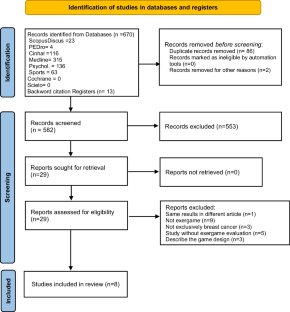
In recent years, exergames have been used in healthcare, and particularly in rehabilitation, with positive results. Exergames in healthcare have a significant potential; however, gaps in some areas remain, including the domain of exergames post-surgery for breast cancer. This study aimed to synthesise the existing studies on exergames following surgery for breast cancer and evaluate their impact through a systematic review. A total of 8 articles published between 2015 and 2022 were selected. The search took place in January 2022 with no time limits. Altogether 209 women participated in these studies. Interventions ranged from 4 to 8 weeks. Most of the interventions took place in the late postoperative period. It was possible to observe their impact on some indicators (range of motion, pain, functionality, depression). Importantly, no negative impact was reported in any of the different studies. The present review concluded that exergames can be a promising intervention for rehabilitation in oncology. However, more robust studies are needed that evaluate the effectiveness of using exergames as a complement to conventional rehabilitation and to assess the degree of satisfaction, motivation, and adherence of participants.
Access this article
Subscribe and save
- Starting from 10 chapters or articles per month
- Access and download chapters and articles from more than 300k books and 2,500 journals
- Cancel anytime View plans
Buy Now
Price excludes VAT (USA)
Tax calculation will be finalised during checkout.
Instant access to the full article PDF.
Fig. 1
Code availability
Not applicable.
References
- Li Y, Guo J, Sui Y, Chen B, Li D, Jiang J. 2022 Quality of life in patients with breast cancer following breast conservation surgery: a systematic review and meta-analysis. Journal of healthcare engineering.:3877984. https://doi.org/10.1155/2022/3877984
- Niewolak K, Fielek D, Pecyna P, et al. Medical resort treatment extended with modern feedback exercises using virtual reality improve postural control in breast cancer survivors. Acta Balneol, 2020; 2(160);2020:96–102
- Ollila DW, Hwang ES, Brenin DR, Kuerer HM, Yao K, Feldman S. The changing paradigms for breast cancer surgery: performing fewer and less-invasive operations. Ann Surg Oncol. 2018;25(10):2807–12. https://doi.org/10.1245/s10434-018-6618-z.
Article PubMed Google Scholar - McCartney CJL, Abdallah F. Pain relief and recovery after breast cancer surgery: translating best evidence into practice. Anaesthesia. 2020;75(9):1136–8. https://doi.org/10.1111/anae.15033.
Article CAS PubMed Google Scholar - Jonczyk MM, Fisher CS, Babbitt R, Paulus JK, Freund KM, Czerniecki B, et al. Surgical predictive model for breast cancer patients assessing acute postoperative complications: the breast cancer surgery risk calculator. Ann Surg Oncol. 2021;28(9):5121–31. https://doi.org/10.1245/s10434-021-09710-8.+.
Article PubMed PubMed Central Google Scholar - Rett MT, Mendonà a, ACR, Santos RMVP, Jesus GKS de, Prado VM, DeSantana JM. Postoperative physical therapy of breast cancer surgery: focus on quality of life. ConScientiae Saude. 2013;12(3):392–7. https://doi.org/10.5585/ConsSaude.v12n3.4341.
- Joseph E, Beranek M. The psychosocial impact of mastectomies on body image in women with breast cancer. International Journal of Health, Wellness & Society. 2018;8(3):21–9. https://doi.org/10.18848/2156-8960/CGP/v08i03/21-29.
- Zhou Z, Li J, Wang H, Luan Z, Li Y, Peng X. Upper limb rehabilitation system based on virtual reality for breast cancer patients: development and usability study. PLoS ONE. 2021;16(12):e0261220. https://doi.org/10.1371/journal.pone.0261220.
Article CAS PubMed PubMed Central Google Scholar - Martínez N, Santamaría-Vázquez M, Ortiz-Huerta J. Effects of a video game–based program on women with lymphedema secondary to breast cancer: pre-experimental study. Rehabilitation Oncology. 2021;39(4):E83–8. https://doi.org/10.1097/01.REO.0000000000000256.
Article Google Scholar - Basha MA, Aboelnour NH, Alsharidah AS, Kamel FH. Effect of exercise mode on physical function and quality of life in breast cancer-related lymphedema: a randomized trial. Support Care Cancer. 2022;30(3):2101–10. https://doi.org/10.1007/s00520-021-06559-1.
Article PubMed Google Scholar - Oliveira PF, Alves R da S, Iunes DH, de Carvalho JM, Borges JBC, Menezes F da S, et al. Effect of exergaming on muscle strength, pain, and functionality of shoulders in cancer patients. Games for health journal. 2020;9(4):297–303. https://doi.org/10.1089/g4h.2019.0113.
- Tough D, Robinson J, Gowling S, Raby P, Dixon J, Harrison SL. The feasibility, acceptability and outcomes of exergaming among individuals with cancer: a systematic review. BMC Cancer. 2018;18(1):1151. https://doi.org/10.1186/s12885-018-5068-0.
Article PubMed PubMed Central Google Scholar - Silva A, Oliveira E, Okubo R, Benetti M. Use of exergaming and its effects on the physical health of patients diagnosed with cancer: an integrative review. Fisioterapia e Pesquisa. 2020;27(4):443–52. https://doi.org/10.1590/1809-2950/20023927042020.
Article Google Scholar - Feyzioğlu Ö, Dinçer S, Akan A, Algun ZC. Is Xbox 360 Kinect-based virtual reality training as effective as standard physiotherapy in patients undergoing breast cancer surgery? Support Care Cancer. 2020;28(9):4295–303. https://doi.org/10.1007/s00520-019-05287-x.
Article PubMed Google Scholar - Rodrigues LF, Martins IDT, Nogueira HS, Rezende LF de, Boas VFV, Costa EC da S. Dança com uso de exergame na fadiga de pacientes oncológicas: um estudo piloto. RBPFEX. 2021;14(93):862–7
- Aguirre-Carvajal M ; Marchant P. Descripción del efecto de los ejercicios de la extremidad superior ipsilateral realizados con realidad virtual en mujeres sometidas a mastectomía. Gaceta Mexicana de Oncología.2015; 14. https://doi.org/10.1016/j.gamo.2015.10.002.
- Atef D, Elkeblawy MM, El-Sebaie A, Abouelnaga WAI. A quasi-randomized clinical trial: virtual reality versus proprioceptive neuromuscular facilitation for postmastectomy lymphedema. J Egypt Natl Canc Inst. 2020;32(1):29. https://doi.org/10.1186/s43046-020-00041-5.
Article PubMed Google Scholar - House G, Burdea G, Grampurohit N, Polistico K, Roll D, Damiani F, et al. A feasibility study to determine the benefits of upper extremity virtual rehabilitation therapy for coping with chronic pain post-cancer surgery. Br J Pain. 2016;10(4):186–97. https://doi.org/10.1177/2049463716664370.
Article PubMed PubMed Central Google Scholar - The Joanna Briggs Institute. Joanna Briggs Institute Reviewers' Manual: 2016 edition. Australia: The Joanna Briggs Institute; 2016.
- Tripette J, Murakami H, Ryan KR, Ohta Y, Miyachi M. The contribution of Nintendo Wii Fit series in the field of health: a systematic review and meta-analysis. PeerJ 2017;2017(9). https://doi.org/10.7717/peerj.3600
- Kooiman B, Sheehan DD. Exergaming theories: a literature review. International Journal of Game-Based Learning. 2015;5(4):1–14. https://doi.org/10.4018/IJGBL.2015100101.
Article Google Scholar - Darejeh A, Salim SS. Gamification solutions to enhance software user engagement—a systematic review. International Journal of Human-Computer Interaction. 2016;32(8):613–42. https://doi.org/10.1080/10447318.2016.1183330.
Article Google Scholar - Algeo N, Bennett K, Connolly D. Rehabilitation interventions to support return to work for women with breast cancer: a systematic review and meta-analysis. BMC Cancer. 2021;21(1):1–19. https://doi.org/10.1186/s12885-021-08613-x.
Article Google Scholar - Ribeiro IL, Moreira RFC, Ferrari AV, Alburquerque-Sendín F, Camargo PR, Salvini TF. Effectiveness of early rehabilitation on range of motion, muscle strength and arm function after breast cancer surgery: a systematic review of randomized controlled trials. Clin Rehabil. 2019;33(12):1876–86. https://doi.org/10.1177/0269215519873026.
Article PubMed Google Scholar - Fernandes CS. Rehabilitation games in a world in digital transition. Rev Cienc Saude. 20;11(2):3-. https://doi.org/10.21876/rcshci.v11i2.1150
- Gamboa E, Ruiz C, Trujillo M. Improving patient motivation towards physical rehabilitation treatments with playtherapy exergame. Studies in health technology and informatics. 2018;249:140–7. https://doi.org/10.3233/978-1-61499-868-6-140.
Article PubMed Google Scholar - Staiano AE, Adams MA, Norman GJ. Motivation for exergame play inventory: construct validity and relationship to game play. Cyberpsychology. 2019;13(3):54–66. https://doi.org/10.5817/CP2019-3-7.
Article Google Scholar
Author information
Authors and Affiliations
- Nursing School of Porto, Porto, Portugal
Carla Sílvia Fernandes & Luís Miguel Ferreira - Center for Health Technology and Services Research (CINTESIS), Porto, Portugal
Carla Sílvia Fernandes & Luís Miguel Ferreira - University Hospital Centre of Porto, Porto, Portugal
Claudia Baldaia
Authors
- Carla Sílvia Fernandes
- Claudia Baldaia
- Luís Miguel Ferreira
Corresponding author
Correspondence toCarla Sílvia Fernandes.
Ethics declarations
Ethics approval
Not applicable.
Consent to participate
Not applicable.
Consent for publication
Not applicable.
Conflict of interest
The authors declare no competing interests.
Additional information
Publisher's Note
Springer Nature remains neutral with regard to jurisdictional claims in published maps and institutional affiliations.
This article is part of the Topical Collection on Surgery
Supplementary Information
Rights and permissions
Springer Nature or its licensor (e.g. a society or other partner) holds exclusive rights to this article under a publishing agreement with the author(s) or other rightsholder(s); author self-archiving of the accepted manuscript version of this article is solely governed by the terms of such publishing agreement and applicable law.
About this article
Cite this article
Fernandes, C.S., Baldaia, C. & Ferreira, L.M. Impact of Exergames in Women with Breast Cancer After Surgery: a Systematic Review.SN Compr. Clin. Med. 5, 5 (2023). https://doi.org/10.1007/s42399-022-01344-5
- Accepted: 09 November 2022
- Published: 22 November 2022
- Version of record: 22 November 2022
- DOI: https://doi.org/10.1007/s42399-022-01344-5