Shifting seas in the greenhouse? (original) (raw)
- News & Views
- Published: 10 June 1999
Nature volume 399, pages 523–524 (1999) Cite this article
- 4687 Accesses
- 81 Citations
- 13 Altmetric
- Metrics details
An Erratum to this article was published on 24 June 1999
The effect that global warming might have on the circulation of the Atlantic Ocean has been a topic of much speculation and research. On page 572 of this issue, Wood et al.1 present greenhouse warming scenarios computed with a climate model that, for the first time, gives a realistic simulation of the large-scale ocean currents without requiring artificial adjustments of the air-sea fluxes.
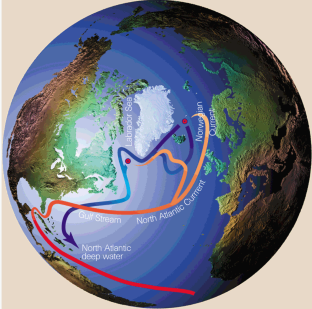
In 1987, in an article entitled “Unpleasant surprises in the greenhouse?”, Broecker2 warned that the response of the climate system to greenhouse warming might involve ‘mode switches’ of the Atlantic circulation. He drew this inference from palaeoclimatic data, indicating that such events had occurred in the past, and from early ocean modelling results. Initially, the idea was simply that a positive feedback meant that the large-scale overturning motion of the Atlantic (sometimes popularly dubbed the ‘conveyor belt’, in which warm surface waters flow northwards and cold deep water returns south throughout the Atlantic, acting like a central-heating system for Europe; see Fig. 1) could exist in two distinct states — switched on (as at present) or switched off.
This is a preview of subscription content, access via your institution
Access options
Subscribe to this journal
Receive 52 print issues and online access
$199.00 per year
only $3.83 per issue
Buy this article
- Purchase on SpringerLink
- Instant access to the full article PDF.
USD 39.95
Prices may be subject to local taxes which are calculated during checkout
Additional access options:
Figure 1: Simplified sketch of currents in the North Atlantic, showing the two main convection sites in the Greenland and Labrador Seas.
The alternative text for this image may have been generated using AI.
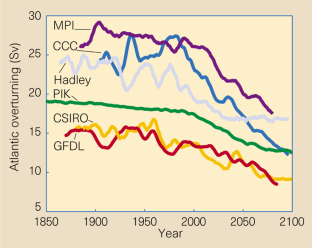
Figure 2: Simulated water-volume transport of the Atlantic ‘conveyor belt’ (Atlantic overturning) in a range of global warming scena.
The alternative text for this image may have been generated using AI.
References
- Wood, R. A., Keen, A. B., Mitchell, J. F. B. & Gregory, J. M. Nature 399, 572–575 ( 1999).
Article ADS CAS Google Scholar - Broecker, W. Nature 328, 123–126 ( 1987).
Article ADS CAS Google Scholar - Lenderink, G. & Haarsma, R. J. J. Phys. Oceanogr. 24, 1480–1493 (1994).
Google Scholar - Rahmstorf, S. Nature 378, 145–149 ( 1995).
Article ADS CAS Google Scholar - Rahmstorf, S. Nature 388, 825–826 ( 1997).
Article ADS CAS Google Scholar - Marotzke, J. & Stone, P. H. J. Phys. Oceanogr. 25, 1350–1364 (1995).
Google Scholar - Rahmstorf, S. & Ganopolski, A. Clim. Change (in the press).
- Dickson, B. Nature 386, 649–650 ( 1997).
Article ADS CAS Google Scholar - Houghton, J. T. et al. (eds) Climate Change 1995: The Science of Climate Change (Cambridge Univ. Press, 1996).
- Oppenheimer, M. Nature 393, 325–332 ( 1998).
Article ADS CAS Google Scholar - Boer, G. J., Flato, G. M. & Ramsden, D. Clim. Dyn. (submitted).
- Hirst, A. C., Gordon, H. B. & O'Farrell, S. P. Geophys. Res. Lett. 23, 3361 –3364 (1996).
Google Scholar - Knutson, T. R., Delworth, T. L., Dixon, K. & Stouffer, R. J. J. Geophys. Res. (submitted).
- Hegerl, G. et al. Clim. Dyn. 13, 631–634 ( 1997).
Google Scholar
Author information
Authors and Affiliations
- Potsdam Institute for Climate Impact Research (PIK), PO Box 60 12 03, 14412 , Potsdam, Germany
Stefan Rahmstorf
Rights and permissions
About this article
Cite this article
Rahmstorf, S. Shifting seas in the greenhouse?.Nature 399, 523–524 (1999). https://doi.org/10.1038/21066
- Issue date: 10 June 1999
- DOI: https://doi.org/10.1038/21066