A general model for the structure and allometry of plant vascular systems (original) (raw)
- Letter
- Published: 12 August 1999
Nature volume 400, pages 664–667 (1999) Cite this article
- 5697 Accesses
- 1196 Citations
- 11 Altmetric
- Metrics details
Abstract
Vascular plants vary in size by about twelve orders of magnitude, and a single individual sequoia spans nearly this entire range as it grows from a seedling to a mature tree. Size influences nearly all of the structural, functional and ecological characteristics of organisms1,2. Here we present an integrated model for the hydrodynamics, biomechanics and branching geometry of plants, based on the application of a general theory of resource distribution through hierarchical branching networks3 to the case of vascular plants. The model successfully predicts a fractal-like architecture and many known scaling laws, both between and within individual plants, including allometric exponents which are simple multiples of 1/4. We show that conducting tubes must taper and, consequently, that the resistance and fluid flow per tube are independent of the total path length and plant size. This resolves the problem of resistance increasing with length, thereby allowing plants to evolve vertical architectures and explaining why the maximum height of trees is about 100 m. It also explains why the energy use of plants in ecosystems is size independent.
This is a preview of subscription content, access via your institution
Access options
Subscribe to this journal
Receive 52 print issues and online access
$199.00 per year
only $3.83 per issue
Buy this article
- Purchase on SpringerLink
- Instant access to the full article PDF.
USD 39.95
Prices may be subject to local taxes which are calculated during checkout
Additional access options:
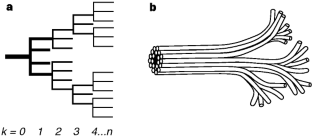
Figure 1: Branching structure.
The alternative text for this image may have been generated using AI.
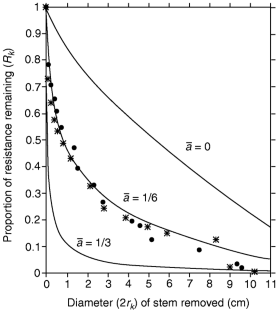
Figure 2: Effect of sequentially removing branches of increasing radius, r k, on the proportion of total resistance remaining, R k.
The alternative text for this image may have been generated using AI.
References
- Schmidt-Nielsen, K. Scaling: Why is Animal Size so Important? (Cambridge Univ. Press, Cambridge, 1984).
Book Google Scholar - Niklas, K. J. Plant Allometry: The Scaling of Form and Process (Univ. of Chicago Press, Chicago, 1994).
Google Scholar - West, G. B., Brown, J. H. & Enquist, B. J. Ageneral model for the origin of allometric scaling laws in biology. Science 276, 122– 126 (1997).
Article CAS Google Scholar - Zimmermann, M. H. Xylem Structure and the Ascent of Sap (Springer, New York, 1983).
Book Google Scholar - Tyree, M. T. & Ewers, F. W. The hydraulic architecture of trees and other woody plants. New Phytol. 119, 345–360 (1991).
Article Google Scholar - Shinozaki, K., Yoda, K., Hozumi, K. & Kira, T. Aquantitative analysis of plant form — the pipe model theory: I. Basic analysis. Jpn. J. Ecol. 14, 97–105 (1964).
Google Scholar - Bertram, J. E. A. Size-dependent differential scaling in branches: the mechanical design of trees revisited. Trees 4, 241– 253 (1989).
Google Scholar - Patino, S., Tyree, M. T. & Herre, E. A. Comparison of hydraulic architecture of woody plants of differing phylogeny and growth form with special reference to free standing and hemi-epiphytic Ficus species from Panama. New Phytol. 129, 125–134 ( 1995).
Article Google Scholar - Kuuluvainen, T., Sprugel, D. G. & Brooks, J. R. Hydraulic architecture and structure of Abies lasiocarpa seedlings in three alpine meadows of different moisture status in the eastern Olympic mountains, Washington, U.S.A. Arct. Alp. Res. 28, 60–64 ( 1996).
Article Google Scholar - Yang, S. & Tyree, M. T. Hydraulic architecture of Acer saccharum and A. rubrum : comparison of branches to whole trees and the contribution of leaves to hydraulic resistance. J. Exp. Bot. 45, 179–186 ( 1994).
Article Google Scholar - Ewers, F. W. & Zimmermann, M. H. The hydraulic architecture of eastern hemlock Tsuga canadensis. Can. J. Bot. 62, 940–946 (1984).
Article Google Scholar - Yang, S. & Tyree, M. T. Hydraulic resistance in Acer saccharum shoots and its influence on leaf water potential and transpiration. Tree Physiol. 12, 231– 242 (1993).
Article CAS Google Scholar - Long, J. N., Smith, F. W. & Scott, D. R. M. The role of Douglas fir stem sapwood and heartwood in the mechanical and physiological support of crowns and development of stem form. Can. J. For. Res. 11, 459– 464 (1981).
Article Google Scholar - Rogers, R. & Hinckley, T. M. Foliar weight and area related to current sapwood area in oak. Forest Sci. 25, 298–303 (1979).
Google Scholar - Niklas, K. J. Size-dependent allometry of tree height, diameter and trunk taper. Ann. Bot. 75, 217–227 ( 1995).
Article Google Scholar - Tyree, M. T. & Alexander, J. D. Hydraulic conductivity of branch junctions in three temperate tree species. Trees 7, 156–159 (1993).
Article Google Scholar - Tyree, M. T., Graham, M. E. D., Cooper, K. E. & Bazos, L. J. The hydraulic architecture of Thuja occidentalis. Can J. Bot. 61, 2105–2111 ( 1983).
Article Google Scholar - Fitter, A. H. & Strickland, T. R. Fractal characterization of root system architecture. Funct. Ecol. 6, 632–635 (1992).
Article Google Scholar - Morse, D. R., Lawton, J. H., Dodson, J. H. & Williamson, M. M. Fractal dimension of vegetation and the distribution of arthropod body lengths. Nature 314, 731–733 (1985).
Article ADS Google Scholar - McMahon, T. A. & Kronauer, R. E. Tree structures: deducing the principle of mechanical design. J. Theor. Biol. 59, 443–436 (1976).
Article CAS Google Scholar - Enquist, B. J., Brown, J. H. & West, G. B. Allometric scaling of plant energetics and population density. Nature 395, 163– 165 (1998).
Article ADS CAS Google Scholar - Turcotte, D. L., Pelletier, J. D. & Newman, W. I. Networks with side branching in biology. J. Theor. Biol. 193, 577–592 (1998).
Article CAS Google Scholar
Acknowledgements
We thank K. Niklas and M. Tyree for comments. J.H.B. was supported by the NSF, B.J.E. by the NSF and with an NSF post-doctoral fellowship, and G.B.W. by the US Department of Energy. We also thank the Thaw Charitable Trust for support.
Author information
Authors and Affiliations
- Theoretical Division, T-8, MS B285 Los Alamos National Laboratory, Los Alamos, 87545, New Mexico , USA
Geoffrey B. West - The Santa Fe Institute, 1399 Hyde Park Road, Santa Fe, 87501, New Mexico, USA
Geoffrey B. West, James H. Brown & Brian J. Enquist - Depatment of Biology, University of New Mexico, Albuquerque, 87131 , New Mexico, USA
James H. Brown & Brian J. Enquist
Authors
- Geoffrey B. West
- James H. Brown
- Brian J. Enquist
Corresponding author
Correspondence toBrian J. Enquist.
Rights and permissions
About this article
Cite this article
West, G., Brown, J. & Enquist, B. A general model for the structure and allometry of plant vascular systems .Nature 400, 664–667 (1999). https://doi.org/10.1038/23251
- Received: 27 November 1998
- Accepted: 20 May 1999
- Issue date: 12 August 1999
- DOI: https://doi.org/10.1038/23251