C-quest in the Amazon Basin (original) (raw)
- News & Views
- Published: 17 December 1998
Nature volume 396, pages 619–620 (1998) Cite this article
- 320 Accesses
- 43 Citations
- 6 Altmetric
- Metrics details
Whether Amazonia is a carbon-dioxide source or sink has a significant effect on estimates of the global carbon budget. On an annual basis, El Niño, and its influence on precipitation in the region, seems to be a controlling factor.
What is happening to all of the extra carbon dioxide being pumped into Earth's atmosphere as a result of human activities? Seven peta (1015) grams of carbon are now being emitted annually by fossil-fuel burning, and another 1-2 Pg by forest clearance in the tropics (for crops and pastures, which contain far less carbon). Only about half of this carbon stays in the atmosphere. The oceans absorb a further quarter or so, leaving at least 2 Pg C yr−1 to be accounted for by uptake into terrestrial ecosystems1. The ‘C-quest’ for the carbon2 presumed to be sequestered on land has been on for two decades — during which time, of course, people have continued to burn fossil fuels and clear forests.
This is a preview of subscription content, access via your institution
Access options
Subscribe to this journal
Receive 52 print issues and online access
$199.00 per year
only $3.83 per issue
Buy this article
- Purchase on SpringerLink
- Instant access to the full article PDF.
USD 39.95
Prices may be subject to local taxes which are calculated during checkout
Additional access options:
Figure 1: Cerrado in Amazonia, where rainfall strongly limits plant growth.

The alternative text for this image may have been generated using AI.
PLANET EARTH
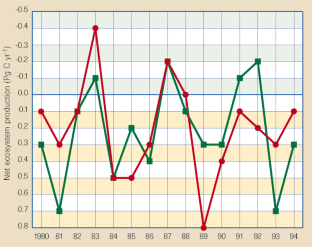
Figure 2: Two model calculations of the annual carbon balance of natural ecosystems in the Amazon Basin.
The alternative text for this image may have been generated using AI.
References
- Heimann, M. Ambio 26, 17–24 (1997).
Google Scholar - Gifford, R. M. in The Global Carbon Cycle (ed. Heimann, M.) 159-199 (Springer, Berlin, 1993).
- Lloyd, J. & Farquhar, G. D. Funct. Ecol. 10, 4–32 (1996).
Google Scholar - Grace, J.et al. Science 270, 778–780 (1995).
Google Scholar - Tian, H.et al. Nature 396, 664–667 (1998).
Article ADS CAS Google Scholar - Rayner, P. J. et al. (in the press).
- Phillips, O. L.et al. Science 282, 439–442 (1998).
Google Scholar - Kindermann, J., Würth, G., Kohlmaier, G. H. & Badeck, F.-W. Glob. Biogeochem. Cycles 10, 737–755 (1996).
Google Scholar - Malhi, Y. et al. (in the press).
- Braswell, B. H., Schimel, D. S., Linder, E. & Moore, B. II Science 278, 870–872 (1998).
Google Scholar - IGBP Terrestrial Carbon Working Group_Science_ 280, 1393–1394 (1998).
Author information
Authors and Affiliations
- Max Planck Institute for Biogeochemistry, PO Box 100164, Jena, D-07701, Germany
I. Colin Prentice & Jon Lloyd
Authors
- I. Colin Prentice
- Jon Lloyd
Rights and permissions
About this article
Cite this article
Prentice, I., Lloyd, J. C-quest in the Amazon Basin.Nature 396, 619–620 (1998). https://doi.org/10.1038/25224
- Issue date: 17 December 1998
- DOI: https://doi.org/10.1038/25224