A hypernova model for the supernova associated with the γ-ray burst of 25 April 1998 (original) (raw)
- Letter
- Published: 15 October 1998
- P. A. Mazzali3,
- K. Nomoto1,2,
- H. Umeda1,2,
- T. Nakamura1,
- F. Patat4,
- I. J. Danziger3,
- T. R. Young1,
- T. Suzuki1,2,
- T. Shigeyama1,2,
- T. Augusteijn4,
- V. Doublier4,
- J.-F. Gonzalez4,
- H. Boehnhardt4,
- J. Brewer4,
- O. R. Hainaut4,
- C. Lidman4,
- B. Leibundgut5,
- E. Cappellaro6,
- M. Turatto6,
- T. J. Galama7,
- P. M. Vreeswijk7,
- C. Kouveliotou8,
- J. van Paradijs7,10,
- E. Pian9,
- E. Palazzi9 &
- …
- F. Frontera9
Nature volume 395, pages 672–674 (1998) Cite this article
- 1478 Accesses
- 616 Citations
- 3 Altmetric
- Metrics details
Abstract
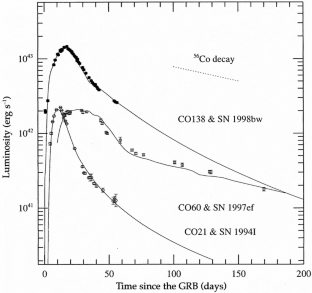
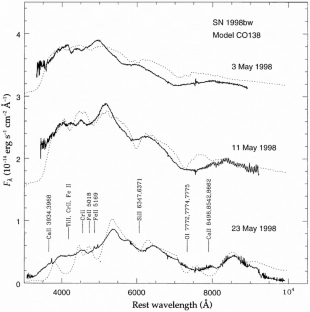
The discovery of the unusual supernova SN1998bw, and its possible association with the γ-ray burst GRB 9804251,2,3, provide new insights into the explosion mechanism of very massive stars and the origin of some classes of γ-ray bursts. Optical spectra indicate that SN1998bw is a type Ic supernova3,4, but its peak luminosity is unusually high compared with typical type Ic supernovae3. Here we report our findings that the optical spectra and the light curve of SN1998bw can be well reproduced by an extremely energetic explosion of a massive star composed mainly of carbon and oxygen (having lost its hydrogen and helium envelopes). The kinetic energy of the ejecta is as large as +(2–5)× 1052 erg, more than ten times that of previously observed supernovae. This type of supernova could therefore be termed ‘hypernova’. The extremely large energy suggests the existence of a new mechanism of massive star explosion that can also produce the relativistic shocks necessary to generate the observed γ-rays.
This is a preview of subscription content, access via your institution
Access options
Subscribe to this journal
Receive 51 print issues and online access
$199.00 per year
only $3.90 per issue
Buy this article
- Purchase on SpringerLink
- Instant access to the full article PDF.
USD 39.95
Prices may be subject to local taxes which are calculated during checkout
Additional access options:
Figure 1: Light curves of three type Ic supernovae, SN1998bw, 1997ef, 1994I and their models.
The alternative text for this image may have been generated using AI.
Figure 2: Observed spectra of SN1998bw and synthetic spectra.
The alternative text for this image may have been generated using AI.
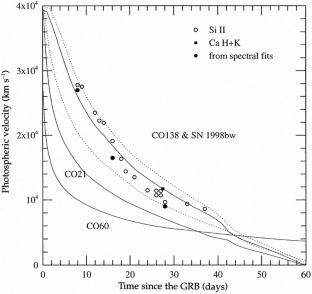
Figure 3: Photospheric velocities of SN1998bw.
The alternative text for this image may have been generated using AI.
References
- Soffitta, P., Feroci, M. & Piro, L. IAU Circ. No. 6884 (1998).
Google Scholar - Lidman, C. et al . IAU Circ.No. 6895 (1998).
Google Scholar - Galama, T. J. et al . An unusual supernova in the error box of the γ-ray burst of 25 April 1998. Nature 395, 670–672 (1998).
Article ADS CAS Google Scholar - Patat, F. & Piemonte, A. IAU Circ.No. 6918 (1998).
Google Scholar - Filippenko, A. V. Optical spectra of supernovae. Annu. Rev. Astron. Astrophys. 35, 309–355 (1997).
Article ADS CAS Google Scholar - Nomoto, K. et al . Acarbon-oxygen star as progenitor of the type Ic supernova 1994I. Nature 371, 227–229 (1994).
Article ADS CAS Google Scholar - Iwamoto, K. et al . Theoretical light curves for the type Ic supernova SN 1994I. Astrophys. J. 437, L115–L118 (1994).
Article ADS Google Scholar - Iwamoto, K. et al . Light curve modeling of the type Ib/Ic supernova 1997ef. Astrophys. J. (submitted).
- Arnett, W. D. Type I supernovae. I. Analytic solutions for the early part of the light curve. Astron. Astrophys. 253, 785–797 (1982).
ADS CAS Google Scholar - Mazzali, P. A. & Lucy, L. B. The application of Monte Carlo methods to the synthesis of early-time supernovae spectra. Astron. Astrophys. 279, 447–456 (1993).
ADS Google Scholar - Paczyński, B. Are gamma-ray bursts in star-forming regions? Astrophys. J. 494, L45–L48 (1998).
Article ADS Google Scholar - Woosley, S. E. Gamma-ray bursts from stellar mass accretion disks around black holes. Astrophys. J. 405, 273–277 (1993).
Article ADS CAS Google Scholar - Piran, T. in Some Unsolved Problems in Astrophysics (eds Bahcall, J. N. & Osriker, J. P.) 343–377 (Princeton Univ. Press, (1997)).
Google Scholar - Kulkarni, S. R. et al . IAU Circ. No. 6903 (1998).
Google Scholar - Baron, E., Young, T. R. & Branch, D. Astrophys. J. 409, 417–421 (1993).
Google Scholar - Garnavich, P., Jha, S., Kirchner, R. & Challis, P. IAU Circ.No. 6798 (1997).
Google Scholar - Richmond, M. W. et al . UBVRI photometry of the Type Ic SN 1994I in M51. Astron. J. 111, 327–339 (1996).
Article ADS Google Scholar - Thielemann, F.-K., Nomoto, K. & Hashimoto, M. Core-collapse supernovae and their ejecta. Astrophys. J. 460, 408–436 (1996).
Article ADS CAS Google Scholar - Nakamura, T., Umeda, T., Nomoto, K., Thielemann, F.-K. & Burrows, A. Nucleosynthesis in type II supernovae and abundances in metal poor stars. Astrophys. J. (submitted).
Acknowledgements
This study is based partly on observations collected at ESO-La Silla.
Author information
Authors and Affiliations
- Department of Astronomy, School of Science, University of Tokyo, 113-0033, Tokyo, Japan
K. Iwamoto, K. Nomoto, H. Umeda, T. Nakamura, T. R. Young, T. Suzuki & T. Shigeyama - Research Centre for the Early Universe, School of Science, University of Tokyo, 113-0033, Tokyo, Japan
K. Nomoto, H. Umeda, T. Suzuki & T. Shigeyama - Osservatorio Astronomico di Trieste, via G.B. Tiepolo 11, I-34131, Trieste, Italy
P. A. Mazzali & I. J. Danziger - European Southern Observatory, Casilla, 19001, Santiago 19, Chile
F. Patat, T. Augusteijn, V. Doublier, J.-F. Gonzalez, H. Boehnhardt, J. Brewer, O. R. Hainaut & C. Lidman - European Southern Observatory, Karl-Schwarzschild-Strasse 2, D-85748, Garching, Germany
B. Leibundgut - Osservatorio Astronomico di Padova, vicolo dell'Osservatorio 5, I-35122, Padova, Italy
E. Cappellaro & M. Turatto - Astronomical Institute Anton Pannekoek, University of Amsterdam, and Center for High Energy Astrophysics, Kruislaan 403, 1098, SJ Amsterdam, The Netherlands
T. J. Galama, P. M. Vreeswijk & J. van Paradijs - NASA Marshall Space Flight Center, ES-84, Huntsville, 35812, Alabama, USA
C. Kouveliotou - Istituto Tecnologie e Studio Radiazioni Extraterrestri, CNR, Bologna, Italy
E. Pian, E. Palazzi & F. Frontera - Department of Physics, University of Alabama, Huntsville, 35899, Alabama, USA
J. van Paradijs
Authors
- K. Iwamoto
- P. A. Mazzali
- K. Nomoto
- H. Umeda
- T. Nakamura
- F. Patat
- I. J. Danziger
- T. R. Young
- T. Suzuki
- T. Shigeyama
- T. Augusteijn
- V. Doublier
- J.-F. Gonzalez
- H. Boehnhardt
- J. Brewer
- O. R. Hainaut
- C. Lidman
- B. Leibundgut
- E. Cappellaro
- M. Turatto
- T. J. Galama
- P. M. Vreeswijk
- C. Kouveliotou
- J. van Paradijs
- E. Pian
- E. Palazzi
- F. Frontera
Corresponding author
Correspondence toK. Nomoto.
Rights and permissions
About this article
Cite this article
Iwamoto, K., Mazzali, P., Nomoto, K. et al. A hypernova model for the supernova associated with the γ-ray burst of 25 April 1998.Nature 395, 672–674 (1998). https://doi.org/10.1038/27155
- Received: 11 June 1998
- Accepted: 27 July 1998
- Issue date: 15 October 1998
- DOI: https://doi.org/10.1038/27155