Plants just say NO to pathogens (original) (raw)
- News & Views
- Published: 06 August 1998
Innate immunity
Nature volume 394, pages 525–527 (1998)Cite this article
- 1263 Accesses
- 109 Citations
- Metrics details
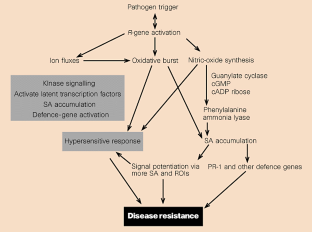
A plant's cellular responses to infection are often correlated with rapid, localized cell death — termed the hypersensitive response — at the site of attempted infection. This is a programmed cell death in the sense that it can be mimicked by plant mutants in the absence of pathogen5. But it is not clear whether the hypersensitive response itself kills the pathogen, or whether the response is a by-product of the execution mechanism.
One of the cellular responses to invasion is an oxidative burst, leading to the production of reactive oxygen intermediates (ROIs). We do not know whether the ROIs orchestrate the hypersensitive response directly (by killing cells6), indirectly (by signalling further cellular responses7), or both. Superoxide8, the first product of the oxidative burst, is a poor candidate for the cell executioner — it has a short half-life, being rapidly converted to hydrogen peroxide, and it does not readily diffuse. Hydrogen peroxide itself is toxic at high concentrations, but not enough of it is commonly produced during resistance responses to kill cells outright7,9.
This is a preview of subscription content, access via your institution
Relevant articles
Open Access articles citing this article.
Access options
Subscribe to this journal
Receive 51 print issues and online access
$199.00 per year
only $3.90 per issue
Buy this article
- Purchase on SpringerLink
- Instant access to the full article PDF.
USD 39.95
Prices may be subject to local taxes which are calculated during checkout
Additional access options:
Figure 1: Plant defence responses to pathogen invasion.
References
- Bent, A. Plant Cell 8, 1757-1771 (1996).
- Hammond-Kosack, K. E. & Jones, J. D. G. Plant Cell 8, 1773-1791 (1996).
- Delledonne, M., Xia, Y., Dixon, R. A. & Lamb, C. Nature 394, 585-588 (1998).
- Durner, J., Wendehenne, D. & Klessig, D. F. Proc. Natl Acad. Sci. USA (in the press).
- Dangl, J. L., Dietrich, R. A. & Richberg, M. H. Plant Cell 8, 1793-1807 (1996).
- Levine, A., Tenhaken, R., Dixon, R. & Lamb, C. J. Cell 79, 583-593 (1994).
- Jabs, T. et al. Natl Acad. Sci. USA 94, 4800-4805 (1997).
- Doke, N. Physiol. Plant Pathol. 23, 345-357 (1983).
- Glazener, J. A., Orlandi, E. W. & Baker, C. J. Plant Physiol. 110, 759-763 (1996).
- Nathan, C. Cell 82, 873-876 (1995).
- Shirasu, K. et al. 9, 261-270 (1997).
- Xia, Y. & Zweier, J. L. Proc. Natl Acad. Sci. USA 94, 6954-6958 (1997).
- Akaike, T. et al. Natl Acad. Sci. USA 93, 2448-2453 (1996).
- Dangl, J. & Jones, J. D. G. (eds) Curr. Opin. Plant Biol. 1, 274-365 (1998).
Author information
Authors and Affiliations
- Department of Biology and Curriculum in Genetics and Molecular Biology, University of North Carolina at Chapel Hill, CB#3280, Chapel Hill, North Carolina, 27599-3280, USA
Jeff Dangl
Rights and permissions
About this article
Cite this article
Dangl, J. Plants just say NO to pathogens.Nature 394, 525–527 (1998). https://doi.org/10.1038/28958
- Issue date: 06 August 1998
- DOI: https://doi.org/10.1038/28958