Sequences lead to tree of worms (original) (raw)
- News & Views
- Published: 05 March 1998
Systematics
Nature volume 392, page 25 (1998)Cite this article
- 2995 Accesses
- 68 Citations
- 15 Altmetric
- Metrics details
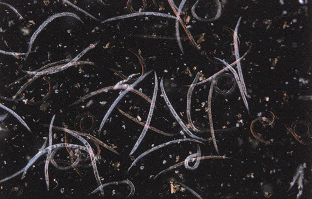
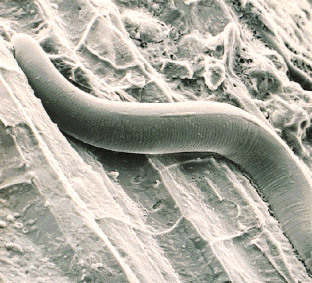
Nematode worms are found just about everywhere, often in enormous numbers. Parasitic species live in almost all animals and plants, and only arid soils and the open oceans seem to be unsuitable for free-living species. Yet only about 15,000 species have been formally described, and some textbooks treat nematodes as one of the ‘minor phyla’. In spite of this, it is now believed that the number of living species should be counted by the million. Classification has been difficult because most of the species are small to microscopic in size, and they lack obvious distinguishing characteristics. But the first attempt at a phylogenetic classification — based on small-subunit ribosomal DNA sequences from 53 species — is presented by Blaxter et al. on page 71 of this issue1. And, according to their findings, only one of the two classes of nematode that are recognized in the traditional classification is natural, consisting of an ancestral species and all its descendants.
Most (but not all) nematodes are small and nondescript. For example, Placentonema gigantissima, which lives as a parasite in the placenta of sperm whales, grows to a length of 8 m, with a diameter of 2.5 cm. The free-living, marine Draconema has elongate adhesive organs on the head and along the tail, and moves like a caterpillar. But the general uniformity of most nematode species has hampered the establishment of a classification that includes both free-living and parasitic species. Two classes have been recognized (the Secernentea and Adenophorea), based on the presence or absence of a caudal sense organ, respectively. But Blaxter et al.1 have concluded from the DNA sequences that the Secernentea is a natural group within the Adenophorea. Based on studies of free-living species, a paraphyletic nature for the Adenophorea — that is, a group comprising an ancestor but not all of its descendants — has previously been suggested (for example, by Lorenzen2), but the position of the various parasitic groups has always caused trouble.
This is a preview of subscription content, access via your institution
Access options
Subscribe to this journal
Receive 51 print issues and online access
$199.00 per year
only $3.90 per issue
Buy this article
- Purchase on SpringerLink
- Instant access to the full article PDF.
USD 39.95
Prices may be subject to local taxes which are calculated during checkout
Additional access options:
Figure 1
NIGEL CATTLIN/HOLT STUDIOS
Figure 2
BIOPHOTO ASSOCS/HOLT STUDIOS
References
- Blaxter, M. L.et al. Nature 392, 71–75 (1998).
Article ADS CAS Google Scholar - Lorenzen, S. in Concepts in Nematode Systematics (eds Stone, A. R., Platt, H. M. &Khalil, L. F.) 11-23 (Academic, New York, 1983).
Author information
Authors and Affiliations
- the Zoological Museum, University of Copenhagen, Universitetsparken 15, Copenhagen, DK-2100, Denmark
Claus Nielsen
Rights and permissions
About this article
Cite this article
Nielsen, C. Sequences lead to tree of worms.Nature 392, 25 (1998). https://doi.org/10.1038/32058
- Issue date: 05 March 1998
- DOI: https://doi.org/10.1038/32058