‘Ghost’ alleles of the Mauritius kestrel (original) (raw)
- Brief Communication
- Published: 10 February 2000
Conservation biology
Nature volume 403, page 616 (2000) Cite this article
- 3333 Accesses
- 174 Citations
- 7 Altmetric
- Metrics details
Abstract
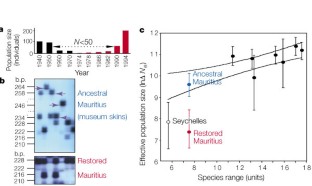
The population of Mauritius kestrels is thought to have recovered from a single wild breeding pair in 19741, when its prospects were considered to be hopeless, to over 200 pairs today2. Here we evaluate the loss of genetic variation that resulted from this bottleneck by typing 12 microsatellite DNA loci in museum skins up to 170 years old and from modern kestrels. We find that ancestral variation was remarkably high and comparable to continental kestrel species. This shows that the unexpected resilience of the population could not have been due either to benefits contributed by an undetected remnant population or to reduction of the inbreeding genetic load by a history of small population size3.
This is a preview of subscription content, access via your institution
Access options
Subscribe to this journal
Receive 52 print issues and online access
$199.00 per year
only $3.83 per issue
Buy this article
- Purchase on SpringerLink
- Instant access to the full article PDF.
USD 39.95
Prices may be subject to local taxes which are calculated during checkout
Additional access options:
Figure 1: The genetic diversity of the ancestral population of Mauritius kestrels is similar to those of continental populations.
References
- Jones, C. G. in Studies of Mascarene Island Birds (ed. Diamond, A. W.) 5–89 (Cambridge Univ. Press, Cambridge, 1987).
- Safford, R. J. & Jones, C. G. Biol. Conserv. 6, 1445–1451 (1997).
Google Scholar - Bataillon, T. & Kirkpatric, M. Genet. Res. 75, 75–82 (2000).
Article CAS Google Scholar - Gilpin, M. E. & Soule, M. E. in Conservation Biology: The Science of Scarcity and Diversity (ed. Soule, M. E.) 19–34 (Sinauer, Sunderland, MA, 1986).
- Jones, C. G. et al. Ibis 137, 173–180 (1995).
Article Google Scholar - Nei, M., Maruyama, T. & Chakraborty, R. Evolution 29, 1–9 (1975).
Article Google Scholar - Gelman, A., Carlin, J. B., Stern, H. S. & Rubin, D. B. Bayesian Data Analysis (Chapman & Hall, London, 1995).
- Johnson, T. H. & Stattersfield, A. J. Ibis 132, 167–180 (1990).
Article Google Scholar - Frankham, R. Heredity 78, 311–327 (1997).
Article Google Scholar - Madsen, T. et al. Nature 402, 34–35 (1999).
Article ADS CAS Google Scholar - Saccheri, I. et al. Evolution 50, 2000–2013 (1996).
Article Google Scholar
Author information
Author notes
- Michael W. Bruford
Present address: Cardiff School of Biosciences, Cardiff University, Cathays Park, Cardiff, CF1 3TL, UK
Authors and Affiliations
- Institute of Zoology, Zoological Society of London, Regents Park, London, NW1 4RY, UK
Jim J. Groombridge - Mauritius Wildlife Foundation, Black River, Mauritius
Carl G. Jones & Michael W. Bruford - School of Biological Sciences, Queen Mary & Westfield College, London, E1 4NS, UK
Richard A. Nichols
Authors
- Jim J. Groombridge
- Carl G. Jones
- Michael W. Bruford
- Richard A. Nichols
Rights and permissions
About this article
Cite this article
Groombridge, J., Jones, C., Bruford, M. et al. ‘Ghost’ alleles of the Mauritius kestrel.Nature 403, 616 (2000). https://doi.org/10.1038/35001148
- Issue date: 10 February 2000
- DOI: https://doi.org/10.1038/35001148