Respiration as the main determinant of carbon balance in European forests (original) (raw)
- Letter
- Published: 20 April 2000
- G. Matteucci1,
- A. J. Dolman2,
- E.-D. Schulze3,4,
- C. Rebmann3,4,
- E. J. Moors2,
- A. Granier5,
- P. Gross5,
- N. O. Jensen6,
- K. Pilegaard6,
- A. Lindroth7,
- A. Grelle8,
- C. Bernhofer9,
- T. Grünwald9,
- M. Aubinet10,
- R. Ceulemans11,
- A. S. Kowalski11,
- T. Vesala12,
- Ü. Rannik12,
- P. Berbigier13,
- D. Loustau14,
- J. Guðmundsson15,
- H. Thorgeirsson15,
- A. Ibrom16,
- K. Morgenstern16,
- R. Clement17,
- J. Moncrieff17,
- L. Montagnani18,
- S. Minerbi19 &
- …
- P. G. Jarvis17
Nature volume 404, pages 861–865 (2000) Cite this article
- 9773 Accesses
- 1436 Citations
- 12 Altmetric
- Metrics details
Abstract
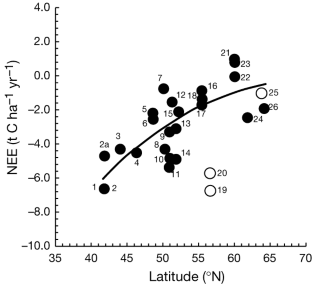
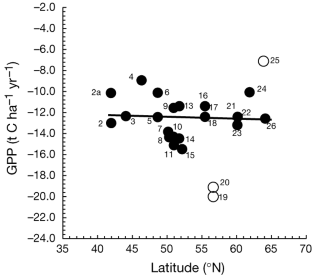
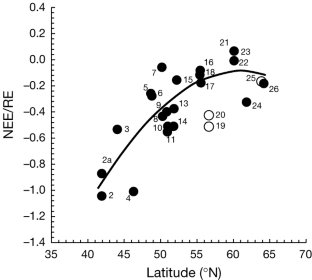
Carbon exchange between the terrestrial biosphere and the atmosphere is one of the key processes that need to be assessed in the context of the Kyoto Protocol1. Several studies suggest that the terrestrial biosphere is gaining carbon2,3,4,5,6,7,8, but these estimates are obtained primarily by indirect methods, and the factors that control terrestrial carbon exchange, its magnitude and primary locations, are under debate. Here we present data of net ecosystem carbon exchange, collected between 1996 and 1998 from 15 European forests, which confirm that many European forest ecosystems act as carbon sinks. The annual carbon balances range from an uptake of 6.6 tonnes of carbon per hectare per year to a release of nearly 1 t C ha-1 yr-1, with a large variability between forests. The data show a significant increase of carbon uptake with decreasing latitude, whereas the gross primary production seems to be largely independent of latitude. Our observations indicate that, in general, ecosystem respiration determines net ecosystem carbon exchange. Also, for an accurate assessment of the carbon balance in a particular forest ecosystem, remote sensing of the normalized difference vegetation index or estimates based on forest inventories may not be sufficient.
This is a preview of subscription content, access via your institution
Access options
Subscribe to this journal
Receive 52 print issues and online access
$199.00 per year
only $3.83 per issue
Buy this article
- Purchase on SpringerLink
- Instant access to the full article PDF.
USD 39.95
Prices may be subject to local taxes which are calculated during checkout
Additional access options:
Figure 1: Net ecosystem exchange (NEE) of the EUROFLUX sites plotted against latitude.
The alternative text for this image may have been generated using AI.
Figure 2: Gross primary production (GPP) of the EUROFLUX sites plotted against latitude.
The alternative text for this image may have been generated using AI.
Figure 3: The ratio of net ecosystem exchange (NEE) and total ecosystem respiration (RE) plotted against latitude.
The alternative text for this image may have been generated using AI.
References
- IGBP Terrestrial carbon working group. The terrestrial carbon cycle: implications for the Kyoto protocol. Science 280, 1393–1394 ( 1998).
Article Google Scholar - Dixon,R. K. et al. Carbon pools and flux of global forest ecosystems. Science 263, 185–190 ( 1994).
Article ADS CAS Google Scholar - Nabuurs,G. J., Pavinen,R., Sikkema,R. & Mohren,G. M. J. The role of European forests in the global carbon cycle – a review. Biomass Bioenergy 13, 345–358 (1997).
Article CAS Google Scholar - Kauppi,P. E., Mielikäinen,K. & Kuusela, K. Biomass and carbon budget of European forests, 1971 to 1990. Science 256, 70– 74 (1992).
Article ADS CAS Google Scholar - Ciais,P., Tans,P. P., Trolier,M., White,J. W. C. & Francey, R. J. A large northern hemisphere terrestrial CO2 sink indicated by 13C/12C ratio of atmospheric CO2. Science 269, 1098– 1102 (1995).
Article ADS CAS Google Scholar - Denning,A. S., Fung,I. Y. & Randall, D. Latitudinal gradient of atmospheric CO2 due to seasonal exchange with the land biota. Nature 376 , 240–243 (1995).
Article ADS CAS Google Scholar - Fan,S. et al. A large terrestrial carbon sink in North America implied by atmospheric and oceanic carbon dioxide data and models. Science 282, 442–446 (1998).
Article ADS CAS Google Scholar - Myneni,R. B., Keeling,C. D., Tucker,C. J., Asrar,G. & Nemani,R. R. Increased plant growth in the northern high latitudes from 1981 to 1991. Nature 386, 698–702 (1997).
Article ADS CAS Google Scholar - Lindroth,A., Grelle,A. & Morén, A.-S. Long-term measurements of boreal forest carbon balance reveal large temperature sensitivity. Glob. Change Biol. 4, 443–450 (1998).
Article ADS Google Scholar - Goulden,M. L. et al. Sensitivity of boreal forest carbon balance to soil thaw. Science 279, 214–217 (1998).
Article ADS CAS Google Scholar - Oechel,W. C. et al. Recent change of arctic tundra ecosystems from a net carbon dioxide sink to a source. Nature 361, 520 –523 (1993).
Article ADS Google Scholar - Schlesinger,W. H. in Biogeochemistry: An Analysis of Global Change 161– 165 (Academic, San Diego, 1997).
Google Scholar - Baldocchi,D. D., Hicks,B. B. & Meyers, T. P. Measuring biosphere-atmosphere exchanges of biologically related gases with micrometeorological methods. Ecology 69, 1331–1340 (1988).
Article Google Scholar - Baldocchi,D. D., Valentini,R., Running,S., Oechel,W. C. & Dahlman, R. Strategies for measuring and modelling carbon dioxide and water vapour fluxes over terrestrial ecosystems. Glob. Change Biol. 2, 159–167 ( 1996).
Article ADS Google Scholar - Aubinet,M. et al. Estimates of the annual net carbon and water exchange of forests: the EUROFLUX methodology. Adv. Ecol. Res. 30, 113–175 (2000).
Article CAS Google Scholar - Running,S. A blueprint for improved global change monitoring of the terrestrial biosphere. Earth Obs. 10, 8–12 (1998).
Google Scholar - Schulze,E. D. & Heimann,M. in Asian Change in the Context of Global Change (eds Galloway, J. & Melillo, J.) 145– 161 (Cambridge Univ. Press, 1998).
Google Scholar - Goulden,M. L., Munger,J. W., Fan,S. -M., Daube,B. C. & Wosfy,W. C. Measurements of carbon sequestration by long-term eddy covariance: methods and critical evaluation of accuracy. Glob. Change Biol. 2, 169–181 (1996).
Article ADS Google Scholar - Chen,W. J. et al. Effects of climatic variability on the annual carbon sequestration by a boreal aspen forest. Glob. Change Biol. 1, 41–53 (1999).
Article ADS Google Scholar - Moncrieff,J. B., Malhi,Y. & Leuning,R. The propagation of errors in long-term measurements of land atmosphere fluxes of carbon and water. Glob. Change Biol 2, 231–240 (1996).
Article ADS Google Scholar - Anderson,J. M. Responses of soils to climate change. Adv. Ecol. Res. 22, 163–210 (1992).
Article CAS Google Scholar - Vogt,K. A. in Soil Management and Greenhouse Effect (eds Lal, R., Kimble, J., Levine, E. & Stewart, B. A.) 159–178 (CRC Press, Boca Raton, 1995)
Google Scholar - Kirschbaum,M. U. The temperature dependence of soil organic matter decomposition, and the effect of global warming on soil organic C storage. Soil Biol. Biochem. 6, 753–760 ( 1995).
Article Google Scholar - Chapman,W. L. & Walsh,J. E. Recent variations of sea ice and air temperatures in high latitudes. Bull. Am. Meteorol. Soc. 74, 33–47 (1993).
Article ADS Google Scholar - Schlenter,R. E. & Van Cleve,K. Relationship between CO2 evolution from soil, substrate temperature, and substrate moisture in four mature forest types in interior Alaska. Can. J. Forest Res. 15, 97–106 ( 1985).
Article Google Scholar - Hanson,P. J., Wullschleger,S. D., Bohlmann, S. A. & Todd,D. E. Seasonal and topographic patterns of forest floor CO2 efflux from an upland oak forest. Tree Physiol. 13, 1–15 (1993).
Article CAS Google Scholar - Burton,A. J., Pregitzer,K. S., Zogg,G. P., & Zak,D. R. Drought reduces root respiration in sugar maple forests. Ecol. Applic. 8, 771–778 ( 1998).
Article Google Scholar - SAS/STAT® User's Guide Version 6, 4th edn, Vol. 2, (SAS Institute Inc., Cary, North Carolina, 1989).
Acknowledgements
The work has been done during the three-year duration of the EUROFLUX project, funded by the European Union. Further funding was provided by the Dutch Ministry of Agriculture, Fisheries and Nature Management (site 6); the Academy of Finland (site 21); the Autonomous Province of Bolzano, Italy (site 4); and the Georg-August Universität, Göttingen, Germany (site 13). A large number of technicians, graduate and doctoral students are acknowledged for help in site management, data collection and elaboration.
Author information
Authors and Affiliations
- Department of Forest Environment and Resources, University of Tuscia, Viterbo, I-01100, Italy
R. Valentini & G. Matteucci - Alterra, PO Box 47, AA Wageningen, 6700, The Netherlands
A. J. Dolman & E. J. Moors - Max-Planck-Institut für Biogeochemie, Jena, D-07745, Germany
E.-D. Schulze & C. Rebmann - Lehrstuhl für Pflanzenökologie, Universität Bayreuth, Bayreuth, D-95440, Germany
E.-D. Schulze & C. Rebmann - Centre de Recherches de Nancy, Unité d’Ecophysiologie Forestière, Equipe de Bioclimatologie, Champenoux, F-54280, France
A. Granier & P. Gross - Risoe National Labouratory, Roskilde, DK-4000, Denmark
N. O. Jensen & K. Pilegaard - Department of Physical Geography, Lund University, Box 118, Lund, SE-221 00, Sweden
A. Lindroth - Department for Production Ecology, SLU, Faculty of Forestry, PO Box 7042, Uppsala , S-7042, Sweden
A. Grelle - TU Dresden, Institut für Hydrologie und Meteorologie , Tharandt, D-01737, Germany
C. Bernhofer & T. Grünwald - Unité de Physique, Faculté Universitaire des Sciences Agronomiques de Gembloux, Gembloux , B-5030, Belgium
M. Aubinet - Department of Biology, University of Antwerpen, Universiteitsplein 1, Wilrijk, B-2610, Belgium
R. Ceulemans & A. S. Kowalski - Department of Physics, University of Helsinki, PO Box 9, FIN-00014, Finland
T. Vesala & Ü. Rannik - Unité de Bioclimatologie, INRA Bourdeaux, BP 81, Villenave d’Ornon Cedex, F33883, France
P. Berbigier - Unité de Recherches Forestières, INRA Bourdeaux, BP 45, Gazinet, F33611, France
D. Loustau - Department of Environmental Research, Agricultural Research Institute, Keldnaholti, Reykjavik , 112, Iceland
J. Guðmundsson & H. Thorgeirsson - Georg-August Universität, Institut für Bioklimatologie , Büsgenweg 2, Göttingen, D-37077, Germany
A. Ibrom & K. Morgenstern - University of Edinburgh, Institute of Ecology and Resource Management, Edinburgh, EH9 3JU, UK
R. Clement, J. Moncrieff & P. G. Jarvis - Department of Land and Agro-Forestry Systems, University of Padova, Agripolis, Legnaro , I-35020, Padova, Italy
L. Montagnani - Autonomous Province of Bolzano, Forest Services, Bolzano, I-39100, Italy
S. Minerbi
Authors
- R. Valentini
- G. Matteucci
- A. J. Dolman
- E.-D. Schulze
- C. Rebmann
- E. J. Moors
- A. Granier
- P. Gross
- N. O. Jensen
- K. Pilegaard
- A. Lindroth
- A. Grelle
- C. Bernhofer
- T. Grünwald
- M. Aubinet
- R. Ceulemans
- A. S. Kowalski
- T. Vesala
- Ü. Rannik
- P. Berbigier
- D. Loustau
- J. Guðmundsson
- A. Ibrom
- K. Morgenstern
- R. Clement
- J. Moncrieff
- L. Montagnani
- S. Minerbi
- P. G. Jarvis
Corresponding author
Correspondence toR. Valentini.
Supplementary information
Rights and permissions
About this article
Cite this article
Valentini, R., Matteucci, G., Dolman, A. et al. Respiration as the main determinant of carbon balance in European forests .Nature 404, 861–865 (2000). https://doi.org/10.1038/35009084
- Received: 12 January 2000
- Accepted: 03 March 2000
- Issue date: 20 April 2000
- DOI: https://doi.org/10.1038/35009084