Genetic ablation of parathyroid glands reveals another source of parathyroid hormone (original) (raw)
- Letter
- Published: 13 July 2000
- Zhou-Feng Chen2 na1,
- Jaesang Kim3,
- Matthias Priemel4,
- Johannes M. Rueger4,
- Michael Amling4,
- Jane M. Moseley5 na1,
- T. John Martin5 na1,
- David J. Anderson3 &
- …
- Gerard Karsenty1
Nature volume 406, pages 199–203 (2000)Cite this article
- 1996 Accesses
- 380 Citations
- 12 Altmetric
- Metrics details
Abstract
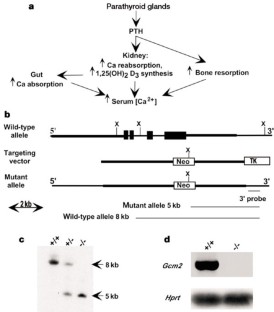
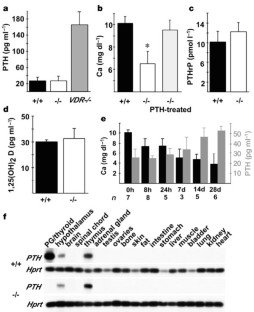
The parathyroid glands are the only known source of circulating parathyroid hormone (PTH), which initiates an endocrine cascade that regulates serum calcium concentration1. Glial cells missing2 (Gcm2), a mouse homologue of Drosophila Gcm, is the only transcription factor whose expression is restricted to the parathyroid glands2,3,4,5. Here we show that _Gcm2_-deficient mice lack parathyroid glands and exhibit a biological hypoparathyroidism, identifying Gcm2 as a master regulatory gene of parathyroid gland development. Unlike _PTH receptor_-deficient mice, however, _Gcm2_-deficient mice are viable and fertile, and have only a mildly abnormal bone phenotype. Despite their lack of parathyroid glands, _Gcm2_-deficient mice have PTH serum levels identical to those of wild-type mice, as do parathyroidectomized wild-type animals. Expression and ablation studies identified the thymus, where Gcm1, another Gcm homologue, is expressed, as the additional, downregulatable source of PTH. Thus, Gcm2 deletion uncovers an auxiliary mechanism for the regulation of calcium homeostasis in the absence of parathyroid glands. We propose that this backup mechanism may be a general feature of endocrine regulation.
This is a preview of subscription content, access via your institution
Access options
Subscribe to this journal
Receive 51 print issues and online access
$199.00 per year
only $3.90 per issue
Buy this article
- Purchase on SpringerLink
- Instant access to the full article PDF.
USD 39.95
Prices may be subject to local taxes which are calculated during checkout
Additional access options:
Figure 1: Regulation of calcium homeostasis and targeted disruption of Gcm2 .
The alternative text for this image may have been generated using AI.
Figure 2: Fate of _Gcm2-_deficient mice and biological chemistry.

The alternative text for this image may have been generated using AI.
Figure 3: Absence of parathyroid glands and increased bone mass in _Gcm2_-deficient mice.

The alternative text for this image may have been generated using AI.
Figure 4: Detection of an auxiliary PTH source.
The alternative text for this image may have been generated using AI.
Figure 5: Physiological role of thymic PTH secretion. a, In situ hybridization revealing overlapping PTH (red) and Casr (yellow) expression in thymus.

The alternative text for this image may have been generated using AI.
References
- Potts, J. T. & Jüppner, H. in Metabolic Bone Disease and Clinically Related Disorders: Parathyroid Hormone and Parathyroid Hormone-Related Peptide in Calcium Homeostasis, Bone Metabolism and Bone Development: The Proteins, their Genes, and Receptors (eds Avioli, L. V. & Krane, S. M.) 52–94 (Academic, San Diego, 1998).
Google Scholar - Hosoya, T., Takizawa, K., Nitta, K. & Hotta, Y. Glial cells missing: A binary switch between neuronal and glial determination in Drosophila . Cell 82, 1025–1036 (1995).
Article CAS Google Scholar - Jones, B. W., Fetter, R. D., Tear, G. & Goodman, C. S. Glial cells missing: A genetic switch that controls glial versus neuronal fate. Cell 82, 1013–1023 ( 1995).
Article CAS Google Scholar - Akiyama, Y., Hosoya, T., Poole, A. & Hotta, Y. The gcm-motif: A novel DNA-binding motif conserved in Drosophila and mammals. Proc. Natl Acad. Sci. USA 93, 14912– 14916 (1996).
Article ADS CAS Google Scholar - Kim, J. et al. Isolation and characterization of mammalian homologs of the Drosophila gene glial cells missing. Proc. Natl Acad. Sci. USA 95, 12364–12369 (1998).
Article ADS CAS Google Scholar - Bronner, F. in Mineral Metabolism: Dynamics in Function of Calcium (eds Comar, L. C. & Bronner, F.) 342–447 (Academic, New York, 1964).
Google Scholar - Cowie, A. T. & Folley, S. J. Parathyroidectomy and lactation in the rat. Nature 156, 19– 720 (1945).
Article Google Scholar - Dusso, A. S. & Brown, A. J. Mechanism of vitamin D action and its regulation. Am. J. Kidney Dis. 32, (Suppl. 2) S13–24 (1998).
Article CAS Google Scholar - Selye, H. On the stimulation of new bone-formation with parathyroid extract and irradiated ergosterol. Endocrinology 16, 547– 558 (1932).
Article CAS Google Scholar - Kalu, D. N., Doyle, F. H., Pennock, J. & Foster, G. V. Parathyroid hormone and experimental osteosclerosis. Lancet 1, 1363–1366 (1970).
Article CAS Google Scholar - Hammett, F. S. Studies of the thyroid apparatus. J. Biol. Chem. 72 , 505–525 (1927).
Google Scholar - Loshkajian, A. et al. Familial Blomstrand chondrodysplasia with advanced skeletal maturation: further delineation. Am. J. Med. Genet. 71, 283–288 (1997).
Article CAS Google Scholar - Jobert, A. S. et al. Absence of functional receptors for parathyroid hormone and parathyroid hormone-related peptide in Blomstrand chondrodysplasia. J. Clin. Invest. 102, 34–40 (1998).
Article CAS Google Scholar - Lanske, B. et al. PTH/PTHrP receptor in early development and Indian hedgehog-regulated bone growth. Science 273, 663– 666 (1996).
Article ADS CAS Google Scholar - Li, Y. C. et al. Targeted ablation of the vitamin D receptor: An animal model of vitamin D-dependent rickets type II with alopecia. Proc. Natl Acad. Sci. USA 94, 9831–9835 (1997).
Article ADS CAS Google Scholar - Suva, L. J. et al. A parathyroid hormone-related protein implicated in malignant hypercalcemia. Science 237, 893– 896 (1987).
Article ADS CAS Google Scholar - Fraser, R. A., Kronenberg, H. M., Pang, P. K. & Harvey, S. Parathyroid hormone messenger ribonucleic acid in the rat hypothalamus. Endocrinology 127, 2517–2522 (1990).
Article CAS Google Scholar - Chisaka, O. & Capecchi, M. R. Regionally restricted developmental defects resulting from targeted disruption of the mouse homeobox gene hox-1. 5. Nature 350, 473–479 (1991).
Article ADS CAS Google Scholar - Kovacs, C. S., Manley, N. R & Kronenberg, H. M. Hoxa3 knockout mice are hypocalcemic and have reduced placental calcium transfer. 80th meeting of the Endocrine Society , 91 (Endocrine Society Press, Bethesda, Maryland, 1998).
- Silver, J., Russel, J. & Sherwood, L. M. Regulation by vitamin D metabolites of messenger ribonucleic acid for preproparathyroid hormone in isolated bovine parathyroid cells. Proc. Natl Acad. Sci. USA 82, 4270 –4273 (1985).
Article ADS CAS Google Scholar - Naveh-Many, T., Friedlaender, M. M., Mayer, H. & Silver, J. Calcium regulates parathyroid hormone messenger ribonucleic acid (mRNA), but not calcitonin mRNA in vivo in the rat. Dominant role of 1,25-Dihydroxyvitamin D. Endocrinology 125, 275– 280 (1989).
Article CAS Google Scholar - Amiel, C., Kuntziger, H., Couette, S., Coureau, C. & Bergounioux, N. Evidence for a parathyroid hormone-independent calcium modulation of phosphate transport along the nephron. J. Clin. Invest. 57, 256–263 (1976).
Article CAS Google Scholar - Jaffe, R. B. in Reproductive Endocrinology: The Menopause and Perimenopausal Period (eds Samuel, S., Yen, C. & Jaffe, R. B.) 389–408 (W. B. Saunders Company, Philadelphia, 1991).
Google Scholar - Ma, Q., Chen, Z., del Barco Barrantes, I., de la Pompa, J. L. & Anderson, D. J. Neurogenin1 is essential for the determination of neuronal precursors for proximal cranial sensory ganglia. Neuron 20, 469– 482 (1998).
Article CAS Google Scholar - Grill, V. et al. Parathyroid hormone-related protein: elevated levels in both humoral hypercalcemia of malignancy and hypercalcemia complicating metastatic breast cancer. J. Clin. Endocrinol. Metab. 73, 1309–1315 (1991).
Article CAS Google Scholar - Neubüser, A., Koseki, H. & Balling, R. Characterization and developmental expression of Pax9, a paired-box-containing gene related to Pax1. Dev. Biol. 170, 701–716 (1995).
Article Google Scholar - Emanuel, R. L. et al. Calcium-sensing receptor expression and regulation by extracellular calcium in the AtT-20 pituitary cell line. Mol. Endocrinol. 10, 555–565 (1996).
CAS PubMed Google Scholar - Ducy, P. et al. Leptin inhibits bone formation through a hypothalamic relay: a central control of bone mass. Cell 100, 197–207 (2000).
Acknowledgements
G.K. thanks R. Behringer for his generosity. We thank R. Balling, R. Civitelli, C. Johner, H. Kronenberg, B. Lanske, J. Mclaughlin, H. Peters, L.D. Quarles and S. Rebalo for reagents and advice, A. Arnold for sharing unpublished information, and R. Behringer, H. Bellen, P. Hastings, C. Silve, H. Zoghbi and members of the Karsenty laboratory for critical reading of the manuscript. This work is supported by a grant from the MOD foundation to G.K. and NIH grants to G.K. and D.A. T.G. was supported by the Deutscher Akademischer Austauschdienst (DAAD). D.J.A. is an investigator of the Howard Hughes Medical Institute.
Author information
Author notes
- Thomas Günther, Zhou-Feng Chen, Jane M. Moseley and T. John Martin: These authors contributed equally to this work
Authors and Affiliations
- Department of Molecular and Human Genetics, Program of Developmental Biology, Baylor College of Medicine, 1 Baylor Plaza, Houston, 77030, Texas, USA
Thomas Günther & Gerard Karsenty - Department of Anesthesiology, Washington University School of Medicine, 660 South Euclid Avenue, St. Louis, 63110, Missouri, USA
Zhou-Feng Chen - Howard Hughes Medical Institute and Division of Biology, California Institute of Technology, Pasadena , 91125, California, USA
Jaesang Kim & David J. Anderson - Department of Trauma Surgery, Hamburg University, Martinistrasse 52, Hamburg, 20246, Germany
Matthias Priemel, Johannes M. Rueger & Michael Amling - St. Vincent's Institute of Medical Research , 9 Princes Street, Melbourne, Fitzroy, 3065, Victoria, Australia
Jane M. Moseley & T. John Martin
Authors
- Thomas Günther
- Zhou-Feng Chen
- Jaesang Kim
- Matthias Priemel
- Johannes M. Rueger
- Michael Amling
- Jane M. Moseley
- T. John Martin
- David J. Anderson
- Gerard Karsenty
Corresponding author
Correspondence toGerard Karsenty.
Supplementary information
Rights and permissions
About this article
Cite this article
Günther, T., Chen, ZF., Kim, J. et al. Genetic ablation of parathyroid glands reveals another source of parathyroid hormone.Nature 406, 199–203 (2000). https://doi.org/10.1038/35018111
- Received: 17 January 2000
- Accepted: 22 May 2000
- Issue date: 13 July 2000
- DOI: https://doi.org/10.1038/35018111