Analysis of an evolutionary species–area relationship (original) (raw)
- Letter
- Published: 14 December 2000
Nature volume 408, pages 847–850 (2000) Cite this article
- 8953 Accesses
- 544 Citations
- 2 Altmetric
- Metrics details
Abstract
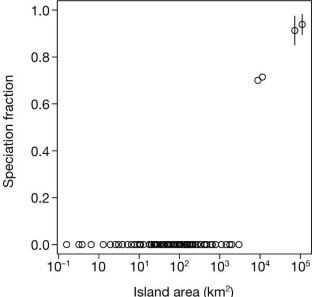
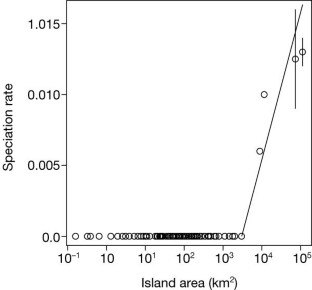
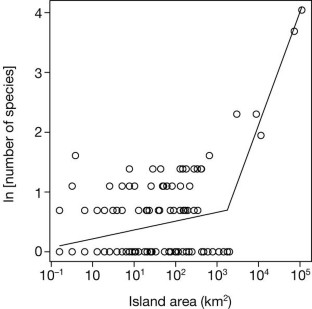
Large islands typically have more species than comparable smaller islands. Ecological theories, the most influential being the equilibrium theory of island biogeography1, explain the species–area relationship as the outcome of the effect of area on immigration and extinction rates. However, these theories do not apply to taxa on land masses, including continents and large islands, that generate most of their species in situ. In this case, species–area relationships should be driven by higher speciation rates in larger areas2,3,4,5,6, a theory that has never been quantitatively tested. Here we show that Anolis lizards on Caribbean islands meet several expectations of the evolutionary theory. Within-island speciation exceeds immigration as a source of new species on all islands larger than 3,000 km2, whereas speciation is rare on smaller islands. Above this threshold island size, the rate of species proliferation increases with island area, a process that results principally from the positive effects of area on speciation rate. Also as expected, the slope of the species–area relationship jumps sharply above the threshold. Although Anolis lizards have been present on large Caribbean islands for over 30 million years, there are indications that the current number of species still falls below the speciation–extinction equilibrium.
This is a preview of subscription content, access via your institution
Access options
Subscribe to this journal
Receive 52 print issues and online access
$199.00 per year
only $3.83 per issue
Buy this article
- Purchase on SpringerLink
- Instant access to the full article PDF.
USD 39.95
Prices may be subject to local taxes which are calculated during checkout
Additional access options:
Figure 1: Recorded speciation events on islands, as a proportion of the total number of speciation and immigration events, in relation to island area. ‘Immigration’ probably includes some between-island speciation events resulting from island fragmentation (vicariance).
The alternative text for this image may have been generated using AI.
Figure 2: Speciation rate on large islands in relation to island area.
The alternative text for this image may have been generated using AI.
Figure 3: The species–area relationship fitted with a regression model having a breakpoint and two slopes.
The alternative text for this image may have been generated using AI.
References
- MacArthur, R. H. & Wilson, E. O. The Theory of Island Biogeography (Princeton Univ. Press, Princeton, 1967).
Google Scholar - MacArthur, R. H. Patterns of communities in the tropics. Biol. J. Linn. Soc. 1, 19–30 (1969).
Article Google Scholar - Rosenzweig, M. L. in Ecology and Evolution of Communities (eds Cody, M. L. & Diamond, J. M.) 121–140 (Harvard Univ. Press, Cambridge, 1975).
Google Scholar - Diamond, J. M. Continental and insular speciation in Pacific land birds. Syst. Zool. 26, 263–268 (1977).
Article Google Scholar - Case, T. J. & Cody, M. in Island Biogeography in the Sea of Cortéz (eds Case T. J. & Cody, M. L.) 307–340 (Univ. California Press, Berkeley, 1983).
Google Scholar - Lomolino, M. V. Ecology's most general, yet protean pattern: the species-area relationship. J. Biogeography 7, 17–26 (2000).
Article Google Scholar - Schochat, D. & Dessauer, H. C. Comparative immunological study of albumins of Anolis lizards of the Caribbean islands. Comp. Biochem. Physiol. A 68, 67–73 (1981).
Article Google Scholar - Williams, E. E. in Lizard Ecology: Studies of a Model Organism (eds Huey, R. B., Pianka, E. R. & Schoener, T. W.) 326–370 (Harvard Univ. Press, Cambridge, 1983).
Google Scholar - Jackman, T. R., Larson, A., de Queiroz, K. & Losos, J. B. Phylogenetic relationships and tempo of early diversification in Anolis lizards. Syst. Biol. 48, 254–285 (1999).
Article Google Scholar - Rand, A. S. Competitive exclusion among anoles (Sauria: Iguanidae) on small islands in the West Indies. Breviora 319, 1–16 (1969).
Google Scholar - Losos, J. B. Ecological and evolutionary determinants of the species-area relation in Caribbean anoline lizards. Philos. Trans. R. Soc. Lond. B 351, 847–854 (1996).
Article ADS Google Scholar - Nee, S., May, R. M. & Harvey, P. The reconstructed evolutionary process. Philos. Trans. R. Soc. B 344, 305–311 (1994).
Article ADS CAS Google Scholar - Brown, J. H. & Lomolino, M. V. Biogeography 2nd edn (Sinauer Ass., Sunderland, 1998).
Google Scholar - Hedges, S. B. Vicariance and dispersal in Caribbean biogeography. 52, 466–473 (1996).
- Crother, B. I. & Guyer, C. Caribbean historical biogeography: was the dispersal-vicariance debate eliminated by an extraterrestrial bolide? Herpetologica 52, 440–465 (1996).
Google Scholar - Toft, C. A. & Schoener, T. W. Abundance and diversity of orb spiders on 106 Bahamian islands: biogeography at an intermediate trophic level. Oikos 41, 411–426 (1983).
Article Google Scholar - Pimm, S. L. The Balance of Nature (Univ. Chicago Press, Chicago, 1991).
Google Scholar - Rosenzweig, M. L. Species Diversity in Space and Time (Cambridge Univ. Press, Cambridge, UK, 1995).
Book Google Scholar - Mayr, E. Animal Species and Evolution (Harvard Univ. Press, Cambridge, MA, 1963).
Book Google Scholar - Futuyma, D. J. Evolutionary Biology 2nd edn. (Sinauer Ass., Sunderland, 1998).
Google Scholar - Donovan, S. K. & Jackson, T. A. Caribbean Geology: An Introduction (Univ. West Indies Publishers' Ass., Kingston, 1994).
Google Scholar - Iturralde-Vinent, M. A. & MacPhee, R. D. E. Paleogeography of the Caribbean region: implications for Cenozoic biogeography. Bull. Am. Mus. Nat. Hist. 238, 1–95 (1999).
Google Scholar - Ricklefs, R. E. & Lovette, I. J. The roles of island area per se and habitat diversity in the species-area relationships of four Lesser Antillean faunal groups. J. Anim. Ecol. 68, 1142–1160 (1999).
Article Google Scholar - Schluter, D. Ecological causes of adaptive radiation. Am. Nat. 148, S40–S64 (1996).
Article Google Scholar - Wagner, W. W. & Funk, V. A. Hawaiian Biogeography: Evolution on a Hot Spot Archipelago (Smith. Inst. Press, Washington DC, 1995).
Google Scholar - Bauer, A. M. Reptiles and the biogeographic interpretation of New Caledonia. Tuatara 30, 39–50 (1988).
Google Scholar - Felsenstein, J. PHYLIP (Phylogeny Inference Package), Version 3.5c. (Distributed by the author from Dept. Genetics, Univ. Washington, Seattle, 1993).
- Creer, D. A., de Queiroz, K., Jackman, T. R., Losos, J. B. & Larson, A. Systematics of the Anolis roquet series of the Southern Lesser Antilles. J. Herp. (in the press).
- Schneider, C. J., Losos, J. B. & de Queiroz, K. Evolutionary relationships of bimaculatus group anoles from the northern Lesser Antilles. J. Herp. (in the press).
- Jackman, T. R., Losos, J. B., Larson, A. & de Queiroz, K. in Molecular Evolution and Adaptive Radiation (eds Givnish, T. J. & Sytsma, K. J.) 535–557 (Cambridge Univ. Press, Cambridge, UK, 1997).
Google Scholar
Acknowledgements
This work was supported by the National Science Foundation, The Natural Sciences and Engineering Research Council of Canada, and the David and Lucille Packard Foundation. We thank T. Jackman and S. Otto for helpful assistance and discussion.
Author information
Authors and Affiliations
- Department of Biology, Campus Box 1137, Washington University, St. Louis, 63130, Missouri, USA
Jonathan B. Losos - Zoology Department and Centre for Biodiversity Research, University of British Columbia, Vancouver, V6T IZ4, British Columbia, Canada
Dolph Schluter
Authors
- Jonathan B. Losos
- Dolph Schluter
Corresponding author
Correspondence toJonathan B. Losos.
Rights and permissions
About this article
Cite this article
Losos, J., Schluter, D. Analysis of an evolutionary species–area relationship.Nature 408, 847–850 (2000). https://doi.org/10.1038/35048558
- Received: 31 July 2000
- Accepted: 23 October 2000
- Issue date: 14 December 2000
- DOI: https://doi.org/10.1038/35048558