Phototropin-related NPL1 controls chloroplast relocation induced by blue light (original) (raw)
- Letter
- Published: 19 April 2001
- Halina Gabrys2,
- Juan Capel1,3,
- Jose M. Alonso1 nAff4,
- Joseph R. Ecker1 nAff4 &
- …
- Anthony R. Cashmore1
Nature volume 410, pages 952–954 (2001) Cite this article
- 2572 Accesses
- 441 Citations
- Metrics details
Abstract
In photosynthetic cells, chloroplasts migrate towards illuminated sites to optimize photosynthesis and move away from excessively illuminated areas to protect the photosynthetic machinery1. Although this movement of chloroplasts in response to light has been known for over a century, the photoreceptor mediating this process has not been identified. The Arabidopsis gene NPL1 (ref. 2) is a paralogue of the NPH1 gene, which encodes phototropin, a photoreceptor for phototropic bending3. Here we show that NPL1 is required for chloroplast relocation induced by blue light. A loss-of-function npl1 mutant showed no chloroplast avoidance response in strong blue light, whereas the accumulation of chloroplasts in weak light was normal. These results indicate that NPL1 may function as a photoreceptor mediating chloroplast relocation.
This is a preview of subscription content, access via your institution
Access options
Subscribe to this journal
Receive 52 print issues and online access
$199.00 per year
only $3.83 per issue
Buy this article
- Purchase on SpringerLink
- Instant access to the full article PDF.
USD 39.95
Prices may be subject to local taxes which are calculated during checkout
Additional access options:
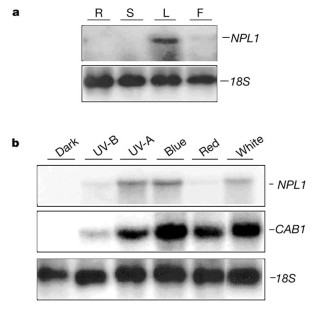
Figure 1: Tissue expression and light inducibility of NPL1 mRNA.
The alternative text for this image may have been generated using AI.
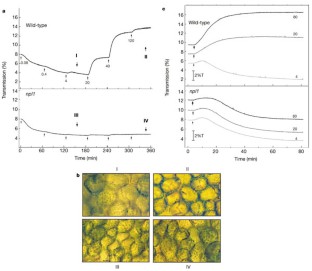
Figure 2: Chloroplast movement in response to continuous blue light.
The alternative text for this image may have been generated using AI.
References
- Zurzycki, J. in Blue-light Syndrome (ed. Senger, H.) 50–68 (Springer, Berlin, 1980).
Book Google Scholar - Jarillo, J. A., Ahmad, M. & Cashmore, A. R. NPL1 (Accession number AF053941): a second member of the NPH serine/threonine kinase family of Arabidopsis. Plant Physiol. 117, 719 (1998).
Google Scholar - Huala, E. et al. Arabidopsis NPH1: a protein kinase with a putative redox-sensing domain. Science 278, 2120–2123 (1997).
Article ADS CAS Google Scholar - Wada, M., Grolig, F. & Haupt, W. Light-oriented chloroplast positioning. Contribution to progress in photobiology. J. Photochem. Photobiol. 17, 3–25 (1993).
Article CAS Google Scholar - Kadota, A., Sato, Y. & Wada, M. Intracellular chloroplast photorelocation in the moss Physcomitrella patents is mediated by phytochrome as well as a blue-light receptor. Planta 210, 932–937 (2000).
Article CAS Google Scholar - Briggs, W. R. & Huala, E. Blue-light photoreceptors in higher plants. Annu. Rev. Cell Dev. Biol. 15, 33–62 (1999).
Article CAS Google Scholar - Zacherl, M., Huala, E., Rudiger, W., Briggs, W. R. & Salomon, M. Isolation and characterization of cDNAs from oat encoding a serine/threonine kinase: an early component in signal transduction for phototropism. Plant Physiol. 116, 869 (1998).
Google Scholar - Kanegae, H. et al. Rice NPH1 homologues, OsNPH1a and OsNPH1b, are differently photoregulated. Plant Cell. Physiol. 41, 415–423 (2000).
Article CAS Google Scholar - Nozue, K., Christie, J. M., Kiyosue, T., Briggs, W. R. & Wada, M. Isolation and characterization of a fern phototropin (Accession number AB037188), a putative blue-light photoreceptor for phototropism. Plant Physiol. 122, 1457 (2000).
Article Google Scholar - Salomon, M., Christie, J. M., Knieb, E., Lempert, U. & Briggs, W. R. Photochemical and mutational analysis of the FMN-binding domains of the plant blue light photoreceptor, phototropin. Biochemistry 39, 9401–9410 (2000).
Article CAS Google Scholar - Hanks, S. K., Quinn, A. M. & Hunter, T. The protein kinase family: conserved features and deduced phylogeny of the catalytic domains. Science 241, 42–52 (1988).
Article ADS CAS Google Scholar - Liscum, E. & Briggs, W. R. Mutations in the NPH1 locus of Arabidopsis disrupt the perception of phototropic stimuli. Plant Cell 7, 473–485 (1995).
CAS PubMed PubMed Central Google Scholar - Lin, C. Photoreceptors and regulation of flowering time. Plant Physiol. 123, 39–50 (2000).
Article CAS Google Scholar - Kagawa, T. & Wada, M. Blue light-induced chloroplast relocation in Arabidopsis thaliana as analyzed by microbeam irradiation. Plant Cell Physiol. 41, 84–93 (2000).
Article CAS Google Scholar - Trojan, A. & Gabrys, H. Chloroplast distribution in Arabidopsis thaliana (L.) depends on light conditions during growth. Plant Physiol. 111, 419–425 (1996).
Article CAS Google Scholar - Tlalka, M. & Gabrys, H. Influence of calcium on blue-light-induced chloroplast movement in Lemna trisulca. Planta 189, 491–498 (1993).
Article CAS Google Scholar - Malec, P. Kinetic modelling of chloroplast phototranslocations in Lemna trisulca L: two rate-limiting components? J. Theor. Biol. 169, 189–195 (1994).
Article Google Scholar - Ahmad, M. & Cashmore, A. R. HY4 gene of A. thaliana encodes a protein with characteristics of a blue-light photoreceptor. Nature 366, 162–166 (1993).
Article ADS CAS Google Scholar - Leutwiler, L. S., Meyerowitz, E. & Tobin, E. M. Structure and expression of three light-harvesting chlorophyll a/b binding protein genes of Arabidopsis thaliana. Nucleic Acids Res. 14, 4051–4064 (1986).
Article CAS Google Scholar - Walczak, T. & Gabrys, H. New type of photometer for measurements of transmission changes corresponding to chloroplast movements in leaves. Photosynthetica 14, 65–72 (1980).
Google Scholar
Acknowledgements
This work was supported by grants to A.R.C. from NIH and DOE, and a NATO fellowship awarded to J.C. We thank N. Bonini and S. Poethig for comments on the manuscript.
Author information
Author notes
- Jose M. Alonso & Joseph R. Ecker
Present address: Plant Biology Laboratory, The Salk Institute for Biological Studies, La Jolla, California, 92037, USA
Authors and Affiliations
- Department of Biology, Plant Science Institute, University of Pennsylvania, Philadelphia, 19104-6018, Pennsylvania, USA
Jose A. Jarillo, Juan Capel, Jose M. Alonso, Joseph R. Ecker & Anthony R. Cashmore - Institute of Molecular Biology, Jagiellonian University, Krakow, 31-120, Poland
Halina Gabrys - Departamento de Biología Aplicada, Universidad de Almería, Almeria, 04120, Spain
Juan Capel
Authors
- Jose A. Jarillo
- Halina Gabrys
- Juan Capel
- Jose M. Alonso
- Joseph R. Ecker
- Anthony R. Cashmore
Corresponding author
Correspondence toAnthony R. Cashmore.
Supplementary information

Figure 1. (download GIF )
Comparisons of conserved domains in NPL1 and other members of the NPH1 protein family. Sequence alignments of AtNPL1 (Accession number, AF053941), and AtNPH1 (Accession number, AF030864) from Arabidopsis thaliana, OsNPH1a (Accession number, AB018444.1), and OsNPH1b (Accession number, AB018443.1) from Oryza sativa, AsNPH1-1 (Accession number, AF033096), and AsNPH1-2 (Accession number, AF033097) from Avena sativa L., ZmNPH1 (Accession number, AF033263) from Zea mays, and AcNPH1-2 (Accession number, AB037188) from Adiantum capillus-veneris. The LOV domains are highlighted by a line below the sequence. A double line indicates the serine-threonine kinase domain. Asterisks represent the conserved cysteine residues involved in the photochemical reactions of the NPH1 LOV domains. (GIF 285 KB)

Figure 2. (download GIF )
Isolation and phenotypic characterization of npl1 mutant. a. NPL1 gene structure and T-DNA insertion mutant. The NPL1 gene that maps to the bottom of chromosome V, bears a coding region of 22 exons (represented by filled boxes) extending for 5.4 Kb. The npl1-1 mutant was identified by PCR-screening of 30,000 T-DNA insertion lines (Alonso and Ecker, unpublished), using oligonucleotides specific for the NPL1 gene and the T-DNA. By DNA sequencing of the amplified products, it was demonstrated that the insertion disrupted the NPL1 gene in the second intron (the site of the T-DNA insertion in the npl1 mutant is indicated). b. Northern blot hybridization with an NPL1 probe against RNA prepared from leaves of wild type (Columbia) and npl1mutant plants. The band in the wild type lane corresponded to a size of approximately 3 kb. No hybridization signal was detected for the mutant. (GIF 12 KB)
Rights and permissions
About this article
Cite this article
Jarillo, J., Gabrys, H., Capel, J. et al. Phototropin-related NPL1 controls chloroplast relocation induced by blue light.Nature 410, 952–954 (2001). https://doi.org/10.1038/35073622
- Received: 27 December 2000
- Accepted: 08 March 2001
- Issue date: 19 April 2001
- DOI: https://doi.org/10.1038/35073622