The heparin-binding haemagglutinin of M. tuberculosis is required for extrapulmonary dissemination (original) (raw)
- Letter
- Published: 12 July 2001
- Sylvie Alonso1,
- Franck Biet1,
- Giovanni Delogu2,
- Michael J. Brennan2,
- Camille Locht1 &
- …
- Franco D. Menozzi1
Nature volume 412, pages 190–194 (2001) Cite this article
- 3058 Accesses
- 420 Citations
- 12 Altmetric
- Metrics details
Abstract
Tuberculosis remains the world's leading cause of death due to a single infectious agent, Mycobacterium tuberculosis, with 3 million deaths and 10 million new cases per year1. The infection initiates in the lungs and can then spread rapidly to other tissues2. The availability of the entire M. tuberculosis genome sequence3 and advances in gene disruption technologies4 have led to the identification of several mycobacterial determinants involved in virulence5,6,7,8. However, no virulence factor specifically involved in the extrapulmonary dissemination of M. tuberculosis has been identified to date. Here we show that the disruption of the M. tuberculosis or Mycobacterium bovis Bacille Calmette–Guérin (BCG) hbhA gene encoding the heparin-binding haemagglutinin adhesin (HBHA) markedly affects mycobacterial interactions with epithelial cells, but not with macrophage-like cells. When nasally administered to mice, the mutant strains were severely impaired in spleen colonization, but not in lung colonization. Coating wild-type mycobacteria with anti-HBHA antibodies also impaired dissemination after intranasal infection. These results provide evidence that adhesins such as HBHA are required for extrapulmonary dissemination, and that interactions with non-phagocytic cells have an important role in the pathogenesis of tuberculosis. They also suggest that antibody responses to HBHA may add to immune protection against tuberculosis.
This is a preview of subscription content, access via your institution
Access options
Subscribe to this journal
Receive 51 print issues and online access
$199.00 per year
only $3.90 per issue
Buy this article
- Purchase on SpringerLink
- Instant access to the full article PDF.
USD 39.95
Prices may be subject to local taxes which are calculated during checkout
Additional access options:
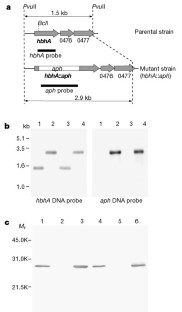
Figure 1: Genotype and phenotype analyses of hbhA::aph strains.
The alternative text for this image may have been generated using AI.
Figure 2: Effect of the hbhA::aph mutation on the interaction of M. tuberculosis 103 with phagocytic and non-phagocytic cells.

The alternative text for this image may have been generated using AI.
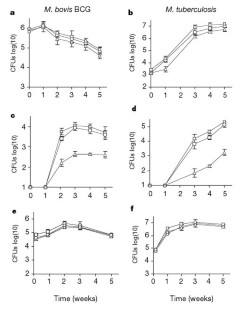
Figure 3: Effect of the hbhA::aph mutation on survival and multiplication of M. bovis BCG (left panels) and M. tuberculosis 103 (right panels).
The alternative text for this image may have been generated using AI.
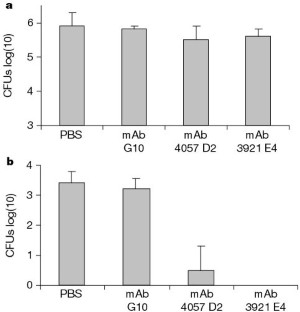
Figure 4: Influence of anti-HBHA antibodies on dissemination.
The alternative text for this image may have been generated using AI.
References
- Dye, C., Scheele, S., Dolin, P., Pathania, V. & Raviglione, M. C. Consensus statement: global burden of tuberculosis: estimated incidence, prevalence, and mortality by country. WHO Global Surveillance and Monitoring Project. J. Am. Med. Assoc. 282, 677–686 (1999).
Article CAS Google Scholar - Balasubramanian, V., Wiegeshaus, E. H., Taylor, B. T. & Smith, D. W. Pathogenesis of tuberculosis: pathway to apical localization. Tuber. Lung Dis. 75, 168–178 (1994).
Article CAS Google Scholar - Cole, S. T. et al. Deciphering the biology of Mycobacterium tuberculosis from the complete genome sequence. Nature 393, 537–544 (1998).
Article ADS CAS Google Scholar - Pelicic, V. et al. Efficient allelic exchange and transposon mutagenesis in Mycobacterium tuberculosis. Proc. Natl Acad. Sci. USA 94, 10955–10960 (1998).
Article ADS Google Scholar - Berthet, F.-X. et al. Attenuation of virulence by disruption of the Mycobacterium tuberculosis erp gene. Science 282, 759–762 (1998).
Article ADS CAS Google Scholar - McKinney, J. D. et al. Persistence of Mycobacterium tuberculosis in macrophages and mice requires the glycoxylate shunt enzyme isocitrate lyase. Nature 406, 735–738 (2000).
Article ADS CAS Google Scholar - Camacho, L. R. et al. Identification of a virulence gene cluster of Mycobacterium tuberculosis by signature-tagged transposon mutagenesis. Mol. Microbiol. 34, 257–267 (1999).
Article CAS Google Scholar - Cox, J. S., Chen, B., McNeil, M. & Jacobs, W. R. Jr Complex lipid determines tissue-specific replication of Mycobacterium tuberculosis in mice. Nature 402, 79–83 (1999).
Article ADS CAS Google Scholar - Henderson, H. J., Dannenberg, A. M. Jr & Lurie, M. B. Phagocytosis of tubercle bacilli by rabbit pulmonary alveolar macrophages and its relation to native resistance to tuberculosis. J. Immunol. 90, 553–556 (1963).
Google Scholar - Teitelbaum, R. et al. The M cells as a portal of entry to the lung for the bacterial pathogen Mycobacterium tuberculosis. Immunity 10, 641–650 (1999).
Article CAS Google Scholar - Menozzi, F. D. et al. Identification of a heparin-binding hemagglutinin present in mycobacteria. J. Exp. Med. 184, 993–1001 (1996).
Article CAS Google Scholar - Reddy, V. M. & Kumar, B. Interaction of Mycobacterium avium complex with human respiratory epithelial cells. J. Infect. Dis. 181, 1189–1193 (2000).
Article CAS Google Scholar - Pethe, K. et al. Mycobacterium smegmatis laminin-binding glycoprotein shares epitopes with Mycobacterium tuberculosis heparin-binding haemagglutinin. Mol. Microbiol. 39, 89–99 (2001).
Article CAS Google Scholar - Pethe, K. et al. Characterization of the heparin-binding site of the mycobacterial heparin-binding hemagglutinin adhesin. J. Biol. Chem. 275, 14273–14280 (2000).
Article CAS Google Scholar - Delogu, G. & Brennan, M. J. Functional domains in the mycobacterial hemagglutinin, HBHA. J. Bacteriol. 181, 7464–7469 (1999).
CAS Google Scholar - Menozzi, F. D. et al. Molecular characterization of the mycobacterial heparin-binding hemagglutinin, a mycobacterial adhesin. Proc. Natl Acad. Sci. USA 95, 12625–12630 (1998).
Article ADS CAS Google Scholar - Pavelka, M. S. & Jacobs, W. R. Jr Biosynthesis of diaminopimelate, the precursor of lysine and a component of peptidoglycan, is an essential function of Mycobacterium tuberculosis. J. Bacteriol. 178, 6496–6507 (1996).
Article CAS Google Scholar - Teitelbaum, R. et al. A mAb recognizing a surface antigen of Mycobacterium tuberculosis enhances host survival. Proc. Natl Acad. Sci. USA 95, 15688–15693 (1998).
Article ADS CAS Google Scholar - Quandt, J. & Hynes, M. F. Versatile suicide vectors which allow direct selection for gene replacement in Gram-negative bacteria. Gene 127, 15–21 (1993).
Article CAS Google Scholar - Wei, J. et al. Identification of a Mycobacterium tuberculosis gene that enhances mycobacterial survival in macrophages. J. Bacteriol. 182, 377–384 (2000).
Article CAS Google Scholar
Acknowledgements
We thank W. R. Jacobs Jr for the gift of pYUB415; B. Gicquel for the gift of pPR27 and M. tuberculosis 103; J. P. Decavel for help in animal handling; and S. T. Cole, P. Bifani and A. R. Baulard for critically reading the manuscript. This work was supported by INSERM, Institut Pasteur de Lille, Région Nord-Pas de Calais, and the Ministère de la Recherche. K.P. and S.A. were supported by a fellowship from the Ministère de la Recherche and Aventis-Pasteur, respectively.
Author information
Authors and Affiliations
- Unité INSERM U447, Institut Pasteur de Lille, 1 rue du Prof. Calmette, Lille Cedex, F-59019, France
Kevin Pethe, Sylvie Alonso, Franck Biet, Camille Locht & Franco D. Menozzi - Laboratory of Mycobacterial Diseases, Center for Biologics Evaluation and Research, Food and Drug Administration, 29 Lincoln Drive, Building 29, Room 502, Bethesda, 20892, Maryland, USA
Giovanni Delogu & Michael J. Brennan
Authors
- Kevin Pethe
- Sylvie Alonso
- Franck Biet
- Giovanni Delogu
- Michael J. Brennan
- Camille Locht
- Franco D. Menozzi
Corresponding author
Correspondence toCamille Locht.
Rights and permissions
About this article
Cite this article
Pethe, K., Alonso, S., Biet, F. et al. The heparin-binding haemagglutinin of M. tuberculosis is required for extrapulmonary dissemination.Nature 412, 190–194 (2001). https://doi.org/10.1038/35084083
- Received: 08 March 2001
- Accepted: 18 May 2001
- Issue date: 12 July 2001
- DOI: https://doi.org/10.1038/35084083