The strongest size (original) (raw)
- News & Views
- Published: 05 February 1998
Nanocrystals
Nature volume 391, pages 532–533 (1998) Cite this article
- 4851 Accesses
- 444 Citations
- 7 Altmetric
- Metrics details
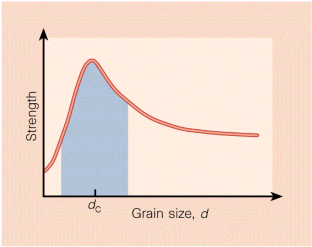
How crystal grains deform in a material under stress is important both scientifically, for the understanding of plastic flow in solids, and technologically, for its direct effect on the material strength. Grain size plays an important part: in polycrystals with grain sizes in the micrometre range, strength increases with decreasing size. This is known as the Hall-Petch effect1,2, and was first explained in terms of the piling up of dislocations, created by the shearing of crystal planes in each grain, at the grain boundaries. As the grains become smaller, the effect of dislocation blocking increases, thereby strengthening the material. But with the synthesis of nanocrystals, with grains in the nanometre range, the opposite behaviour was found — specimens of copper and palladium softened with decreasing size3.
Why? As reported on page 561 of this issue4, computer simulations show that the reverse Hall-Petch effect arises primarily from sliding motions at grain boundaries. This is a timely demonstration of how materials simulations can now provide atomic-level insights into a wide range of physical phenomena.
This is a preview of subscription content, access via your institution
Relevant articles
Open Access articles citing this article.
Access options
Subscribe to this journal
Receive 51 print issues and online access
$199.00 per year
only $3.90 per issue
Buy this article
- Purchase on SpringerLink
- Instant access to the full article PDF.
USD 39.95
Prices may be subject to local taxes which are calculated during checkout
Additional access options:
Figure 1: Variation of strength with grain size for metals.
The alternative text for this image may have been generated using AI.
References
- Hall, E. O. Proc. Phys. Soc. Lond. B 64, 747–753 (1951).
Google Scholar - Petch, N. J. J. Iron Steel Inst. 174, 25–28 (1953).
Google Scholar - Chokshi, A. H., Rosen, A., Karch, J. & Gleiter, H. Scripta Metall. 23, 1679–1684 (1989).
Google Scholar - Schiøtz, J., Di Tolla, F. D. & Jacobsen, K. W. Nature 391, 561–563 (1998).
Article ADS Google Scholar - Nieh, T. G. & Wadsworth, J. Scripta Met. Mater. 25, 955–958 (1991).
Google Scholar - Chen, I.-W. & Rosenflanz, A. Nature 389, 701–704 (1997).
Article ADS CAS Google Scholar - Keblinski, P., Phillpot, S. R., Wolf, D. & Gleiter, H. Interface Sci. (in the press).
- Schowalter, L. J. (ed.) _Heteroepitaxy and Strain, MRS Bull._spec. issue 21, No. 4 (1996).
- Tadmor, E. B., Ortiz, M. & Phillips, R. Phil. Mag. A 73, 1529(1996).
Google Scholar - Yip, S. (ed. J. Computer-Aided Materials Design 3, 1–410 (1997).
Google Scholar
Author information
Authors and Affiliations
- the Nuclear Engineering Department, Massachusetts Institute of Technology, Cambridge, 02139, Massachusetts, USA
Sidney Yip
Rights and permissions
About this article
Cite this article
Yip, S. The strongest size.Nature 391, 532–533 (1998). https://doi.org/10.1038/35254
- Issue date: 05 February 1998
- DOI: https://doi.org/10.1038/35254