Making mistakes when predicting shifts in species range in response to global warming (original) (raw)
- Letter
- Published: 19 February 1998
Nature volume 391, pages 783–786 (1998) Cite this article
- 6941 Accesses
- 966 Citations
- 31 Altmetric
- Metrics details
Abstract
Many attempts to predict the biotic responses to climate change rely on the ‘climate envelope’ approach1,2,3, in which the current distribution of a species is mapped in climate-space and then, if the position of that climate-space changes, the distribution of the species is predicted to shift accordingly4,5,6. The flaw in this approach is that distributions of species also reflect the influence of interactions with other species7,8,9,10, so predictions based on climate envelopes may be very misleading if the interactions between species are altered by climate change11. An additional problem is that current distributions may be the result of sources and sinks12, in which species appear to thrive in places where they really persist only because individuals disperse into them from elsewhere13,14. Here we use microcosm experiments on simple but realistic assemblages to show how misleading the climate envelope approach can be. We show that dispersal and interactions, which are important elements of population dynamics15, must be included in predictions of biotic responses to climate change.
This is a preview of subscription content, access via your institution
Access options
Subscribe to this journal
Receive 51 print issues and online access
$199.00 per year
only $3.90 per issue
Buy this article
- Purchase on SpringerLink
- Instant access to the full article PDF.
USD 39.95
Prices may be subject to local taxes which are calculated during checkout
Additional access options:
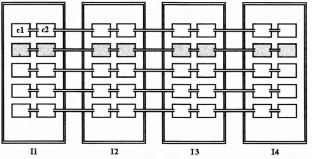
Figure 1: Experimental arrangement.
The alternative text for this image may have been generated using AI.
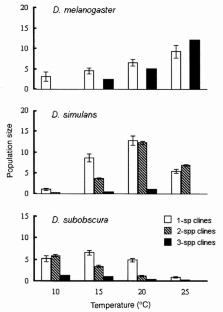
Figure 2: Comparison of Drosophila populations in single-species clines, two-species clines, and three-species clines.
The alternative text for this image may have been generated using AI.
Figure 3: Comparison of Drosophila populations in cold three-species clines with or without L.boulardi parasitoids.

The alternative text for this image may have been generated using AI.
Figure 4: Comparison of Drosophila populations on their own, with and without dispersal.

The alternative text for this image may have been generated using AI.
Figure 5: Comparison of Drosophila subobscura populations in cold and hot clines, either in two-species clines or three-species clines.

The alternative text for this image may have been generated using AI.
References
- Jeffree, E. P. & Jeffree, C. E. Redistribution of the potential geographic ranges of Mistletoe and Colorado Beetle in Europe in response to the temperature component of climate change. Funct. Ecol. 10, 562–577 (1996).
Article Google Scholar - Porter, J. in Insects in a Changing Environment (eds Harrington, R. & Stork, N. E.) 93–123 (Academic, London, (1995)).
Google Scholar - Sutherst, R. W., Maywald, G. F. & Skarrat, D. B. in Insects in a Changing Environment (eds Harrington, R. & Stork, N. E.) 59–91 (Academic, London, (1995)).
Google Scholar - Beerling, D. J. The impact of temperature on the northern distribution limits of the introduced species Fallopia japonica and Impatiens glandulifera in north-west Europe. J. Biogeog. 20, 45–53 (1993).
Article Google Scholar - Rogers, D. J. & Randolph, S. E. Distribution of tsetse and ticks in Africa: past, present and future. Parasitol. Today 9, 266–271 (1993).
Article CAS Google Scholar - Scott, D. & Poynter, M. Upper temperature limits for trout in New Zealand and climate change. Hydrobiology 222, 147–151 (1991).
Article Google Scholar - Connell, J. H. The influence of competition and other factors on the distribution of the barnacle Chthamalus stellatus. Ecology 40, 49–78 (1961).
Google Scholar - LaSalle, J. in Hymenoptera and Biodiversity (eds LaSalle, J. & Gauld, I. D.) 197–215 (CAB International, Wallingford, (1993)).
Google Scholar - Lawton, J. H. & Hassell, M. P. in Ecological Entomology (eds Huffaker, C. B. & Rabb, R. L.) 451–420 (John Wiley, Chichester, (1984)).
Google Scholar - Paine, R. T. Food web complexity and species diversity. Am. Nat. 100, 65–75 (1966).
Article Google Scholar - Graham, R. W. in Global Warming and Biological Diversity (eds Peters, R. L. & Lovejoy, T. E.) 76–87 (Yale Univ. Press, New Haven, CT, (1992)).
Google Scholar - Pulliam, H. R. Sources, sinks and population regulation. Am. Nat. 132, 652–661 (1988).
Article Google Scholar - Rodriguez, J., Jordano, D. & Fernandez Haegar, J. Spatial heterogeneity in a butterfly-host plant interaction. J. Anim. Ecol. 63, 31–38 (1994).
Article Google Scholar - Watkinson, A. R. On the abundance of plants along an environmental gradient. J. Ecol. 73, 569–578 (1985).
Article Google Scholar - Pacala, S. W. & Hurtt, G. C. in Biotic Interactions and Global Change (eds Kareiva, P. M., Kingsolver, J. G. & Huey, R. B.) 57–74 (Sinauer, Boston, MA, (1993)).
Google Scholar - Nordlander, G. Revision of the genus Leptopilina Forster, 1869, with notes on the status of some other genera (Hymenoptera, Cynipoidea: Eucoilidae). Entomol. Scand. 11, 428–453 (1980).
Article Google Scholar - Wheeler, M. R. in The Genetics and Biology of Drosophila Vol. 3a (eds Ashburner, M., Carson, H. & Thompson, J. N.) 1–98 (Academic, London, (1986)).
Google Scholar - Kraaijeveld, A. R. & van Alphen, J. J. M. Geographical variation in encapsulation ability of Drosophila melanogaster larvae and evidence for parasitoid-specific components. Evol. Ecol. 9, 10–17 (1995).
Article Google Scholar - Bennetts, D. A. in Insects in a Changing Environment (eds Harrington, R. & Stork, N. E.) 49–58 (Academic, London, (1995)).
Google Scholar - Coope, G. R. in Insects in a Changing environment (eds Harrington, R. & Stork, N. E.) 30–48 (Academic, London, (1995)).
Google Scholar - Davis, M. B. in Community Ecology (eds Diamond, J. & Case, T. J.) 269–284 (Harper & Row, New York, (1986)).
Google Scholar - Graham, R. W. et al. Spatial responses of mammals to late quaternary environmental fluctuations. Science 272, 1601–1606 (1996).
Article ADS CAS Google Scholar - Valentine, J. W. & Jablonski, D. in Species Diversity in Ecological Communities (eds Ricklefs, R. E. & Schluter, D.) 341–349 (Univ. Chicago Press, (1993)).
Google Scholar - Holt, R. D. & Lawton, J. H. The ecological consequences of shared natural enemies. Annu. Rev. Ecol. Syst. 25, 495–520 (1994).
Article Google Scholar - Hanski, I. A. & Gilpin, M. E. (eds) Metapopulation Biology: Ecology, Genetics and Evolution (Academic, San Diego, (1997)).
MATH Google Scholar - Brussard, P. Geographic patterns and environmental gradients: the central-marginal model in Drosophila revisited. Annu. Rev. Ecol. Syst. 15, 25–64 (1984).
Article Google Scholar - Parmesan, C. Climate and species' range. Nature 382, 765–766 (1996).
Article ADS CAS Google Scholar
Acknowledgements
This work was funded by BBSRC under the Biological Adaptation to Global Environmental Change programme.
Author information
Author notes
- Simon Wood
Present address: Mathematical Institute, University of St Andrews, North Haugh, St Andrews, Fife, KY16 9SS, UK
Authors and Affiliations
- Biology Department, Ecology and Evolution Group, The University, Leeds, LS2 9JT, Yorkshire, UK
Andrew J. Davis, Linda S. Jenkinson & Bryan Shorrocks - NERC Centre for Population Biology, Imperial College Silwood Park, Ascot, SL5 7PY, Berkshire, UK
John H. Lawton & Simon Wood
Authors
- Andrew J. Davis
- Linda S. Jenkinson
- John H. Lawton
- Bryan Shorrocks
- Simon Wood
Corresponding author
Correspondence toAndrew J. Davis.
Rights and permissions
About this article
Cite this article
Davis, A., Jenkinson, L., Lawton, J. et al. Making mistakes when predicting shifts in species range in response to global warming.Nature 391, 783–786 (1998). https://doi.org/10.1038/35842
- Received: 09 April 1997
- Accepted: 27 October 1997
- Issue date: 19 February 1998
- DOI: https://doi.org/10.1038/35842