The radio afterglow from the γ-ray burst of 8 May 1997 (original) (raw)
- Letter
- Published: 18 September 1997
Nature volume 389, pages 261–263 (1997) Cite this article
- 1162 Accesses
- 501 Citations
- 3 Altmetric
- Metrics details
Abstract
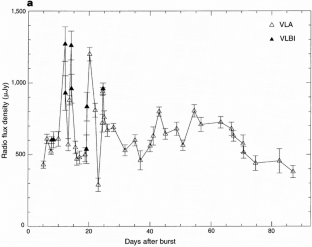
Important insight into the nature of γ-ray bursts (GRBs) has been gained in recent months mainly due to the immediate, precise localization of the bursts1,2,3 and the discovery of relatively long-lived X-ray afterglows1,2,3,4 by the satellite BeppoSAX5. These advances have enabled deep searches which have led to the discovery of optical transients6,7 coincident with fading X-ray sources. Optical spectroscopy of the latest burst (GRB970508; ref. 8) has clearly demonstrated that it lies at a cosmological distance, thus resolving a long-standing controversy about the distance scale to GRBs. Here we report a variable radio source within the error box of GRB970508 and coincident with the optical transient. We suggest that this is the much-sought-after radio counterpart of a GRB. If the observed fluctuations in the radio emission (‘twinkling’) are a result of a strong scattering by the irregularities in the ionized Galactic interstellar gas, then the source must have an angular size of about 3 microarcseconds in the first few weeks. The damping of the fluctuations with time indicates that the source expands to a significantly larger size later on.
This is a preview of subscription content, access via your institution
Access options
Subscribe to this journal
Receive 51 print issues and online access
$199.00 per year
only $3.90 per issue
Buy this article
- Purchase on SpringerLink
- Instant access to the full article PDF.
USD 39.95
Prices may be subject to local taxes which are calculated during checkout
Additional access options:
Figure 1: Light curves of the radio counterpart of GRB970508.
The alternative text for this image may have been generated using AI.
References
- Costa, E. et al. Discovery of an X-ray afterglow associated with the γ-ray burst of 28 February 1997. Nature 387, 783–785 (1997).
Article ADS CAS Google Scholar - Costa, E. et al. IAU Circ. No. 6649(1997).
Google Scholar - Heise, J. et al. IAU Circ. No. 6654(1997).
Google Scholar - Piro, L. et al. IAU Circ. No. 6656(1997).
Google Scholar - Boella, G. et al. BeppoSAX, the wideband mission for X-ray astronomy. Astron. Astrophys. Suppl. Ser. 122, 299–307 (1997).
Article ADS Google Scholar - van Paradijs, J. et al. Transient optical emission from the error box of the γ-ray burst of 28 February 1997. Nature 386, 686–689 (1997).
Article ADS CAS Google Scholar - Bond, H. E. et al. IAU Circ. No. 6665(1997).
Google Scholar - Metzger, M. R. et al. Spectral constraints on the redshift of the optical counterpart to the γ-ray burst of 8 May 1997. Nature 387, 878–880 (1997).
Article ADS CAS Google Scholar - Djorgovski, S. G. et al. The optical counterpart to the γ-ray burst GRB970508. Nature 387, 876–878 (1997).
Article ADS CAS Google Scholar - Windhorst, R. A. et al. Microjansky source counts and spectral indices at 8.44 GHz. Astrophys. J. 405, 498–517 (1993).
Article ADS Google Scholar - Pian, E. et al. Hubble space telescope imaging of the optical counterpart to the gramma-ray burster GRB970508. Astrophys. J. (submitted).
- Pooley, G. & Green, D. A. IAU Circ. No. 6670(1997).
Google Scholar - Smith, I. A. et al. IAU Circ. No. 6663(1997).
Google Scholar - Shepherd, D. S., Metzger, M. R. & Kulkarni, S. R. IAU Circ. No. 6664(1997).
Google Scholar - Waxman, E. γ-ray burst after-glow: confirming the cosmological fireball model. Nature (submitted).
- Mészáros, P. & Rees, M. J. Optical and long wavelength afterglow from gamma-ray bursts. Astrophys. J. 476, 232–237 (1997).
Article ADS Google Scholar - Paczyński, B. & Rhoads, J. E. Radio transients from gamma-ray bursters. Astrophys. J. 418, L5–L8 (1993).
Article ADS Google Scholar - Katz, J. I. Low frequency spectra from gamma-ray bursts. Astrophys. J. 432, L107–L109 (1994).
Article ADS Google Scholar - Wijers, R. A. M. J., Rees, M. J. & Meszaros, P. Shocked by GRB 970228: the afterglow of a cosmological fireball. Mon. Not. R. Astron. Soc. (submitted); Preprint astroph/9704158(1997).
Google Scholar - Vietri, M. The afterglow of gamma ray bursts II: the cases of GRB 970228 and GRB 970508. Astrophys. J. (submitted).
- Goodman, J. Radio scintillation of gamma-ray burst afterglows. Preprint astro-ph/9706084 (1997).
- Narayan, R. in Pulsars as Physics Laboratories(eds Blandford, R. D., Hewish, A., Lyne, A. G.&Mestel, L.) 151–165 (Oxford Univ. Press, (1993).
Google Scholar - Taylor, G. B., Frail, D. A., Beasley, A. J. & Kulkarni, S. R. Position and parallax of the γ-ray burst of 8 May 1997. Nature 389, 263–265 (1997).
Article ADS CAS Google Scholar - Katz, J. I. & Piran, T. Persistent counterparts ot GRBs. Preprint astro-ph/9706141 (1997).
Acknowledgements
The VLA is a facility of the NSF operated under cooperative agreement by Associated Universities, Inc. D.A.F. and S.R.K. thank NRAO, and in particular B. Clark and M. Goss, for their support of the GRB programme. We thank R. Blandford and E. Waxman for discussions. S.R.K. is supported by the NSF and NASA.
Author information
Authors and Affiliations
- National Radio Astronomy Observatory, Socorro, 87801, New Mexico, USA
D. A. Frail & G. B. Taylor - Division of Physics, Mathematics and Astronomy 105-24, Caltech, Pasadena, 91125, California, USA
S. R. Kulkarni - Istituto Tecnologie e Studio Radiazioni Extraterrestri, CNR, I-40129, Bologna, Italy
L. Nicastro - Istituto di Astrofisica Spaziale, CNR, Via E. Fermi, 21, 00044, Frascati, Italy
M. Feroci
Authors
- D. A. Frail
- S. R. Kulkarni
- L. Nicastro
- M. Feroci
- G. B. Taylor
Corresponding author
Correspondence toD. A. Frail.
Rights and permissions
About this article
Cite this article
Frail, D., Kulkarni, S., Nicastro, L. et al. The radio afterglow from the γ-ray burst of 8 May 1997.Nature 389, 261–263 (1997). https://doi.org/10.1038/38451
- Received: 08 August 1997
- Accepted: 28 August 1997
- Issue date: 18 September 1997
- DOI: https://doi.org/10.1038/38451
This article is cited by
Simulation of the in-flight background and performance of DRO/GTM
- Chenwei Wang
- Juan Zhang
- Yanqiu Zhang
Experimental Astronomy (2024)
The scientific performance of the microchannel X-ray telescope on board the SVOM mission
- D. Götz
- M. Boutelier
- R. Willingale
Experimental Astronomy (2023)
Line-of-shower trigger method to lower energy threshold for GRB detection using LHAASO-WCDA
- F. Aharonian
- Q. An
- X. Zuo
Radiation Detection Technology and Methods (2021)
The key role of BeppoSAX in the GRB history
- Filippo Frontera
Rendiconti Lincei. Scienze Fisiche e Naturali (2019)
- Filippo Frontera
Radio Afterglows of Gamma Ray Bursts
- Lekshmi Resmi
Journal of Astrophysics and Astronomy (2017)
- Lekshmi Resmi