Fibulin-5/DANCE is essential for elastogenesis in vivo (original) (raw)
- Letter
- Published: 10 January 2002
- Pilar Ruiz Lozano1,
- Yasuhiro Ikeda1,
- Yoshitaka Iwanaga1,2,
- Aleksander Hinek3,
- Susumu Minamisawa1,
- Ching-Feng Cheng1,
- Kazuhiro Kobuke4,
- Nancy Dalton1,
- Yoshikazu Takada2,
- Kei Tashiro5,
- John Ross Jr1,
- Tasuku Honjo4 &
- …
- Kenneth R. Chien1
Nature volume 415, pages 171–175 (2002) Cite this article
- 3330 Accesses
- 584 Citations
- 10 Altmetric
- Metrics details
Abstract
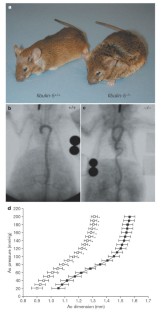
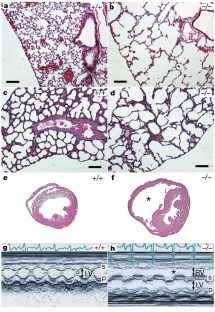
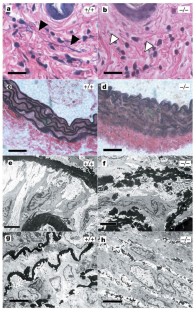
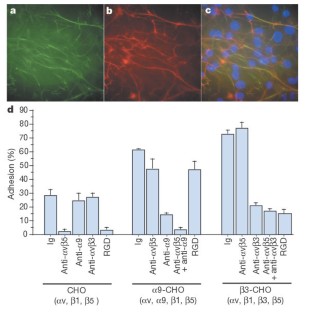
The elastic fibre system has a principal role in the structure and function of various types of organs that require elasticity, such as large arteries, lung and skin1,2. Although elastic fibres are known to be composed of microfibril proteins (for example, fibrillins and latent transforming growth factor (TGF)-β-binding proteins) and polymerized elastin, the mechanism of their assembly and development is not well understood. Here we report that fibulin-5 (also known as DANCE), a recently discovered integrin ligand3, is an essential determinant of elastic fibre organization. _fibulin-5_-/- mice generated by gene targeting exhibit a severely disorganized elastic fibre system throughout the body. _fibulin-5_-/- mice survive to adulthood, but have a tortuous aorta with loss of compliance, severe emphysema, and loose skin (cutis laxa). These tissues contain fragmented elastin without an increase of elastase activity, indicating defective development of elastic fibres. Fibulin-5 interacts directly with elastic fibres in vitro, and serves as a ligand for cell surface integrins αvβ3, αvβ5 and α9β1 through its amino-terminal domain. Thus, fibulin-5 may provide anchorage of elastic fibres to cells, thereby acting to stabilize and organize elastic fibres in the skin, lung and vasculature.
This is a preview of subscription content, access via your institution
Access options
Subscribe to this journal
Receive 51 print issues and online access
$199.00 per year
only $3.90 per issue
Buy this article
- Purchase on SpringerLink
- Instant access to the full article PDF.
USD 39.95
Prices may be subject to local taxes which are calculated during checkout
Additional access options:
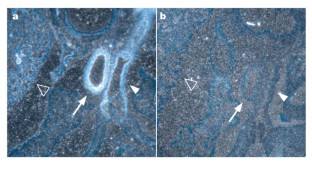
Figure 1: In situ hybridization of P0.5 fibulin-5+/+ (a) and _fibulin-5_-/- (b) transverse sections at the level of the cardiac outflow tract, probed with 35S-labelled fibulin-5 riboprobes.
The alternative text for this image may have been generated using AI.
Figure 2: Gross phenotypes and physiological studies of _fibulin-5_-/- mice.
The alternative text for this image may have been generated using AI.
Figure 3: Emphysema and secondary cardiac phenotype in _fibulin-5_-/- mice.
The alternative text for this image may have been generated using AI.
Figure 4: Fine structure of elastic fibres in tissues of fibulin-5+/+ and _fibulin-5_-/- mice.
The alternative text for this image may have been generated using AI.
Figure 5: Fibulin-5 binding to elastic fibres and to cell surface integrins.
The alternative text for this image may have been generated using AI.
References
- Debelle, L. & Tamburro, A. M. Elastin: molecular description and function. Int. J. Biochem. Cell Biol. 31, 261–272 (1999).
Article CAS Google Scholar - Rosenbloom, J., Abrams, W. R. & Mecham, R. Extracellular matrix 4: the elastic fiber. FASEB J. 7, 1208–1218 (1993).
Article CAS Google Scholar - Nakamura, T. et al. DANCE, a novel secreted RGD protein expressed in developing, atherosclerotic, and balloon-injured arteries. J. Biol. Chem. 274, 22476–22483 (1999).
Article CAS Google Scholar - Fazio, M. J., Olsen, D. R. & Uitto, J. J. Skin aging: lessons from cutis laxa and elastoderma. Cutis 43, 437–444 (1989).
CAS PubMed Google Scholar - Rapaport, E. in Textbook of Respiratory Medicine (eds Murray, J. F. & Nadel, J. A.) 1631–1648 (Saunders, Philadelphia, 2000).
Google Scholar - Minamisawa, S. et al. Chronic phospholamban-sarcoplasmic reticulum calcium ATPase interaction is the critical calcium cycling defect in dilated cardiomyopathy.. Cell 99, 313–322 (1999).
Article CAS Google Scholar - Feigenbaum, H. Ecocardiography (Lippincott Williams & Wilkins, Baltimore, 1995).
Google Scholar - Piquette, C. A., Rennard, S. I. & Snider, G. L. in Textbook of Respiratory Medicine (eds Murray, J. F. & Nadel, J. A.) 1187–1245 (Saunders, Philadelphia, 2000).
Google Scholar - Senior, R. M. & Shaprio, S. D. in Pulmonary Diseases and Disorders (ed. Fishman, A. P.) 659–681 (McGraw-Hill, New York, 1998).
Google Scholar - Dobrin, P. B., Schwarcz, T. H. & Mrkvicka, R. Longitudinal retractive force in pressurized dog and human arteries. J. Surg. Res. 48, 116–120 (1990).
Article CAS Google Scholar - Milewicz, D. M., Urban, Z. & Boyd, C. Genetic disorders of the elastic fiber system. Matrix Biol. 19, 471–480 (2000).
Article CAS Google Scholar - Robb, B. W., Wachi, H., Schaub, T., Mecham, R. P. & Davis, E. C. Characterization of an in vitro model of elastic fiber assembly. Mol. Biol. Cell 10, 3595–3605 (1999).
Article CAS Google Scholar - Robert, L. Mechanisms of aging of the extracellular matrix: role of the elastin-laminin receptor. Gerontology 44, 307–317 (1998).
Article CAS Google Scholar - Taooka, Y., Chen, J., Yednock, T. & Sheppard, D. The integrin α9β1 mediates adhesion to activated endothelial cells and transendothelial neutrophil migration through interaction with vascular cell adhesion molecule-1. J. Cell Biol. 145, 413–420 (1999).
Article CAS Google Scholar - Shattil, S. J. & Ginsberg, M. H. Integrin signaling in vascular biology. J. Clin. Invest. 100, S91–S95 (1997).
Article CAS Google Scholar - Yokosaki, Y. et al. The integrin α9β1 mediates cell attachment to a non-RGD site in the third fibronectin type III repeat of tenascin. J. Biol. Chem. 269, 26691–26696 (1994).
CAS PubMed Google Scholar - Eto, K. et al. RGD-independent binding of integrin α9β1 to the ADAM-12 and -15 disintegrin domains mediates cell–cell interaction. J. Biol. Chem. 275, 34922–34930 (2000).
Article CAS Google Scholar - Li, D. Y. et al. Elastin is an essential determinant of arterial morphogenesis. Nature 393, 276–280 (1998).
Article ADS CAS Google Scholar - Dietz, H. C. & Mecham, R. P. Mouse models of genetic diseases resulting from mutations in elastic fiber proteins. Matrix Biol. 19, 481–488 (2000).
Article CAS Google Scholar - Bailey, A. J. Molecular mechanisms of ageing in connective tissues. Mech. Ageing Dev. 122, 735–755 (2001).
Article CAS Google Scholar - Labat-Robert, J. & Robert, L. Aging of the extracellular matrix and its pathology. Exp. Gerontol. 23, 5–18 (1988).
Article CAS Google Scholar - Pashmforoush, M. et al. Adult mice deficient in actinin-associated LIM-domain protein reveal a developmental pathway for right ventricular cardiomyopathy. Nature Med. 7, 591–597 (2001).
Article CAS Google Scholar - Zhang, X. P., Kamata, T., Yokoyama, K., Puzon-McLaughlin, W. & Takada, Y. Specific interaction of the recombinant disintegrin-like domain of MDC-15 (metargidin, ADAM-15) with integrin αvβ3. J. Biol. Chem. 273, 7345–7350 (1998).
Article CAS Google Scholar
Acknowledgements
We thank Y. Gu, J. Anderson, T. Mikuni, N. Tomikawa and C. Suzuki for technical assistance; P. L. Haywood-Reid for electron microscopy; M. Hoshijima and H. Yasukawa for advice on experimental design; and S. Evans and J. Chen for suggestions in preparing the manuscript. This study was supported by the National Institutes of Health, the Jean LeDucq Foundation, and the American Heart Association Endowed Chair to K.R.C. T.N. was supported by the American Heart Association Western Affiliate Postdoctoral Fellowship.
Author information
Authors and Affiliations
- UCSD-Salk Program in Molecular Medicine and the UCSD Institute of Molecular Medicine, University of California, San Diego, La Jolla, 92093, California, USA
Tomoyuki Nakamura, Pilar Ruiz Lozano, Yasuhiro Ikeda, Yoshitaka Iwanaga, Susumu Minamisawa, Ching-Feng Cheng, Nancy Dalton, John Ross Jr & Kenneth R. Chien - Vascular Biology, the Scripps Research Institute, La Jolla, 92037, California, USA
Yoshitaka Iwanaga & Yoshikazu Takada - Division of Cardiovascular Research, The Hospital for Sick Children, Toronto, M5G 1X8, Ontario, Canada
Aleksander Hinek - Department of Medical Chemistry, Graduate School of Medicine, Kyoto University, Kyoto, 606-8501, Japan
Kazuhiro Kobuke & Tasuku Honjo - Center for Molecular Biology and Genetics, Kyoto University, Kyoto, 606-8501, Japan
Kei Tashiro
Authors
- Tomoyuki Nakamura
- Pilar Ruiz Lozano
- Yasuhiro Ikeda
- Yoshitaka Iwanaga
- Aleksander Hinek
- Susumu Minamisawa
- Ching-Feng Cheng
- Kazuhiro Kobuke
- Nancy Dalton
- Yoshikazu Takada
- Kei Tashiro
- John Ross Jr
- Tasuku Honjo
- Kenneth R. Chien
Corresponding author
Correspondence toKenneth R. Chien.
Ethics declarations
Competing interests
The authors declare no competing financial interests.
Supplementary information
Rights and permissions
About this article
Cite this article
Nakamura, T., Lozano, P., Ikeda, Y. et al. Fibulin-5/DANCE is essential for elastogenesis in vivo.Nature 415, 171–175 (2002). https://doi.org/10.1038/415171a
- Received: 11 September 2001
- Accepted: 12 November 2001
- Issue date: 10 January 2002
- DOI: https://doi.org/10.1038/415171a