Neglect disrupts the mental number line (original) (raw)
- Brief Communication
- Published: 09 May 2002
Brain damage
Nature volume 417, pages 138–139 (2002) Cite this article
- 5396 Accesses
- 637 Citations
- 144 Altmetric
- Metrics details
Abstract
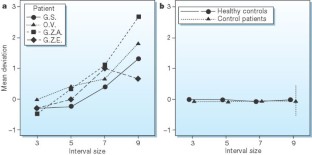
A popular metaphor for the representation of numbers in the brain is the 'mental number line', in which numbers are represented in a continuous, quantity-based analogical format1,2. Here we show that patients with hemispatial neglect3 misplace the midpoint of a numerical interval when asked to bisect it (for example, stating that five is halfway between two and six), with an error pattern that closely resembles the bisection of physical lines4. This new form of representational neglect constitutes strong evidence that the mental number line is more than simply a metaphor, and that its spatial nature renders it functionally isomorphic to physical lines.
This is a preview of subscription content, access via your institution
Access options
Subscribe to this journal
Receive 51 print issues and online access
$199.00 per year
only $3.90 per issue
Buy this article
- Purchase on SpringerLink
- Instant access to the full article PDF.
USD 39.95
Prices may be subject to local taxes which are calculated during checkout
Additional access options:
Figure 1: Displacement error with respect to the midpoint (0) of a numerical interval as a function of interval size.
The alternative text for this image may have been generated using AI.
References
- Restle, F. J. Exp. Psychol. 83, 274–278 (1970).
Article Google Scholar - Dehaene, S., Dupoux, E. & Mehler, J. J. Exp. Psychol. Hum. Percept. Perform. 16, 626–641 (1990).
Article CAS Google Scholar - Bisiach, E. & Vallar, G. in Handbook of Neuropsychology (eds Boller, F. & Grafman, G.) 459–502 (Elsevier, Amsterdam, 2000).
- Marshall, J. & Halligan, P. Cortex 25, 503–515 (1989).
Article CAS Google Scholar - Seron, X., Pesenti, M., Noël, M. P., Deloche, G. & Cornet, J. A. Cognition 44, 159–196 (1992).
Article CAS Google Scholar - Dehaene, S., Bossini, S. & Giraux, P. J. Exp. Psychol. Gen. 122, 371–396 (1993).
Article Google Scholar - Moyer, R. & Landauer, T. Nature 215, 1519–1520 (1967).
Article ADS CAS Google Scholar - Brannon, E. & Terrace, H. Science 282, 746–749 (1998).
Article ADS CAS Google Scholar - Bächtold, D., Baumüller, M. & Brugger, P. Neuropsychologia 36, 731–735 (1998).
Article Google Scholar - Dehaene, S., Dehaene-Lambertz, G. & Cohen, L. Trends Neurosci. 21, 355–361 (1998).
Article CAS Google Scholar - Caramazza, A. & Hillis, A. E. Nature 346, 267–269 (1990).
Article ADS CAS Google Scholar - Dehaene, S. & Cohen, L. Cortex 33, 219–250 (1997).
Article CAS Google Scholar - Hadamard, J. The Mathematician's Mind: The Psychology of Invention in the Mathematical Field (Princeton Univ. Press, New Jersey, 1996).
Author information
Authors and Affiliations
- Dipartimento di Psicologia Generale, Università di Padova, via Venezia 8, Padova, 35131, Italy
Marco Zorzi, Konstantinos Priftis & Carlo Umiltà - Università Vita-Salute San Raffaele, via Olgettina 58, Milano, 20132, Italy
Marco Zorzi
Authors
- Marco Zorzi
- Konstantinos Priftis
- Carlo Umiltà
Corresponding author
Correspondence toMarco Zorzi.
Ethics declarations
Competing interests
The authors declare no competing financial interests.
Rights and permissions
About this article
Cite this article
Zorzi, M., Priftis, K. & Umiltà, C. Neglect disrupts the mental number line.Nature 417, 138–139 (2002). https://doi.org/10.1038/417138a
- Issue date: 09 May 2002
- DOI: https://doi.org/10.1038/417138a