Bees trade off foraging speed for accuracy (original) (raw)
- Brief Communication
- Published: 24 July 2003
Psychophysics
Nature volume 424, page 388 (2003)Cite this article
- 6375 Accesses
- 384 Citations
- 11 Altmetric
- Metrics details
Abstract
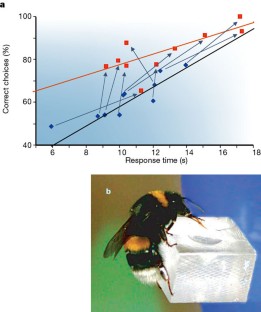
Bees have an impressive cognitive capacity1,2,3,4, but the strategies used by individuals in solving foraging tasks have been largely unexplored. Here we test bumblebees (Bombus terrestris) in a colour-discrimination task on a virtual flower meadow and find that some bees consistently make rapid choices but with low precision, whereas other bees are slower but highly accurate. Moreover, each bee will sacrifice speed in favour of accuracy when errors are penalized instead of just being unrewarded. To our knowledge, bees are the first example of an insect to show between-individual and within-individual speed– accuracy trade-offs.
This is a preview of subscription content, access via your institution
Access options
Subscribe to this journal
Receive 51 print issues and online access
$199.00 per year
only $3.90 per issue
Buy this article
- Purchase on SpringerLink
- Instant access to the full article PDF.
USD 39.95
Prices may be subject to local taxes which are calculated during checkout
Additional access options:
Figure 1: Bumblebees can choose wisely or rapidly, but not both at once.
The alternative text for this image may have been generated using AI.
References
- Menzel, R. in Neurobiology of Comparative Cognition (eds Kesner, R. P. & Olten, D. S.) 237–292 (Erlbaum, Hillsdale, New Jersey, 1990).
Google Scholar - Chittka, L. & Geiger, K. Anim. Behav. 49, 159–164 (1995).
Article Google Scholar - Giurfa, M., Zhang, S., Jenett, A., Menzel, R. & Srinivasan, M. V. Nature 410, 930–933 (2001).
Article ADS CAS Google Scholar - Dukas, R. & Waser, N. M. Anim. Behav. 48, 1001–1006 (1994).
Article Google Scholar - Rival, C., Oliver, I. & Ceyte, H. Neurosci. Lett. 336, 65–69 (2002).
Article Google Scholar - Smith, B. H., Abramson, C. I. & Tobin, T. R. J. Comp. Psychol. 105, 345–356 (1991).
Article CAS Google Scholar - Maleszka, R., Helliwell, P. & Kucharski R. Behav. Brain. Res. 115, 49–53 (2000).
Article CAS Google Scholar - Zenger, B. & Fahle, M. J. Exp. Psychol. 23, 1783–1791 (1997).
CAS Google Scholar - Thomson, J. D. & Chittka, L. in Cognitive Ecology of Pollination (eds Chittka, L. & Thomson, J. D.) 191–213 (Cambridge Univ. Press, Cambridge, 2001).
Book Google Scholar
Author information
Authors and Affiliations
- Zoologie II, Biozentrum, Universität Würzburg, Am Hubland, Würzburg, 97074, Germany
Lars Chittka, Adrian G. Dyer, Fiola Bock & Anna Dornhaus - Biological Sciences, Queen Mary, University of London, London, E1 4NS, UK
Lars Chittka - School of Orthoptics, Faculty of Health Sciences, La Trobe University, Bundoora, 3086, Victoria, Australia
Adrian G. Dyer - School of Biological Sciences, University of Bristol, Woodland Road, Bristol, BS8 1UG, UK
Anna Dornhaus
Authors
- Lars Chittka
- Adrian G. Dyer
- Fiola Bock
- Anna Dornhaus
Corresponding author
Correspondence toLars Chittka.
Ethics declarations
Competing interests
The authors declare no competing financial interests.
Rights and permissions
About this article
Cite this article
Chittka, L., Dyer, A., Bock, F. et al. Bees trade off foraging speed for accuracy.Nature 424, 388 (2003). https://doi.org/10.1038/424388a
- Issue date: 24 July 2003
- DOI: https://doi.org/10.1038/424388a